Strongest Quake in 40 Years Rattles Naples’ Campi Flegrei, Injures Ten
Magnitude 4.7 tremor strikes volcanic caldera west of Naples as bradyseism unrest intensifies; buildings damaged, transit halted, port closed
Orbis Weather — July 31, 2026
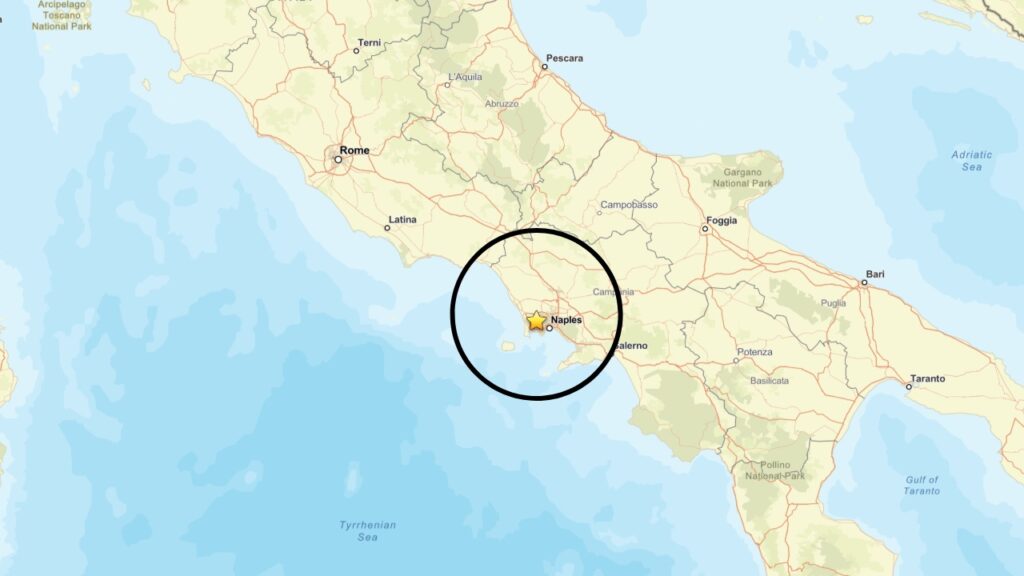
A magnitude 4.7 earthquake struck the Campi Flegrei volcanic caldera near Pozzuoli, just west of Naples, Italy, at 7:46 p.m. local time on Friday, sending residents into the streets and causing the most significant damage the region has seen in roughly four decades.
The quake’s epicenter was located about 5 kilometers from central Pozzuoli, with Italy’s National Institute of Geophysics and Volcanology (INGV) revising the depth to approximately 2.6 kilometers after initial estimates placed it slightly deeper. The shallow depth amplified the shaking, which was felt widely across greater Naples and on the nearby islands of Ischia and Procida. A magnitude 2.6 aftershock followed at 8:49 p.m., one of at least ten smaller tremors recorded in the hours after the main shock.
Damage and disruption
By late evening, Italy’s Department of Civil Protection said ten people had suffered minor, “yellow-code” injuries; no deaths were reported. Officials said several uninhabited buildings collapsed, and a partial wall collapse was reported on a residential building along Via Pergolesi in Pozzuoli. A rockfall from a hillside above Via Sottopasso Savino Vitagliano sent debris onto homes and parked cars, and a high-voltage transmission tower partially collapsed in the nearby Agnano district, contributing to power outages across the Fuorigrotta and Bagnoli neighborhoods and the broader Naples–Pozzuoli grid. Crews had partially restored electricity using backup systems by late evening.
Transportation across the city ground to a halt as a precaution. All national rail services through the Naples hub — high-speed, intercity and regional lines — were suspended, along with the Cumana commuter line, after a section of tunnel wall partially collapsed onto its tracks. Naples’ Metro Lines 1 and 2 ran with delays of up to 100 minutes. The Pozzuoli harbor authority declared the town’s main dock unusable, halting ferry service to Ischia and Procida. Minor landslides and debris flows were also reported in outlying areas.
Pozzuoli Mayor Luigi Manzoni urged residents to “maintain calm” and activated the town’s emergency operations center. Italy’s national Crisis Unit, led by Civil Protection department head Fabio Ciciliano, convened to coordinate the response and opened two reception centers for displaced residents — one on Via Terracina in Naples and another at Palatrincone in Pozzuoli.
A caldera under pressure
Friday’s earthquake is the latest and largest in a swarm of tremors linked to bradyseism, the slow cycle of ground uplift and subsidence driven by heat and fluid pressure beneath the Campi Flegrei caldera, one of the most closely watched volcanic systems in the world. Seismic activity in the area has intensified markedly since 2023 as the ground beneath Pozzuoli has continued to rise, a process scientists attribute to shifting gas and fluid pressure in the volcanic system’s shallow crust rather than an imminent magmatic eruption.
The director of the Vesuvius Observatory, INGV’s monitoring center for the region, said the uplift rate near the epicenter has continued to accelerate and that further seismic activity in the area should be expected. Despite the severity of Friday’s shock, Italian authorities have not raised the volcanic alert level, which remains at yellow — signifying heightened monitoring rather than an active eruptive threat.
Campi Flegrei’s last comparably strong period of unrest culminated in the 1980s, when a bradyseism crisis forced the evacuation of roughly 40,000 residents from Pozzuoli’s historic center. Scientists have cautioned since the current unrest began that, while an eruption is not considered imminent, the region’s dense population and aging building stock leave it vulnerable to structural damage even from moderate quakes — a risk Friday’s tremor underscored.
Civil Protection officials said structural inspections of damaged buildings, the Cumana rail tunnel and the Pozzuoli dock would begin Saturday, with rail and ferry services expected to remain suspended until engineers complete safety checks.
Sources: INGV (Istituto Nazionale di Geofisica e Vulcanologia); Italian Department of Civil Protection; Il Fatto Quotidiano; Il Sole 24 Ore; Euro Weekly News; Quotidiano Nazionale; NapoliToday.