
Winter Weather Lower 48




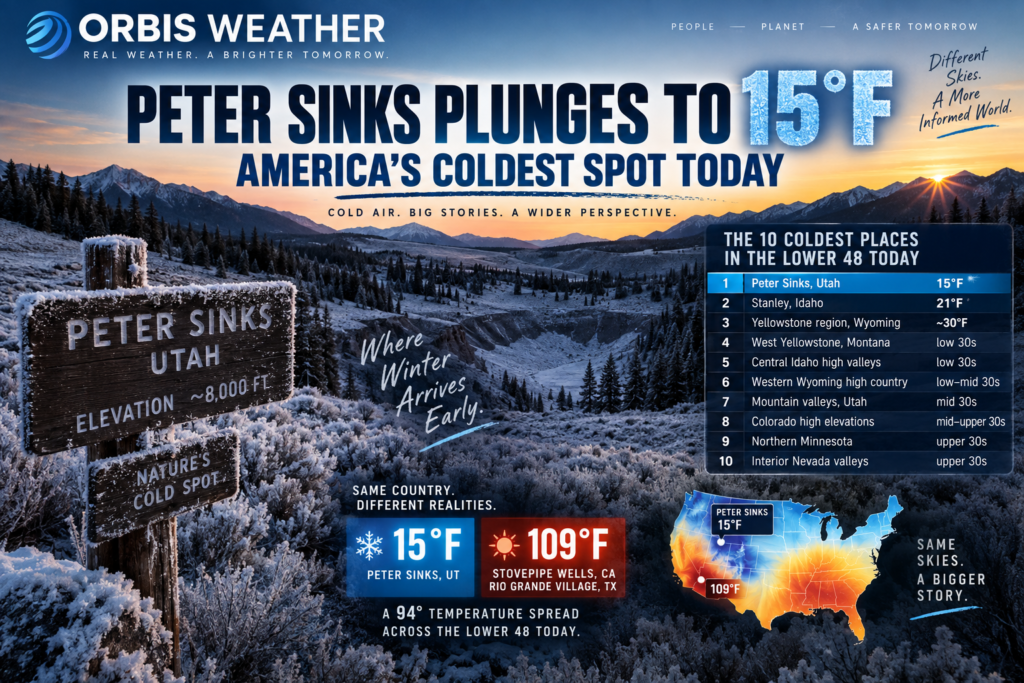

🥶 America’s Cold Spot Today: The 10 Coldest Places in the Lower 48
September 16, 2026 | Orbis Weather
While much of the United States is still experiencing late-summer warmth, winter is already making brief appearances in some of the coldest valleys and high-elevation locations of the American West.
The standout is Peter Sinks, Utah, where temperatures plunged to just 15°F (-9.4°C) in the latest completed daily reporting period. The National Weather Service Weather Prediction Center identified Peter Sinks as the coldest location in the contiguous United States for September 15.
That is remarkably cold for the middle of September — and cold enough to remind us that meteorological autumn can behave very differently depending on elevation and terrain.
❄️ 10 Coldest Spots in the Lower 48
Based on the latest available observations and regional weather reports, these are among the coldest locations across the Lower 48 heading into Wednesday morning:
| Rank | Location | Temperature |
|---|---|---|
| 🥇 1 | Peter Sinks, Utah | 15°F / -9.4°C |
| 🥈 2 | Stanley, Idaho | 21°F / -6.1°C |
| 🥉 3 | Yellowstone region, Wyoming | around 30°F / -1.1°C |
| 4 | West Yellowstone region, Montana | low 30s°F / near 0°C |
| 5 | High valleys of central Idaho | low 30s°F / near 0°C |
| 6 | High country of western Wyoming | low-to-mid 30s°F / 1–2°C |
| 7 | Mountain valleys of Utah | mid-30s°F / around 2°C |
| 8 | High elevations of Colorado | mid-to-upper 30s°F / 2–4°C |
| 9 | Northern Minnesota cold pockets | upper 30s°F / around 3–4°C |
| 10 | Interior mountain valleys of Nevada | upper 30s°F / around 3–4°C |
Important: The list beyond the nationally verified low should be considered a snapshot rather than a final official national ranking. Thousands of stations report at different times, and late observations can change the order. WPC describes its national high/low data as preliminary until final quality control is completed.
🏆 Today’s Cold Champion: Peter Sinks, Utah
Peter Sinks once again demonstrates why it is one of the most extraordinary cold-weather locations in the Lower 48.
The high-elevation sinkhole in northern Utah is famous for temperature inversions. Dense cold air drains down the surrounding slopes during clear, calm nights and becomes trapped at the bottom of the basin.
Instead of flowing away, the cold air pools inside the depression.
The result can be temperatures dramatically colder than surrounding locations — sometimes even colder than places hundreds of miles farther north.
WPC’s latest national report put Peter Sinks at 15°F (-9.4°C), making it the coldest verified location in the Lower 48 for Tuesday, September 15.
For perspective, WPC also reported 109°F (42.8°C) at Stovepipe Wells, California, and Rio Grande Village, Texas. That produced an extraordinary 94°F temperature spread across the contiguous United States on the same day.
🧊 Stanley, Idaho Drops to 21°F
Stanley, Idaho also experienced an impressive September chill.
The National Weather Service climate summary recorded a minimum temperature of 21°F (-6.1°C) on September 15. That was 10°F below the 1991–2020 normal minimum of 31°F for the date.
Stanley’s geography helps explain the cold. The community sits at roughly 6,250 feet in elevation and is surrounded by mountains, making it another prime location for nighttime cold-air pooling.
Temperatures can plunge after sunset under clear skies even when afternoon temperatures are relatively comfortable.
In fact, Stanley reached approximately 68°F (20°C) during the afternoon before falling into the lower 20s — an enormous day-to-night temperature swing.
🌡️ Northern Minnesota Joins the Chill
The cold isn’t confined entirely to the Rockies.
Northern Minnesota is also experiencing a taste of early autumn. The National Weather Service forecast for Baudettecalled for an early-morning temperature around 36°F (2.2°C) Wednesday before temperatures recover into the 60s during the afternoon.
That puts parts of northern Minnesota close to frost territory even though astronomical autumn has not yet officially begun.
❄️ Is Winter Starting Early?
Not exactly.
A handful of freezing or subfreezing temperatures in high mountain valleys during September doesn’t mean widespread winter weather has arrived.
In fact, the Weather Prediction Center shows no organized area of heavy snow of four inches or greater across the Lower 48 for September 16.
What we are seeing instead is a classic early-autumn pattern: very dry air, longer nights, high elevations and sheltered valleys allowing temperatures to fall rapidly after sunset.
Still, September is historically capable of producing genuine winter weather in the northern Rockies and adjacent high country.
Historical records show measurable snow has occurred during September in places including Great Falls, Montana; Jackson, Wyoming; Rapid City, South Dakota; International Falls, Minnesota; Denver, Colorado; and Salt Lake City, Utah.
🌎 A 94-Degree American Temperature Divide
Perhaps the most remarkable part of today’s temperature story isn’t simply how cold Peter Sinks became.
It’s the enormous contrast across the country.
While Utah’s famous cold sink dropped to 15°F (-9.4°C), temperatures reached 109°F (42.8°C) in parts of California and Texas.
That means Americans experienced everything from deep-winter-like cold to dangerous desert heat within the same Lower 48 states.
Few countries on Earth regularly experience temperature contrasts of that magnitude over such a large observing network.
🥶 Orbis Weather Cold Spot of the Day
🏆 Peter Sinks, Utah — 15°F (-9.4°C)
Runner-up: Stanley, Idaho — 21°F (-6.1°C)
Temperature spread across the Lower 48: approximately 94°F / 52.2°C
Winter weather status: Localized freezing temperatures in mountain valleys, but no widespread Lower 48 winter storm.
The calendar may still say September, but in the coldest pockets of the American West, temperatures are already showing that winter is never very far away.
Orbis Weather will continue tracking America’s coldest locations as autumn advances and the first significant freezes and snowstorms of the 2026–27 winter season begin to develop.
Data sources: NOAA/National Weather Service, Weather Prediction Center and regional observing networks. Temperatures are preliminary and may be revised as additional observations are received.