
Winter Weather Worldwide




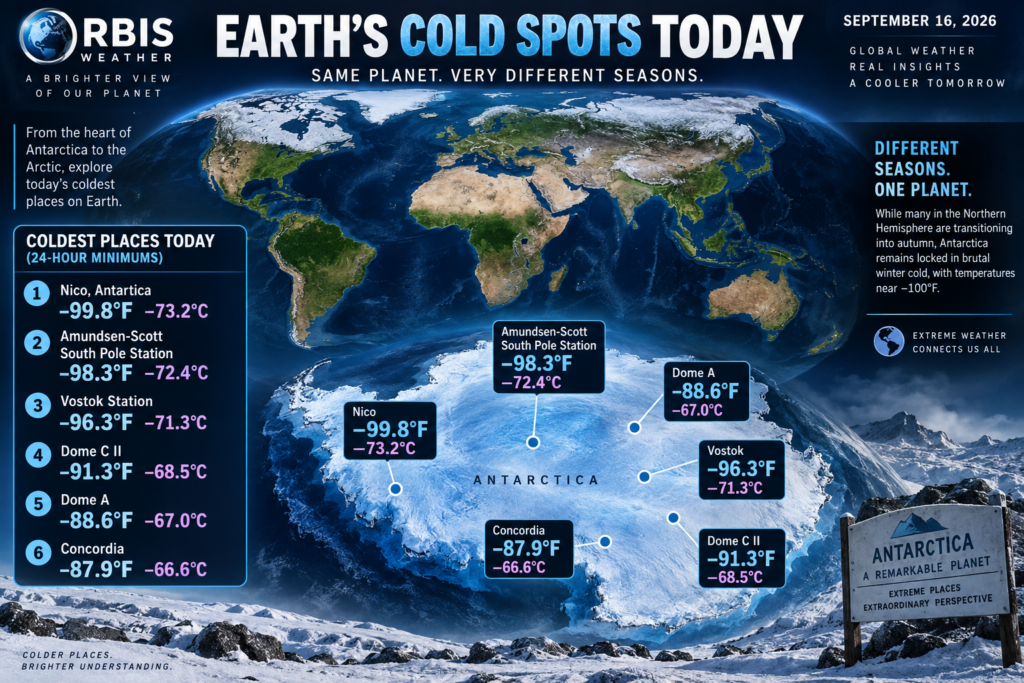

🥶 Earth’s Cold Spots Today: Antarctica Plunges Toward −100°F
September 16, 2026 — Orbis Weather
Winter may only be beginning to show its hand across parts of the Northern Hemisphere, but at the bottom of the planet, the cold is operating on an entirely different scale.
The latest global observations show temperatures across the Antarctic interior plunging below −90°F (−68°C), with several stations experiencing some of the most extreme cold currently being measured anywhere on Earth.
And one Antarctic station has dropped below the remarkable −100°F threshold during the past 24 hours.
🌎 Earth’s Coldest Observations
Global station data for the 24 hours ending early September 16 show Antarctica completely dominating the coldest locations measured.
🥇 Nico, Antarctica
🌡️ −99.8°F / −73.2°C
Nico recorded a 24-hour minimum of approximately −73.2°C (−99.8°F), making it the lowest temperature among the stations included in the global observations examined by Orbis Weather.
That is just a fraction of a degree away from −100°F.
🥈 Amundsen-Scott South Pole Station
🌡️ −98.3°F / −72.4°C
The geographic South Pole wasn’t far behind.
The Amundsen-Scott South Pole Station reached approximately −72.4°C (−98.3°F) during the reporting period.
Later observations continued to show extraordinary conditions around the South Pole, including snow flurries, ice fog and a reported apparent temperature near −133°F (−92°C).
🥉 Vostok Station, Antarctica
🌡️ −96.3°F / −71.3°C
Vostok — one of the most famously cold weather stations on Earth — recorded approximately −71.3°C (−96.3°F) in the latest global minimum-temperature data.
Conditions remained brutally cold afterward, with observations around −95°F (−71°C) and a reported apparent temperature near −132°F (−91°C).
Vostok’s extreme cold is no surprise. The station sits deep within the high Antarctic interior, far removed from the moderating influence of the ocean.
❄️ The Antarctic Deep Freeze
Several additional Antarctic stations reported extraordinary minimum temperatures:
Dome C II: about −91.3°F / −68.5°C
Dome A: about −88.6°F / −67.0°C
Concordia: about −87.9°F / −66.6°C
That means multiple observing stations across the Antarctic Plateau were simultaneously experiencing temperatures below −85°F (−65°C).
Even by Antarctic standards, that is serious cold.
🧊 Why Is Interior Antarctica So Cold?
The Antarctic Plateau has almost the perfect recipe for producing extreme cold.
The continent is covered by an enormous ice sheet that reflects much of the incoming solar energy. The interior also sits thousands of feet above sea level, allowing temperatures to fall even farther.
Add extremely dry air, long periods of darkness during winter and the continent’s isolation from warmer ocean air, and temperatures can reach levels found almost nowhere else on the planet.
September also represents an important seasonal transition.
The sun is returning to Antarctica as the Southern Hemisphere approaches spring, but the enormous ice sheet retains the accumulated cold of the polar winter.
As a result, some exceptionally low temperatures can persist even while daylight rapidly returns.
🌬️ Coastal Antarctica Tells a Different Story
The contrast between Antarctica’s interior and coastline is remarkable.
At Williams Field near McMurdo Station, the temperature early September 16 was approximately:
🌡️ −6.9°F / −21.6°C
💨 Wind chill: −18°F / −28°C
That is certainly cold, but it is roughly 90°F warmer than some locations deep inside the continent.
The difference demonstrates just how powerful elevation, geography and distance from the ocean are in controlling Antarctic temperatures.
🌍 Meanwhile, the Northern Hemisphere Heads Toward Winter
Across the Arctic, Greenland, Canada, Alaska and Siberia, the seasonal cooling process is accelerating as daylight decreases.
But for now, Antarctica remains in another league.
Some inhabited Arctic communities are already seeing freezing temperatures, while the high interior of Greenland is becoming increasingly wintry.
Siberia will eventually become one of the world’s major cold centers as Northern Hemisphere winter develops. Places such as Yakutia routinely experience extraordinary winter temperatures and contain some of the coldest permanently inhabited settlements on Earth.
For the moment, however, the deepest cold belongs overwhelmingly to Antarctica.
🥶 Orbis Weather Cold Spot of the Day
🇦🇶 NICO, ANTARCTICA
24-hour minimum:
🌡️ −99.8°F
🌡️ −73.2°C
Nearby Antarctic stations weren’t far behind, with the South Pole reaching about −98°F and Vostok approximately −96°Fduring the reporting period.
🌎 One Planet — Very Different Seasons
September is one of the most fascinating times of year to examine global temperatures.
Across North America, Europe and Asia, summer is fading and autumn is arriving.
Across much of the Southern Hemisphere, spring is approaching.
And deep inside Antarctica?
It still looks and feels like the heart of winter.
A temperature approaching −100°F is a powerful reminder of the enormous range of weather occurring simultaneously across our planet.
While millions of people are still experiencing late-summer warmth, the coldest parts of Earth remain locked in conditions almost difficult to imagine.
Orbis Weather will continue tracking Earth’s coldest locations as the Northern Hemisphere moves toward winter and the world’s extreme cold gradually begins shifting northward.
Data note: Global cold rankings depend on which stations are reporting and when observations are received. Remote regions of Antarctica, Greenland, Siberia and the Arctic have sparse observing networks, so this should be considered a ranking of available reporting stations rather than every point on Earth.