Pollen & Allergy Tracker: Understanding Your Local Pollen Forecast


Pollen Allergy Tracker
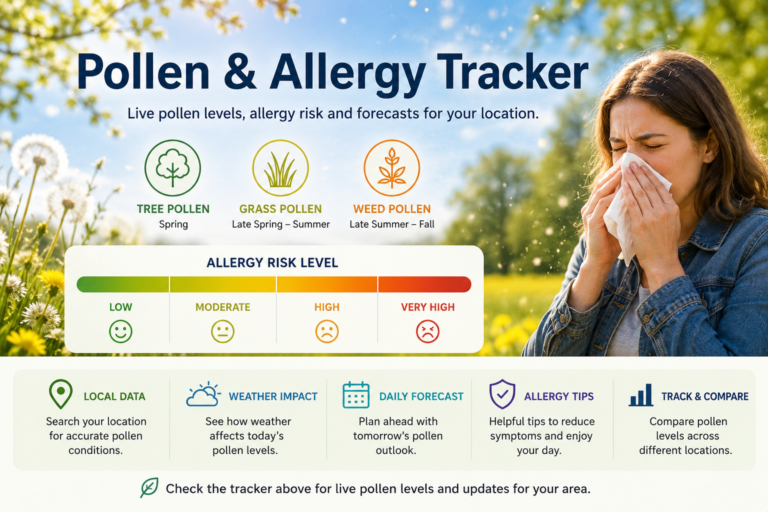
The Pollen & Allergy Tracker helps you check local pollen conditions and understand how weather may affect airborne allergens in your area. Pollen levels can change considerably from one day to the next, making current conditions useful when planning outdoor activities.
Use the tracker above to search your location and explore current conditions. Weather patterns such as wind, rain, temperature, and humidity can all influence how much pollen becomes airborne and how far it travels.
🌳 Tree Pollen
Tree pollen is a major seasonal allergen in many parts of the United States. Different tree species release pollen at different times of the year, with activity often increasing during warmer periods.
Common pollen-producing trees include oak, cedar, maple, elm, birch, and pine. The timing and intensity of tree pollen season varies considerably depending on climate and location.
🌱 Grass Pollen
Grass pollen commonly becomes more noticeable during late spring and summer. Warm temperatures combined with dry and breezy conditions can help grass pollen become airborne.
Grass pollen levels can vary even between nearby communities because vegetation, rainfall, temperature, and wind conditions are different from place to place.
🌿 Weed Pollen
Weed pollen often becomes increasingly important during late summer and fall. Ragweed is one of the best-known sources, although numerous plants can contribute to seasonal pollen levels.
Wind can carry lightweight pollen considerable distances, meaning pollen detected in an area doesn’t necessarily originate in the immediate neighborhood.
🌦️ How Weather Affects Pollen Levels
Weather plays an important role in daily pollen conditions. Warm, dry, and windy weather can allow pollen to remain airborne and travel farther.
Rain can temporarily remove pollen particles from the air, although rainfall can also encourage plant growth that contributes to pollen production later.
Wind direction and speed matter too. Strong winds can transport pollen from surrounding areas, while calm conditions may limit how far airborne pollen travels.
Because these factors change constantly, today’s pollen conditions may be quite different from yesterday’s.
📍 Why Check Your Local Pollen Forecast?
Pollen seasons aren’t identical everywhere. Geography, vegetation, elevation, rainfall, and temperature all influence when different plants release pollen.
That’s why checking conditions for your particular location can provide more useful information than relying on a broad regional outlook.
The tracker above lets you search different locations and compare conditions, which can also be useful before traveling or planning outdoor activities.
🌬️ Pollen and Air Quality Are Different
Pollen and air pollution aren’t the same thing. A location can experience relatively low pollution while simultaneously having elevated pollen levels.
Air-quality measurements generally track pollutants such as fine particulate matter and ozone, while pollen monitoring focuses on biological particles released by plants.
For a more complete look at outdoor atmospheric conditions, check the Orbis Weather Air Quality Tracker alongside today’s pollen information.
☀️ Planning Around High-Pollen Days
If pollen is a concern, checking conditions before spending extended periods outdoors can help with planning. Conditions may change throughout the day as temperature, humidity, wind, and precipitation change.
Rather than relying solely on the season or calendar, use current local conditions and forecasts to understand what’s happening in your area.
For additional educational information about pollen and seasonal allergies, visit the American Academy of Allergy, Asthma & Immunology.
📊 Pollen Tracker Data & Methodology
The Orbis Weather Pollen & Allergy Tracker uses different data methods depending on geographic coverage.
Europe: Pollen forecast information is obtained through Open-Meteo using CAMS pollen data for supported pollen types including alder, birch, grass, mugwort, olive and ragweed.
Outside supported CAMS pollen coverage: The tracker may display a weather-adjusted seasonal estimate based on expected pollen season combined with forecast temperature, rainfall, humidity and wind conditions from Open-Meteo.
These estimated values are not direct pollen-count observations from a monitoring station. Actual pollen concentrations can vary considerably over short distances because of local vegetation, weather and other environmental conditions.
Orbis Weather presents this information for general environmental awareness and outdoor planning. It should not be used as medical advice or as a substitute for guidance from a qualified healthcare professional.
❓ Pollen & Allergy FAQ
When is pollen season?
Pollen season varies by climate and plant species. Tree pollen is commonly associated with spring, grass pollen with late spring and summer, and weed pollen with late summer and fall. Warmer climates can experience longer pollen seasons.
Does rain reduce pollen?
Rain can temporarily remove airborne pollen from the atmosphere. However, moisture also supports vegetation growth, so the longer-term relationship between rainfall and pollen can be more complicated.
Does wind make pollen conditions worse?
Wind can lift pollen into the atmosphere and transport it over significant distances. Dry and breezy days can therefore produce very different conditions from calm or rainy days.
How often should I check pollen conditions?
During periods of elevated pollen, checking current conditions and the forecast daily can provide a better picture of changing conditions.
Global Weather Tracker Hub
Explore weather maps, tropical systems, storms and natural hazards around the world.
No matching trackers found.