
Winter Weather Europe




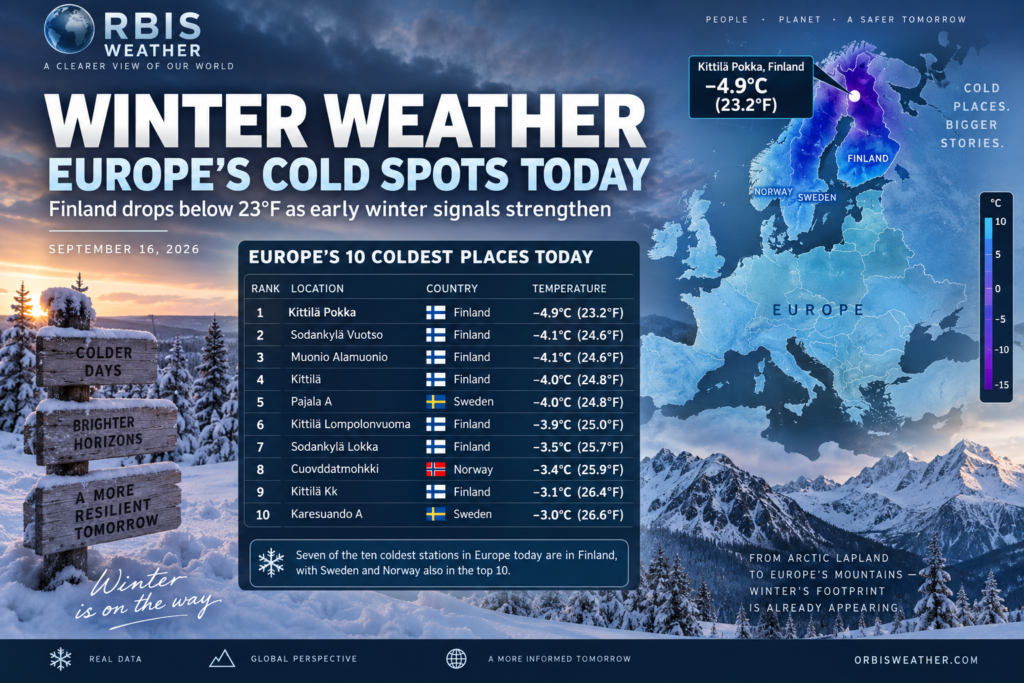

Europe’s Cold Spots Today: Finland Drops Below 23°F as Early Winter Signals Strengthen
Orbis Weather | Winter Weather Report | September 16, 2026
Winter may still be months away on the calendar, but parts of northern Europe are already getting a convincing preview.
Temperatures fell well below freezing across northern Finland, Sweden and Norway early Wednesday, September 16, with Kittilä Pokka, Finland, dropping to −4.9°C (23.2°F) — the lowest minimum among the European stations in the latest daily observations reviewed by Orbis Weather. (Weather and Climate)
The developing cold is particularly noticeable across Finnish Lapland, where several observing stations recorded temperatures below −3°C (27°F). Meanwhile, Arctic islands and high mountain stations are also firmly back into wintry territory.
❄️ Europe’s 10 Coldest Places Today
Based on the latest reported daily minimum temperatures, northern Finland dominates today’s cold list. (Weather and Climate)
| Rank | Location | Country | Temperature |
|---|---|---|---|
| 🥶 1 | Kittilä Pokka | 🇫🇮 Finland | −4.9°C / 23.2°F |
| 2 | Sodankylä Vuotso | 🇫🇮 Finland | −4.1°C / 24.6°F |
| 3 | Muonio Alamuonio | 🇫🇮 Finland | −4.1°C / 24.6°F |
| 4 | Kittilä | 🇫🇮 Finland | −4.0°C / 24.8°F |
| 5 | Pajala A | 🇸🇪 Sweden | −4.0°C / 24.8°F |
| 6 | Kittilä Lompolonvuoma | 🇫🇮 Finland | −3.9°C / 25.0°F |
| 7 | Sodankylä Lokka | 🇫🇮 Finland | −3.5°C / 25.7°F |
| 8 | Cuovddatmohkki | 🇳🇴 Norway | −3.4°C / 25.9°F |
| 9 | Kittilä Kk | 🇫🇮 Finland | −3.1°C / 26.4°F |
| 10 | Karesuando A | 🇸🇪 Sweden | −3.0°C / 26.6°F |
Observations can update through the day, so the ranking may change as additional station reports arrive. The source also notes that its current-value service is automated and recommends checking station archives when verifying extremes.(Weather and Climate)
🇫🇮 Finland Owns Europe’s Cold Map
The standout feature today isn’t simply the lowest temperature — it’s how heavily Finland dominates the list.
Seven of Europe’s ten coldest stations in the latest minimum-temperature table are in Finland, concentrated largely across Lapland. Sweden takes two positions and Norway one. (Weather and Climate)
This is classic early-autumn northern European cooling. Nights are becoming rapidly longer at high latitudes, allowing temperatures to fall sharply under favorable conditions.
It is also an important reminder that meteorological autumn can look very different across Europe. While southern and western Europe can still experience summerlike warmth in September, the far north is already capable of producing widespread frost.
🌡️ Arctic Europe Is Feeling Even Colder
Actual air temperature tells only part of today’s story.
When wind is taken into account, some Arctic European locations have effective temperatures near −10°C (14°F) or lower. White Island, Norway, tops the source’s “chilly places” category with an effective temperature around −11°C (12°F), while Verlegenhuken is near −10°C (14°F). (Weather and Climate)
Ny-Ålesund and several other Arctic Norwegian locations are also experiencing conditions that feel distinctly wintry.
Farther south, high elevations are joining the cold. Mussala in Bulgaria, one of the Balkans’ highest weather stations, appears among Europe’s coldest current high-altitude observations. The latest European climate monitor also lists Alpine and Scandinavian mountain stations such as Jungfraujoch, Juvvasshøe and Gaustatoppen among the continent’s cold spots. (Weather and Climate)
🏔️ Winter Returns to Europe’s Mountains
September is an important transition month for Europe’s mountains.
Cold air can quickly push freezing levels downward across the Scandinavian mountains and Alps, turning rainfall into wet snow or snow at the highest elevations even while valleys remain comparatively mild.
Today’s observations illustrate that enormous vertical difference. For example, Davos, Switzerland, is forecast to range from around 9°C to 17°C (48–63°F) Wednesday, while high Alpine observing sites can hover close to freezing. (Davos)
That doesn’t mean widespread European winter has arrived. It means the atmosphere is increasingly capable of producing winter conditions at high elevations and northern latitudes.
🌍 Europe Is Split Between Autumn and Summer
Perhaps the most interesting part of today’s weather is the contrast.
While northern Finland dipped to −4.9°C (23°F), parts of Europe remain dramatically warmer. The European climate monitor continues to show temperatures around or above 30°C (86°F) at some southern stations. (Weather and Climate)
That creates a temperature spread of more than 30°C (54°F) across the continent.
September is often a month of enormous contrasts: frost in Lapland, near-freezing conditions on Alpine summits and lingering summer warmth around the Mediterranean can all occur simultaneously.
❄️ Is This the Beginning of Winter?
Not quite — at least not for most of Europe.
Sub-freezing September mornings are not unusual in the far north, particularly across inland Scandinavia. Temperatures can rebound significantly during subsequent weather patterns.
But the seasonal transition is clearly underway.
The combination of rapidly shortening daylight, longer nights and increasingly frequent incursions of colder Arctic air means the probability of frost and eventually snow will continue increasing across northern Europe over the coming weeks.
For Finland, Sweden and northern Norway, today’s readings provide another sign that winter is no longer very far away.
🌡️ Europe Cold Spot of the Day
🥇 Kittilä Pokka, Finland
Low: −4.9°C (23.2°F)
Seven of the ten coldest stations in today’s European minimum-temperature ranking are in Finland, making Finnish Lapland the center of Europe’s early-season cold on September 16, 2026. (Weather and Climate)
Orbis Weather will continue tracking Europe’s coldest locations as autumn advances and the first significant snow and Arctic outbreaks of the 2026–27 winter season begin to develop.