Air Pollution News – Latest Global Reports & Updates
By Paul Harrison | Founder & Publisher, Orbis Weather

Singapore tops global air pollution rankings
By Paul Harrison, Orbis Weather ·
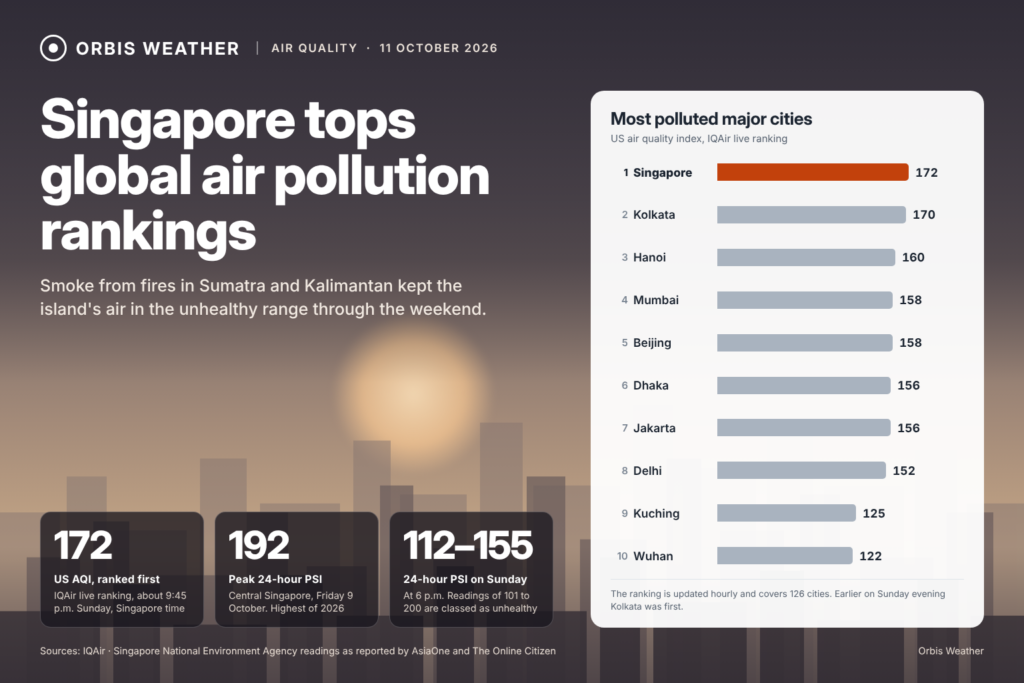
Singapore ranked as the most polluted major city in the world on Sunday night, as smoke from forest and peatland fires in Indonesia kept the island’s air in the unhealthy range through the weekend.
The Swiss monitoring firm IQAir listed Singapore first of more than 100 cities in its live ranking at about 9:45 p.m. local time on October 11, with a US air quality index of 172. Kolkata was second at 170. The city-state has moved in and out of the top spot since Wednesday, when it overtook Kuala Lumpur.
Singapore’s own measure tells the same story. The National Environment Agency (NEA) reported a 24-hour Pollutant Standards Index (PSI) of up to 155 at 6 p.m. Sunday and forecast that it will stay in the unhealthy range.
Key points
- Ranking: Singapore was first in IQAir’s live major-city ranking on Sunday night, with a US AQI of 172. It also led on October 7 and October 9.
- Peak: The 24-hour PSI reached 192 in central Singapore on Friday, October 9, the highest reading of 2026.
- Now: The PSI stood between 112 and 155 at 6 p.m. Sunday. Readings from 101 to 200 are classed as unhealthy.
- Cause: Smoke is drifting from fires in southern Sumatra and Kalimantan on south-easterly and southerly winds.
- Response: Clinics begin subsidised haze treatment on Monday. Masks and haze shelters are ready if the PSI passes 200.
- Outlook: Showers may bring brief relief, but the dry season is not expected to end before late October or early November.
What the ranking shows
Singapore led an all-Asian top 10 on Sunday night. IQAir updates the list every hour, and positions change quickly: earlier in the evening, Kolkata was first at 186 and Singapore second at 185.
Rank | City | US AQI |
|---|---|---|
1 | Singapore | 172 |
2 | Kolkata, India | 170 |
3 | Hanoi, Vietnam | 160 |
4 | Mumbai, India | 158 |
5 | Beijing, China | 158 |
6 | Dhaka, Bangladesh | 156 |
7 | Jakarta, Indonesia | 156 |
8 | Delhi, India | 152 |
9 | Kuching, Malaysia | 125 |
10 | Wuhan, China | 122 |
IQAir live ranking of major cities, about 9:45 p.m. Singapore time, October 11, 2026.
Singapore’s readings were higher earlier in the week. It took first place on October 7 with an AQI of 211, as Kuala Lumpur slipped to second at 194. IQAir recorded 216 in mid-morning on October 9 and 209 at 2:30 p.m. that day, a level the firm classes as very unhealthy.
IQAir said PM2.5 and PM10, the fine and coarse particles in smoke, were the dominant pollutants. It also noted elevated carbon monoxide, which it called consistent with biomass burning.
Official readings
The NEA’s figures put every reported region in the unhealthy band on Sunday evening, with the west and centre worst affected. The agency publishes two measures: a 24-hour PSI for planning the day ahead and a one-hour PM2.5 reading for immediate activities.
Region | 24-hour PSI, 6 p.m. Oct 11 | One-hour PM2.5 (µg/m³) | PM2.5 band |
|---|---|---|---|
West | 155 | 111 | Elevated |
Central | 147 | 95 | Elevated |
East | 143 | 81 | Elevated |
North | 112 | 53 | Normal |
South | Not reported | 39 | Normal |
NEA readings as reported by AsiaOne. The south’s 24-hour PSI was 115 at 9 a.m. Sunday.
The week’s peak came on Friday, October 9. The 24-hour PSI in central Singapore climbed from 137 on Thursday evening to 192 by 5 p.m. Friday, the highest of 2026. The previous high this year was 167 on September 29. The one-hour PM2.5 reading reached 171 in the west at 2 a.m. Friday, also a 2026 high.
A PSI of 101 to 200 is unhealthy, 201 to 300 is very unhealthy, and above 300 is hazardous. This is the first year since 2023 that haze has pushed Singapore’s PSI into the unhealthy range, The Straits Times reported.
Why the air is so poor
The smoke comes from fires in Indonesia, carried to Singapore by the prevailing wind. The NEA said on Sunday that haze from southern Sumatra and West Kalimantan was drifting toward the island under south-easterly or southerly winds.
The ASEAN Specialised Meteorological Centre counted 53 hotspots in Sumatra and 214 in Kalimantan on October 9. The full extent could not be determined, because thick smoke and cloud covered parts of both islands. The centre has Alert Level 3 in force for the southern ASEAN region.
Three factors lie behind the fires:
- Land clearing. Fires are set to clear land for agriculture, The Straits Times reported. Indonesian police have identified 196 suspected fire-starters and investigated 96 companies, according to Australia’s ABC.
- Peat. Dried peatlands can burn for weeks and are hard to put out.
- El Niño. A strong El Niño has brought drier weather and raised the fire risk. Singapore’s authorities had warned of a higher haze risk from June to October.
Indonesia is having its worst fire season in more than a decade, Al Jazeera reported, with at least 200,000 hectares burned across six provinces. Its Health Ministry has recorded at least 175,000 respiratory infections linked to the fires since August.
Health advice and official response
The NEA advises everyone to cut back on strenuous outdoor activity while the PSI is unhealthy, with stricter limits for vulnerable groups.
Group | PSI 101–200 (unhealthy) | PSI 201–300 (very unhealthy) |
|---|---|---|
Healthy people | Reduce prolonged or strenuous outdoor exertion | Avoid prolonged or strenuous outdoor exertion |
Elderly, pregnant women and children | Minimise prolonged or strenuous outdoor exertion | Minimise outdoor activity |
People with chronic lung or heart disease | Avoid prolonged or strenuous outdoor exertion | Avoid outdoor activity |
The agency asks residents to check the one-hour PM2.5 reading before going out. When it is in the elevated band, 56 to 150 µg/m³, healthy people should reduce strenuous outdoor activity for the next hour and others should avoid it.
The government has stepped up its response over the weekend:
- Clinics. The Ministry of Health will activate its Public Health Preparedness Clinic scheme and Haze Subsidy Scheme from Monday, October 12.
- Masks and shelters. The Haze Task Force, which groups the NEA and 28 other agencies, will distribute N95 masks to vulnerable residents and open air-conditioned haze shelters if the PSI passes 200.
- Schools. Lessons and national examinations continue in enclosed rooms with air purifiers. The Education Ministry may consider closures if the next day’s PSI is forecast above 300.
- Diplomacy. Environment Minister Grace Fu said she has been in contact with her Indonesian counterpart and that Singapore has offered help with the fires.
The Formula One Singapore Grand Prix weekend went ahead from October 9 to 11. Saturday’s sprint was run in unhealthy air, and Sunday’s night race was set to start in hazy conditions.
National weather services and environment agencies issue the official air quality advisories. Residents should follow NEA guidance at haze.gov.sg and on the myENV app.
The regional picture
Singapore is one of several places affected: the same smoke has closed schools in Malaysia and is linked to at least 175,000 respiratory infections in Indonesia.
- Malaysia. On Friday morning, 38 of the country’s 68 monitoring stations recorded unhealthy air and none recorded good air, Malay Mail reported. Seremban had the highest Air Pollutant Index reading, 186. Schools closed that day in Kuala Lumpur, Putrajaya and five states, affecting about two million students.
- Diplomacy. Prime Minister Anwar Ibrahim said the haze was “at a worrying level”. He spoke with Indonesian President Prabowo Subianto and asked for an urgent meeting of ASEAN environment ministers. Malaysia is also stepping up cloud seeding.
- Indonesia. More than 69,000 personnel are fighting fires in six priority provinces, ABC reported. Civil society groups in West Kalimantan have filed a class action against the national government over its handling of the fires.
Outlook
The haze is likely to come and go for several more weeks, because the fire areas remain dry. The NEA forecasts a 24-hour PSI in the unhealthy range for the coming day.
Period | What forecasters expect | Source |
|---|---|---|
Next 24 hours | PSI in the unhealthy range. Showers over Singapore and parts of the region. | NEA |
Coming days | Dry conditions persist over parts of southern Sumatra and Kalimantan. Smoke may keep drifting toward Singapore on south-easterly or southerly winds. | NEA |
Late October to early November | Expected end of the dry season, later than in the previous two years because strong El Niño events delay its retreat. | Meteorological Service Singapore |
October and November | Haze could persist through both months. | IQAir |
Showers on Saturday afternoon showed how quickly conditions can change. Readings eased from 4 p.m. after rain fell over parts of the island, yet the air stayed unhealthy. The NEA says areas that receive showers should improve, while fire-prone areas that stay dry keep the risk of severe haze. The wet season in most of Indonesia is not expected until November, ABC reported.
How to read the ranking
The ranking is a live snapshot, not a verdict on Singapore’s air over the year. Four points help put it in context.
- It is hourly. IQAir compares more than 100 major cities and refreshes the list each hour, so the order can change within the same evening.
- It covers major cities only. The list ranks 126 cities. Places outside it are not ranked, however polluted.
- It uses a different scale. IQAir reports a US-style air quality index. The NEA’s PSI is a 24-hour rolling average of six pollutants. The two numbers are not interchangeable, so IQAir’s 209 on Friday afternoon and the PSI’s peak of 192 cannot be compared directly.
- Singapore’s usual air is far cleaner. Its average PM2.5 level for 2025 was 11.9 µg/m³, which IQAir equates to an AQI of 50, in the good range. That annual figure was still 2.4 times the World Health Organization guideline.
For decisions about going outside, the NEA’s one-hour PM2.5 reading is the more useful guide, because it reflects conditions now and not the past day.
Frequently asked questions
Is Singapore really the most polluted city in the world?
It was first in IQAir’s live ranking of major cities on Sunday night, October 11, and on at least two earlier days this week. The ranking changes every hour and covers 126 cities. Over a full year, Singapore’s air is far cleaner: its 2025 average PM2.5 level corresponds to an AQI of 50, in the good range.
What is causing the haze?
Smoke from forest and peatland fires in Sumatra and Kalimantan, in Indonesia. South-easterly and southerly winds carry it to Singapore. A strong El Niño has made the dry season drier and longer.
How bad is the air right now?
The 24-hour PSI was between 112 and 155 at 6 p.m. Sunday, in the unhealthy range. The west was highest. The peak this year was 192 on Friday, October 9.
Is it safe to exercise outdoors?
The NEA advises healthy people to reduce prolonged or strenuous outdoor exertion while the PSI is unhealthy. Elderly people, pregnant women and children should minimise it. People with chronic lung or heart disease should avoid it.
Should residents wear a mask?
Singapore plans to distribute N95 masks to vulnerable residents if the PSI passes 200. IQAir recommends a KN95 or FFP2 mask for anyone who must be outdoors in poor air. Employers are advised to provide N95 masks where strenuous outdoor work cannot be avoided in very unhealthy conditions.
Will schools close?
Not at current levels. Lessons and national examinations continue indoors with air purifiers. The Education Ministry may consider closures if the next day’s PSI is forecast above 300, and would announce them by 8 p.m. the day before.
When will the haze end?
No end date has been forecast. Singapore’s weather service expects the dry season to end in late October or early November. IQAir says haze could persist through October and November.
Where can residents check official readings?
The NEA publishes hourly readings and daily forecasts at haze.gov.sg, on its website and in the myENV app.
Sources
All pages were opened on Sunday, October 11, 2026. The date after each link is the date of the report or reading.
Rankings
- IQAir: live world air quality ranking, October 11, about 9:45 p.m. Singapore time
- IQAir: Singapore among the most polluted cities, October 9
- IQAir: air quality in Singapore, October 11
- SAYS: Singapore overtakes Kuala Lumpur, October 7
Official readings and response in Singapore
- NEA: haze situation update, October 10
- AsiaOne: haze update, night race under unhealthy PSI forecast, October 11
- AsiaOne: showers slightly improve air quality, October 10
- Yahoo News Singapore / The Straits Times: air quality remains unhealthy, October 11
- Yahoo News Singapore / The Straits Times: PSI forecast, October 10
- The Online Citizen: haze hits 2026 high, October 9
- The Online Citizen: Haze Task Force convenes, October 9
- The Star / The Straits Times: Singapore shrouded in haze, October 8
- Malay Mail: afternoon showers bring brief relief, October 10
Fires and the region
About the Author
Paul Harrison — Founder & Publisher, Orbis Weather
Paul Harrison founded Orbis Weather in 2026 to make global weather and natural-hazard information easier to find, follow and understand. His coverage includes tropical cyclones, severe weather, extreme temperatures, earthquakes, volcanoes, wildfires, flooding and significant natural disasters worldwide.
View all articles by Paul Harrison → | Editorial Standards →