
By Paul Harrison | Founder & Publisher, Orbis Weather

🇯🇵 Typhoon Dujuan Disaster in Japan: Six Reported Dead as Record Rain Triggers Landslides and Flooding
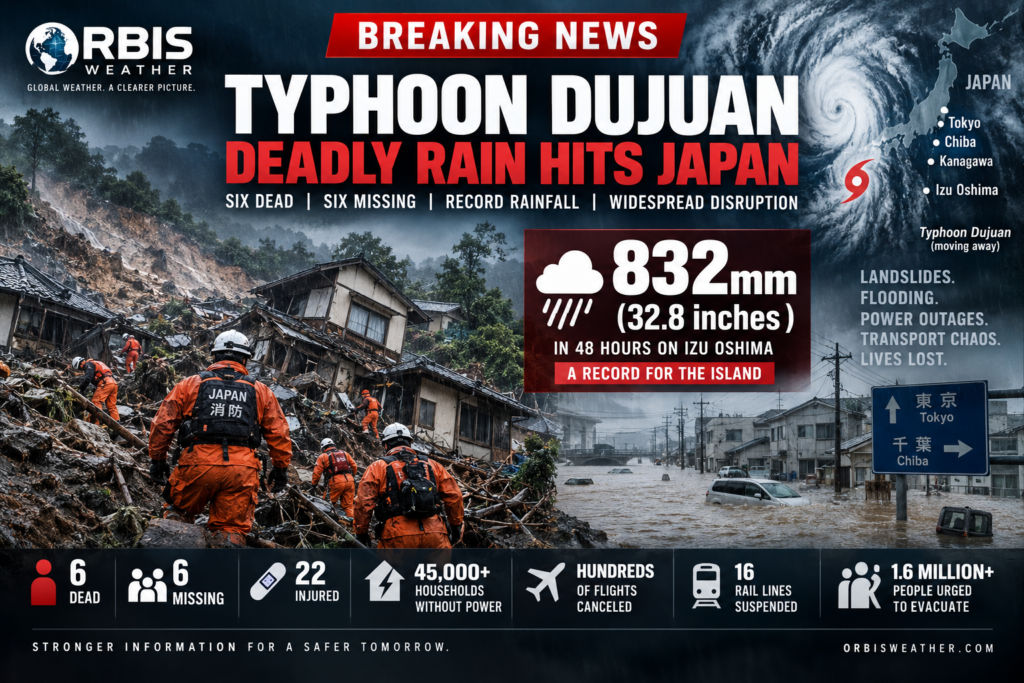
TOKYO, Japan — September 22, 2026 — Typhoon Dujuan has left a deadly trail across eastern Japan, unleashing extraordinary rainfall that triggered landslides, flooded communities, knocked out electricity and brought major transportation networks to a halt.
Later reports Tuesday put the death toll at six, with six people still missing, as emergency crews continued searching areas struck by landslides in and around the greater Tokyo region. Earlier reports from Japanese authorities and NHK had confirmed four deaths, underscoring how rapidly the situation is evolving.
At least 22 people have also been reported injured, while more than 45,000 households remained without electricityafter the storm moved away from Japan.
🌧️ Extraordinary Rainfall Hits Eastern Japan
Dujuan’s most remarkable impact may ultimately be the amount of water it dumped across parts of the country.
On Izu Oshima, south of Tokyo, rainfall reached an extraordinary 832 mm (32.8 inches) in 48 hours. That was more than twice the island’s typical rainfall for the entire month of September and represented a record for the location.
The Japan Meteorological Agency issued its highest-level landslide warning for Oshima as torrents of rain saturated hillsides and dramatically increased the danger of slope failures.
Tokyo itself was hammered.
In the city’s Edogawa area, rainfall totals reached record levels as Dujuan’s moisture swept across the Kanto region. Rivers and drainage systems struggled to cope with the volume of water, and numerous streets and residential neighborhoods were inundated.
🏚️ Deadly Landslides in Kanagawa and Chiba
Some of the most serious destruction occurred in Kanagawa and Chiba prefectures, immediately surrounding Tokyo.
Landslides tore into homes on the Miura Peninsula in Kanagawa, prompting large-scale search-and-rescue operations.
In Yokosuka, mud and debris crashed into a house, killing a woman in her 60s. Emergency crews have also been searching damaged homes and debris fields in neighboring Miura for people reported missing.
Police officers, firefighters and rescue personnel have been digging through mud and wreckage while authorities warn that saturated slopes could remain unstable even after the heaviest rainfall ends.
That danger does not disappear when the rain stops.
Water can continue penetrating deeply into hillsides for hours, increasing soil pressure and potentially triggering delayed landslides.
🌊 Neighborhoods Under Water
Flooding was widespread across parts of Chiba Prefecture.
In Sakura, swollen waterways overflowed and sent floodwater into residential neighborhoods. One resident told Reuters that water entered his home after a nearby river overflowed — something he said he had never experienced in more than three decades living there.
Images from the region showed streets transformed into muddy waterways, vehicles surrounded by floodwater and emergency crews using boats to reach stranded residents.
The flooding comes only weeks after another episode of extreme rainfall caused serious damage in Chiba.
⚡ Tens of Thousands Lose Electricity
Dujuan’s combination of powerful winds, falling trees, flooding and saturated ground also caused widespread electrical outages.
Approximately 45,000 households were still without electricity Tuesday, according to Tokyo Electric Power Company figures cited by Reuters.
At the height of the disruption, Chiba accounted for the majority of outages, with additional failures reported in Kanagawa, Yamanashi and Saitama prefectures.
✈️ Flights, Trains and Roads Disrupted
Transportation across eastern Japan was thrown into chaos.
Hundreds of flights were canceled as Dujuan approached the Tokyo region, affecting operations at both Haneda and Narita airports.
Japan Airlines canceled 135 flights and All Nippon Airways canceled roughly 140 as conditions deteriorated.
Rail transportation was also heavily affected. At one stage, 16 conventional railway lines operated by eight companies were suspended, while sections of expressways and local roads were closed because of flooding, heavy rainfall or dangerous coastal conditions.
The storm even disrupted major events in Tokyo, including forcing an early closure of a major video-game trade show.
🚨 More Than 1.6 Million People Urged to Evacuate
As Dujuan approached, authorities urged more than 1.6 million people in and around Tokyo to evacuate because of the threat from flooding, landslides and swollen rivers.
Some later reports put the number covered by evacuation orders or advisories closer to 1.9 million as conditions deteriorated across several prefectures.
Japan’s evacuation notices are generally not mandatory, but the scale of the warnings reflected the exceptional rainfall threat posed by the storm.
🌀 Dujuan Moves Away — But the Danger Isn’t Over
By Tuesday, Typhoon Dujuan was moving northeastward and away from Japan into the Pacific Ocean.
That allowed authorities to downgrade or lift many of the immediate heavy-rain warnings.
But the emergency is not necessarily finished.
After hundreds of millimeters of rainfall, hillsides across affected areas remain saturated, rivers remain elevated and damaged drainage systems can continue producing localized flooding.
The Japan Meteorological Agency has urged residents in vulnerable areas to remain alert for additional landslides even after skies begin clearing.
🌏 Orbis Weather Analysis
Typhoon Dujuan demonstrates an often overlooked aspect of tropical cyclones: wind speed alone does not determine how destructive a storm becomes.
Dujuan’s greatest danger to Japan came from water.
Extreme rainfall falling over densely populated communities and mountainous terrain produced a dangerous combination of:
🌧️ Record rainfall
⛰️ Saturated hillsides
🏚️ Deadly landslides
🌊 Flash and river flooding
⚡ Widespread power outages
✈️ Major transportation disruption
The staggering 832 mm — nearly 33 inches — measured on Oshima in just 48 hours illustrates how extraordinary this event became.
And even as Dujuan disappears into the Pacific, Japan’s disaster response continues.
Search teams are still working through landslide debris, communities are beginning to assess flood damage, power crews are trying to restore electricity and authorities are watching unstable hillsides for additional failures.
⚠️ Developing Story
Typhoon Dujuan’s casualty figures remain subject to change as search-and-rescue operations continue.
Orbis Weather will continue monitoring the aftermath across Japan, including additional flooding, landslides, power restoration and any changes in the number of people confirmed dead or missing.
Last updated: September 22, 2026
About the Author
Paul Harrison — Founder & Publisher, Orbis Weather
Paul Harrison founded Orbis Weather in 2026 to make global weather and natural-hazard information easier to find, follow and understand. His coverage includes tropical cyclones, severe weather, extreme temperatures, earthquakes, volcanoes, wildfires, flooding and significant natural disasters worldwide.
View all articles by Paul Harrison → | Editorial Standards →