
Swiss Glaciers Lose Over 5% of Ice in Disastrous 2026 Melt
By Paul Harrison | Founder & Publisher, Orbis Weather
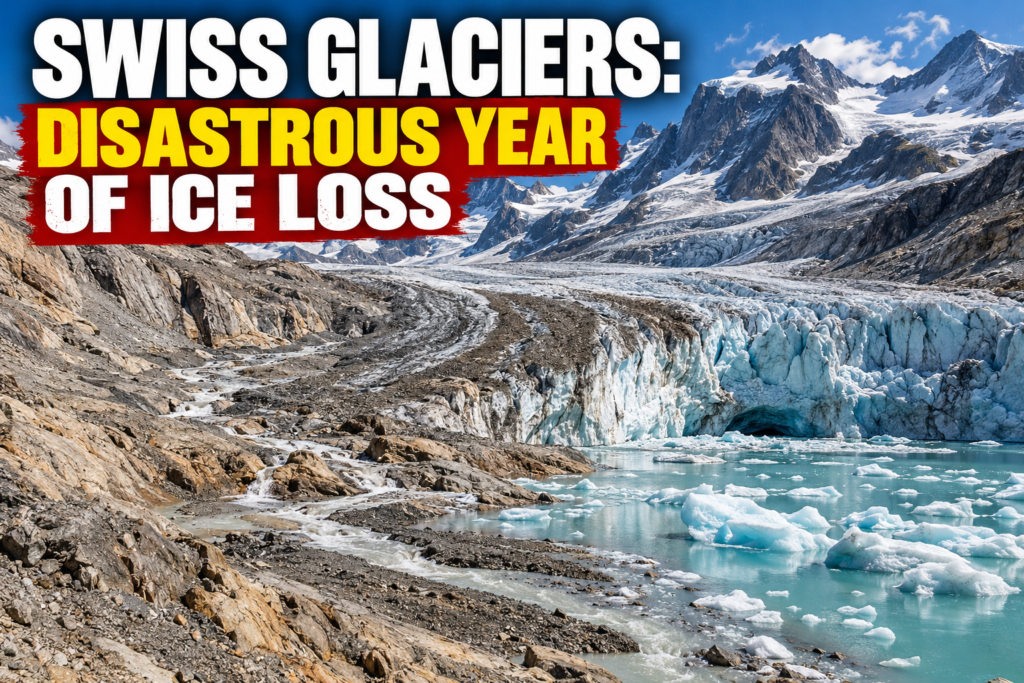

Swiss Glaciers Lose Over 5% of Ice in Disastrous 2026 Melt
· @Paul
By Paul Harrison, Orbis Weather
Switzerland’s glaciers lost 5.5% of their remaining ice in 2026, the second-worst year since measurements began. Only 2022 was worse. Nearly a fifth of all the ice in the Swiss Alps has now melted in five years.
The figures were published on October 1 by GLAMOS, the Swiss glacier monitoring network, and the Swiss Academy of Sciences. They blame a winter with very little snow followed by the hottest summer in the country’s records. “Alpine glaciers have no chance of surviving in the long term under such conditions,” the two bodies said.
The Aletsch, the largest glacier in the Alps, and the Rhône and Clariden glaciers all recorded their greatest melt on record. About 30 small glaciers are thought to have disappeared altogether over the summer.
Key facts
Detail | Source | |
|---|---|---|
Ice lost in 2026 | 5.5% of remaining volume, about 2.5 km³ (0.6 cubic miles) | GLAMOS, via AP and 20 Minuten |
Rank | Second-largest annual loss on record, after 5.9% in 2022 | GLAMOS |
Ice remaining | 42.6 km³ (10.2 cubic miles) over about 714 km² (276 square miles) | GLAMOS, via 20 Minuten |
Five-year loss | Almost 20% since 2021 | GLAMOS and the Swiss Academy of Sciences |
Ten-year loss | About 27% from 2016 to 2026 | GLAMOS, via 20 Minuten |
Thinning | 2.5 to 4 m (8 to 13 ft) on average; up to 10 m (33 ft) on glacier tongues | ETH Zurich |
Record melt | Great Aletsch, Rhône, Clariden and Allalin glaciers | GLAMOS |
Winter | Among the ten least snowy since records began | ETH Zurich |
Summer | Freezing level above 4,000 m (13,100 ft) on 76 days, a record | ETH Zurich |
Meltwater | About 2,200 billion liters (581 billion gallons) from July to September | ETH Zurich; AP |
Glaciers gone | About 30 small glaciers thought to have vanished this summer | Swissinfo |
Period measured | October 1, 2025, to September 30, 2026 | GLAMOS |
What the 2026 measurements show
Swiss glaciers lost about 2.5 cubic kilometers of ice in the 12 months to the end of September. That left 42.6 cubic kilometers in the whole country.
How it is measured. Each September, GLAMOS teams visit a set of reference glaciers, 23 this year, and read stakes drilled into the ice to see how much the surface has dropped. Combined with snow measurements from the spring, this gives each glacier’s balance for the year. The results are then scaled up to all of Switzerland’s roughly 1,300 glaciers.
The national result. The average balance was a loss equal to a layer of water 2.86 meters deep across every glacier. In 2022, the record year, it was 3.13 meters. GLAMOS says 2026 ranks just behind 2022 among the most extreme years since 1950.
How much thinner the ice is. Individual glaciers lost between 2.5 and 4 meters of thickness on average. Low-lying glacier tongues lost close to 10 meters.
Glacier | What was measured in 2026 |
|---|---|
Great Aletsch, Valais | About 13 m (43 ft) of ice lost at the lowest stake, near 1,980 m; nearly 6 m at Konkordiaplatz over the summer; greatest melt on record |
Rhône, Valais | 4 m (13 ft) lost between mid-June and mid-July alone; greatest melt on record; collapse pits forming on the tongue |
Clariden, Glarus | Greatest melt on record; completely free of snow in September |
Allalin, Valais | Greatest melt on record |
Findel, Valais | Foreland of lakes and scree expanding as the ice recedes |
Four glaciers, the Great Aletsch, Allalin, Clariden and Rhône, lost more ice than they did in 2022.
Why it was not a new national record. Many glaciers had slightly more snow on them than in 2022, and there was less Saharan dust. In 2022, reddish dust blown from North Africa darkened the snow and ice so that they absorbed more of the sun’s heat.
“It’s staggering to see the enormous amount of ice that has melted,” said Matthias Huss, the head of GLAMOS and a glaciologist at ETH Zurich.
How 2026 compares with recent years
The last five years include the two worst on record for Swiss glaciers.
The pace has changed by the decade. Swiss glaciers lost about 10% of their volume between 1990 and 2000 and 14% between 2000 and 2010. In the ten years to 2026 they lost about 27%. The loss between 2022 and 2026 was more than double that of any earlier five-year period, GLAMOS said.
Huss described the past five years to ABC News as “almost an explosion of the melting”.
One older year is often cited for comparison. In the heat wave summer of 2003 more ice melted in absolute terms than in 2026, but that was 3.5% of the ice that existed then. The same heat applied to today’s smaller glaciers removes a larger share.
Why 2026 was so bad
A glacier’s year depends on two things: how much snow falls on it in winter and how much melts in summer. In 2026 both went against the ice.
A winter with little snow
- The winter of 2025 to 2026 was among the ten least snowy since measurements began, by average snow depth from November to April.
- December to mid-February was exceptionally dry.
- By the end of April, about 25% less snow lay on the glaciers than the long-term average.
- The shortfall was greatest in the southern and eastern Alps.
Winter snow matters twice over. It feeds the glacier at high altitude, where it slowly turns to ice. It also covers the darker ice below through the first part of summer and reflects sunlight. “Winter snow protects bare ice from melting,” Huss explained.
A long, hot summer
- May to September was hot and dry. MeteoSwiss, the national weather service, recorded the hottest June-to-August period in its records.
- The freezing level stood above 4,000 meters on 76 days between May and September. That is more than twice the average and a Swiss record. On those days, melting reached the upper parts of most glaciers.
- Heat waves in June stripped the snow cover from many glaciers early.
- By September no snow remained even at 3,500 meters (11,500 ft).
- Melt from May to September ran 58% above the 2010 to 2020 average.
The date the gains were gone
GLAMOS tracks a “glacier loss day”: the date when all the snow gained over winter has melted and the glacier starts to lose mass for the year. In 2026 it fell around the turn of July, with reports giving June 29 or July 2. In 2022 it was June 26. In other years since 2000 it has come later, in July, August or September. Every day of melting after that date is a net loss.
The cause behind the weather
“The warming that we are experiencing now can be attributed 100% to anthropogenic climate change,” Huss told the Associated Press. He added that conditions once considered extreme now arrive in most summers: “What used to be extreme events, by definition rare and very intense, now occur almost every summer.”
Where the losses were greatest
The biggest glaciers set records, and the smallest ones ran out of ice altogether.
The giants
The Great Aletsch Glacier in Valais is the largest in the Alps. At its lowest measuring stake, about 1,980 meters above sea level, the surface dropped roughly 13 meters in a single year. Even high on the glacier at Konkordiaplatz, where several ice streams join, almost 6 meters melted over the summer.
On the Rhône Glacier, the source of the river of the same name, 4 meters of ice went in one month from mid-June. Collapse pits, where the roof of a meltwater cavity falls in, are opening on its tongue and speeding the retreat.
The south and east
The snow shortfall was worst in the southern and eastern Alps. The Clariden glacier in Glarus had no snow left on it at all by September and recorded its greatest melt.
The ones that vanished
- Bella Tola, Valais: gone completely and permanently, ETH Zurich reported.
- Griessfirn and Plattalva, Glarus: gone. Swissinfo reported that the Plattalva Glacier was declared extinct in September.
- About 30 small glaciers are thought to have disappeared during the summer. Huss had predicted in late August that 30 or more would vanish “without a sound” by the end of the season.
Around the Matterhorn the ice continues to pull back sharply. Below the Findel Glacier near Zermatt, a growing plain of lakes and loose rock marks where ice lay a few years ago. Huss told The Guardian that former glacier sites now resemble a “lunar landscape”.
The long-term picture
Switzerland has lost more than 30 cubic kilometers of ice since 2000, and the number of glaciers is falling along with the volume.
Measure | Figure |
|---|---|
Ice volume at the end of 2026 | 42.6 km³ |
Volume lost since 2000 | More than 30 km³ |
Glacier area today | About 714 km², roughly a third less than in 2000 |
Volume lost in the past ten years | About 27% |
Volume lost in the past five years | Almost 20% |
Glaciers lost in 50 years | More than 1,000, about 40% of the national total |
Glaciers that disappeared from 2016 to 2023 | 160 |
GLAMOS figures as reported by 20 Minuten and Swissinfo.
Put another way, about four of every ten cubic kilometers of ice that Switzerland had in 2000 are gone.
Most of the glaciers that have disappeared were small, but their loss shows where the larger ones are heading.
“These exceptional losses show that the climate is warming too rapidly for glaciers to adapt,” Huss said.
What it means
The melt is changing how much water flows out of the Alps and when, and it is reshaping the mountains themselves.
Water
Swiss glaciers released about 2,200 billion liters of meltwater between July and September. That is more than four times what all Swiss households use as drinking water in a year.
In a hot, dry summer that water is useful. It kept rivers flowing when rain did not. But it is a withdrawal from a shrinking account. Scientists say Alpine glaciers have reached, or will soon reach, “peak water”: the point after which a smaller glacier yields less meltwater each year no matter how hot it gets.
The sign is already visible. Although more ice melted in 2026 than in 2003, less meltwater ran off, because the glaciers now cover a smaller area. The year ranked third for meltwater volume.
“Today, glaciers melt all summer long, providing a steady stream of runoff,” said Giovanni De Cesare of the Swiss Federal Institute of Technology in Lausanne. That steadiness will not last.
Rivers and power beyond Switzerland
Switzerland is often called Europe’s water tower. Its glaciers feed the Rhine, the Rhône, the Po and the Danube. Less late-summer meltwater affects shipping, farming, river ecosystems, drinking water and energy production downstream.
Switzerland itself gets more than half of its electricity from hydropower, much of it from reservoirs filled partly by glacier melt.
Unstable mountains
Ice holds rock in place and buttresses valley walls. As it thins, slopes can fail. In May 2025 the collapse of the Birch Glacier, under the weight of rock falling from the mountain above, buried most of the village of Blatten in Valais, which had been evacuated days earlier.
A changed landscape
New lakes are forming where ice has gone, and bare rock and scree are replacing white slopes. That affects tourism, summer skiing and mountain routes that once crossed stable ice.
Sea level
The Alps hold too little ice to matter much for the oceans. Huss made the wider point: cutting emissions is “almost too late” for the Swiss Alps, he said, but the polar ice sheets are not beyond saving, and acting for them matters for limiting sea-level rise.
What happens next
The glaciers will go on shrinking for decades even if warming stopped today, because they are far larger than the present climate can sustain. How much survives depends on emissions.
Outlook | Source |
|---|---|
Half of all Alpine glaciers could disappear within 20 years without deep cuts in emissions | A 2025 study cited by Swissinfo |
By 2100, only the largest glaciers, such as the Aletsch and the Rhône, may survive | Same study |
Rapid emission cuts could preserve about a third of the ice in the Swiss and European Alps | Matthias Huss, to Al Jazeera |
A small glacier such as Scex Rouge will probably have no ice in 10 to 15 years | Huss, to AFP |
What is uncertain
- Next winter. A snowy winter followed by a cool summer would slow the losses for a year, as happened in 2024. It would not reverse them.
- The count of vanished glaciers. The figure of about 30 for this summer is an estimate. A full inventory takes longer.
- The exact national figure. The 5.5% is scaled up from 23 measured glaciers and carries an uncertainty that GLAMOS sets out in its report.
- The glacier loss day. Reports give June 29 and July 2 for 2026.
Can anything be done locally?
Not at the scale of the problem. Some ski areas cover small patches of ice with reflective sheets to slow melting, which protects a piste but not a glacier. The national figures respond only to global temperature.
“Alpine glaciers have no chance of surviving in the long term under such conditions,” GLAMOS and the Swiss Academy of Sciences said.
About this article
This article is based on the annual results published on October 1, 2026, by GLAMOS (Glacier Monitoring Switzerland) and the Swiss Academy of Sciences, as reported by ETH Zurich, the Associated Press, Swissinfo and Swiss media. GLAMOS is run from ETH Zurich and the universities of Fribourg and Zurich.
Terms used
Term | Meaning |
|---|---|
Ice volume | The total amount of ice in a glacier or a country’s glaciers, in cubic kilometers. One cubic kilometer of ice holds about 900 billion liters of water. |
Mass balance | The difference between the snow a glacier gains in a year and the ice and snow it loses. Negative means it shrank. |
Meters of water equivalent | The unit for mass balance: the depth of water the lost ice would make if spread over the whole glacier. |
Hydrological year | The 12 months from October 1 to September 30, used so that one winter’s snow and the following summer’s melt are counted together. |
Freezing level | The height at which the air temperature is 0°C. Above it, snow and ice survive; below it, they melt. |
Glacier tongue | The lower end of a glacier, where melting is fastest. |
Glacier loss day | The date on which a glacier has melted all the snow it gained over winter and starts to lose mass for the year. |
Peak water | The point at which meltwater from a shrinking glacier reaches its maximum and begins to decline. |
Reference glacier | One of the glaciers measured directly each year, from which national totals are estimated. |
Saharan dust | Fine sand blown north from Africa. When it settles on snow it darkens the surface and speeds melting. |
Notes on the figures
- 5.5% or “over 5%”. The joint statement said “more than five per cent”. The Associated Press and Swissinfo reported 5.5%.
- Percentages are of what remained. Each year’s loss is a share of the ice present at the start of that year, so the five annual figures do not simply add up to the five-year total.
- The 2024 figure. Reports give 2.4% or 2.5%. This article uses 2.4%, as reported by AFP.
- The glacier loss day. Swissinfo reported June 29 and 20 Minuten reported July 2.
- Number of glaciers. Reports of the national total vary with the inventory used and the smallest size counted.
Limits
- National figures are estimates scaled up from 23 measured glaciers.
- The count of glaciers that disappeared in 2026 is preliminary.
- This article relies on reports of the GLAMOS results. The full annual report was not reviewed directly.
Frequently asked questions
How much ice did Swiss glaciers lose in 2026?
About 5.5% of their remaining volume, or roughly 2.5 cubic kilometers. That is the second-largest annual loss on record.
Was 2026 the worst year ever?
No. In 2022 the glaciers lost 5.9%. Four individual glaciers, including the Great Aletsch and the Rhône, did have their worst year on record in 2026.
Why did they melt so much?
Very little snow fell over the winter, and the summer was the hottest in Swiss records. The freezing level stayed above 4,000 meters for 76 days, a record.
How much ice is left in Switzerland?
About 42.6 cubic kilometers, spread over roughly 714 square kilometers. More than 30 cubic kilometers have been lost since 2000.
How many glaciers have disappeared?
About 30 small glaciers are thought to have vanished in the summer of 2026. More than 1,000 have gone in the past 50 years.
When will Swiss glaciers be gone?
Small glaciers are disappearing now. A 2025 study found that half of all Alpine glaciers could vanish within 20 years without deep emission cuts, and that only the largest may survive to 2100.
Can the glaciers be saved?
Not most of them. GLAMOS director Matthias Huss says rapid emission cuts could still preserve about a third of the ice in the Alps.
Does glacier melt mean more water for rivers?
For now, in hot summers, yes. But as glaciers shrink they yield less. Less meltwater ran off in 2026 than in 2003, even though more ice melted.
Is this caused by climate change?
Huss says the warming driving the melt “can be attributed 100% to anthropogenic climate change”.
Is it only Switzerland?
No. Glaciers are retreating across the Alps and in most mountain ranges worldwide. Switzerland has some of the longest and most detailed measurements, which is why its annual figures are widely reported.
About the Author
Paul Harrison — Founder & Publisher, Orbis Weather
Paul Harrison founded Orbis Weather in 2026 to make global weather and natural-hazard information easier to find, follow and understand. His coverage includes tropical cyclones, severe weather, extreme temperatures, earthquakes, volcanoes, wildfires, flooding and significant natural disasters worldwide.
View all articles by Paul Harrison → | Editorial Standards →