
PAPUA’S ETERNAL SNOW IS DISAPPEARING
By Paul Harrison | Founder & Publisher, Orbis Weather
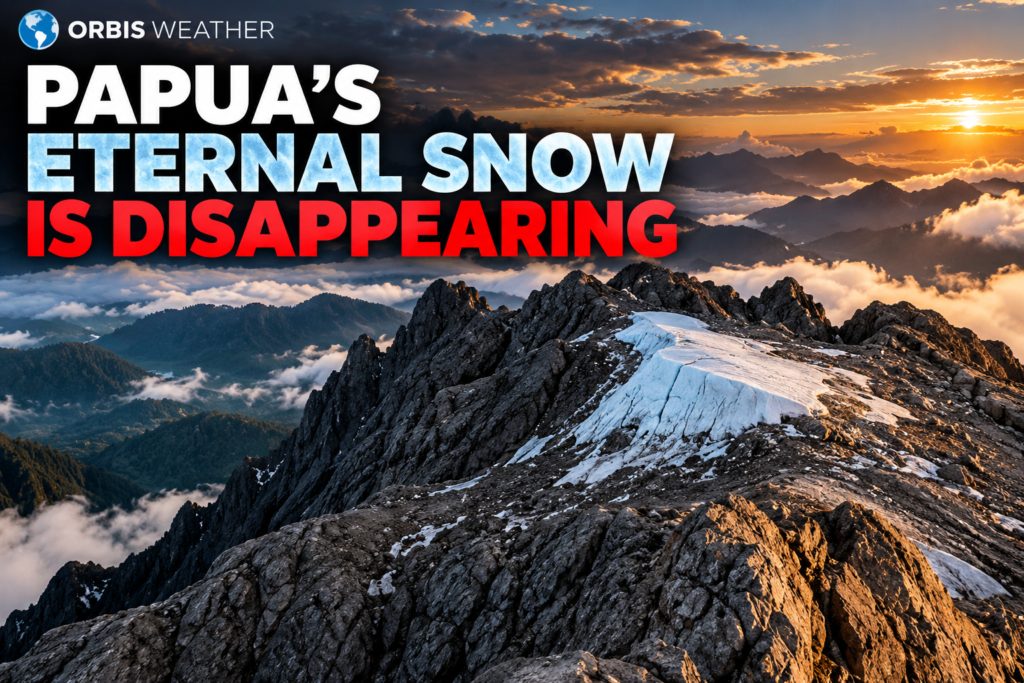

Papua’s Eternal Snow Is Disappearing
· @Paul
By Paul Harrison, Orbis Weather
The last glaciers in tropical Asia are almost gone. The ice near the summit of Puncak Jaya in Indonesia’s Papua region, known for generations as salju abadi, the eternal snow, covered about 0.09 square kilometers in September 2025. That is roughly 2% of its extent in 1988 and less than half of one percent of what stood there in 1850.
Indonesia’s weather and climate agency, BMKG, expects the ice to disappear completely in late 2026 or early 2027. “Before long, Indonesia may lose its eternal ice forever,” the agency said in July.
The cause is a warming atmosphere, made worse in some years by El Niño. Rain now falls where snow once did, and the ice has no altitude left to retreat to. When it goes, Asia will have no tropical glaciers, and the Indigenous peoples of the highlands will lose a mountain they hold sacred in the form their ancestors knew.
Key facts
Detail | Source | |
|---|---|---|
Where | Near the summit of Puncak Jaya (4,884 m, 16,024 ft), Sudirman Range, Central Papua, Indonesia | Eos |
What is left | Two remnant glaciers: the Carstensz Glacier and the East Northwall Firn, now in separate patches | Cold Regions Science and Technology study; Project Pressure |
What is gone | Four of six glaciers: Meren, Southwall Hanging, West Northwall Firn and Ngga Pilimsit | Same study |
Ice area | About 0.09 km² (9 hectares, 22 acres) in September 2025 | BMKG |
Ice thickness | 31.5 m in 2010; zero at the monitoring stake by November 2024 | BMKG |
Loss of area | About 97% between 1980 and 2024 | Hematang and colleagues, 2026 |
Expected to vanish | Late 2026 or early 2027 | BMKG |
A later estimate | By 2030 | Hematang and colleagues, 2026 |
Main cause | Rising air temperature, with El Niño years speeding the loss | BMKG |
Local name | Nemangkawi Ninggok, “Peak of the White Arrow” | BMKG, via Arab News |
What the latest measurements show
The ice is now measured in hectares, and at the place where scientists tracked its thickness there is none left.
Area. Satellite images put the remaining ice at about 0.09 km² in September 2025, according to BMKG. In April 2022 it was 0.23 km². The agency calculates that the glaciers have been losing about 0.07 km² a year, which leaves little more than a year’s worth from the 2025 figure.
Thickness. In 2010, scientists drilled through the East Northwall Firn and planted a measuring stake. BMKG has read it on return visits ever since.
Date | Ice thickness at the stake |
|---|---|
Early 2010 | 31.49 m (103 ft) |
November 2015 | 26.23 m (86 ft) |
February 2021 | 8.03 m (26 ft) |
December 2023 | 4.09 m (13 ft) |
November 2024 | 0 m: the stake stood on bare rock |
The figures are from Donaldi Sukma Permana, the BMKG climatologist who has led the agency’s work on the glacier, in an interview with IDN Times in August. Ice remains elsewhere on the mountain, but the monitoring site itself has melted out.
The speed of loss has varied with the weather. Thinning ran at about 1 meter a year from 2010 to 2015. During the strong El Niño of 2015 and 2016 it reached 5.69 meters a year, the fastest on record. During the three La Niña years from 2020 to 2023 it slowed to 1.33 meters a year.
From the air. A drone survey by the organization Project Pressure, reported by the American Geophysical Union’s magazine Eos in July, found that the East Northwall Firn has shrunk by about 95% since 2002 and is no longer one glacier. It has broken into three separate patches. “I was surprised to see there was still some ice left,” the project’s founder, Klaus Thymann, told the magazine.
The other survivor. The Carstensz Glacier, which hangs just east of the summit, measured about 0.04 km² and 440 meters long in November 2025, according to satellite observations cited by Wikipedia.
A century and a half of retreat
The glaciers have been shrinking since at least the mid-1800s, and the loss has sped up this century.
Two things stand out in the record. The ice had already lost about three quarters of its area by 1988. Then, between 2002 and 2022, it lost nine tenths of what was left.
A study led by Francine Hematang of Papua University, published in January 2026 in the journal Cold Regions Science and Technology, used satellite images to measure a 97% decline between 1980 and 2024. It found that four of the six glaciers present in 1980 have disappeared: the Meren, the Southwall Hanging, the West Northwall Firn and the Ngga Pilimsit.
The ice itself is far older than the record of its decline. The ice cap that these glaciers are the last pieces of formed about 5,000 years ago. An earlier ice cap covered the mountains from about 15,000 to 7,000 years ago and melted away.
Why the ice is melting
The air around the summit is now too warm, too often, for ice to survive. Three things drive the loss, and they reinforce each other.
1. The freezing level has risen above the ice
A glacier survives only where more snow falls each year than melts. On Puncak Jaya the height at which the air reaches 0°C has climbed as the atmosphere has warmed, Permana explained, so the ice now sits in above-freezing air far more of the time.
Glaciers on higher mountains can retreat uphill to colder air. These cannot. The summit stands at 4,884 meters, which is low for a tropical glacier, and there is no higher ground to retreat to.
2. Rain is falling where snow used to
Total precipitation in the Papuan highlands has generally increased, BMKG says, but far less of it now falls as snow. “Instead of receiving new snow, the glacier area is more often drenched by rain,” Permana said.
Rain does double damage. It adds no new ice, and it delivers heat that melts the surface. It also washes away the bright snow cover that reflects sunlight, leaving darker ice and rock that absorb more of the sun’s energy.
3. El Niño speeds everything up
El Niño is a periodic warming of the tropical Pacific. In Indonesia it brings drier weather, fewer clouds, more direct sun on the ice and a still higher freezing level. The record at the measuring stake shows the effect: thinning ran more than four times faster in the 2015 to 2016 El Niño than in the La Niña years of 2020 to 2023.
A new El Niño is under way. The U.S. Climate Prediction Center said on October 8, 2026, that El Niño “continues to strengthen”, and that a strong to very strong event is likely to last through the first months of 2027. BMKG had warned in June that an El Niño in the second half of 2026 was “likely to hasten the thaw”.
The underlying cause
Behind all three is the long-term warming of the atmosphere from greenhouse gases. BMKG puts global warming at about 1.45°C above pre-industrial levels, and says Indonesia’s average temperature has been rising by about 0.15°C a decade. It describes the years 2023 to 2025 as the hottest on record.
“This event indicates that regional warming has exceeded a critical threshold beyond which recovery is no longer possible,” the agency said.
Why it matters
The ice is too small to change sea level or to supply a river. Its loss matters for what it means to the people who live below it, for what it recorded, and for what it signals.
A sacred mountain
The Amungme and Moni peoples of the highlands regard the peak as sacred. Its name in the local language is Nemangkawi Ninggok, the Peak of the White Arrow. BMKG says the loss of the ice means the loss of part of their spiritual identity.
Alion Belau, a Moni pilot who flies over the range, put it more simply to Eos. Of the name “eternity glaciers”, he said: “It’s just a name now.”
Water and wildlife
BMKG and other Indonesian sources warn of effects on the valleys below.
- Water. Glaciers store water and release it slowly. Without that buffer, river flow swings more sharply between wet and dry seasons.
- Farms. Highland communities rely on mountain rivers to water root-crop gardens, a staple food.
- Species. Mosses and animals adapted to the cold summit zone have nowhere higher to move to as it warms.
These effects should be kept in proportion. With less than a tenth of a square kilometer of ice remaining, most of the change in meltwater has already happened. Thomas Djamaluddin, a researcher at Indonesia’s national research agency BRIN, told Detik that the gradual melting has no significant direct local impact.
A climate archive
Glacier ice traps dust, pollen and air as it forms, layer by layer, and scientists read those layers as a record of past climate. The 2010 expedition that drilled through the East Northwall Firn was among the last chances to recover such a record here. None can be taken from ice that no longer exists.
A warning from the edge
Tropical glaciers sit at the very limit of where ice can survive, so they respond to warming before larger ice masses do. BMKG calls them a “stark warning” for the rest of the world.
The wider picture bears that out. Glaciers outside Greenland and Antarctica have lost an average of 273 billion metric tons of ice a year since 2000, according to the European Space Agency, and the loss from 2012 to 2023 was 36% higher than from 2000 to 2011.
No way back
“Once the ice disappears it cannot return, because global temperatures keep rising,” Djamaluddin said.
The world’s other tropical glaciers
Puncak Jaya holds the only tropical glaciers in Asia. The rest are in two regions, and they are shrinking too.
Region | Where | Status |
|---|---|---|
Asia and Oceania | Puncak Jaya, Papua, Indonesia | Two remnants, about 0.09 km² in total; expected to vanish within months to a few years |
South America | The Andes | Home to most of the world’s tropical glaciers; losing ice at a comparable pace, Indonesian science outlet Ekuatorial reports |
Africa | Kilimanjaro in Tanzania; Mount Stanley in Uganda’s Rwenzori Mountains | In decline; Project Pressure documented the retreat on Mount Stanley in 2024 |
The study by Hematang and colleagues states the consequence plainly: once these remnants disappear, there will be no more tropical glaciers in Asia.
What happens next
The remaining ice is expected to vanish within months by one estimate and within four years by another. Nothing can now prevent it.
Estimate | Source | Basis |
|---|---|---|
Late 2026 or early 2027 | BMKG | The area remaining in September 2025 and the recent rate of loss |
Possibly sooner | BMKG’s Donaldi Sukma Permana | The El Niño that began in mid-2026 |
By 2030 | Hematang and colleagues, 2026 | The trend in satellite images from 1980 to 2024 |
“The total disappearance of the permanent ice on Puncak Jaya is projected to occur in a very short timeframe,” Permana said in August.
What is uncertain
- The current state of the ice. The newest published area figure is from September 2025, more than a year ago. No agency has announced that the ice is gone.
- The exact date. Small patches of ice shaded by rock can outlast forecasts. Earlier predictions were wrong: a 2010 expedition expected the glaciers to last only until about 2015.
- How to define the end. Scientists stop calling a body of ice a glacier when it is too thin to flow under its own weight. Stagnant ice can linger after that point, so the glaciers may be declared extinct before the last ice melts.
- The effect of this El Niño. It is forecast to be strong, and past strong events multiplied the rate of loss.
What can be done
Nothing will save these glaciers. BMKG frames the loss as a reason to cut the emissions that caused it, and urges people to save energy, use public transport and plant trees. Researchers are meanwhile recording what is left. The drone model built by Project Pressure maps the ice in detail, so that its final extent is documented for the communities and scientists who will no longer be able to see it.
About this article
This article draws on statements and data from BMKG, Indonesia’s Meteorology, Climatology and Geophysics Agency, as reported by Indonesian and international media between June and August 2026, on a peer-reviewed study published in January 2026, and on reporting by the science magazine Eos. It was written on October 9, 2026.
Terms used
Term | Meaning |
|---|---|
Glacier | A body of ice thick enough to flow slowly downhill under its own weight. |
Tropical glacier | A glacier lying between the Tropics of Cancer and Capricorn. They exist only on very high mountains. |
Firn | Old, compacted snow on its way to becoming glacier ice. The East Northwall Firn keeps the word in its name. |
Freezing level | The height in the atmosphere at which the temperature is 0°C. Below it, precipitation falls as rain. |
Ablation | The loss of ice from a glacier by melting or evaporation. |
El Niño and La Niña | The warm and cool phases of a natural cycle in the tropical Pacific that shifts weather around the world. |
Albedo | How much sunlight a surface reflects. Fresh snow reflects most of it; bare ice and rock absorb more. |
Photogrammetry | Building an accurate 3D model from many overlapping photographs, here taken by drone. |
BMKG | Badan Meteorologi, Klimatologi, dan Geofisika, Indonesia’s national weather, climate and earthquake agency. |
Salju abadi | Indonesian for “eternal snow”, the popular name for the Puncak Jaya ice. |
Notes on names and numbers
- Puncak Jaya or Jayawijaya. Indonesian media often call the ice the “Jayawijaya snow”. The glaciers are on and beside Puncak Jaya, also known as Carstensz Pyramid, in the Sudirman Range. The Jayawijaya Mountains are the neighboring range to the east.
- The 1850 figure. BMKG gives about 19.3 km². Eos, citing earlier research, gives about 18.8 km². This article uses the BMKG figure.
- Thickness in 2023 and 2024. Some reports give 4 meters for 2024. BMKG’s detailed readings put 4.09 meters at December 2023 and zero at November 2024.
- Percentages. “2% left” compares 2025 with 1988. “97% lost” compares 2024 with 1980. Both describe the same decline from different starting points.
Limits
- The most recent area measurement published is from September 2025.
- Area is measured from satellite images, which can be affected by cloud and fresh snow.
- Thickness was measured at a single stake and does not describe the whole ice body.
- Forecasts of the final date depend on weather that cannot be predicted months ahead.
Frequently asked questions
Is there really snow in Indonesia?
Yes, for now. Small glaciers survive near the summit of Puncak Jaya in Papua, at roughly 4,600 to 4,880 meters above sea level. They are the only glaciers in Indonesia and the only tropical glaciers in Asia.
How much ice is left?
About 0.09 km², or 9 hectares, as of September 2025. That is about 2% of the area in 1988.
When will Papua’s glaciers disappear?
Indonesia’s BMKG expects late 2026 or early 2027. A 2026 scientific study gives a later limit of 2030.
Why are they melting?
The air at the summit has warmed. The freezing level has risen above the ice, rain falls there more often than snow, and strong El Niño years speed up the loss.
Have the glaciers already gone?
No announcement has been made. The latest published measurement, from September 2025, showed ice remaining. The monitoring stake on the East Northwall Firn was found standing on bare rock in November 2024.
Could the ice come back?
Not in any foreseeable climate. Scientists say regional warming has passed the point at which ice can form and persist there.
Will the melting cause floods or raise sea level?
No. The remaining ice is far too small to do either. Its loss is significant culturally, scientifically and as a sign of warming.
Why is it called eternal snow?
Salju abadi, eternal snow, is the Indonesian name for ice that has lasted for about 5,000 years. The Moni people know the glaciers by a similar name.
Can visitors still see the ice?
It is still visible from the air and to climbers on Puncak Jaya. Reaching it requires a mountaineering expedition and permits.
Are other tropical glaciers disappearing?
Yes. Glaciers in the tropical Andes and on the high mountains of East Africa are also shrinking.
About the Author
Paul Harrison — Founder & Publisher, Orbis Weather
Paul Harrison founded Orbis Weather in 2026 to make global weather and natural-hazard information easier to find, follow and understand. His coverage includes tropical cyclones, severe weather, extreme temperatures, earthquakes, volcanoes, wildfires, flooding and significant natural disasters worldwide.
View all articles by Paul Harrison → | Editorial Standards →