
Nepal’s Glaciers Will Flood Again. Can Scientists Predict the Next One?
By Paul Harrison | Founder & Publisher, Orbis Weather

🏔️ Nepal’s Glaciers Will Flood Again. Can Scientists Predict the Next One?
ORBIS WEATHER — August 28, 2026
The catastrophic Himalayan flood that struck Nepal and the Tibet border region this week has exposed an increasingly urgent problem: scientists know that warming mountains are becoming more unstable, but predicting exactly which glacier will collapse — and when — remains extraordinarily difficult.
The August 26 disaster appears to have begun high on Lāngtāng Lirung, where satellite and seismic analysis indicates a massive section of glacier, rock and underlying mountainside broke loose. The collapse generated seismic energy equivalent to roughly a magnitude-5.2 earthquake before sending ice, rock, sediment and water racing into the river system below. (apnews.com, usgs.gov)
The question now facing Nepal is unsettlingly simple:
Could scientists see the next one coming?
🧊 This Wasn’t a Typical Glacial-Lake Flood
Early reports focused on a possible glacial lake outburst flood, or GLOF, but subsequent satellite analysis points toward something more complicated.
Scientists believe part of the bedrock beneath the glacier itself failed, carrying an enormous mass of ice and rock into the valley. The avalanche may then have temporarily dammed the Lhende River before water broke through and surged downstream. (apnews.com, nationalgeographic.com)
The result was a cascading disaster.
🌊 Water levels reportedly climbed as much as 9 meters — about 30 feet — within 30 minutes downstream.
🪨 The flood carried enormous quantities of mud, boulders, ice and sediment.
🏘️ Communities, roads, bridges and hydropower infrastructure were overwhelmed.
The USGS says the resulting debris flow and flooding traveled nearly 100 kilometers through the Trishuli and Bhote Koshi river systems. (usgs.gov)
🌡️ A Mountain Range Becoming Less Stable
Scientists are careful not to blame a single glacier collapse entirely on climate change. Establishing what triggered this particular failure will require much more research.
But the larger trend is troubling.
Nepal’s glaciers have lost close to one-third of their ice in just over three decades, while recent melting has accelerated dramatically. Rising temperatures can also thaw mountain permafrost — frozen material that effectively helps bind rock and ice together. (reuters.com, nature.com)
As that frozen “glue” weakens, steep Himalayan slopes can become increasingly unstable.
The danger isn’t limited to traditional glacial lakes. Scientists now have to consider a much broader chain of hazards:
glacier collapse → rock avalanche → river blockage → temporary lake → dam failure → flash flood → landslides downstream.
One event can trigger the next.
🛰️ Can Satellites Find the Dangerous Glaciers?
Partly.
Satellite imagery allows scientists to monitor glaciers for warning signs such as rapid retreat, expanding lakes, unusual surface movement, cracking, rockfalls and changes in surrounding slopes.
Researchers are already using satellite data and machine learning to identify potentially dangerous locations.
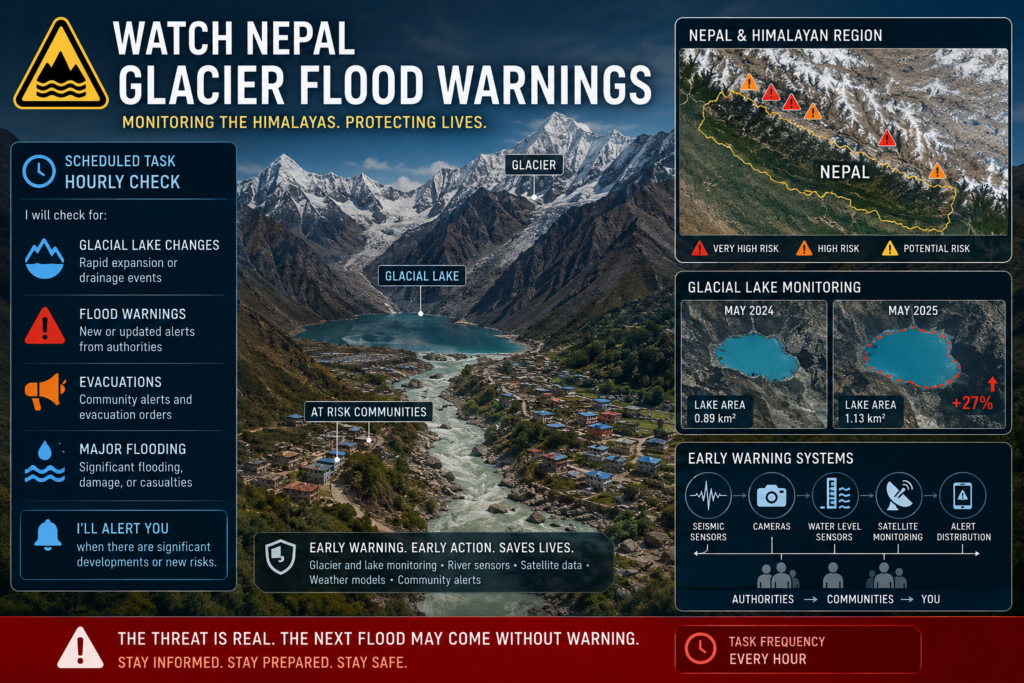
A 2026 study examining the China-Nepal Himalaya identified 2,377 glacial lakes and found their combined area increased about 27% between 1992 and 2022. Researchers classified 76 lakes as potentially hazardous, including four considered very high risk and 14 high risk. (sciencedirect.com)
Another 2026 study tracking four potentially dangerous lakes in Nepal found that all four expanded between 1992 and 2024, with roughly 609 million cubic meters of additional water estimated to have accumulated among them. (egusphere.copernicus.org)
That means scientists are becoming much better at answering:
Where could a disaster happen?
The harder question remains:
When?
⚠️ Some Collapses Give Almost No Warning
The glacier involved in Wednesday’s catastrophe wasn’t considered one of Nepal’s most closely watched threats.
That illustrates the fundamental problem.
A glacier can look relatively stable from space while changes are occurring deep within the ice, beneath the glacier or inside the underlying rock.
Cloud cover presents another problem. Monsoon weather can obscure satellite observations for days precisely when scientists need them most. (reading.ac.uk)
Continuous ground instruments would help enormously, but installing seismic sensors, GPS stations, cameras, radar and weather equipment across thousands of square miles of remote Himalayan terrain would be extremely expensive.
🚨 Prediction May Be Impossible — Warning Isn’t
Scientists don’t necessarily have to predict the precise moment a glacier collapses to save lives.
Early-warning systems can monitor rivers and mountains for sudden changes.
Sensors can detect rapidly rising water. Seismometers can identify avalanches and landslides. Cameras can watch unstable slopes. Radar and GPS equipment can detect accelerating movement. Satellite systems can identify expanding lakes and major changes in glaciers.
Nepal already has a flash-flood prediction system developed through ICIMOD’s SERVIR-HKH initiative with NASA and other partners. It combines weather prediction, satellite precipitation information and hydrological modeling to estimate dangerous river flows. (tethys.icimod.org)
But events caused by sudden glacier and mountainside collapses remain considerably harder to forecast.
🇨🇭 There Is Evidence Monitoring Can Work
One of the strongest examples came from Switzerland in 2025.
Scientists monitoring the unstable Birch Glacier detected increasingly concerning movement and rockfalls above the village of Blatten.
Authorities evacuated residents nine days before the glacier collapsed.
The avalanche ultimately buried much of the village beneath millions of tons of debris — but the evacuation prevented what could have been an enormous loss of life. (nationalgeographic.com)
Applying that level of monitoring throughout the Himalayas would be far more difficult.
The mountain range is enormous, many areas are inaccessible, and countries such as Nepal simply don’t have Switzerland’s resources for monitoring individual glaciers continuously.
🚨 And the Danger in Nepal Isn’t Over
Authorities are currently watching two lakes upstream from this week’s disaster zone.
Satellite imagery Friday indicated that one had begun draining. Another, larger lake appeared to be continuing to grow without an obvious outlet, raising concern that water pressure could continue building.
Nepalese authorities say the flood threat will remain until the lakes have safely drained. Plans are underway to deploy additional cameras and sensors downstream. (reuters.com)
That makes the current disaster both a rescue operation and an active geological emergency.
🌍 The Bigger Warning
The lesson from Nepal isn’t simply that glacial lakes are dangerous.
It is that entire high-mountain landscapes are changing.
Scientists can identify dangerous lakes. They can map unstable glaciers. They can model potential flood paths and increasingly use satellites, artificial intelligence and sensors to recognize warning signs.
But they still cannot reliably point to a Himalayan mountainside and say:
“That glacier will collapse next Tuesday.”
For now, the most realistic defense is identifying the most dangerous locations, continuously monitoring them, installing downstream warning systems and ensuring communities know exactly where to go when alarms sound.
Because scientists increasingly agree on one thing:
There will be another Himalayan glacier disaster.
The race is to make sure the warning arrives before the water does. (nature.com)
Highlights:
- Nepal monitoring two lakes, flood risk to remain until they’re fully drained, official says
- New flood risks hamper Himalayan rescue work
- Why a newly formed lake is sparking fears of more flooding along the Nepal-China border
- Satellite images show bedrock and glacier collapsed on Nepal-China border, then rivers flooded
About the Author
Paul Harrison — Founder & Publisher, Orbis Weather
Paul Harrison founded Orbis Weather in 2026 to make global weather and natural-hazard information easier to find, follow and understand. His coverage includes tropical cyclones, severe weather, extreme temperatures, earthquakes, volcanoes, wildfires, flooding and significant natural disasters worldwide.
View all articles by Paul Harrison → | Editorial Standards →
🌎 EARTH RIGHT NOW
A quick look at significant natural hazards and live monitoring tools around the planet.