
Formula E: Racing Toward the Future
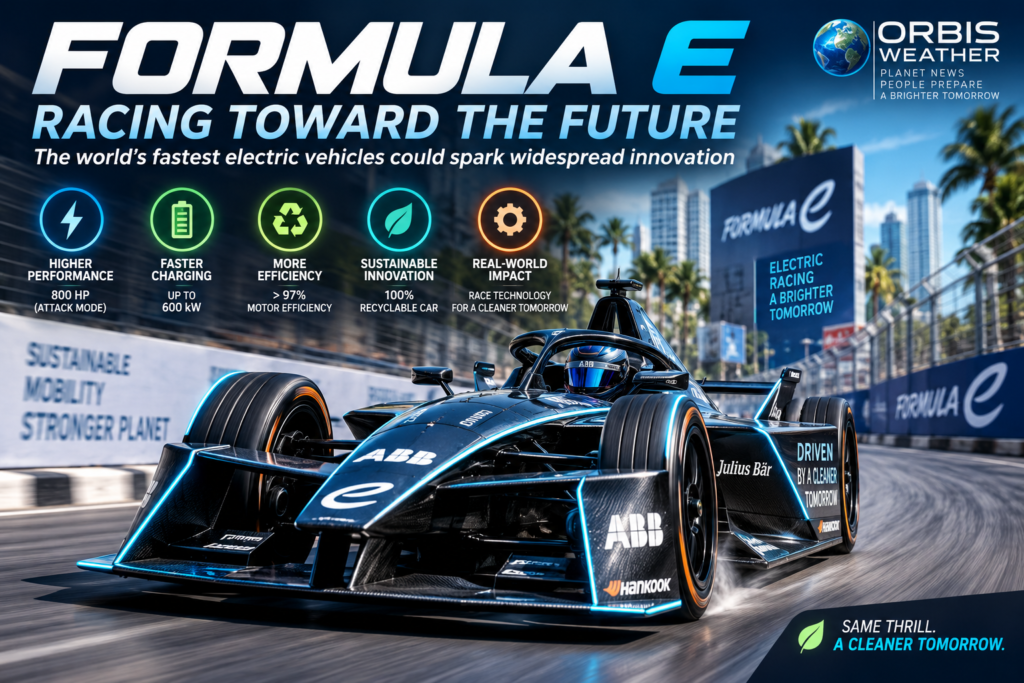

Formula E: The World’s Fastest Electric Vehicles Could Spark Widespread Innovation
Electric race cars capable of more than 200 mph may seem far removed from the family EV sitting in a driveway, but the technology being developed in Formula E could eventually help reshape the cars millions of people drive every day.
The ABB FIA Formula E World Championship is preparing for its biggest technological leap yet with the arrival of the GEN4 race car, scheduled to make its competitive debut during the 2026–27 season.
And the numbers are remarkable.
GEN4 is designed to exceed 335 km/h (208 mph), accelerate from 0–100 km/h (0–62 mph) in roughly 1.8 seconds, and produce as much as 600 kW — roughly 800 horsepower — in ATTACK MODE.
But outright speed may actually be the least important part of the story.
⚡ A Rolling Laboratory for Electric Vehicles
Motor racing has long served as a proving ground for technologies that eventually migrate into passenger vehicles. Formula E is attempting to do the same thing for the electric era.
The extreme demands of racing force engineers to solve many of the same problems facing today’s EV industry: extracting more range from batteries, recovering energy during braking, managing enormous electrical loads, improving motor efficiency and charging batteries rapidly without sacrificing reliability.
Formula E describes this as a “race-to-road” philosophy, with technologies including high-efficiency electric motors and ultra-high-power charging feeding research relevant to future electric vehicles.
🔋 Regenerative Braking Becomes a Power Plant
One of GEN4’s most impressive technologies is its regenerative braking system.
Instead of wasting braking energy primarily as heat, electric motors can operate as generators when the vehicle slows down, converting kinetic energy back into electricity.
GEN4 can regenerate at up to 700 kW, and Formula E says more than 40% of the energy used during a race can be recovered through regeneration.
That matters well beyond racing.
More sophisticated regenerative braking could eventually help passenger EVs squeeze additional miles from the same battery, reduce conventional brake use and improve overall vehicle efficiency.
🔌 Charging at Extraordinary Speeds
Formula E is also pushing charging technology toward power levels far beyond most current public EV chargers.
The championship has been developing extremely high-power charging systems, with GEN4’s broader race-to-road program targeting 600 kW charging technology.
The engineering lessons learned from repeatedly delivering enormous amounts of electricity into a battery under racing conditions could prove valuable as automakers and charging companies attempt to shorten EV charging times.
The challenge isn’t simply delivering more electricity. Engineers must control battery temperature, degradation, voltage and safety while doing it.
A racetrack provides an unusually demanding place to find out what works—and what doesn’t.
⚙️ Electric Motors Are Becoming Astonishingly Efficient
Formula E’s electric powertrains also demonstrate one of the fundamental advantages of electrification: efficiency.
Formula E has reported electric motor efficiency exceeding 95%, compared with roughly 40% for a typical internal-combustion racing engine. The GEN4 platform pushes efficiency even further, with Formula E citing figures above 97%.
That means substantially more of the energy stored onboard can ultimately be converted into useful motion rather than being lost primarily as heat.
For road vehicles, even relatively small improvements in efficiency can translate into longer range or potentially allow manufacturers to achieve the same range with smaller batteries.
🏎️ 800 Horsepower Meets All-Wheel Drive
GEN4 also introduces permanent active all-wheel drive.
Its standard race output reaches 450 kW, rising to 600 kW in ATTACK MODE, while a sophisticated front-and-rear electric drivetrain controls how that enormous amount of power reaches the pavement.
Software increasingly determines how modern EVs accelerate, regenerate energy, distribute torque and manage their batteries.
That makes Formula E particularly relevant to an automotive industry in which vehicles are becoming as dependent on software engineering as mechanical engineering.
♻️ Racing With Recycling Built In
Formula E is also attempting to demonstrate that extreme performance and sustainability don’t necessarily have to move in opposite directions.
GEN4 has been designed around a circular manufacturing philosophy. Formula E says the vehicle will be constructed using 100% recyclable or reusable materials, with at least 20% recycled content incorporated across key components.
Battery materials, tyres, carbon-fibre components and supply chains are increasingly being evaluated not simply for performance but for what happens to those materials throughout—and after—their useful lives.
That could become increasingly important as millions more EV batteries eventually reach retirement.
🌎 Why Formula E Could Matter Far Beyond Racing
Nobody is likely to drive a Formula E car to the grocery store.
But that’s not really the point.
Racing compresses years of engineering stress into brutally demanding environments. Batteries are repeatedly charged and discharged. Motors operate near their limits. Software must make thousands of decisions while engineers fight for tiny improvements in efficiency.
A technology that saves even a fraction of a percent of energy can matter when races are won by seconds.
Eventually, those tiny improvements can become much more important when multiplied across millions of passenger vehicles.
Formula E manufacturers are therefore competing on something potentially much larger than trophies.
They’re competing to understand the electric automobile better than their rivals.
🚗 From Racetrack to Driveway
The history of motorsport is filled with technologies that eventually became commonplace in road vehicles.
Formula E is attempting to write the electric version of that story.
Better regenerative braking could increase range. More efficient motors could reduce energy consumption. Improved thermal management could protect batteries. Faster charging technology could make long-distance EV travel easier. Advanced software could improve traction and energy management.
Not every Formula E innovation will reach a production vehicle, and technologies developed for racing often require major redesign before they’re practical or affordable for consumers.
But the direction is increasingly clear.
The world’s fastest electric race cars aren’t simply demonstrating how quickly an EV can travel.
They’re helping engineers discover how much better electric vehicles can become.
And the technology screaming around Formula E circuits today could eventually be quietly moving millions of people down ordinary roads tomorrow.
Orbis Weather | Technology • Environment • Future Mobility