
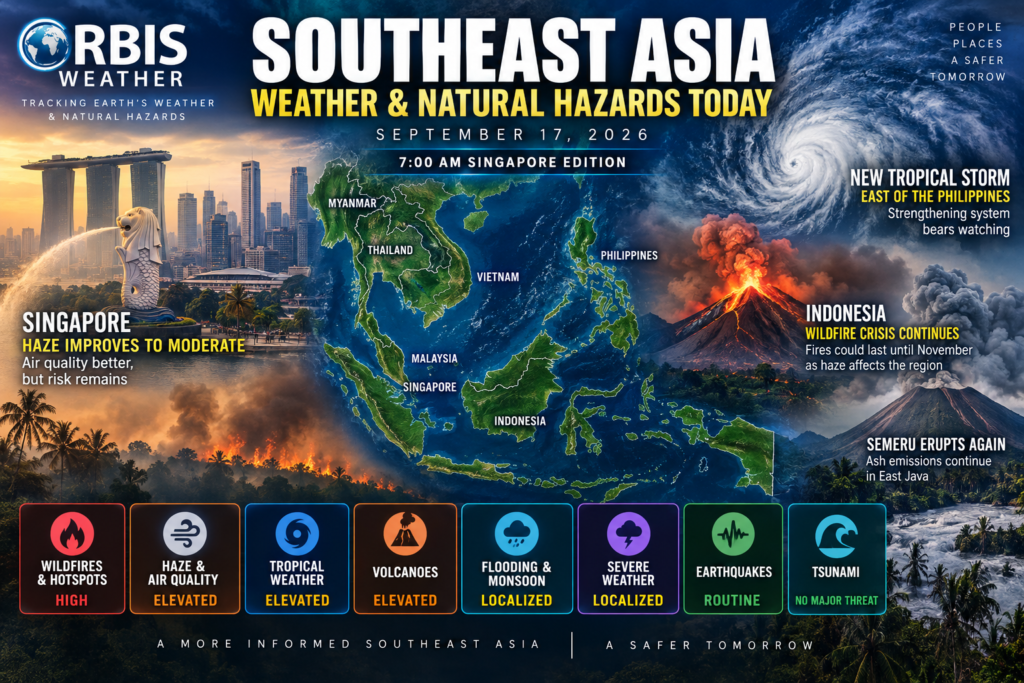

🌏 Southeast Asia Weather & Natural Hazards Today — September 17, 2026
Indonesia’s Wildfire Crisis Deepens as New Tropical Storm Develops East of the Philippines
ORBIS WEATHER — 7:00 AM Singapore Morning Edition
Southeast Asia begins Thursday, September 17 with Indonesia’s wildfire and transboundary haze crisis still the region’s most consequential environmental hazard, while a newly strengthened tropical storm east of the Philippines becomes the main tropical system to watch.
Indonesia is experiencing its worst wildfire season in 11 years, according to reporting published September 16, with severe drought and El Niño conditions fueling fires across Kalimantan and Sumatra. More than 12.5 million people across seven Indonesian provinces have been exposed to hazardous smoke, while respiratory illnesses surged from 50,891 to 113,336 cases between September 1 and 9. (Reuters)
Meanwhile, PAGASA says the tropical depression east of the Philippine Area of Responsibility has strengthened into a tropical storm, making its future track increasingly important for the Philippines and Western Pacific. (The Manila Times)
🔥 Indonesia Wildfires — Crisis Could Continue Into November
Indonesia’s enormous forest and peat-fire emergency shows little sign of ending soon.
Indonesia’s forestry minister warned September 16 that the fires could continue until early November, as the rainy season is now expected to arrive later than previously anticipated. More than 50 aircraft have been deployed for water bombing and cloud-seeding operations, while Japan has provided three CH-47 Chinook helicopters and personnel to assist firefighting efforts. (Reuters)
The scale of the smoke emergency is substantial.
Around 800,000 hectares — roughly 1.9 million acres — had burned by August, according to the latest reporting, while wildfire emissions reached approximately 19.7 million metric tons during one week in September, representing more than one-third of global fire-related emissions during that period. (Reuters)
Indonesia has also suspended the business permits of 26 companies linked to forest and land fires, according to an announcement September 16. (Tempo)
🔥 Orbis Wildfire Risk: 🔴 HIGH
Kalimantan and Sumatra remain the primary regions to watch, particularly if prolonged dry weather continues.
🌫️ Regional Haze — Singapore Improves, But Threat Has Not Ended
There is some encouraging news for Singapore this morning.
After all five regions of Singapore entered the Unhealthy PSI category on September 15, air quality subsequently improved, with all regions returning to the Moderate range in the latest reporting. (The Straits Times)
That does not mean the regional haze episode is over.
Smoke from Indonesia’s fires continues to affect portions of Indonesia, Malaysia and Singapore, and continued burning in Kalimantan and Sumatra means changing winds could bring another deterioration.
Indonesia’s forestry minister said September 16 that the wildfire threat may persist until early November. (Reuters)
🌫️ Singapore Haze Risk: 🟠 ELEVATED
Conditions are better than they were Tuesday, but Orbis Weather considers the haze situation an ongoing regional threat rather than a resolved event.
Readers should follow rapidly changing conditions through the Singapore Haze & Air Quality Tracker.
🇸🇬 Singapore Today
🌤️ Weather
Singapore remains under the influence of the Southwest Monsoon, with winds generally blowing from the southeast or southwest.
Meteorological Service Singapore’s September outlook called for generally dry conditions punctuated by localized, short-duration thundery showers, particularly during the late morning and afternoon. Temperatures during the period were expected to frequently reach 33–35°C (91–95°F). (National Environment Agency)
Localized thunderstorms therefore remain possible even while the broader regional pattern is unusually dry.
⛈️ Thunderstorm Risk: 🟡 LOCALIZED
The Singapore Lightning & Thunderstorm Tracker should be used for changing lightning conditions throughout the day.
🌧️ Flash-Flood Risk: 🟢 LOW TO LOCALIZED
No major Singapore flood emergency is evident in the latest authoritative information reviewed for this morning’s briefing.
Short-duration tropical downpours can still produce localized drainage problems, however, particularly beneath stronger thunderstorms.
Follow rainfall conditions through the Singapore Monsoon & Flood Tracker.
🌫️ Air Quality: 🟠 ELEVATED WATCH
Air quality has improved from Tuesday’s island-wide unhealthy episode, but smoke transport from Indonesia remains possible while regional fires continue.
The Singapore Weather & Natural Hazards dashboard provides the broader local picture.
🌀 Tropical Weather — New Tropical Storm East of Philippines
Tropical weather is becoming more important this morning.
PAGASA reported that the tropical depression outside the Philippine Area of Responsibility had strengthened into a tropical storm by September 17. (The Manila Times)
This is an important change from yesterday, when the system was still being monitored as a tropical depression.
The key questions now are:
➡️ Does the storm enter the Philippine Area of Responsibility?
➡️ How quickly does it strengthen?
➡️ Does its track bring significant weather toward Luzon or remain farther over the Western Pacific?
Until official forecasts establish a clearer threat, Orbis Weather will treat this as a developing system to monitor rather than an imminent major Philippine impact.
🌀 Tropical Risk: 🟠 ELEVATED WATCH
Readers should watch the Southeast Asia Natural Hazards regional hub and Orbis Weather’s Western Pacific tropical coverage for subsequent advisories.
🌋 Indonesia Volcano Watch
Indonesia’s extraordinary level of volcanic activity continues.
Government Geological Agency data released earlier this month showed 11 Indonesian volcanoes had erupted during 2026 through early September, with several remaining at elevated alert levels. (Antara News)
🌋 Semeru
Mount Semeru remains one of Indonesia’s most active volcanoes.
It produced repeated eruptions earlier this week, including an eruption on September 15 that sent ash approximately 1,000 metres above the summit. (Askara)
Semeru has remained at Level III — Siaga, with exclusion zones maintained around hazardous sectors. (Antara News)
🌋 Anak Krakatau
Anak Krakatau also remains at Level III — Siaga following its significant eruptive episode earlier in September.
Its activity disrupted aviation and affected more than 270,000 travelers earlier this month, demonstrating why even eruptions that do not threaten large nearby populations can have major regional consequences. (Reuters)
🌋 Sinabung
Sinabung is also listed among Indonesia’s Level III volcanoes following renewed activity this year. (Antara News)
🌋 Indonesia Volcano Risk: 🟠 ELEVATED
No evidence reviewed for this briefing indicates that these volcanoes are erupting because of a single shared geological trigger; Indonesian authorities have emphasized that simultaneous activity at different volcanoes should be treated independently. (Jakarta Globe)
Follow official developments through the Indonesia Volcano Tracker.
🌏 Earthquake Watch
Southeast Asia remains one of Earth’s most seismically active regions, particularly Indonesia and the Philippines.
No new major regional earthquake or tsunami emergency stood out in the authoritative sources reviewed for this 7:00 AM Singapore briefing.
That distinction is important: smaller and moderate earthquakes occur routinely throughout the region and should not automatically be characterized as disasters.
🌏 Regional Earthquake Status: 🟢 ROUTINE SEISMIC ACTIVITY
Readers can monitor new earthquakes as they occur through the Southeast Asia Earthquake Tracker.
🌧️ Monsoon & Flood Watch
The Southwest Monsoon remains established across the region, creating a sharp meteorological contrast.
Parts of the northern ASEAN region can still experience periods of heavy tropical rainfall, while sections of Indonesia remain extraordinarily dry.
Singapore’s meteorological authorities noted earlier this month that dense smoke haze had been observed over southern and central Sumatra and parts of Kalimantan, reflecting the severity of the dry pattern south of the Equator. (National Environment Agency)
No single new catastrophic Southeast Asian flood disaster was sufficiently verified in the sources reviewed for this morning’s briefing to justify elevating the entire regional flood category.
🌧️ Regional Flood Risk: 🟡 LOCALIZED
Localized flash flooding nevertheless remains possible beneath strong monsoon thunderstorms.
⛈️ Severe Weather & Lightning
Thunderstorms remain a routine but potentially dangerous hazard across tropical Southeast Asia.
The principal threats are:
⚡ Frequent lightning
🌧️ Short-duration torrential rainfall
💨 Localized damaging wind gusts
🌊 Sudden urban flash flooding
There is no verified widespread regional severe-weather outbreak evident this morning.
⛈️ Severe Weather Risk: 🟡 LOCALIZED
👀 What We’re Watching Next
🔥 Indonesia Wildfires — VERY HIGH PRIORITY
The possibility that major fires could continue until November makes this the most persistent regional hazard.
🌫️ Singapore & Malaysia Haze — HIGH PRIORITY
Air quality has improved in Singapore, but another wind shift could transport smoke back across the region.
🌀 Tropical Storm East of the Philippines — HIGH PRIORITY
Watch for entry into the Philippine Area of Responsibility, strengthening and changes in forecast track.
🌋 Semeru — ELEVATED
Repeated eruptions and ash emissions remain possible.
🌋 Anak Krakatau — ELEVATED
Its recent eruption demonstrated the potential for substantial aviation disruption.
🌧️ Southwest Monsoon — MONITOR
Localized heavy rainfall and flash flooding remain possible across wetter portions of Southeast Asia.
🌏 Orbis Southeast Asia Hazard Scorecard
| Hazard | Status |
|---|---|
| 🔥 Wildfires & Hotspots | 🔴 HIGH |
| 🌫️ Haze & Air Quality | 🟠 ELEVATED |
| 🌀 Tropical Weather | 🟠 ELEVATED WATCH |
| 🌋 Volcanoes | 🟠 ELEVATED |
| 🌧️ Flooding & Monsoon | 🟡 LOCALIZED |
| ⛈️ Severe Weather | 🟡 LOCALIZED |
| 🌏 Earthquakes | 🟢 ROUTINE ACTIVITY |
| 🌊 Tsunami | 🟢 NO MAJOR REGIONAL THREAT IDENTIFIED |
🌏 Overall Southeast Asia Hazard Level: 🟠 ELEVATED
The Indonesian wildfire crisis remains Southeast Asia’s defining natural-hazard story on September 17.
The immediate haze over Singapore has improved, but the underlying source has not. Indonesia’s government now warns that wildfire conditions could persist into early November, meaning smoke and degraded air quality may remain recurring problems across the southern ASEAN region. (Reuters)
At the same time, the strengthening tropical storm east of the Philippines introduces a new meteorological threat that could become considerably more important over the next several days.
The Southeast Asia Weather & Natural Hazards Today briefing from Orbis Weather tracks the most important weather and natural-hazard developments across Singapore, Indonesia, the Philippines, Malaysia, Thailand, Vietnam, Myanmar and the wider Southeast Asia region.
Updated regularly, the briefing covers tropical weather, earthquakes, volcanic activity, monsoon flooding, severe thunderstorms, wildfire smoke, haze and other significant hazards. Conditions can change rapidly, so readers should follow official national authorities for warnings, evacuations and emergency information.