
Singapore Monsoon & Flood Tracker – Live Rain & Flood Risk
By Paul Harrison | Founder & Publisher, Orbis Weather

- Europe Weather & Natural Hazards Today — Thursday, November 5, 2026 7:25 PM
- Southeast Asia Weather & Natural Hazards Today: Thursday, November 5, 2026 7:03 PM
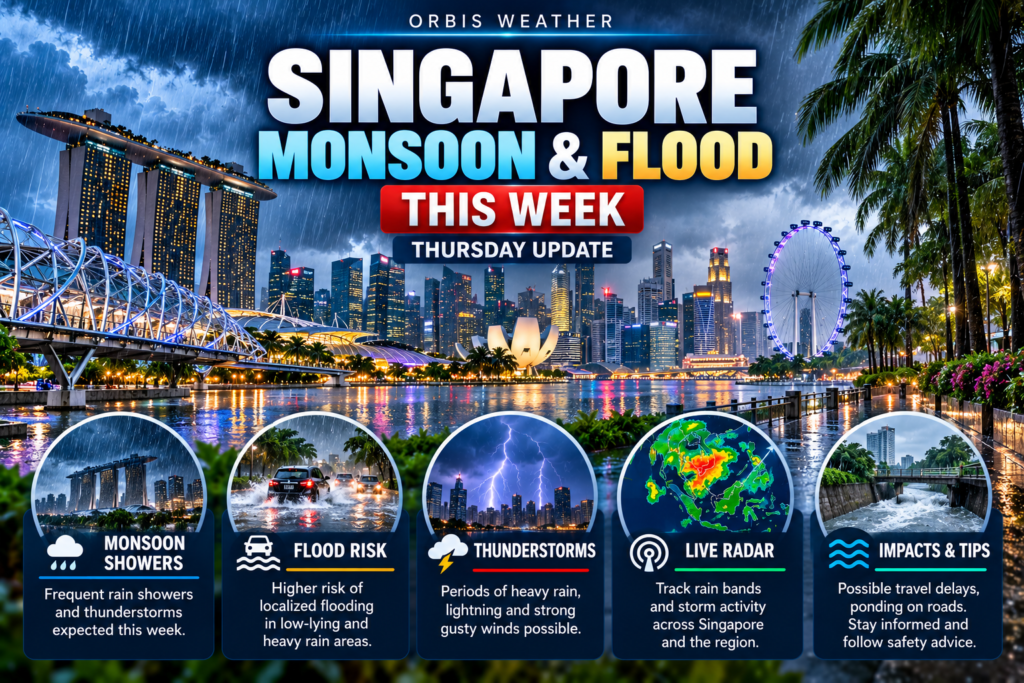
- Singapore Monsoon & Flood This Week: Thursday, November 5, 2026 6:53 PM
- Africa Weather & Natural Hazards Today — Thursday, November 5, 2026 6:08 PM
- Sydney Battered by Storms 5:15 PM
- Middle East Weather & Natural Hazards Today — Thursday, November 5, 2026 4:29 PM
- Earth’s Cold Spots This Week Nov 4, 2026 3:05 PM
- Catastrophic Flooding Forces Florida Schools to Remain Closed as Communities Struggle to Recover 12:23 PM
- Australia, New Zealand & Oceania Weather & Natural Hazards Today — Thursday, November 5, 2026 12:05 PM
- South America Weather & Natural Hazards Today — November 4, 2026 8:14 AM
- Central America Weather & Natural Hazards Today: Heavy Rain, Dangerous Flooding and Landslide Threats Increase Across the Region 8:05 AM
- North America Weather & Natural Hazards Today: Heavy Mountain Snow, Flash Flood Risks and Atlantic Tropical Development 7:53 AM
- Daily Earthquakes, Storms, Fires & Floods Report — November 4, 2026 7:41 AM
- Weekly Earth’s Extreme Weather Report — Wednesday, November 4, 2026 7:34 AM
- Tropical Atlantic Daily Report: Wednesday, November 4, 2026 7:26 AM
- Eastern & Central Pacific Tropical Weather Update: Wednesday, November 4, 2026 7:11 AM
- WESTERN PACIFIC Tropical Weather Update: Typhoon In-Fa Remains Active as Storm Turns North 6:58 AM




Singapore Monsoon & Flood This Week: Thursday, November 5, 2026
By Paul Harrison, Orbis Weather
Current to 7.45am SGT on Thursday, November 5, 2026 (6.45pm EST on Wednesday, November 4). All times are Singapore time (SGT, UTC+8) unless stated.
At a glance
Singapore is in the inter-monsoon period, with afternoon thundery showers forecast every day from Thursday to Sunday.
- Monsoon phase: inter-monsoon, with light and variable winds. MSS expects the Northeast Monsoon to set in towards late November or early December.
- Forecast: afternoon thundery showers each day, 24°C to 33°C (75°F to 91°F).
- Warnings and floods: a heavy rain warning on Monday, November 2, was followed by 11 PUB risk-of-flash-flood alerts, mostly in central Singapore.
- Rainfall against normal: MSS forecasts first-half November rainfall slightly above average, after a mostly drier-than-average late October.
- Haze: the 24-hour PSI was Moderate on Wednesday; NEA says forecast showers should limit smoke reaching Singapore.
The Meteorological Service Singapore (MSS), the National Environment Agency (NEA) and national water agency PUB issue the official forecasts, warnings and flood alerts.
Monsoon status and rainfall
Singapore is in the inter-monsoon period, and the Northeast Monsoon is still a few weeks away. In its monsoon update of October 29, MSS said “the region is currently in the inter-monsoon period with the winds mostly light and variable in direction.” It expects the Northeast Monsoon “to progressively set in towards the end of November 2026 or early December 2026.” The same update forecasts “near-normal rainfall and above-normal temperatures” for November.
November and December are among the wettest months. The 1991-2020 averages at Changi are:
Month | Average rainfall | Average rain days | Average daily max / min |
|---|---|---|---|
November | 252.3 mm (9.93 in) | 19 | 31.2°C (88.2°F) / 24.6°C (76.3°F) |
December | 331.9 mm (13.07 in) | 19 | 30.5°C (86.9°F) / 24.3°C (75.7°F) |
A rain day is a day with 0.2 mm or more of rain. MSS describes the October-November inter-monsoon as “generally wetter than the Inter-monsoon Period earlier in the year.”
The late-October fortnight was mostly dry. MSS said “most parts of Singapore recorded below average rainfall” from October 16 to 28. Rainfall around Tanjong Katong was 72% below average, while Punggol was 24% above. The fortnight’s highest daily total was 81.0 mm (3.19 in) at Tuas South on October 21.
The week’s forecast
MSS forecasts afternoon thundery showers on all four days from Thursday to Sunday. Its four-day outlook was updated at 5.50pm on Wednesday, November 4.
Day | Forecast | Temperature | Wind |
|---|---|---|---|
Thu, Nov 5 | Afternoon thundery showers | 24–33°C (75–91°F) | Variable, 5–15 km/h (3–9 mph) |
Fri, Nov 6 | Afternoon thundery showers | 24–33°C (75–91°F) | Variable, 5–15 km/h (3–9 mph) |
Sat, Nov 7 | Afternoon thundery showers | 24–33°C (75–91°F) | Variable, 5–15 km/h (3–9 mph) |
Sun, Nov 8 | Afternoon thundery showers | 24–33°C (75–91°F) | Variable, 5–15 km/h (3–9 mph) |
For Thursday, the MSS 24-hour forecast expects “thundery showers over many areas in the afternoon,” with relative humidity of 65% to 95%.
The four-day outlook does not cover Monday, November 9, to Wednesday, November 11. For those days, the MSS fortnightly outlook issued on October 29 (covering October 29 to November 15) is the latest guidance. It expects “moderate to heavy thundery showers” over parts of the island in the afternoon on most days, sometimes extending into the evening. It forecasts fortnight rainfall “slightly above its long-term average over most parts of the island,” with daily highs of 33°C to 35°C (91°F to 95°F).
Heavy rain and flash floods
Monday, November 2, was the week’s main heavy rain event. No heavy rain warning was shown on the MSS home page on Wednesday evening, November 4.
On Monday, MSS issued a heavy rain warning at 1.55pm for moderate to heavy thundery showers over many areas from 2pm to 3pm, later extended to 3.30pm. PUB then posted 11 risk-of-flash-flood alerts on X, each advising people to avoid the spot for an hour. The Straits Times listed 11 alerts and AsiaOne nine. Both describe them as risk alerts, not confirmed flooding.
Location | Alert time (Nov 2) |
|---|---|
Lorong Kismis and Kismis Place junction, Bukit Batok | 2.18pm |
Lorong Gambir (Lorong Penchalak to Gambir Walk) | 2.19pm |
Bukit Timah Road, near King Albert Park | 2.20pm |
Wan Tho Avenue (Pheng Geck Avenue) | 2.34pm |
Puay Hee Avenue, near Siak Kew Avenue | 2.37pm |
Mackenzie Road, near Bukit Timah Road | 2.51pm |
Craig Road and Tanjong Pagar Road junction | 2.54pm |
Bencoolen Street | 2.54pm |
Thomson Road (Balestier Road to Novena Rise) | 2.55pm |
Playfair Road and Irving Road junction, MacPherson | 2.55pm |
Balmoral Road and Stevens Road junction | 2.59pm |
Source: The Straits Times via Yahoo and AsiaOne, November 2.
Other days brought scattered showers. NEA reported showers over parts of Singapore on November 1 and November 4. On Wednesday, the highest rainfall to 9pm was 19.8 mm (0.78 in) at Kim Chuan Road.
Haze link: the October haze episode has eased. At 5pm on Wednesday the 24-hour PSI was 60–69 (Moderate), and NEA forecast 51–80 for Thursday. NEA expects showers over Sumatra, Kalimantan and Singapore to “limit the transport of smoke haze towards Singapore” through Saturday.
Staying safe and getting alerts
PUB warns that flash floods “may suddenly and quickly occur” in heavy storms. Its public advisory says:
- Pedestrians: do not walk into flooded areas. Turn back and move to higher ground, as floodwater may rise suddenly.
- Moving water: do not walk through it. PUB says 15 cm (6 in) of moving water can make a person fall.
- Drains: be aware of drains, especially open drains, and of areas known to flood suddenly.
- Motorists: do not drive into flooded areas. PUB says 30 cm (12 in) of water may stall a car and 60 cm (24 in) can carry away most vehicles, including SUVs.
- At home: do not touch electrical equipment when wet or standing in water. In low-rise housing, move essential items to an upper floor.
Tool | What it gives |
|---|---|
High water level alerts for a chosen sensor station, plus MSS heavy rain warnings | |
Live risk-of-flash-flood alerts and NEA heavy rain notices | |
Push alerts for heavy rain, flash floods, drain water levels, lightning and haze | |
Forecasts, two-hour nowcasts and heavy rain warnings |
PUB’s advisory page gives the Telegram address as t.me/sgflood.
What to watch
The week’s showers are forecast mainly in the afternoon.
When | What | Source |
|---|---|---|
Thu–Sun, Nov 5–8, afternoons | Thundery showers forecast each day | MSS four-day outlook |
Thu–Sat, Nov 5–7 | Showers expected to limit smoke haze reaching Singapore | NEA haze update, Nov 4 |
Mon–Wed, Nov 9–11 | Not yet in the four-day outlook, which MSS updates at 5am and 6pm daily | MSS four-day outlook |
Sun, Nov 15 | Current fortnightly outlook period ends | MSS fortnightly outlook |
Late November to early December | Expected onset of the Northeast Monsoon | MSS monsoon update, Oct 29 |
About this report
This report draws on MSS, NEA and PUB products and on news reports, each dated in the sources. The four-day outlook was updated at 5.50pm on November 4; the fortnightly outlook and monsoon update were issued on October 29. Averages are 1991-2020 normals at Changi. Conversions are rounded. Forecasts change, so check MSS for the latest before making plans.
Term | Meaning |
|---|---|
Inter-monsoon | The transition between monsoons, with light, variable winds and afternoon thunderstorms |
Northeast Monsoon | December to early March; its early wet phase can bring monsoon surges of prolonged rain |
Heavy rain warning | An MSS alert that moderate to heavy rain is expected over parts of Singapore within a set time |
Risk-of-flash-flood alert | A PUB notice to avoid a location for about an hour during heavy rain |
PSI | Pollutant Standards Index, NEA’s measure of air quality |
Frequently asked questions
Has the Northeast Monsoon started? No. MSS said on October 29 that Singapore is in the inter-monsoon period. It expects the Northeast Monsoon to set in progressively towards late November or early December 2026.
Will it rain this weekend? MSS forecasts afternoon thundery showers on both Saturday and Sunday. Temperatures are forecast between 24°C and 33°C (75°F and 91°F).
Were there flash floods this week? PUB issued 11 risk-of-flash-flood alerts on the afternoon of November 2, mainly in central Singapore. These were advisories to avoid specific roads for an hour; reports did not describe confirmed flooding.
Is November usually wet? Yes. The 1991-2020 November average is 252.3 mm (9.93 in) over 19 rain days. MSS expects first-half November rainfall to be slightly above average.
Will the rain help with haze? NEA expects showers and light winds to limit smoke haze reaching Singapore through Saturday. The 24-hour PSI was in the Moderate range on Wednesday evening.
Sources
- MSS four-day outlook, updated 5.50pm, November 4, 2026
- MSS home page: 24-hour forecast and observations, as of 9pm to 9.31pm, November 4, 2026
- MSS fortnightly outlook, October 29 to November 15, issued October 29, 2026
- MSS monsoon update, updated October 29, 2026
- MSS Climate of Singapore (1991-2020 normals), page dated August 21, 2024
- NEA Haze Situation Update, November 4, 2026
- NEA Haze Situation Update, November 1, 2026
- The Straits Times via Yahoo: Motorists advised to avoid areas in central Singapore, November 2, 2026
- AsiaOne: Thundery showers over many areas of Singapore on Nov 2 afternoon, November 2, 2026
- AsiaOne: Haze expected to ease with onset of inter-monsoon, October 29, 2026
- The Straits Times via Yahoo: Lower risk of transboundary haze, October 29, 2026
- PUB public advisory on flash floods, undated, accessed November 5, 2026
- PUB SMS alerts information, undated, accessed November 5, 2026
- PUB SMS alert subscription form, undated, accessed November 5, 2026
- PUB Flood Alerts Telegram channel, accessed November 5, 2026
- NEA myENV app, page updated August 7, 2026
🌧️ Next 6 Hours
🧭 Singapore Monsoon Calendar
Wet phase typically Dec–Jan.
Frequent afternoon thunderstorms.
Sumatra squalls can occur.
Light winds and thunderstorms.
🌊 Flood Safety
Official Live Flood Information
Global Weather Tracker Hub
Explore weather maps, tropical systems, storms and natural hazards around the world.
No matching trackers found.
🌧️ Singapore Monsoon & Flood Tracker – Live Rain & Flood Risk
Monitor heavy rain, monsoon conditions and potential flash-flood risk across Singapore with the Orbis Weather Singapore Monsoon & Flood Tracker.
Singapore’s tropical climate produces abundant rainfall throughout the year, but rainfall patterns change with the Northeast Monsoon, Southwest Monsoon and the two inter-monsoon periods.
Heavy tropical downpours can develop rapidly. Although Singapore has an extensive drainage and flood-management system, exceptionally intense rainfall can temporarily exceed drainage capacity and cause localized flash flooding. Singapore’s national water agency, PUB, says these flash floods are generally small and localized and typically subside within an hour.
The Orbis Weather tracker provides general situational awareness using rainfall, short-range precipitation forecasts, wind and Singapore’s seasonal monsoon cycle. For official heavy-rain warnings and flood alerts, always follow PUB and the Meteorological Service Singapore.
🌧️ Why Singapore Gets So Much Rain
Singapore is located close to the equator and has a tropical climate characterized by high humidity, warm temperatures and abundant rainfall throughout the year.
Strong solar heating warms the surface and the humid air above it. When that warm air rises, it cools and water vapor condenses into clouds.
Under unstable atmospheric conditions, towering cumulonimbus clouds can develop and produce intense thunderstorms.
Singapore’s rainfall is also influenced by regional monsoon winds, sea breezes, Sumatra squalls and larger weather systems.
🧭 Singapore’s Monsoon Seasons
Singapore experiences two primary monsoon seasons separated by inter-monsoon periods.
The Northeast Monsoon generally lasts from December to early March.
The Southwest Monsoon generally occurs from June through September.
Inter-monsoon conditions typically occur from late March through May and again during October and November.
These seasons influence wind direction, rainfall patterns and the types of thunderstorms most likely to affect Singapore.
🌧️ Northeast Monsoon
The Northeast Monsoon is especially important for heavy-rain monitoring.
Its wetter phase usually occurs during the earlier part of the season, when monsoon surges can produce widespread and persistent moderate to heavy rain.
Unlike isolated afternoon thunderstorms, these rain events can affect large parts of Singapore for extended periods.
Later in the Northeast Monsoon, conditions typically become comparatively drier and windier.
💨 What Is a Monsoon Surge?
A monsoon surge is a strengthening of the northeasterly winds associated with the Northeast Monsoon.
These surges can move across the South China Sea and bring widespread cloud cover, stronger winds and prolonged rainfall to Singapore and surrounding areas.
The Meteorological Service Singapore identifies monsoon surges as one of the major weather systems capable of producing heavy rainfall in Singapore.
Because rainfall may continue much longer than a typical afternoon thunderstorm, monsoon surges deserve particular attention when monitoring flood potential.
🌦️ Southwest Monsoon
The Southwest Monsoon generally lasts from June through September.
Singapore often experiences short-duration showers and thunderstorms during this period.
Another important feature of the Southwest Monsoon is the possibility of Sumatra squalls.
These organized lines of thunderstorms can approach Singapore from the west and bring sudden heavy rain, frequent lightning and powerful wind gusts.
⛈️ What Is a Sumatra Squall?
A Sumatra squall is an organized line of thunderstorms that usually develops over Sumatra or the Strait of Malacca before moving eastward toward Singapore.
These systems commonly occur during the Southwest Monsoon and inter-monsoon periods.
According to the Meteorological Service Singapore, they often affect Singapore overnight or during the morning and can produce heavy rainfall lasting roughly one to two hours, along with strong gusty winds.
Because they can arrive rapidly, Sumatra squalls are important for commuters, aviation, marine operations and outdoor activities.
⛈️ Singapore’s Inter-Monsoon Thunderstorms
Singapore experiences two inter-monsoon periods each year.
Winds are often lighter and more variable during these transitional periods.
Strong daytime heating and interactions between local land and sea breezes can then create favorable conditions for thunderstorms.
Afternoon and early-evening thunderstorms can sometimes become intense.
These storms may be relatively short-lived but capable of producing very heavy rainfall over localized parts of the island.
🌊 What Causes Flash Floods in Singapore?
Flash flooding occurs when rainfall produces water faster than drains and waterways can safely carry it away.
Singapore has invested heavily in drainage infrastructure and flood management, but no urban drainage system can completely eliminate flood risk during every extreme rainfall event.
PUB explains that extremely heavy rainfall over a short period can exceed drainage capacity, resulting in localized flash floods.
⏱️ Why Flash Floods Can Develop So Quickly
The intensity of rainfall is crucial.
A moderate amount of rain spread across an entire day may create fewer problems than an enormous amount falling over one neighborhood in a very short period.
Tropical thunderstorms can release large quantities of water rapidly.
Roads, drains and canals must then handle that runoff almost immediately.
This is why conditions can change from normal to flooded within a relatively short time during an intense downpour.
🏙️ Urban Development and Flooding
Singapore is one of the world’s most highly urbanized countries.
Roads, buildings, pavements and other hard surfaces prevent rainfall from soaking naturally into the ground as easily as it might in undeveloped areas.
Instead, much of that water becomes surface runoff that must be managed by drains, canals and other infrastructure.
Singapore has developed an extensive drainage system and continues to invest in flood-resilience improvements.
PUB says it uses a holistic approach that includes drainage improvements, flood monitoring and longer-term coastal protection.
📡 How Singapore Monitors Flood Risk
Singapore has a sophisticated flood-monitoring network.
PUB says its Catchment and Waterways Operations System combines information from more than 1,000 water-level sensors, more than 500 CCTV cameras, rain gauges, weather radar and flood-response resources.
PUB also operates an X-band weather radar capable of providing short-range rainfall forecasts to support flood operations.
These official systems are much more comprehensive than the weather-based indicator displayed by Orbis Weather.
⚠️ Orbis Flood Risk vs Official PUB Flood Alerts
This distinction is extremely important.
The Orbis Weather Flash Flood Risk Indicator is not an official Singapore flood warning.
It uses weather conditions and forecast rainfall to provide general situational awareness.
An elevated Orbis risk level does not mean flooding is definitely occurring.
Likewise, conditions at a specific location can differ from a broad weather-based indicator.
For confirmed flood incidents and official warnings, use PUB and Meteorological Service Singapore information.
🌧️ Heavy Rain Doesn’t Always Mean Flooding
An intense thunderstorm does not automatically produce a flash flood.
Whether flooding develops depends on rainfall intensity, duration, drainage conditions, location, previous rainfall and other factors.
Some parts of Singapore may experience extremely heavy rain while drainage continues to function normally.
This is another reason the weather-based Orbis risk indicator should be treated as an early awareness tool rather than confirmation of flooding.
🚗 Driving During Heavy Rain
Tropical downpours can quickly reduce visibility and leave standing water on roads.
Drivers should slow down, allow additional stopping distance and remain alert for water collecting in low-lying areas.
Never deliberately drive into a flooded road when the depth or condition of the roadway cannot be determined.
Follow road closures, flood alerts and instructions from Singapore authorities.
🚶 Walking During Flash Flooding
Pedestrians should avoid entering floodwater.
Water can conceal drains, uneven surfaces, debris and other hazards.
Fast-moving water can also be more powerful than it appears.
If water is rising, move away from the affected area and follow instructions from local authorities.
🌊 Coastal Flooding Is Different From Flash Flooding
Not all flooding in Singapore is caused by heavy rain.
Coastal flooding can occur when elevated sea levels affect low-lying coastal areas.
PUB notes that high tides, storm surges and longer-term sea-level rise all contribute to Singapore’s coastal flood considerations.
This differs from the localized flash flooding that can develop when intense rainfall overwhelms drainage capacity.
🌕 High Tides and Flood Risk
Singapore generally experiences two high tides each day.
Most high tides do not cause significant flooding.
However, unusually high tides combined with other factors can increase coastal water levels.
Over the longer term, rising sea levels make coastal protection increasingly important for a low-lying island nation.
🌍 Climate Change and Singapore Flood Risk
A warming climate can increase the potential for more extreme rainfall and rising sea levels.
PUB specifically identifies more frequent and intense rainfall as an increasing challenge for Singapore’s drainage and flood-management systems.
Climate change does not mean every thunderstorm will cause flooding.
Instead, it changes the background risk by increasing the potential for extreme weather and coastal-water events.
📍 Is Singapore Flooding Right Now?
The Orbis Weather Singapore Monsoon & Flood Tracker can help identify whether current and short-range weather conditions favor heavy rainfall.
The dashboard displays current rain, forecast rain probability, expected six-hour precipitation and wind conditions.
However, the tracker does not confirm that a particular street or neighborhood is flooded.
For active flood incidents, water levels and official alerts, consult PUB Singapore.
☔ Understanding the 6-Hour Rain Forecast
Short-range rainfall information can be particularly useful in Singapore because tropical weather can change rapidly.
The tracker displays forecast precipitation and rain probability over the next six hours.
These values provide guidance about the possibility and potential amount of rainfall.
They should not be interpreted as a guarantee that a specific neighborhood will receive the displayed amount.
Tropical thunderstorms can be highly localized.
📱 Official Singapore Flood Alerts
PUB provides official flood-monitoring and alert services.
Members of the public can also subscribe to official alerts for heavy rain and rising water levels in selected canals and drains.
For potentially dangerous conditions, these official services should take priority over third-party weather dashboards.
🛰️ Where Does Orbis Weather Get Its Data?
The Orbis Weather Singapore Monsoon & Flood Tracker currently uses Open-Meteo weather information for its weather-based rainfall and flood-risk indicators. The page identifies PUB Singapore as its official flood reference and the Meteorological Service Singapore as its weather reference.
Orbis Weather does not independently issue Singapore flood warnings.
🇸🇬 Monitor Singapore’s Monsoon & Flood Risk
Singapore’s weather can change quickly.
Localized thunderstorms, Sumatra squalls and Northeast Monsoon surges can all produce heavy rainfall, while exceptionally intense downpours can temporarily overwhelm drainage systems and cause flash flooding.
Use the Orbis Weather Singapore Monsoon & Flood Tracker to monitor changing weather conditions and short-range rainfall potential.
For broader regional awareness, also explore Singapore Weather & Natural Hazards, Singapore Lightning & Thunderstorm Tracker, Singapore Haze & Air Quality Tracker and Southeast Asia Natural Hazards.
Important Flood & Weather Disclaimer
The Orbis Weather Singapore Monsoon & Flood Tracker is provided for general information, education and situational awareness.
The Orbis Flash Flood Risk Indicator is a weather-based indicator and is not an official PUB flood alert or warning. Weather forecasts may change, and rainfall can vary significantly across Singapore.
For confirmed flooding, official flood alerts and water-level information, consult PUB Singapore. For official weather forecasts and heavy-rain warnings, consult the Meteorological Service Singapore.
Do not use the Orbis Weather tracker alone for emergency or life-safety decisions.