
Earth’s Cold Spots This Week: The 10 Coldest Places in the World
By Paul Harrison | Founder & Publisher, Orbis Weather

- Middle East Weather & Natural Hazards Today — Thursday, November 5, 2026 4:29 PM
- Earth’s Cold Spots This Week Nov 4, 2026 3:05 PM
- Catastrophic Flooding Forces Florida Schools to Remain Closed as Communities Struggle to Recover 12:23 PM
- Australia, New Zealand & Oceania Weather & Natural Hazards Today — Thursday, November 5, 2026 12:05 PM
- South America Weather & Natural Hazards Today — November 4, 2026 8:14 AM
- Central America Weather & Natural Hazards Today: Heavy Rain, Dangerous Flooding and Landslide Threats Increase Across the Region 8:05 AM
- North America Weather & Natural Hazards Today: Heavy Mountain Snow, Flash Flood Risks and Atlantic Tropical Development 7:53 AM
- Daily Earthquakes, Storms, Fires & Floods Report — November 4, 2026 7:41 AM
- Weekly Earth’s Extreme Weather Report — Wednesday, November 4, 2026 7:34 AM
- Tropical Atlantic Daily Report: Wednesday, November 4, 2026 7:26 AM
- Eastern & Central Pacific Tropical Weather Update: Wednesday, November 4, 2026 7:11 AM
- WESTERN PACIFIC Tropical Weather Update: Typhoon In-Fa Remains Active as Storm Turns North 6:58 AM





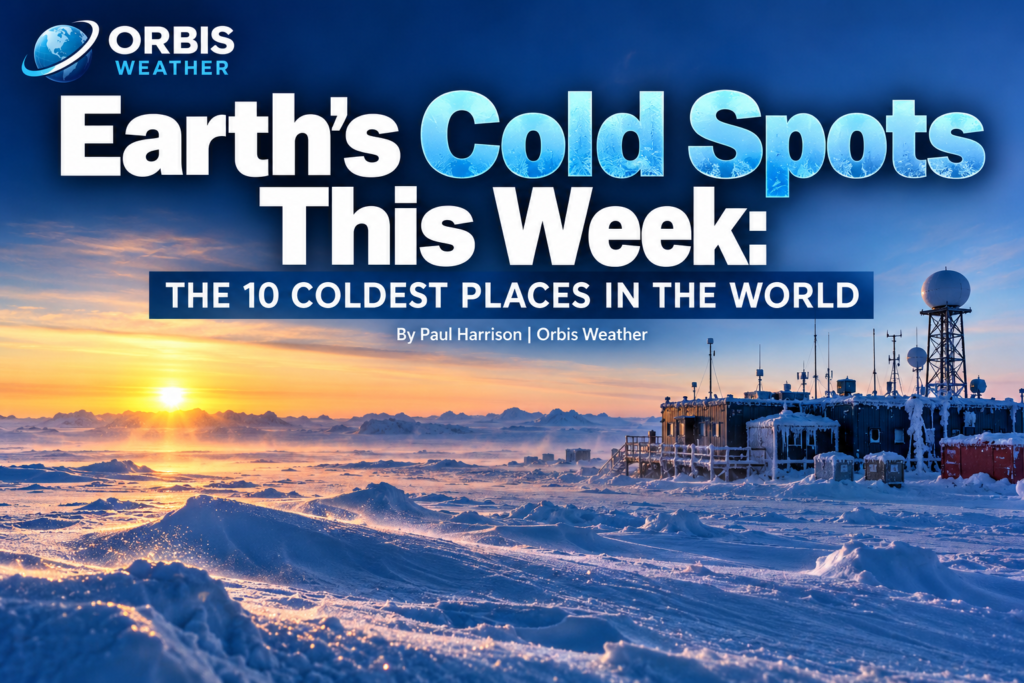
Earth’s Cold Spots This Week: The 10 Coldest Places in the World
By Paul Harrison, Orbis Weather
Week covered: Wednesday, October 28 to Tuesday, November 3, 2026.
The coldest reading on Earth this week was −85°F (−64.9°C) at Concordia, the French-Italian station at Dome C in Antarctica. It was recorded at 18:00 UTC on Wednesday, October 28, in the station’s synoptic reports archived by Pogoda i Klimat.
Seven of the ten coldest places were in Antarctica. Wednesday, October 28 was the coldest day for five of the ten, and Saturday, October 31 for four. Outside Antarctica, the coldest inhabited place was Oymyakon in Yakutia, Russia, at −33°F (−36.3°C) on Saturday.
The 10 coldest places
Each place is ranked by its lowest observed temperature of the week; places with the same reading share a rank.
Rank | Place | Elevation | Lowest temperature | Date | Station type |
|---|---|---|---|---|---|
1 | 10,610 ft (3,234 m) | −85°F (−64.9°C) | Wed Oct 28 | French-Italian research station | |
2 | 10,663 ft (3,250 m) | −83°F (−63.8°C) | Wed Oct 28 | Automatic weather station | |
3 | 11,220 ft (3,420 m) | −76°F (−60.1°C) | Sat Oct 31 (night into Sun Nov 1) | Russian Antarctic research station | |
4 | 11,001 ft (3,353 m) | −69°F (−56.1°C) | Mon Nov 2 | Automatic weather station | |
5 | 9,285 ft (2,830 m) | −59°F (−50.6°C) | Wed Oct 28 | US research station | |
6 | 9,039 ft (2,755 m) | −54°F (−47.6°C) | Wed Oct 28 | Automatic weather station | |
7 | 9,629 ft (2,935 m) | −53°F (−47.3°C) | Wed Oct 28 | Automatic weather station | |
8 | 2,428 ft (740 m) | −33°F (−36.3°C) | Sat Oct 31 | Roshydromet synoptic station | |
8 | 2,635 ft (803 m) | −33°F (−36.3°C) | Sat Oct 31 | Roshydromet synoptic station | |
10 | 2,116 ft (645 m) | −30°F (−34.7°C) | Sat Oct 31 | Roshydromet synoptic station |
Where the cold showed up
East Antarctic Plateau: At Concordia the deepest cold came at the start and end of the week. Its lowest daily reading rose to −63°F (−52.8°C) on Friday, October 30, then fell back to −76°F (−59.9°C) on Tuesday. Vostok followed a similar path, with daily minimums of −73°F (−58.2°C) on Wednesday and −59°F (−50.4°C) on Friday. At Relay Station the trend ran the other way: it started near −59°F (−50.7°C) and reached its low early on Monday.
South Pole region: Amundsen-Scott and the nearby Henry and Nico stations all had their lowest readings on Wednesday, then warmed sharply. By Thursday the South Pole’s minimum was −31°F (−35°C). Readings fell again from Monday, reaching −55°F (−48.6°C) at the South Pole on Tuesday.
Coastal Antarctica: Stations on the coast were far milder than the plateau. Mirny dropped to −7°F (−21.5°C) on Thursday and Davis to −4°F (−20.2°C) on Friday. Mawson’s lowest was −1°F (−18.3°C) on Sunday.
Siberia and Yakutia: Cold built across eastern Yakutia and the upper Kolyma from Wednesday to Saturday. Oymyakon’s daily low fell from −13°F (−25.1°C) on Wednesday to its weekly low on Saturday, and dipped to −32°F (−35.4°C) again on Tuesday. Tompo, just outside the top ten, reached −27°F (−32.6°C) on Saturday. In Yakutsk, the regional capital, the week’s lowest was −9°F (−23.0°C) on Thursday.
North American Arctic: Eureka, on Ellesmere Island in Nunavut, was the coldest site found in North America, at −28°F (−33.5°C) on Thursday, October 29. That placed it eleventh among the stations checked worldwide. Its lows eased to 6°F (−14.2°C) by Monday. In Alaska, Northway and Arctic Village both fell to −4°F (−20°C) on Tuesday.
About this list
The ranking uses observed temperatures from national weather reports for the UTC dates October 28 to November 3, 2026. Readings come from Roshydromet, the national Antarctic programmes that run the staffed stations, the University of Wisconsin automatic weather station network, Environment and Climate Change Canada and the US National Weather Service. They were taken from the Pogoda i Klimat and Meteociel archives and the Iowa Environmental Mesonet. Concordia and the automatic stations do not report a daily minimum, so their lowest reported reading of each day is used; with readings only every few hours at Concordia, the true minimum may have been slightly lower. Russian minimums are those given in the 21:00 or 00:00 UTC reports, and Alaska and Canadian airport figures follow local days.
The Greenland ice sheet, Dome Fuji and Dome A had no data for the week, and several Alaska stations, including Arctic Village and Fort Yukon, were missing October 29 to 31. Three readings at Siberian and Mongolian stations that did not match the station’s other observations were left out; none would have reached the top ten. Dome C II is listed by the University of Wisconsin under WMO index 89828, which one archive labels as Dome Fuji. All figures are preliminary and can be revised.
Frequently asked questions
Why does Antarctica fill most of the list? All seven Antarctic entries sit on the high polar plateau, between 9,039 ft (2,755 m) and 11,220 ft (3,420 m). Coastal Antarctic stations were at least 45°F (25°C) milder than the plateau entries this week. Only three places outside Antarctica, all in northeast Russia, made the top ten.
What was the coldest inhabited place this week? Oymyakon, a village in Yakutia, was the coldest inhabited place found outside Antarctica. Delyankir matched its reading on the same night, and the town of Susuman in Magadan Oblast was close behind. Among Antarctic research stations with staff, Concordia was the coldest.
Why does Vostok show two dates? Vostok’s minimum comes from the report sent at 00:00 UTC on Sunday, November 1, covering the night before. Meteociel files that value under Saturday, October 31, so the table gives both.
Why do Oymyakon and Delyankir share a rank? Both stations reported exactly −36.3°C in their 21:00 UTC reports on October 31. Under this list’s rules, equal readings share a rank.
Sources
Antarctica
- Pogoda i Klimat, Concordia archive (Oct 28–31, 2026) and Nov 1–3
- Pogoda i Klimat, WMO 89828 archive (Oct 28–31, 2026) and Nov 1–3
- University of Wisconsin AMRC, AWS station list
- Meteociel, Vostok (October 2026) and November 2026
- Pogoda i Klimat, Vostok archive (Oct 28–31, 2026) and Nov 1–3
- Pogoda i Klimat, Relay Station archive (Oct 28–31, 2026) and Nov 1–3
- Meteociel, Amundsen-Scott South Pole (October 2026) and November 2026
- Pogoda i Klimat, Henry archive (Oct 28–31, 2026) and Nico archive (Oct 28–31, 2026)
- Meteociel, Mirny (October 2026), Davis (October 2026) and Mawson (November 2026)
Russia
- Pogoda i Klimat, Oymyakon archive (Oct 28–31, 2026) and Nov 1–3
- Pogoda i Klimat, Delyankir archive (Oct 28–31, 2026)
- Pogoda i Klimat, Susuman archive (Oct 28–31, 2026)
- Pogoda i Klimat, Tompo archive (Oct 28–31, 2026)
- Pogoda i Klimat, Yakutsk archive (Oct 28–31, 2026)
North America
About the Author
Paul Harrison — Founder & Publisher, Orbis Weather
Paul Harrison founded Orbis Weather in 2026 to make global weather and natural-hazard information easier to find, follow and understand. His coverage includes tropical cyclones, severe weather, extreme temperatures, earthquakes, volcanoes, wildfires, flooding and significant natural disasters worldwide.
View all articles by Paul Harrison → | Editorial Standards →
Global Weather Tracker Hub
Explore weather maps, tropical systems, storms and natural hazards around the world.
No matching trackers found.