
🌍 Middle East Weather & Natural Hazards Today
By Paul Harrison | Founder & Publisher, Orbis Weather

- Sydney Battered by Storms 5:15 PM
- Middle East Weather & Natural Hazards Today — Thursday, November 5, 2026 4:29 PM
- Earth’s Cold Spots This Week Nov 4, 2026 3:05 PM
- Catastrophic Flooding Forces Florida Schools to Remain Closed as Communities Struggle to Recover 12:23 PM
- Australia, New Zealand & Oceania Weather & Natural Hazards Today — Thursday, November 5, 2026 12:05 PM
- South America Weather & Natural Hazards Today — November 4, 2026 8:14 AM
- Central America Weather & Natural Hazards Today: Heavy Rain, Dangerous Flooding and Landslide Threats Increase Across the Region 8:05 AM
- North America Weather & Natural Hazards Today: Heavy Mountain Snow, Flash Flood Risks and Atlantic Tropical Development 7:53 AM
- Daily Earthquakes, Storms, Fires & Floods Report — November 4, 2026 7:41 AM
- Weekly Earth’s Extreme Weather Report — Wednesday, November 4, 2026 7:34 AM
- Tropical Atlantic Daily Report: Wednesday, November 4, 2026 7:26 AM
- Eastern & Central Pacific Tropical Weather Update: Wednesday, November 4, 2026 7:11 AM
- WESTERN PACIFIC Tropical Weather Update: Typhoon In-Fa Remains Active as Storm Turns North 6:58 AM





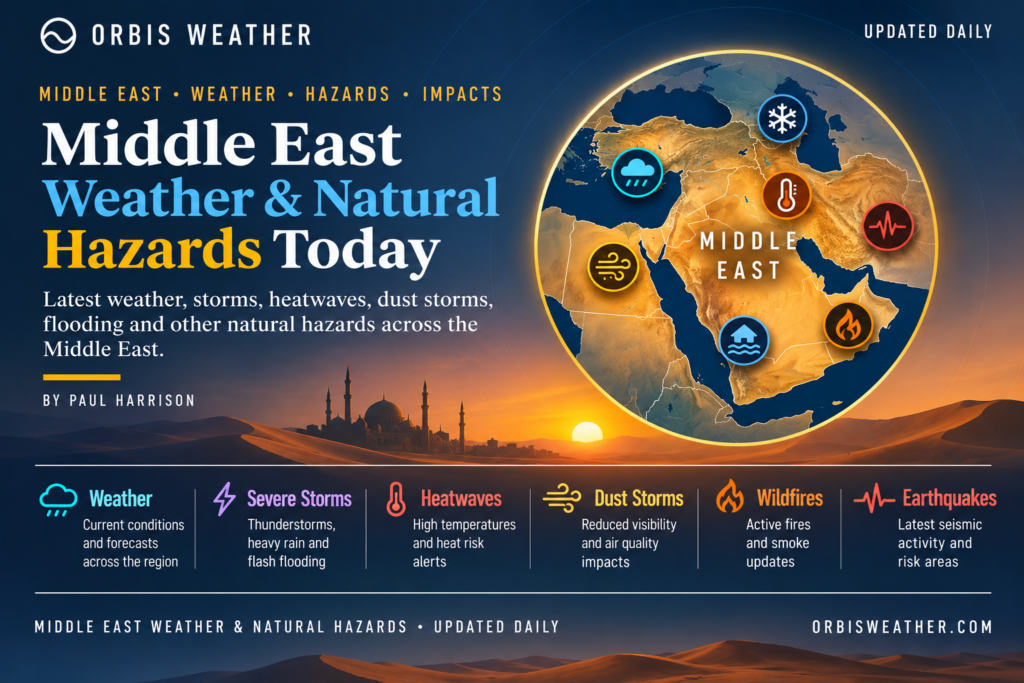
🌍 Middle East Weather & Natural Hazards Today — Thursday, November 5, 2026
By Paul Harrison | Orbis Weather
Regional weather outlook covering Saudi Arabia, the United Arab Emirates, Qatar, Bahrain, Kuwait, Oman, Yemen, Iraq, Iran, Israel, Jordan, Lebanon, Syria and the wider Middle East.
🌤️ Middle East Weather Overview
Thursday, November 5, 2026, brings the Middle East further into its autumn transition, with cooler nights becoming increasingly important across the Arabian Peninsula, the Levant, Iraq and Iran.
Although much of the region typically remains warm and dry during early November, seasonal changes can bring thunderstorms, localized flooding, blowing dust, coastal humidity and mountain snowfall at higher elevations.
The principal weather hazards to monitor at this time of year include:
⛈️ Thunderstorms: Potential for localized heavy rainfall and lightning, particularly where unstable air develops over mountainous or coastal areas.
🌊 Flash flooding: Dry riverbeds, known as wadis, can become dangerous rapidly following heavy rain.
🌫️ Dust and reduced visibility: Exposed desert regions remain vulnerable to blowing sand and dust.
🌡️ Temperature changes: Cooler overnight conditions contrast with warmer afternoons, particularly inland.
🌊 Marine conditions: Wind-driven waves and changing sea conditions may affect the Persian Gulf, Gulf of Oman, Arabian Sea and Red Sea.
🏔️ Mountain weather: Higher elevations in Iran and neighboring countries face increasing cold-weather risks as winter approaches.
Important: This report distinguishes seasonal weather risks from confirmed active warnings. Readers should consult national meteorological agencies for live alerts, observed conditions and location-specific forecasts.
🚨 Country-by-Country Weather and Hazard Outlook — Thursday, November 5
The following is a regional planning outlook, not a verified list of active Thursday weather alerts. Specific temperatures, rainfall totals and warning levels are omitted where current official forecasts could not be confirmed.
Country / Region | Weather focus | Main hazard to monitor |
|---|---|---|
🇸🇦 Saudi Arabia | Rainfall potential and regional thunderstorms | Flash floods, lightning, hail |
🇦🇪 UAE | Humidity, cloud development and morning visibility | Fog, localized rain |
🇶🇦 Qatar | Unsettled weather potential | Thunderstorms, gusty winds |
🇧🇭 Bahrain | Coastal humidity and changing winds | Marine conditions |
🇰🇼 Kuwait | Autumn weather changes | Dust, reduced visibility |
🇴🇲 Oman | Mountain and coastal conditions | Wadi flooding |
🇾🇪 Yemen | Western highlands and valleys | Flash floods, landslides |
🇮🇶 Iraq | Changing temperatures and rainfall potential | Dust, localized flooding |
🇮🇷 Iran | Mountain precipitation and colder nights | Mountain hazards, earthquakes |
🇹🇷 Türkiye | Autumn rainfall and highland cooling | Heavy rain, mountain weather |
🇸🇾 Syria | Seasonal rainfall | Local flooding |
🇱🇧 Lebanon | Coastal and mountain weather | Heavy rain, slippery roads |
🇯🇴 Jordan | Desert valleys and changing weather | Flash floods |
🇮🇱 Israel and Palestinian territories | Seasonal rainfall potential | Urban and desert flooding |
🇸🇦 Saudi Arabia — Thunderstorms and Flash-Flood Awareness
Saudi Arabia remains an important area for weather monitoring following unsettled conditions earlier in the week.
Forecast information published for November 3 identified thunderstorm risks across several regions, including parts of Makkah, Asir, Al-Jouf and the Northern Borders.
Those earlier alerts cannot automatically be extended to Thursday.
Residents in Jazan, Asir, Al-Baha, Makkah and other flood-prone districts should pay particular attention to updated national warnings.
Heavy rainfall over mountainous terrain can generate fast-moving floodwaters in valleys and normally dry channels. Strong thunderstorms may also produce lightning, hail and sudden gusts.
Thursday monitoring priority: Updated Saudi National Center for Meteorology rainfall warnings and road conditions.
🇦🇪 United Arab Emirates — Fog, Humidity and Localized Rain Potential
The UAE’s recent weather outlook has featured warm temperatures, partly cloudy skies and the possibility of localized showers in northern and eastern districts.
Increasing overnight humidity has also been identified as a potential cause of fog or mist.
For Thursday, residents of Dubai, Abu Dhabi, Sharjah, Fujairah and Ras Al Khaimah should check the latest National Centre of Meteorology forecast before traveling.
Morning fog can develop quickly, particularly on inland roads and highways connecting coastal cities with desert districts.
Marine operators should monitor conditions in both the Persian Gulf and Gulf of Oman.
Thursday monitoring priority: Early-morning visibility, localized showers and changing coastal winds.
🇶🇦 Qatar — Localized Thunderstorm Potential
Recent meteorological reporting has indicated that localized rain clouds could develop across Qatar through the latter part of the week.
Where thunderstorms form, the principal risks include sudden heavy rainfall, lightning, gusty winds and reduced visibility.
However, the outlook does not establish that widespread thunderstorms will affect Doha or the rest of Qatar on Thursday.
Outdoor workers, motorists and marine operators should monitor updated forecasts from the Qatar Meteorology Department.
Thursday monitoring priority: Convective cloud development, thunderstorm advisories and offshore winds.
🇧🇭 Bahrain and 🇰🇼 Kuwait — Dust and Coastal Weather
Bahrain and Kuwait are entering a period when changing wind patterns and approaching weather disturbances can influence daily conditions.
In Bahrain, coastal humidity, sea conditions and occasional showers are the principal seasonal considerations.
Kuwait faces additional exposure to blowing dust across desert highways and open terrain.
Strong winds can quickly reduce visibility, creating hazards for road traffic and aviation.
No specific November 5 dust-storm warning has been independently confirmed in this report.
🇴🇲 Oman — Mountain Weather and Wadi Flooding
Oman’s Al Hajar Mountains are especially vulnerable to sudden runoff when heavy thunderstorms develop.
Rainfall in mountain catchments can cause downstream wadis to flood rapidly, sometimes without substantial rainfall at the location where flooding occurs.
The danger is particularly important for motorists, hikers and visitors to mountain valleys.
Coastal residents should also monitor conditions across the Gulf of Oman and Arabian Sea.
Thursday monitoring priority: Mountain thunderstorms, wadi conditions and marine forecasts.
🇾🇪 Yemen — Highland Rainfall and Landslide Risks
Yemen’s mountainous western districts remain susceptible to localized flooding and landslides when heavy rainfall occurs.
Steep terrain can channel runoff toward settlements and roads, while saturated slopes may become unstable.
Weather hazards can be especially difficult to manage where infrastructure and emergency response capabilities are limited.
There is insufficient verified information to identify a specific nationwide flood emergency for November 5.
🇮🇶 Iraq — Autumn Rainfall and Dust
Iraq’s seasonal transition brings greater variability in temperatures and rainfall.
Northern districts typically experience cooler conditions, while Baghdad and southern areas can remain comparatively warm.
Weather systems crossing the country may produce showers, thunderstorms or changes in wind direction.
Blowing dust remains an important hazard in exposed locations.
Residents should consult Iraqi meteorological bulletins for current warnings rather than treating seasonal conditions as confirmation of an active storm.
🇮🇷 Iran — Mountain Weather and Earthquake Preparedness
Iran’s mountainous regions face increasing cold-weather concerns as November progresses.
Higher elevations of the Zagros and Alborz ranges can experience freezing conditions and seasonal snowfall, while lower elevations may receive rain.
Western and northern Iran also face changing weather associated with passing autumn systems.
Iran is situated within a major tectonically active region. Earthquake preparedness remains essential, although earthquakes cannot be reliably predicted by exact time, location or magnitude.
Thursday monitoring priority: Mountain travel conditions, regional weather warnings and observed seismic activity.
🇹🇷 Türkiye — Rainfall, Cooling Temperatures and Seismic Monitoring
November brings increasingly changeable conditions across Türkiye.
Mediterranean and Black Sea weather systems can produce coastal rainfall, while eastern mountain districts become colder.
Higher-elevation roads may face hazardous conditions when precipitation coincides with freezing temperatures.
Türkiye also lies across major active fault systems, making earthquake preparedness an important year-round concern.
There is no basis in the information reviewed to predict a significant earthquake for Thursday.
🇸🇾 Syria, 🇱🇧 Lebanon and 🇯🇴 Jordan — Eastern Mediterranean Rainfall Season
The eastern Mediterranean is moving into its wetter season.
Lebanon’s coastal and mountain districts can experience periods of heavy rainfall as weather systems move eastward.
Syria may see increasing opportunities for rain, particularly in western and northern areas.
Jordan faces a distinctive flash-flood hazard in steep desert drainage basins, including areas around the Dead Sea.
Rainfall far upstream can produce dangerous flooding downstream.
Travelers should avoid entering narrow valleys during heavy rain or when flooding warnings are in effect.
🇮🇱 Israel and the Palestinian Territories — Seasonal Rain and Flood Awareness
Rainfall opportunities generally increase across the eastern Mediterranean during November.
Coastal urban areas can experience localized surface flooding during intense downpours, while desert drainage systems are vulnerable to sudden runoff.
Flooding can be particularly dangerous where roads, drainage systems and essential infrastructure are damaged.
Current warnings should be checked through the Israeli Meteorological Service and relevant local emergency authorities.
🌍 Natural Hazards Watch
⛈️ Thunderstorms and flash flooding
The most immediate seasonal weather danger in parts of the Arabian Peninsula is intense localized rainfall.
Dry riverbeds may fill suddenly, and flooding can develop even where skies appear relatively clear.
🌫️ Dust and air quality
Dust events can reduce visibility and increase airborne particulate pollution. People with asthma or other respiratory conditions should follow local health guidance when air quality deteriorates.
🌊 Marine conditions
Changing winds can affect the Persian Gulf, Red Sea, Gulf of Oman, Arabian Sea and eastern Mediterranean.
Mariners should consult official forecasts for wind speed, wave height and visibility.
🌍 Earthquake monitoring
Iran, Türkiye and the eastern Mediterranean are among the region’s significant seismic areas. Earthquake risk is continuous and independent of the daily weather forecast.
For observed earthquake locations and magnitudes, consult the USGS and regional geological authorities.
📅 Weather Outlook — November 5–7, 2026
Date | Regional monitoring priorities |
|---|---|
Thursday, Nov. 5 | Gulf humidity and visibility, Arabian Peninsula thunderstorms, mountain weather |
Friday, Nov. 6 | Updated rainfall forecasts, localized flood risks, marine conditions |
Saturday, Nov. 7 | Changing autumn weather systems, cooler highland conditions, dust potential |
These are monitoring priorities, not confirmed daily storm forecasts.
🛡️ Weather Safety Advice
🌊 Flooding: Never drive through a flooded wadi or submerged roadway.
⛈️ Lightning: Seek substantial shelter when thunderstorms approach.
🌫️ Fog: Reduce speed, use appropriate headlights and maintain safe distances.
🌬️ Dust: Avoid unnecessary travel during severe visibility restrictions.
🏔️ Mountains: Check road and weather conditions before traveling into high elevations.
🌍 Earthquakes: During shaking, Drop, Cover and Hold On.
🚤 Marine: Check official wind and wave forecasts before departure
About the Author
Paul Harrison — Founder & Publisher, Orbis Weather
Paul Harrison founded Orbis Weather in 2026 to make global weather and natural-hazard information easier to find, follow and understand. His coverage includes tropical cyclones, severe weather, extreme temperatures, earthquakes, volcanoes, wildfires, flooding and significant natural disasters worldwide.
View all articles by Paul Harrison → | Editorial Standards →
Global Weather Tracker Hub
Explore weather maps, tropical systems, storms and natural hazards around the world.
No matching trackers found.