
Sydney Battered by Storms
By Paul Harrison | Founder & Publisher, Orbis Weather

- Africa Weather & Natural Hazards Today — Thursday, November 5, 2026 6:08 PM
- Sydney Battered by Storms 5:15 PM
- Middle East Weather & Natural Hazards Today — Thursday, November 5, 2026 4:29 PM
- Earth’s Cold Spots This Week Nov 4, 2026 3:05 PM
- Catastrophic Flooding Forces Florida Schools to Remain Closed as Communities Struggle to Recover 12:23 PM
- Australia, New Zealand & Oceania Weather & Natural Hazards Today — Thursday, November 5, 2026 12:05 PM
- South America Weather & Natural Hazards Today — November 4, 2026 8:14 AM
- Central America Weather & Natural Hazards Today: Heavy Rain, Dangerous Flooding and Landslide Threats Increase Across the Region 8:05 AM
- North America Weather & Natural Hazards Today: Heavy Mountain Snow, Flash Flood Risks and Atlantic Tropical Development 7:53 AM
- Daily Earthquakes, Storms, Fires & Floods Report — November 4, 2026 7:41 AM
- Weekly Earth’s Extreme Weather Report — Wednesday, November 4, 2026 7:34 AM
- Tropical Atlantic Daily Report: Wednesday, November 4, 2026 7:26 AM
- Eastern & Central Pacific Tropical Weather Update: Wednesday, November 4, 2026 7:11 AM
- WESTERN PACIFIC Tropical Weather Update: Typhoon In-Fa Remains Active as Storm Turns North 6:58 AM





Sydney Battered by Storms
By Paul Harrison, Orbis Weather
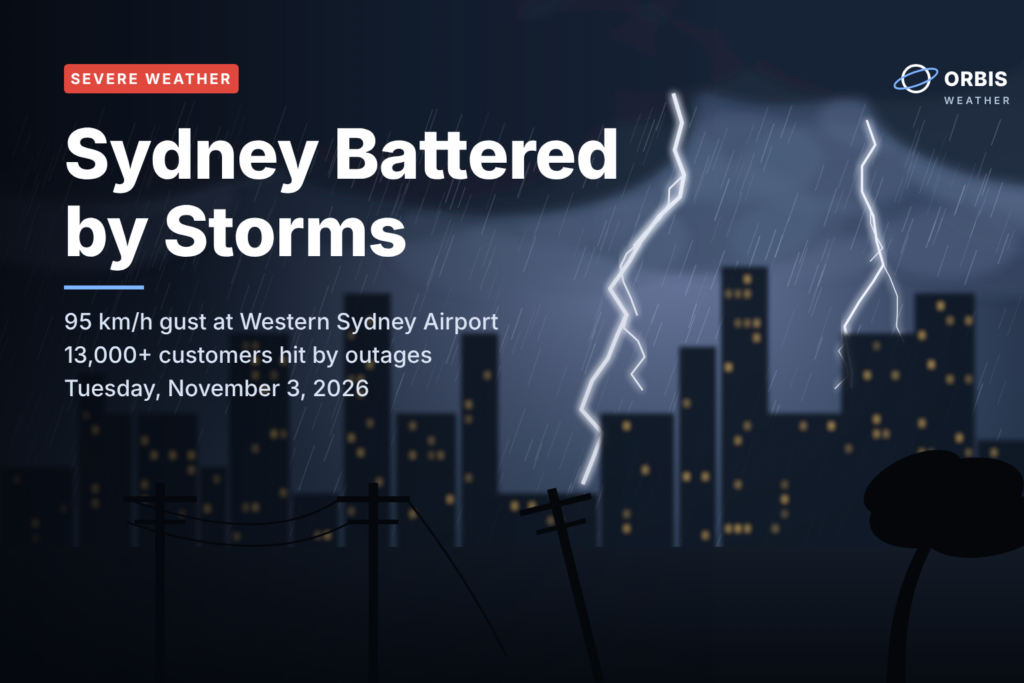
A line of severe thunderstorms swept across Greater Sydney on the evening of Tuesday, November 3, 2026, bringing down trees and power lines across the western suburbs. Endeavour Energy said more than 13,000 of its customers were affected, and the NSW State Emergency Service (SES) handled more than 400 jobs in the Sydney metropolitan area.
The worst of the damage was in Greater Western Sydney. At the new Western Sydney International Airport, the Bureau of Meteorology recorded a gust of 59 mph (95 km/h) as the storm arrived.
What happened
The storms reached western Sydney in the late afternoon. Weatherzone had warned on Tuesday morning that an upper-level trough would make the atmosphere unstable. It said a storm outbreak could stretch about 1,240 miles (2,000 km) “from central Queensland to eastern Victoria, possibly including Brisbane, Sydney and Canberra.”
Bureau of Meteorology observations at Western Sydney International Airport show how quickly conditions changed on Tuesday:
Time (AEDT) | Reading |
|---|---|
4:32 pm | Temperature 77°F (25.2°C) |
5:00 pm | Strongest gust of the day, 59 mph (95 km/h) |
5:15 pm | Temperature down to 56°F (13.4°C) |
11:30 pm | 0.98 in (24.8 mm) of rain since 9 am |
The temperature fell by 21°F (11.8°C) in about 43 minutes as the storm passed. Most of the day’s rain fell between about 4:50 pm and 8 pm.
Damage and power outages
Power: Endeavour Energy said the storms caused “broken power poles and fallen power lines” across its network. It named Wentworthville, Greystanes, Seven Hills, Pendle Hill and Horsley Park among the hardest-hit areas. At 6 am on Wednesday, 1,965 customers were still without power, and extra crews had been brought in.
Emergency calls: Most of the storm’s impact in NSW was in Sydney, where there were more than 400 SES jobs, zone duty commander Ian Leckie told ABC North Coast. The Blacktown SES unit alone received more than 50 calls for help overnight into Wednesday. “Strong winds have brought down numerous trees across roads, homes and powerlines, with several properties sustaining structural damage,” a unit spokesman said.
Insurance: As of Wednesday, the Insurance Council of Australia had not declared the storms a catastrophe or significant event, according to Insurance Business. The SES reported at least one car crushed by an uprooted tree.
The storm came nine days after another severe system on Sunday, October 25. Bureau of Meteorology meteorologist David Crock described that one as “a multi-state system of storms” that was “unusually large.”
What happens next
Wednesday was much calmer in western Sydney. The strongest gust at Western Sydney International Airport was 35 mph (57 km/h), with only 0.02 in (0.4 mm) of rain by late evening. Weatherzone’s forecast for Sydney on Wednesday gave a medium chance of showers and “the chance of a thunderstorm in the evening.”
The storm season is far from over. The Bureau of Meteorology says the severe storm season in eastern Australia runs until at least February 2027, Insurance Business reported.
Residents who need storm help can call the SES on 132 500. Fallen power lines in Endeavour Energy’s area can be reported on 131 003.
Frequently asked questions
Which parts of Sydney were hit hardest? Greater Western Sydney took the brunt of the storm. Endeavour Energy named Wentworthville, Greystanes, Seven Hills, Pendle Hill and Horsley Park among its hardest-hit areas, and the Blacktown SES unit reported structural damage to several properties.
How strong were the winds? The strongest gust recorded at Western Sydney International Airport was 59 mph (95 km/h) at 5 pm on Tuesday. Weatherzone defines destructive gusts as those exceeding 78 mph (125 km/h).
Is power back on? Endeavour Energy had restored power to most affected customers by Wednesday morning. At 6 am, 1,965 customers were still waiting, with extra crews at work.
When does storm season end? The Bureau of Meteorology says eastern Australia’s severe storm season runs until at least February 2027. Finder notes that the NSW storm season runs from September to April.
Sources
- Bureau of Meteorology, Western Sydney Airport observations (Nov 3–5, 2026)
- Endeavour Energy, Storm update, 6 am Wednesday (Nov 4, 2026)
- ABC News, NSW North Coast local news briefing (Nov 4, 2026)
- Insurance Business, Early storm season claims hit western Sydney (Nov 4, 2026)
- Weatherzone, Severe thunderstorms could bring giant hail, destructive winds and flash flooding to eastern Australia on Tuesday (Nov 3, 2026)
- Weatherzone, Sydney forecast (Nov 4, 2026)
- Yahoo News Australia, Wild weather lashes Australia’s east (Oct 25, 2026)
- Finder, What to do if last night’s storm damaged your home (Nov 4, 2026)
About the Author
Paul Harrison — Founder & Publisher, Orbis Weather
Paul Harrison founded Orbis Weather in 2026 to make global weather and natural-hazard information easier to find, follow and understand. His coverage includes tropical cyclones, severe weather, extreme temperatures, earthquakes, volcanoes, wildfires, flooding and significant natural disasters worldwide.
View all articles by Paul Harrison → | Editorial Standards →
Global Weather Tracker Hub
Explore weather maps, tropical systems, storms and natural hazards around the world.
No matching trackers found.