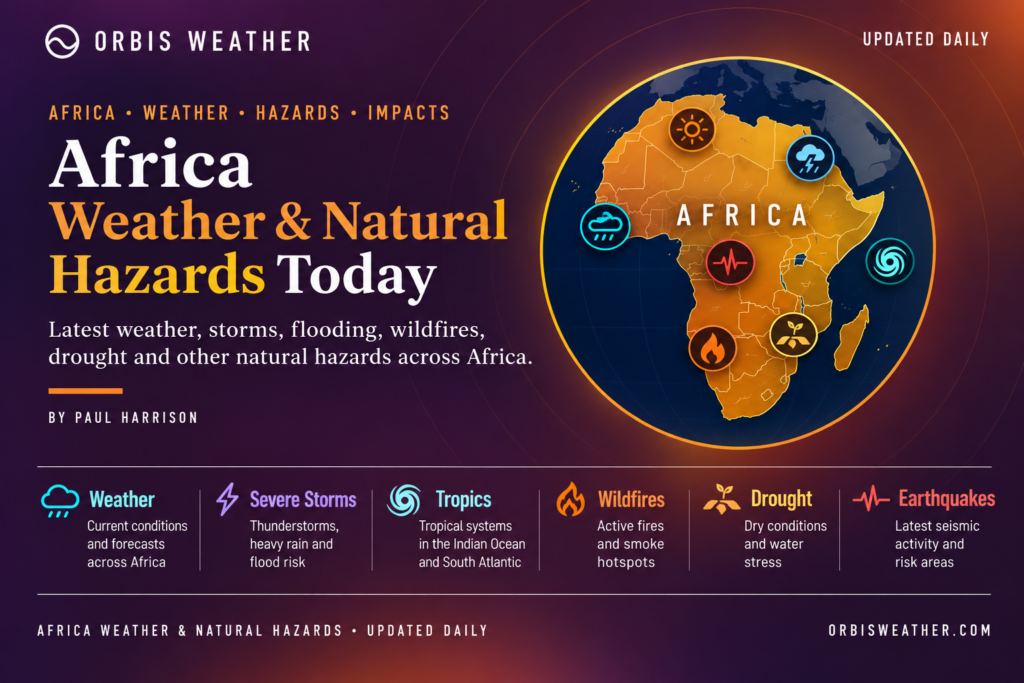
🌍 Africa Weather & Natural Hazards Today
By Paul Harrison | Founder & Publisher, Orbis Weather

- Europe Weather & Natural Hazards Today — Thursday, November 5, 2026 7:25 PM
- Southeast Asia Weather & Natural Hazards Today: Thursday, November 5, 2026 7:03 PM
- Singapore Monsoon & Flood This Week: Thursday, November 5, 2026 6:53 PM
- Africa Weather & Natural Hazards Today — Thursday, November 5, 2026 6:08 PM
- Sydney Battered by Storms 5:15 PM
- Middle East Weather & Natural Hazards Today — Thursday, November 5, 2026 4:29 PM
- Earth’s Cold Spots This Week Nov 4, 2026 3:05 PM
- Catastrophic Flooding Forces Florida Schools to Remain Closed as Communities Struggle to Recover 12:23 PM
- Australia, New Zealand & Oceania Weather & Natural Hazards Today — Thursday, November 5, 2026 12:05 PM
- South America Weather & Natural Hazards Today — November 4, 2026 8:14 AM
- Central America Weather & Natural Hazards Today: Heavy Rain, Dangerous Flooding and Landslide Threats Increase Across the Region 8:05 AM
- North America Weather & Natural Hazards Today: Heavy Mountain Snow, Flash Flood Risks and Atlantic Tropical Development 7:53 AM
- Daily Earthquakes, Storms, Fires & Floods Report — November 4, 2026 7:41 AM
- Weekly Earth’s Extreme Weather Report — Wednesday, November 4, 2026 7:34 AM
- Tropical Atlantic Daily Report: Wednesday, November 4, 2026 7:26 AM
- Eastern & Central Pacific Tropical Weather Update: Wednesday, November 4, 2026 7:11 AM
- WESTERN PACIFIC Tropical Weather Update: Typhoon In-Fa Remains Active as Storm Turns North 6:58 AM




🌍 Africa Weather & Natural Hazards Today — Thursday, November 5, 2026
By Paul Harrison | Orbis Weather
Published: Thursday, November 5, 2026 (African local date)
Coverage: North Africa • West Africa • Central Africa • East Africa • Southern Africa • Madagascar • Southwest Indian Ocean
🌍 Africa Weather Overview: Flood Threats, Severe Thunderstorms, Rising Heat and Strengthening El Niño
Africa enters Thursday, November 5, with several contrasting weather and natural-hazard concerns. Seasonal rainfall continues to threaten flooding in parts of East and Central Africa, Southern Africa is moving deeper into its thunderstorm season, and dry-season heat is becoming increasingly important across the Sahel.
Meanwhile, a strengthening El Niño is raising longer-term concerns about agricultural drought, extreme temperatures and food security across vulnerable regions.
The World Meteorological Organization (WMO) has indicated that El Niño is likely to strengthen further during November 2026 through January 2027, with potentially significant consequences for global rainfall and temperature patterns.
🚨 Today’s main weather concerns
-
🌧️ East Africa: Kenya’s November rainfall outlook brings continued concern about flash flooding, thunderstorms and landslides.
-
🌊 Central Africa: Heavy tropical rainfall and possible river flooding remain important concerns across equatorial regions.
-
⛈️ Southern Africa: Thunderstorms, lightning, localized flooding and heat remain hazards to monitor.
-
☀️ West Africa: Dry-season heat, changing rainfall patterns and agricultural water stress are becoming more important.
-
🏜️ North Africa: Mediterranean weather systems, strong winds and Saharan dust remain seasonal hazards.
-
🌀 Madagascar and Indian Ocean: The beginning of cyclone season increases the need for tropical-weather monitoring.
-
🌡️ Continental climate: El Niño could significantly affect rainfall, agriculture and water availability into 2027.
Reporting note: This report is dated November 5 for African readers. It combines the latest accessible published information, established seasonal conditions and regional hazard assessments. Specific November 5 warnings and observations have not been independently confirmed for every country. Seasonal hazards are not presented as active emergencies.
🚨 1. Africa Natural Hazards Summary — November 5
|
Region |
Primary hazard |
Assessment |
|---|---|---|
|
🇰🇪 Kenya |
Heavy rainfall, flash flooding |
Elevated seasonal concern |
|
🇺🇬 Uganda and 🇹🇿 Tanzania |
Thunderstorms, localized flooding |
Seasonal monitoring |
|
🇨🇩 DR Congo |
Tropical rainfall, river flooding |
Elevated seasonal concern |
|
🇿🇦 South Africa |
Thunderstorms, lightning, heat |
Recent severe weather; monitor new alerts |
|
🇲🇿 Mozambique |
Heavy rain, flooding, drought variability |
Seasonal monitoring |
|
🇳🇬 Nigeria |
Heat, localized storms, flooding |
Regional monitoring |
|
🌍 Sahel |
Heat, dust, water stress |
Dry-season transition |
|
🏜️ North Africa |
Dust, wind, localized heavy rain |
Seasonal monitoring |
|
🇲🇬 Madagascar |
Cyclones, heavy rain, drought |
Cyclone-season monitoring |
These classifications are editorial monitoring assessments, not official alert levels.
🇰🇪 2. East Africa — Heavy Rainfall and Flooding Remain Major Concerns
🌧️ Kenya: November rainfall increases flood concerns
Kenya remains one of Africa’s important weather-monitoring regions as the October–December short-rains season continues.
The Kenya Meteorological Department has previously warned that El Niño could influence late-2026 rainfall patterns, increasing the possibility of flooding and infrastructure disruption. The effects may also depend on Indian Ocean conditions.
Areas requiring continued attention include:
-
Nairobi and central Kenya: Urban flooding where intense thunderstorms overwhelm drainage.
-
Western Kenya and the Lake Victoria Basin: Heavy showers, lightning and possible river-level rises.
-
Coastal Kenya: Tropical downpours, localized flooding and humid conditions.
-
Northern and northeastern Kenya: High temperatures and considerable rainfall variability.
-
Highland regions: Landslides and road disruption following prolonged rainfall.
The November 3–10 forecast discussed in the previous edition remains the relevant forecast period, but this report does not establish that every previously identified area will experience heavy rainfall on November 5.
🌊 Uganda and Tanzania
Across Uganda and northern Tanzania, seasonal thunderstorms remain important weather hazards.
The Lake Victoria region is particularly sensitive to rapidly developing storms, which can create dangerous conditions for fishing boats and other small vessels.
Potential impacts include localized flash flooding, lightning injuries, transport disruption and damage to poorly drained roads.
These are regional risks rather than confirmation of a widespread severe-weather event today.
🇪🇹 Ethiopia and 🇸🇴 Somalia
The Horn of Africa faces a complex combination of seasonal rainfall variability and longer-term climate vulnerability.
In Somalia, the Juba and Shabelle river basins remain important locations for monitoring possible river flooding.
Parts of Ethiopia may experience very different rainfall conditions depending on elevation, location and the seasonal movement of tropical weather systems.
East Africa outlook: Rainfall intensity, river conditions and local flood warnings should remain the main monitoring priorities through the coming days.
🌿 3. Central Africa — Tropical Rainfall and River Flooding
🌊 Democratic Republic of the Congo
The Congo Basin is entering another period when substantial tropical rainfall can affect communities, roads and river systems.
The principal hazards include:
-
Heavy thunderstorms producing rapid surface-water flooding.
-
Rising rivers affecting low-lying settlements.
-
Landslides in mountainous terrain.
-
Damage to unpaved roads and rural transport routes.
-
Water contamination following flooding.
Kinshasa and other densely populated urban areas can be particularly vulnerable where heavy rain overwhelms drainage infrastructure.
A regional flood-risk outlook from FEWS NET covered parts of equatorial Africa through November 4. That outlook has now reached the end of its stated validity period and must not be treated as an active November 5 warning without renewal.
🇨🇲 Cameroon
Cameroon continues its seasonal transition, with wetter conditions generally more important across southern and central areas than in the far north.
Localized thunderstorms may bring intense rainfall and short-lived flooding.
Communities near steep terrain and river crossings should pay particular attention to official rainfall and flood information.
🇨🇬 Republic of the Congo, 🇬🇦 Gabon and 🇨🇫 Central African Republic
Equatorial rainfall remains a significant seasonal influence.
Potential impacts include swollen streams, localized flooding, muddy roads and reduced access to isolated communities.
Central Africa outlook: Heavy rainfall and flood preparedness remain important, although no specific new November 5 flood emergency has been independently verified for these countries.
🇿🇦 4. Southern Africa — Thunderstorms, Heat and Agricultural Concerns
⛈️ South Africa: Storm activity remains an important concern
South Africa has experienced an unsettled beginning to November.
Earlier this week, the South African Weather Service issued severe-thunderstorm warnings for parts of KwaZulu-Natal, the Free State, Mpumalanga and neighboring regions.
Those earlier alerts involved the potential for intense rainfall, hail, excessive lightning and localized flooding.
However, warnings issued for November 3 should not be assumed to remain active on November 5.
For Thursday, the principal regional weather concerns remain:
|
Area |
Weather concern |
|---|---|
|
Gauteng |
Afternoon thunderstorms and lightning |
|
KwaZulu-Natal |
Showers, thunderstorms and coastal conditions |
|
Mpumalanga |
Thunderstorms and rainfall near high ground |
|
Limpopo |
Heat and localized storm development |
|
Free State |
Heat, wind and possible afternoon storms |
|
Northern Cape |
Hot, dry weather and fire danger |
|
Western Cape |
Wind, temperature changes and localized fire risk |
|
Eastern Cape |
Variable temperatures and possible showers |
This table identifies weather patterns and hazards to monitor, not verified daily forecasts for each province.
🔥 Fire danger
Hot weather, low humidity, strong winds and dry vegetation can combine to create dangerous grassland-fire conditions.
The risk can increase quickly in exposed inland areas.
Residents should avoid uncontrolled outdoor burning and follow any fire-danger warnings issued by local authorities.
🌾 Zimbabwe, Zambia, Malawi and Mozambique
The development of the 2026–27 rainy season is becoming increasingly important for Southern Africa.
A strengthening El Niño can influence rainfall distribution and temperature patterns, potentially increasing the risk of agricultural drought in some areas.
However, El Niño does not mean that every country will experience drought, and heavy rainfall events remain possible even during a season with below-average rainfall.
The World Meteorological Organization has warned that the evolving climate pattern could affect rainfall and temperature conditions well into 2027.
🇧🇼 Botswana and 🇳🇦 Namibia
High daytime temperatures, dry vegetation and localized thunderstorm development remain important seasonal considerations.
Farmers and livestock owners should monitor rainfall accumulation and water availability as the warmer season develops.
Southern Africa outlook: Thunderstorm activity, heat, fire conditions and the developing agricultural season remain the main issues to monitor.
☀️ 5. West Africa — Heat, Dry Conditions and Agricultural Stress
🇳🇬 Nigeria: Contrasting weather conditions
Nigeria continues its seasonal transition, with different weather conditions between the northern and southern regions.
Northern Nigeria is moving further into the dry season, bringing increasing attention to heat, dust and water availability.
Southern Nigeria may continue to experience localized showers and thunderstorms, particularly near coastal areas.
Potential hazards include urban flooding during intense downpours, reduced visibility from dust and heat-related illness during prolonged hot conditions.
🇬🇭 Ghana: El Niño raises heat concerns
Ghana is preparing for potentially hotter and drier conditions as El Niño strengthens.
Recent reporting on guidance from the Ghana Meteorological Agency indicates that heat stress could become particularly significant during the 2027 dry season, with February through April identified as a period of concern.
For November, attention should focus on changing rainfall patterns, rising daytime temperatures and the gradual development of drier seasonal conditions.
🌾 Mali, Niger, Burkina Faso and Chad
Across the Sahel, the retreat of the rainy season is shifting attention toward water supplies, agricultural production and livestock grazing.
Hot temperatures and dry winds can increase evaporation, while dust may affect air quality and visibility.
Rainfall deficits during the preceding growing season can have lasting consequences for crops and food availability.
🇸🇳 Senegal, 🇨🇮 Côte d’Ivoire, 🇧🇯 Benin and 🇹🇬 Togo
Coastal West Africa can continue to experience occasional showers and thunderstorms during November.
However, rainfall generally becomes less frequent across many areas as the dry season develops.
West Africa outlook: Heat, dust, water availability and agricultural conditions are the main seasonal concerns. No widespread November 5 emergency has been independently verified for the region.
🏜️ 6. North Africa — Mediterranean Weather, Desert Winds and Dust
🇲🇦 Morocco, 🇩🇿 Algeria and 🇹🇳 Tunisia
North Africa’s Mediterranean coastline is progressing through its autumn season.
Atlantic and Mediterranean weather systems can bring cooler temperatures, gusty winds and occasional periods of heavy rainfall.
Flash flooding is an important hazard in mountainous terrain and normally dry riverbeds, where rainfall can produce rapid increases in water levels.
The Atlas Mountains can also experience substantial temperature differences between daytime and nighttime.
🇱🇾 Libya and 🇪🇬 Egypt
Coastal areas generally experience milder seasonal temperatures than inland desert regions.
Weather concerns include localized rainfall, strong winds and blowing dust.
Desert highways may experience reduced visibility during strong wind events.
🌬️ Sahara Desert
Dry weather dominates much of the Sahara, but strong winds can lift sand and dust into the atmosphere.
Dust may affect visibility, aviation operations and respiratory health.
North Africa outlook: Seasonal wind, dust and localized rainfall remain monitoring priorities. This is not confirmation of a major dust storm or flood emergency on November 5.
🌀 7. Madagascar and Southwest Indian Ocean — Cyclone Season Begins
November marks the beginning of the main southwest Indian Ocean tropical cyclone season.
Countries and territories requiring increased tropical-weather awareness include Madagascar, Mauritius, Réunion, Comoros and nearby island communities.
🇲🇬 Madagascar
Madagascar faces contrasting climate risks.
Eastern and northern coastal areas are vulnerable to tropical rainfall, flooding and cyclones, while southern Madagascar may experience rainfall shortages during unfavorable seasonal conditions.
Potential cyclone-related hazards include damaging winds, torrential rain, landslides, coastal flooding and dangerous marine conditions.
🏝️ Mauritius, Réunion and Comoros
Island communities should monitor tropical disturbances developing over the Indian Ocean.
Even systems that do not make landfall can generate dangerous surf, strong winds and heavy rainfall.
Tropical cyclone status: No active named cyclone or official November 5 cyclone warning has been independently confirmed in the sources reviewed for this report. This statement does not establish that the basin is storm-free.
Official tropical cyclone information is available from Météo-France La Réunion.
🌡️ 8. El Niño 2026–27 — A Major Climate Threat Across Africa
The strengthening El Niño is one of the most significant longer-term developments affecting Africa’s weather and agricultural outlook.
The World Meteorological Organization’s September assessment indicated that El Niño was firmly established and could intensify substantially.
Its October seasonal update subsequently indicated that strengthening could continue into early 2027, potentially affecting global rainfall patterns and temperatures.
🌍 Potential regional impacts
|
Region |
Possible seasonal consequence |
|---|---|
|
East Africa |
Increased rainfall and flooding in some locations |
|
Southern Africa |
Agricultural drought and reduced rainfall |
|
Southern Madagascar |
Rainfall deficits and water stress |
|
Central Africa |
Rainfall variability and flooding |
|
West Africa |
Heat and agricultural vulnerability |
|
North Africa |
Temperature and rainfall variability |
These are broad climate tendencies, not guaranteed outcomes for individual countries.
🌾 Food security concerns
Save the Children warned in September that approximately 8 million children across East and Southern Africa could face acute hunger by early 2027 under its climate-risk analysis. This is a projection, not a count of children newly affected on November 5.
The consequences of rainfall shortages can extend beyond the immediate growing season.
Reduced crop yields, declining pasture conditions and pressure on water supplies may contribute to food-price increases and humanitarian needs.
🌊 9. Africa Flood Risk — Thursday, November 5
Flooding remains one of the continent’s most important natural hazards.
Highest monitoring priorities
🇰🇪 Kenya: The Kenya Meteorological Department’s November 3–9 seven-day forecast covers Thursday, November 5. Rainfall is expected across numerous counties during the broader forecast period, and the agency has warned about flooding and transport disruption.
🇨🇩 Central Africa: Tropical rainfall and river conditions remain important to monitor across the Congo Basin. An earlier regional flood-risk assessment expired November 4 and requires updated confirmation.
🇿🇦 South Africa: Severe thunderstorms are forecast for Thursday, November 5, with renewed warnings affecting several provinces.
⛈️ Important South Africa warning update
Forecast information published November 4 for Thursday, November 5, reports:
-
Yellow Level 4 severe-thunderstorm warnings: Including Gauteng, the Mpumalanga Highveld, parts of Limpopo, eastern Free State, eastern North West and much of KwaZulu-Natal.
-
Yellow Level 2 warnings: Including other parts of Limpopo, Mpumalanga, Free State, North West and the northern Eastern Cape interior.
-
Additional hazards: Hail, damaging winds, lightning, localized flooding and possible power disruptions.
Extremely high fire-danger conditions are also forecast across several inland regions. These warnings are based on published forecasts attributed to the South African Weather Service; readers should confirm the latest warning boundaries and validity periods directly with SAWS.
This makes South Africa’s severe-thunderstorm threat one of the most significant specific forecast developments for November 5.
🌍 10. Earthquakes, Volcanoes and Geological Hazards
Africa’s natural hazards extend beyond weather.
🌋 East African Rift System
The East African Rift is one of the continent’s most important geological regions.
It extends through parts of eastern Africa and contains active faults, volcanic systems and areas of seismic activity.
Countries with relevant geological monitoring needs include Ethiopia, Kenya, Tanzania, Uganda and the Democratic Republic of the Congo.
🇨🇩 Democratic Republic of the Congo
The Virunga volcanic region includes Mount Nyiragongo and Mount Nyamuragira.
These volcanoes require ongoing scientific monitoring because eruptions can threaten nearby communities, infrastructure and air quality.
🇪🇹 Ethiopia
Ethiopia’s Afar region contains active volcanic and tectonic systems.
Earthquake swarms, ground deformation and volcanic activity are among the phenomena monitored by scientists.
Geological status: No specific major earthquake or new volcanic eruption occurring on November 5 has been independently verified for this report.
Readers can check the USGS Latest Earthquakes service for updated seismic observations.
🔥 11. Wildfires, Dust and Air Quality
🔥 Southern Africa
Hot, windy conditions and dry vegetation can produce dangerous wildfire conditions.
Parts of South Africa face particularly important fire-weather concerns during periods of extreme heat and low humidity.
🌫️ West Africa and the Sahel
Dry-season dust and haze can reduce visibility and worsen respiratory conditions.
The intensity of dust events depends on local winds, atmospheric conditions and available surface material.
🌿 Central Africa
Vegetation fires and agricultural burning can contribute to smoke pollution.
Smoke concentrations vary considerably by location and weather conditions.
Air-quality status: No continent-wide air-quality emergency has been independently verified for November 5.
For regional observations, consult Copernicus Atmosphere Monitoring Service.
📅 12. Africa Weather Outlook — November 5–7, 2026
|
Date |
Main monitoring priorities |
|---|---|
|
Thursday, Nov. 5 |
South African severe thunderstorms; Kenyan rainfall; Central African flooding risk |
|
Friday, Nov. 6 |
Further South African storms; East African rainfall; regional heat |
|
Saturday, Nov. 7 |
Continued flood monitoring, Southern African weather and Indian Ocean tropical activity |
The November 6–7 entries identify forecast-monitoring priorities rather than verified countrywide daily warnings.
🛡️ 13. Weather and Natural Hazard Safety
🌊 Flooding
Never drive or walk through fast-moving floodwater. Flooded roads may conceal washed-out surfaces, damaged bridges and dangerous currents.
⚡ Thunderstorms
Move indoors when thunder is heard. Avoid isolated trees, open fields and exposed high ground.
☀️ Extreme heat
Drink water regularly, reduce strenuous outdoor activity during the hottest part of the day and check on vulnerable people.
🔥 Wildfires
Avoid outdoor burning during dangerous fire-weather conditions. Follow local evacuation instructions immediately.
🌀 Tropical cyclones
Residents of Madagascar and surrounding Indian Ocean islands should maintain emergency supplies and monitor official cyclone bulletins throughout the season.
📚 14. Sources and Official Weather Information
Orbis Weather uses recognized meteorological, scientific and disaster-monitoring organizations to inform its reporting.
The following sources provide forecasts, warnings, observations and background information relevant to this edition.
|
Organization |
Coverage |
Official website |
|---|---|---|
|
World Meteorological Organization |
Global climate and El Niño |
|
|
South African Weather Service |
South Africa forecasts and warnings |
|
|
Kenya Meteorological Department |
Kenya forecasts and rainfall |
|
|
FEWS NET |
Drought, rainfall and food security |
|
|
Météo-France La Réunion |
Southwest Indian Ocean cyclones |
|
|
US Geological Survey |
Earthquake monitoring |
|
|
Copernicus Atmosphere Monitoring Service |
Smoke, dust and atmospheric conditions |
|
|
World Food Programme |
Climate and food-security impacts |
About the Author
Paul Harrison — Founder & Publisher, Orbis Weather
Paul Harrison founded Orbis Weather in 2026 to make global weather and natural-hazard information easier to find, follow and understand. His coverage includes tropical cyclones, severe weather, extreme temperatures, earthquakes, volcanoes, wildfires, flooding and significant natural disasters worldwide.
View all articles by Paul Harrison → | Editorial Standards →
Global Weather Tracker Hub
Explore weather maps, tropical systems, storms and natural hazards around the world.
No matching trackers found.