
Central America Weather & Natural Hazards Today — Friday, October 30, 2026
By Paul Harrison | Founder & Publisher, Orbis Weather

- Europe’s Hot Spots This Week Oct 30 3:03 PM
- Central America Weather & Natural Hazards Today — Friday, October 30, 2026 2:47 PM
- Bhutan Glacial Lake Outburst Triggers Flash Flood Emergency in India’s Bengal and Assam 8:51 AM
- Cyclone Arnab Aftermath 8:33 AM
- Global Natural Disasters This Week — October 30, 2026 7:51 AM
- Daily Earthquakes, Storms, Fires & Floods Report — October 30, 2026 7:42 AM
- Western Pacific Tropical Weather Oct 30 7:27 AM
- Eastern & Central Pacific Tropical Weather Update: Friday, October 30, 2026 7:16 AM
- Tropical Atlantic Daily Report: Friday, October 30, 2026 7:05 AM





🌎 Central America Weather & Natural Hazards Today — Friday, October 30, 2026
By Paul Harrison | Orbis Weather | Friday, October 30, 2026
🌧️ Heavy Rainfall • 🌊 Flooding • ⛰️ Landslides • 🌋 Volcanoes • 🌎 Earthquakes • 🌀 Tropical Weather
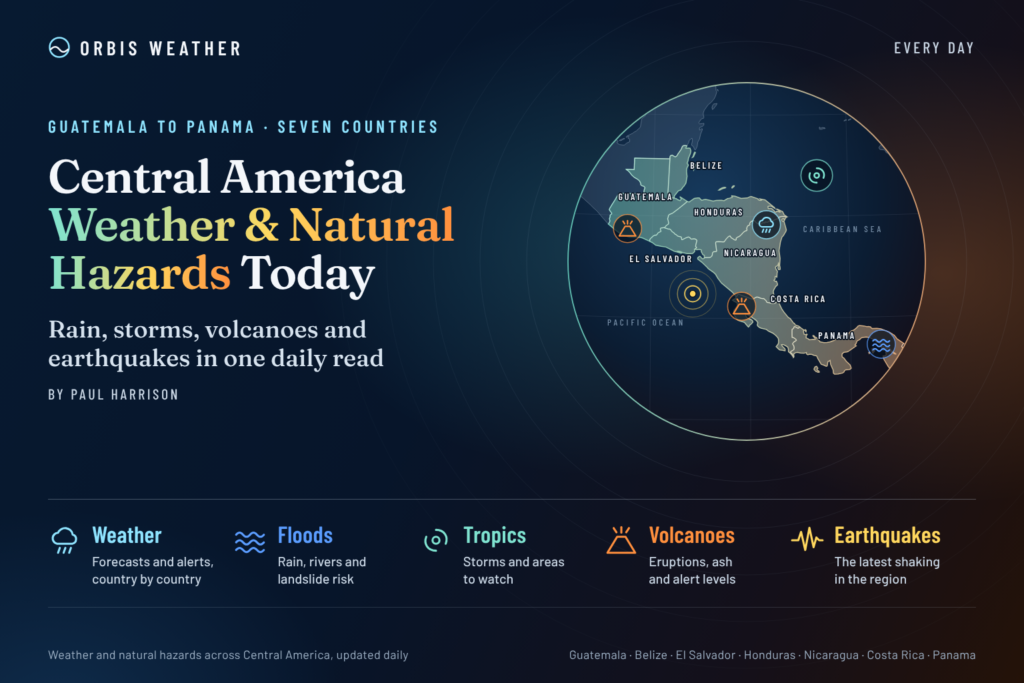
Central America enters the final days of October with the region’s familiar combination of tropical moisture, mountainous terrain, active volcanoes and earthquake hazards demanding continued attention.
From Guatemala and Belize in the north to Costa Rica and Panama in the south, the principal weather concerns during the late rainy season remain localized heavy thunderstorms, flash flooding, swollen rivers and landslides.
There is some encouraging news in the tropics. As of the National Hurricane Center’s October 30 update, there are no active tropical cyclones in the Atlantic or eastern Pacific basins. That does not eliminate the possibility of dangerous rainfall from ordinary thunderstorms and other non-cyclonic weather systems.
🚨 Central America — Today’s Hazard Overview
🌀 Active tropical cyclones
🌧️ Heavy rain and thunderstorms
Localized potential
🌊 Flash flooding
Rainfall-dependent risk
⛰️ Landslides
Steep terrain vulnerable
🌋 Volcanic activity
Monitor observatories
🌎 Earthquakes
Ongoing regional hazard
Hazard overview is a regional assessment, not a live national warning map. Local rainfall alerts, volcano bulletins and earthquake events require confirmation from the responsible national agencies.
🌎 Country-by-Country Weather and Natural Hazards
🇬🇹 Guatemala — Rainfall, Rivers and Volcano Monitoring
Guatemala is transitioning from its rainy season toward cooler conditions. INSIVUMEH reported this seasonal change on October 23 and has issued a river-rise outlook covering October 28–30. Residents near rivers and flood-prone areas should check the latest basin forecasts.
Fuego, Santiaguito and Pacaya remain important volcano-monitoring priorities. No new eruption or ash warning is confirmed in this report.
🇧🇿 Belize — Coastal Showers and Flood Awareness
Coastal showers, localized thunderstorms and river conditions remain important concerns during the late wet season.
Low-lying communities should monitor local forecasts, particularly where rainfall can cause rapid drainage problems. No nationwide flood emergency has been independently confirmed for today.
🇭🇳 Honduras — Mountain Flooding and Landslide Risk
Mountainous terrain and communities along rivers remain susceptible to localized flooding and slope failures when intense rainfall develops.
Northern coastal areas and the interior highlands should follow forecasts from CENAOS and emergency information from COPECO. A specific October 30 warning level has not been verified.
🇸🇻 El Salvador — Thunderstorms and Steep Terrain
Localized heavy downpours can produce sudden street flooding, especially in urban areas and communities below steep hillsides.
Volcanic and seismic hazards are monitored by El Salvador’s Ministry of Environment. No significant new eruption or damaging earthquake is confirmed in this report.
🇳🇮 Nicaragua — Rainfall and Volcanic Hazards
Nicaragua’s Pacific volcanic chain and mountainous interior remain important natural-hazard areas.
Heavy showers, where they occur, may lead to localized flooding. INETER and SINAPRED should be consulted for the latest meteorological, earthquake and volcano bulletins.
🇨🇷 Costa Rica — Afternoon Rain and Gusty Winds
Costa Rica’s National Meteorological Institute forecasts scattered afternoon showers and isolated thunderstorms in the southern and central Pacific regions and southern Nicoya Peninsula. The Caribbean slope could experience more widespread rainfall Friday night.
Moderate trade winds and occasional strong gusts are also expected, particularly around the northern Pacific region.
🇵🇦 Panama — Tropical Rainfall and Urban Flooding
Panama remains within its wet-season period, when intense localized thunderstorms can affect roads, drainage systems and low-lying neighborhoods.
Mountainous western districts also require attention during prolonged heavy rainfall. No specific national emergency declaration has been verified for October 30.
🌀 Tropical Weather — Atlantic, Caribbean and Eastern Pacific
The National Hurricane Center’s October 30 bulletin reports no active tropical cyclones in the Atlantic, eastern Pacific or central Pacific.
Hurricane Vance, which previously affected waters off western Mexico, lost its organized tropical cyclone structure on October 29. Its remnant moisture remains a concern farther north, particularly in Mexico and parts of the southwestern United States, rather than representing a direct tropical cyclone threat to Central America.
However, the absence of named storms does not mean that Central America is free of weather hazards. Tropical moisture, local thunderstorms and terrain-enhanced rainfall can still generate dangerous conditions.
Official monitoring: National Hurricane Center.
🌋 Volcano Watch — Central America’s Active Volcanic Belt
Central America sits along an active tectonic boundary, with numerous volcanoes extending from Guatemala through Costa Rica.
Important volcanoes to monitor include Fuego and Santiaguito in Guatemala, San Miguel in El Salvador, Masaya in Nicaragua, and Poás, Rincón de la Vieja and Turrialba in Costa Rica.
Volcanic hazards may include ash emissions, gas exposure, explosions and lahars — fast-moving mixtures of volcanic debris and water. Heavy rain can increase lahar hazards on some volcanic slopes.
Today’s verification status: This update does not establish that any of these volcanoes experienced a new eruption, significant ash plume or escalation in alert level on October 30. Readers should consult observatory bulletins before traveling near active craters.
🌎 Earthquake Watch — Central America
The region lies near the boundary between the Cocos and Caribbean tectonic plates. Earthquakes are a persistent hazard along the Pacific margin, including offshore areas of Guatemala, El Salvador, Nicaragua and Costa Rica.
Earthquakes cannot currently be predicted reliably by exact date, time or magnitude.
No specific earthquake magnitude or casualty figure is being reported here without a verified event record for October 30.
For the latest recorded earthquakes, visit the USGS Earthquake Map.
🌊 Flooding and Landslide Watch
The main concern during periods of intense rainfall is how quickly water can accumulate in narrow valleys, urban drainage systems and steep mountain catchments.
Guatemala’s INSIVUMEH published a river-rise outlook valid October 28–30, using forecast rainfall and watershed conditions to assess possible river rises and overflows.
Residents and travelers throughout the region should be alert to rising streams, cracks in slopes, falling rocks and unusual movement of mud or debris. Never attempt to drive through a flooded road.
🌡️ Temperature Outlook
Costa Rica’s October 30 regional forecast provides a useful example of the temperature contrasts across Central America.
Location | Forecast high |
|---|---|
🇨🇷 San José | 79°F / 26°C |
🇨🇷 Cartago | 73°F / 22.5°C |
🇨🇷 Liberia | 94°F / 34.2°C |
🇨🇷 Puntarenas | 95°F / 35°C |
🇨🇷 Quepos | 89°F / 31.5°C |
Forecast daily maximums from Costa Rica’s IMN, valid Friday, October 30, 2026. Temperatures rounded to the nearest degree Fahrenheit.
These contrasts illustrate the importance of elevation and coastal geography. Conditions in Central America’s cooler highlands can differ dramatically from those along the Pacific and Caribbean coasts.
🔭 What to Watch Over the Next 24–48 Hours
🌧️ Rainfall: Monitor the Pacific regions of Costa Rica and other locations where locally intense thunderstorms develop.
🌊 River levels: Watch Guatemala’s river basins and other flood-sensitive catchments.
⛰️ Landslides: Remain cautious on mountain roads, particularly following sustained rainfall.
🌀 Tropics: Monitor the National Hurricane Center for any new tropical development.
🌋 Volcanoes: Check national observatories for changes in ash, gas or seismic activity.
🌎 Earthquakes: Follow USGS and national seismic networks for newly recorded events.
📚 Sources and Editorial Methodology
Orbis Weather combines official meteorological information, geological monitoring and regional hazard reporting to explain natural hazards in clear, accessible language.
Primary sources for this report include:
NOAA National Hurricane Center — tropical cyclone outlooks and discussions.
INSIVUMEH Guatemala — meteorology, hydrology, volcanoes and earthquakes.
Costa Rica National Meteorological Institute — regional forecasts.
INETER Nicaragua — weather and geological monitoring.
USGS Earthquake Hazards Program — earthquake records.
U.S. National Weather Service — regional weather information.
Report verification: Friday, October 30, 2026. National Hurricane Center information was available through its October 30 afternoon UTC update; Costa Rican forecast information is valid for October 30; Guatemala’s river outlook covers October 28–30.
Editorial distinction: Officially reported conditions and forecast figures are identified with sources. General descriptions of seasonal hazards are not presented as confirmed active warnings. Where reliable same-day data could not be established, no alert level, rainfall total, earthquake magnitude or volcanic eruption has been invented.
This report is informational and is not an official emergency bulletin. Weather forecasts and warnings may change rapidly. Local meteorological agencies and civil protection authorities remain the authoritative sources for evacuation instructions and immediate safety decisions.
❓ Frequently Asked Questions
Is there a hurricane threatening Central America today?
No active tropical cyclone was reported in the Atlantic or eastern Pacific in the NHC’s October 30 update. Conditions can change, so continue monitoring official outlooks.
Which country has a specific rainfall forecast today?
Costa Rica’s IMN forecasts scattered afternoon showers and possible isolated thunderstorms in several Pacific regions, with rainfall increasing along parts of the Caribbean slope Friday night.
Can landslides occur without a hurricane?
Yes. Persistent rainfall or an intense localized thunderstorm can saturate steep slopes and trigger landslides, even without a named tropical storm.
Is Central America experiencing an earthquake emergency?
No region-wide earthquake emergency has been verified for this report. That does not rule out localized seismic events.
🌎 Orbis Weather — Keeping an Eye on Our Changing Planet
Central America’s extraordinary geography brings together tropical coastlines, towering volcanoes, steep mountain ranges and active geological boundaries.
While the tropical basins are currently free of active cyclones, localized rainfall and natural hazards still deserve attention as October draws to a close.
Orbis Weather will continue following significant developments across the region, with an emphasis on verified observations, official warnings and practical explanations of what they mean.
About the Author
Paul Harrison — Founder & Publisher, Orbis Weather
Paul Harrison founded Orbis Weather in 2026 to make global weather and natural-hazard information easier to find, follow and understand. His coverage includes tropical cyclones, severe weather, extreme temperatures, earthquakes, volcanoes, wildfires, flooding and significant natural disasters worldwide.
View all articles by Paul Harrison → | Editorial Standards →
Global Weather Tracker Hub
Explore weather maps, tropical systems, storms and natural hazards around the world.
No matching trackers found.