
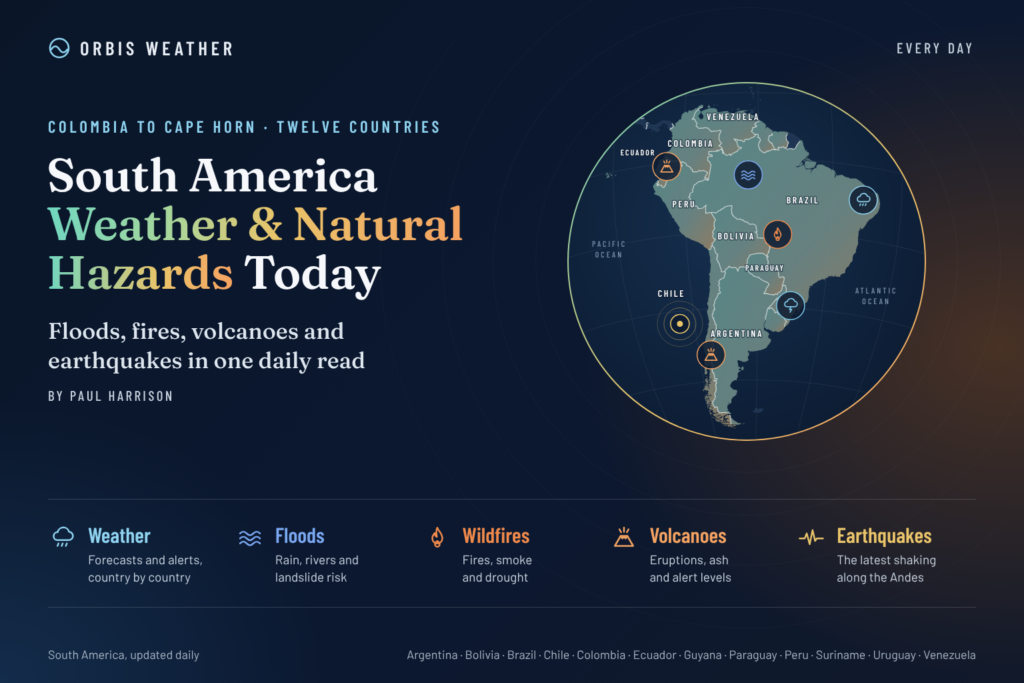
South America Weather & Natural Hazards Today
By Paul Harrison | Founder & Publisher, Orbis Weather

- Thailand Warns Eight Provinces of Possible Flooding as High Tides Threaten Bangkok and Coastal Communities 10:55 AM
- South America Weather & Natural Hazards Today — November 1, 2026 10:15 AM
- Central America Weather & Natural Hazards Today — Sunday, November 1, 2026 10:03 AM
- North America Weather & Natural Hazards Today Nov 1 9:46 AM
- Indonesia Forest Fire Haze Linked to More Than 3,500 Deaths in September as Air Pollution Crisis Deepens 8:37 AM
- Weekly Earth Watch: Volcanoes, Earthquakes & Natural Hazards – Week ending November 1, 2026 7:57 AM
- Daily Earthquakes, Storms, Fires & Floods Report — November 1, 2026 7:48 AM
- WESTERN PACIFIC Tropical Weather Update – November 1, 2026 7:34 AM
- Eastern & Central Pacific Tropical Weather Update: Sunday, November 1, 2026 7:27 AM
- Tropical Atlantic Daily Report: Sunday, November 1, 2026 7:20 AM
- Galápagos Islands Flood Disaster: One Dead, Two Missing as Torrential Rain Forces Families From Homes 5:26 AM
- Powerful Pacific Storm Could Bring Tornadoes, Damaging Winds and Widespread Rain Across the United States 5:07 AM





🌎 South America Weather & Natural Hazards Today — November 1, 2026
By Paul Harrison | Founder & Publisher, Orbis Weather
Sunday, November 1, 2026 | Regional weather, flooding, severe storms, earthquakes and volcanic hazards
⛈️ Extreme rainfall warnings remain in force across Ecuador, thunderstorms threaten parts of Brazil, and Colombia faces continuing landslide and flooding concerns as South America begins November under the influence of a powerful El Niño climate pattern.
South America enters November with a mixture of dangerous rainfall, thunderstorms, saturated hillsides and changing seasonal weather patterns.
The most significant verified warnings this morning are in Ecuador, where the national meteorological agency has issued extreme-severity alerts for several provinces through Sunday evening.
Brazil is also experiencing an unsettled weather pattern, with official storm alerts affecting several regions. Meanwhile, Colombia continues monitoring landslide-prone communities following recent heavy rainfall.
The developing 2026–27 El Niño event adds another dimension to the continent’s weather outlook, potentially influencing rainfall, drought and flood risks over the coming months.
This Orbis Weather report examines verified warnings, developing hazards and regional conditions, while distinguishing confirmed emergencies from potential risks.
🚨 South America Natural Hazards at a Glance
Country / Region | Main concern | Status |
|---|---|---|
🇪🇨 Ecuador | 🌧️ Extreme rain, flash floods, landslides | Extreme official alerts |
🇧🇷 Brazil | ⛈️ Thunderstorms, heavy rainfall, gusty winds | Storm alerts |
🇨🇴 Colombia | ⛰️ Landslides, river flooding | Official monitoring |
🇦🇷 Argentina | ⛈️ Thunderstorms and localized flooding | Monitor forecasts |
🇵🇾 Paraguay | 🌊 River levels and flood recovery | Monitoring |
🇵🇪 Peru | 🌧️ Mountain rainfall and landslide potential | Monitoring |
🇨🇱 Chile | 🏔️ Mountain weather and seismic hazards | Monitoring |
🇧🇴 Bolivia | 🌧️ Seasonal thunderstorms and river levels | Monitoring |
🇻🇪 Venezuela | ⛈️ Tropical rainfall and flooding | Monitoring |
🌳 Amazon Basin | 🌦️ Thunderstorms and changing river conditions | Regional monitoring |
🌋 Andes | 🌋 Earthquakes and volcanic activity | Continuous monitoring |
Status descriptions are not a standardized continental warning scale. “Monitoring” does not mean an active warning has been confirmed for November 1.
🇪🇨 1. Ecuador: Extreme Rainfall Alerts Remain in Force
Ecuador faces some of the continent’s most significant weather hazards today.
The National Institute of Meteorology and Hydrology (INAMHI) lists six active alerts, including two classified as extreme severity. These cover Esmeraldas and parts of northwestern Pichincha and Imbabura, along with Los Ríos, Guayas and El Oro.
The alerts are valid until 11:00 p.m. Ecuador time on Sunday, November 1.
INAMHI warns of moderate to very heavy rainfall, thunderstorms and wind gusts, with October 30–31 identified as the period when the most intense rainfall could occur. Although the expected peak may have passed, the alerts remain relevant through Sunday.
🌊 Main hazards
Flash flooding in low-lying neighborhoods and poorly drained roads.
Rising rivers and streams following prolonged rainfall.
Landslides on saturated western Andean slopes.
Lightning, strong wind gusts and falling trees.
Travel disruption from standing water and reduced visibility.
The Galápagos Islands are also included in INAMHI’s active severe rainfall alerts, making island conditions important to monitor.
Orbis Weather assessment: Ecuador remains a priority for flood and landslide preparedness today. Residents should follow INAMHI and local emergency authorities, particularly in vulnerable coastal and mountain communities.
Official alerts: Ecuador INAMHI Weather Warnings
🇧🇷 2. Brazil: Thunderstorms and Heavy Rain Threaten Several Regions
Brazil begins November with a developing storm pattern across portions of the south, southeast and central regions.
Warnings attributed to Brazil’s National Institute of Meteorology (INMET) include potential-danger thunderstorm alerts affecting areas of Paraná, Santa Catarina, São Paulo, Mato Grosso do Sul, Minas Gerais, Rio Grande do Sul, Rio de Janeiro and Goiás during the early-November period.
Additional recent heavy-rain alerts have affected northern and central-western Brazil. The precise locations and validity periods vary between warnings.
⛈️ What residents should watch
Southern Brazil: Thunderstorms may produce localized heavy rainfall, lightning and strong gusts, particularly where storm systems organize into larger clusters.
Southeastern Brazil: São Paulo, Minas Gerais and Rio de Janeiro should monitor changing storm forecasts. Urban flooding can develop rapidly during intense downpours.
Amazon and central-western regions: Warm, humid conditions can support frequent convective thunderstorms, particularly during afternoon and evening hours.
🌧️ Why flooding can develop quickly
Brazil’s densely populated urban centers contain extensive paved surfaces that limit the amount of rainwater absorbed by the ground.
Heavy downpours can overwhelm drainage systems, producing street flooding even when nearby rivers remain below flood stage.
Orbis Weather assessment: The principal concerns are localized flooding, lightning and wind damage. These are forecast hazards, not confirmation that damage has occurred today.
Official source: Brazil INMET Weather Alerts
🇨🇴 3. Colombia: Landslide Warnings and Saturated Ground
Colombia continues to face hydrological concerns, particularly in mountainous departments where persistent rainfall can destabilize slopes.
Alerts issued by Colombia’s Institute of Hydrology, Meteorology and Environmental Studies (IDEAM) on October 31 identified landslide concerns across numerous municipalities in Antioquia.
Other IDEAM notices identified forest-fire potential in selected municipalities, demonstrating how different parts of Colombia can experience contrasting hazards simultaneously.
⛰️ Principal concerns
In Antioquia and other mountainous areas, heavy rainfall can increase the likelihood of slope failures, especially beside steep roads, unstable hillsides and river valleys.
Elsewhere, river levels and local rainfall accumulation require continued monitoring. Colombia’s Pacific coast is particularly susceptible to intense tropical rainfall.
🚨 Warning signs of landslides
Residents should take seriously newly appearing cracks in the ground, leaning trees, unusual water seepage and sudden changes in stream flow.
These indicators can suggest slope instability, although they do not establish that a landslide is imminent.
Orbis Weather assessment: Landslides remain an important regional concern. Current municipal-level warning information should be checked before travel.
Official source: Colombia IDEAM
🇦🇷 4. Argentina: Orange and Yellow Storm Alerts Across Nine Provinces
Argentina faces another day of potentially dangerous weather, with orange and yellow alerts issued by the National Meteorological Service (SMN) for Sunday, November 1.
Orange-level warnings cover portions of northwestern Buenos Aires province, northern La Pampa, San Luis and southern Santa Fe.
Forecast hazards include intense thunderstorms, hail, frequent lightning and wind gusts potentially exceeding 90 km/h (56 mph). Rainfall accumulations of 50–90 mm (2–3.5 inches) are possible in the orange-alert areas, with locally higher totals.
Other areas, including parts of Córdoba, Entre Ríos, Formosa and Misiones, face yellow-level thunderstorm alerts.
Southern Chubut also has strong-wind concerns, while San Juan and La Rioja face the possibility of dry, warm Zonda winds.
The combination of heavy rainfall and existing flood vulnerability could create further problems for agricultural communities and transportation networks.
Official source: Argentina National Meteorological Service
🇵🇾 5. Paraguay: Strong Thunderstorms Could Affect Asunción
Paraguay’s Directorate of Meteorology and Hydrology (DMH) issued a thunderstorm alert on Sunday morning, identifying an active storm system over the central Western Region.
The warning highlights central Presidente Hayes, with storms potentially affecting Asunción and surrounding communities during the afternoon.
Forecast hazards include:
⛈️ Moderate to strong thunderstorms.
💨 Strong wind gusts.
🧊 Isolated hail.
🌧️ Intense rainfall over short periods.
Stormy conditions could persist overnight into Monday, November 2.
🌊 Flood recovery continues
Paraguay is also recovering from serious river flooding. Reuters reported on October 22 that rising Paraná River waters had affected approximately 4,200 families, with evacuations and displacement reported.
That figure reflects the situation at the time of reporting, not a verified November 1 total.
Official source: Paraguay Meteorological Service
🇵🇪 6. Peru: Flooding, Coastal Weather and Landslide Monitoring
Peru remains an important country to monitor as the developing El Niño event influences the eastern Pacific.
Recent extreme coastal weather has caused disruption and economic damage. Peru’s government has announced financial assistance and tax relief for affected businesses, according to reporting published October 22.
🌧️ Main regional concerns
Northern coastal communities are vulnerable to intense rainfall and flooding when unusually warm Pacific waters help support greater atmospheric moisture.
In the Andes, steep terrain creates additional hazards, including debris flows and landslides following sustained rainfall.
Along Peru’s Pacific coastline, rough seas and coastal erosion can threaten roads, fishing operations and exposed infrastructure.
No new nationwide emergency warning for November 1 was independently confirmed for this report.
Official source: Peru SENAMHI
🇨🇱 7. Chile: Mountain Weather, Flood Recovery and Geological Hazards
Chile’s long Pacific coastline and extensive Andean mountain system expose the country to a wide variety of natural hazards.
Recent severe weather has included flooding, mudslides and hailstorms, according to October reporting.
As spring progresses in the Southern Hemisphere, conditions can vary dramatically between northern Chile’s arid landscapes, central agricultural regions and the cooler, wetter south.
Mountain communities should remain attentive to precipitation, changing snow conditions and slope stability.
Chile also sits along an active tectonic boundary, making earthquake and volcanic monitoring an essential part of the country’s natural-hazard preparedness.
Official sources: Chile SENAPRED and Chile Meteorological Directorate
🌳 8. Amazon Basin: Thunderstorms, River Levels and Wildfire Risk
The Amazon Basin extends across several South American countries, including Brazil, Peru, Colombia, Bolivia, Ecuador and Venezuela.
Its enormous geographical area means that conditions can differ substantially from one river basin to another.
🌦️ Rainfall and river conditions
Warm temperatures, high humidity and atmospheric instability frequently support thunderstorms across the tropical rainforest.
Rainfall upstream can influence downstream river levels days or even weeks later. Consequently, local weather conditions alone do not always explain river flooding.
🔥 Wildfires and air quality
Although the Amazon is associated with abundant rainfall, dry spells can increase vegetation flammability, particularly in disturbed forests and agricultural areas.
Smoke from fires can affect air quality far beyond the immediate fire location.
No specific new Amazon-wide wildfire emergency has been verified for November 1 in this report.
🌋 9. Earthquakes and Volcanoes: The Andes Remain Active
The western margin of South America forms part of the Pacific Ring of Fire, one of the world’s most geologically active regions.
The Nazca tectonic plate moves beneath the South American plate, producing earthquakes, mountain building and volcanic activity.
🌋 Volcano monitoring
Volcanic systems requiring routine observation include:
Country | Volcano | Main hazards |
|---|---|---|
🇪🇨 Ecuador | Reventador | Ash emissions, volcanic activity |
🇪🇨 Ecuador | Sangay | Ash, lava and volcanic debris |
🇨🇴 Colombia | Nevado del Ruiz | Ash, lahars and volcanic unrest |
🇵🇪 Peru | Sabancaya | Ash and explosive activity |
🇨🇱 Chile | Villarrica | Ash, lava and lahars |
🇨🇱 Chile | Láscar | Explosive eruptions and ash |
These are volcanoes of ongoing scientific interest, not a list of confirmed eruptions occurring today.
🌎 Earthquake monitoring
Earthquakes can occur without warning across the Andean region. Residents in earthquake-prone areas should understand evacuation routes, tsunami procedures where relevant and local emergency communication systems.
For verified earthquake locations and magnitudes, consult the USGS Real-Time Earthquake Map.
For volcanic activity, consult the Smithsonian Global Volcanism Program.
🌡️ 10. El Niño 2026–27: Why South America’s Weather Is Changing
One of the most important developments affecting South America’s seasonal outlook is the strengthening El Niño event.
El Niño occurs when unusually warm ocean temperatures develop across the central and eastern equatorial Pacific.
This alters atmospheric circulation and can redistribute rainfall across large areas of the planet.
The 2026–27 event has attracted particular scientific attention because climate model projections indicate the possibility of exceptionally strong conditions. However, its eventual peak intensity remains a forecast rather than a confirmed outcome.
How El Niño can affect South America
Region | Possible seasonal influence |
|---|---|
Ecuador and northern Peru | Increased heavy-rain and flood potential |
Southern Brazil | Wetter periods and flood risk |
Northern Argentina | Greater likelihood of heavy rainfall |
Paraguay | Rainfall variability and river flooding |
Colombia and Venezuela | Increased dryness in some regions |
Northern Brazil | Drought and wildfire potential |
Central Chile | Changes in precipitation and storm patterns |
These are broad climate tendencies, not guaranteed outcomes for individual locations.
El Niño does not directly explain every flood, storm or drought. Individual events depend on multiple atmospheric and geographical factors.
📅 11. South America Weather and Natural Hazards Outlook: November 1–5
Region | What to watch |
|---|---|
🇪🇨 Ecuador | Extreme rain warnings through Sunday night; subsequent river and slope conditions |
🇦🇷 Argentina | Sunday severe storms; additional rainfall and flood monitoring |
🇵🇾 Paraguay | Thunderstorms Sunday into Monday and continued river monitoring |
🇧🇷 Brazil | Storm alerts extending into the early-November period |
🇨🇴 Colombia | Landslide alerts and rainfall over saturated terrain |
🇵🇪 Peru | Coastal weather, river levels and landslide susceptibility |
🇨🇱 Chile | Mountain conditions and regional hazard advisories |
🌳 Amazon Basin | Thunderstorms, river levels and local fire conditions |
🌋 Andes | Earthquake and volcano monitoring |
Forecast clarification: The November 1 warnings are based on identified official alerts or reporting of those alerts. Later dates represent verified warning periods where available, otherwise general monitoring priorities. This table is not a complete five-day numerical forecast for every country.
🛡️ 12. Staying Safe During Severe Weather
People living in or traveling through affected regions should take precautions appropriate to local warnings.
🌊 Flooding: Never drive through floodwater. Road surfaces may be damaged or washed away.
⛰️ Landslides: Avoid unstable slopes and roads where authorities have issued warnings.
⚡ Lightning: Move into a substantial building when thunder is heard.
💨 Strong winds: Secure loose outdoor objects and avoid damaged power lines.
🌋 Volcanic ash: Follow evacuation and respiratory-protection guidance from local authorities.
🌎 Earthquakes: Drop, cover and hold on during shaking. Near the coast, follow tsunami evacuation instructions if strong or prolonged shaking occurs.
📱 Emergency updates: Follow national meteorological agencies and civil-protection services.
📡 13. Official South America Weather and Natural Hazard Sources
Orbis Weather recommends the following authoritative services for current conditions and emergency information.
Organization | Information |
|---|---|
Ecuador weather alerts | |
Brazil weather warnings | |
Argentina forecasts and alerts | |
Paraguay weather information | |
Colombian weather and hydrology | |
Peru weather monitoring | |
Chile emergency information | |
Earthquake monitoring | |
Volcano monitoring | |
Global weather and climate science |
🌎 Final Outlook: South America Begins November Under Severe Weather Pressure
South America’s weather concerns are widespread, but the greatest immediate threats are concentrated in areas with active warnings.
Ecuador’s extreme rainfall alerts, Argentina’s severe thunderstorms and Paraguay’s developing storm system deserve particular attention today.
Brazil faces further thunderstorm activity, while Colombia remains vulnerable to landslides in areas with saturated ground.
Across the continent, recent flooding has left communities and infrastructure exposed to additional disruption.
The strengthening El Niño event adds uncertainty to the months ahead, potentially increasing the contrast between unusually wet and unusually dry regions.
For vulnerable communities, the most important lesson is that the danger does not necessarily end when rainfall stops. Rivers can continue rising, unstable hillsides can collapse and flood-damaged roads can remain hazardous.
Orbis Weather will continue following weather, climate and natural-hazard developments across South America.
Orbis Weather — Tracking Earth’s Weather, Climate and Natural Hazards
About the Author
Paul Harrison — Founder & Publisher, Orbis Weather
Paul Harrison founded Orbis Weather in 2026 to make global weather and natural-hazard information easier to find, follow and understand. His coverage includes tropical cyclones, severe weather, extreme temperatures, earthquakes, volcanoes, wildfires, flooding and significant natural disasters worldwide.
View all articles by Paul Harrison → | Editorial Standards →
Global Weather Tracker Hub
Explore weather maps, tropical systems, storms and natural hazards around the world.
No matching trackers found.