
Central America Weather & Natural Hazards Today
By Paul Harrison | Founder & Publisher, Orbis Weather

- Thailand Warns Eight Provinces of Possible Flooding as High Tides Threaten Bangkok and Coastal Communities 10:55 AM
- South America Weather & Natural Hazards Today — November 1, 2026 10:15 AM
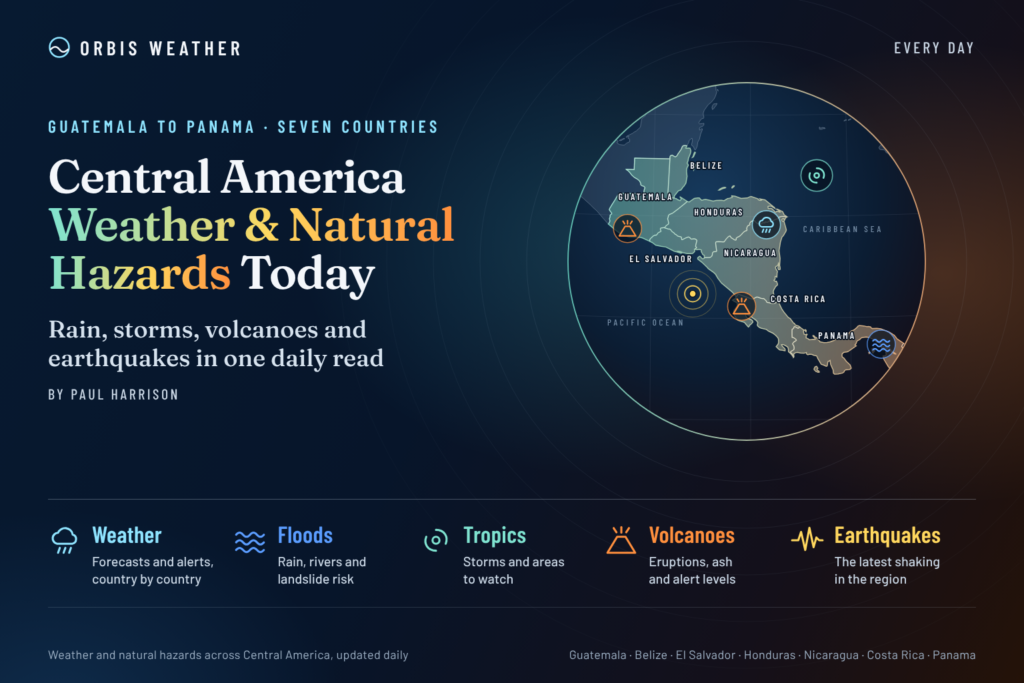
- Central America Weather & Natural Hazards Today — Sunday, November 1, 2026 10:03 AM
- North America Weather & Natural Hazards Today Nov 1 9:46 AM
- Indonesia Forest Fire Haze Linked to More Than 3,500 Deaths in September as Air Pollution Crisis Deepens 8:37 AM
- Weekly Earth Watch: Volcanoes, Earthquakes & Natural Hazards – Week ending November 1, 2026 7:57 AM
- Daily Earthquakes, Storms, Fires & Floods Report — November 1, 2026 7:48 AM
- WESTERN PACIFIC Tropical Weather Update – November 1, 2026 7:34 AM
- Eastern & Central Pacific Tropical Weather Update: Sunday, November 1, 2026 7:27 AM
- Tropical Atlantic Daily Report: Sunday, November 1, 2026 7:20 AM
- Galápagos Islands Flood Disaster: One Dead, Two Missing as Torrential Rain Forces Families From Homes 5:26 AM
- Powerful Pacific Storm Could Bring Tornadoes, Damaging Winds and Widespread Rain Across the United States 5:07 AM





🌎 Central America Weather & Natural Hazards Today — Sunday, November 1, 2026
By Paul Harrison | Founder & Publisher, Orbis Weather
Published: November 1, 2026 | Regional Weather & Natural Hazards Report
🌧️ Heavy Rain • 🌊 Flash Flooding • ⛰️ Landslides • 💨 Strong Winds • 🌋 Volcanoes • 🌎 Earthquakes • 🌀 Tropical Weather
Central America begins November with changing weather conditions, increased rainfall in parts of Costa Rica, strong trade winds and the continuing threat of localized flooding and landslides across the region’s mountainous terrain.
From Guatemala and Belize to Panama, the transition toward the drier season is underway in parts of Central America. However, the arrival of November does not mean the end of dangerous weather.
The most significant verified weather developments today concern Costa Rica, where the National Meteorological Institute (IMN) forecasts heavy showers and thunderstorms in southern Pacific areas, increased rainfall along the Caribbean side and wind gusts reaching 85 km/h (53 mph) in exposed northern and mountainous locations.
Meanwhile, the National Hurricane Center reports no active tropical cyclones in the Atlantic or eastern Pacific in its November 1 updates.
🚨 Central America — Today’s Hazard Overview
Hazard | November 1 assessment |
|---|---|
🌀 Tropical cyclones | No active Atlantic or eastern Pacific cyclones reported |
🌧️ Heavy rainfall | Showers and thunderstorms forecast in parts of Costa Rica |
🌊 Flash flooding | Localized potential where heavy rain develops |
⛰️ Landslides | Conditional risk on steep, rain-soaked slopes |
💨 Strong winds | Gusts of 60–85 km/h possible in exposed Costa Rican locations |
🌋 Volcanoes | Continued monitoring; no new major eruption verified in this report |
🌎 Earthquakes | Persistent regional tectonic hazard; no new damaging event verified here |
🌊 Coastal hazards | Monitor local marine advisories and thunderstorms |
Editorial note: This table distinguishes verified weather forecasts from general hazards that require continued monitoring. It is not a declaration of active warnings throughout Central America.
🗺️ Country-by-Country Weather & Natural Hazards
🇬🇹 Guatemala — Highlands, Rivers and Volcanic Monitoring
Guatemala begins November with the seasonal transition toward generally drier conditions in many Pacific and central districts. However, Caribbean moisture can still produce rainfall, particularly in northern and eastern areas.
The country’s mountainous landscape makes short periods of intense rainfall potentially dangerous, especially in communities near steep slopes, river valleys and vulnerable road networks.
Main hazards to monitor:
🌧️ Localized showers where moisture and atmospheric instability develop.
🌊 Rapid river rises following heavy rainfall.
⛰️ Landslides in highland departments such as Alta Verapaz, Quiché, Huehuetenango and San Marcos.
🌋 Volcanic activity at Fuego, Santiaguito and Pacaya.
Guatemala’s volcanic chain requires year-round monitoring, but routine volcanic activity should not be confused with a newly confirmed eruption emergency.
Today’s assessment: No specific new nationwide flooding emergency, major volcanic escalation or damaging earthquake has been independently verified for this November 1 report.
Official monitoring: INSIVUMEH — Guatemala’s meteorological and geological agency.
🇧🇿 Belize — Caribbean Showers and Coastal Flood Awareness
Belize remains exposed to Caribbean moisture as November begins, with the possibility of showers and thunderstorms during the late wet-season transition.
Low-lying coastal communities, including Belize City, are particularly vulnerable when intense rainfall overwhelms local drainage systems.
Residents should monitor river levels following prolonged rainfall, especially in communities near the Belize River and other flood-prone waterways.
The absence of an active Atlantic tropical cyclone is encouraging, but isolated thunderstorms can still produce hazardous conditions.
Today’s assessment: No specific November 1 nationwide flood emergency has been verified in the information reviewed.
Official monitoring: National Meteorological Service of Belize.
🇭🇳 Honduras — Northern Rainfall and Mountain Landslide Risks
Honduras remains vulnerable to heavy rainfall associated with Caribbean moisture, particularly across its northern coastal departments.
Cortés, Atlántida, Colón and mountainous interior districts can experience localized flooding when persistent showers or thunderstorms develop.
Roads crossing steep mountain terrain require particular attention following periods of heavy rainfall.
Communities near rivers and streams should monitor local forecasts and emergency information rather than relying on broad regional weather descriptions.
Today’s assessment: Flooding and landslides remain important conditional hazards, but no new nationwide emergency is confirmed in this report.
Official monitoring: COPECO — Honduras civil protection.
🇸🇻 El Salvador — Localized Thunderstorms and Volcanic Hazards
El Salvador’s compact geography combines densely populated urban districts, steep mountain slopes and an active volcanic chain.
Although the country is moving toward its drier season, localized thunderstorms can still create problems where intense rainfall overwhelms drainage infrastructure.
San Salvador and other urban centers are particularly sensitive to rapid surface-water accumulation.
The country’s volcanoes, including San Miguel, also require continued geological observation.
Today’s assessment: No new major eruption or damaging earthquake has been independently confirmed for November 1 in the information reviewed.
Official monitoring: El Salvador’s environmental and natural hazards monitoring service.
🇳🇮 Nicaragua — Caribbean Moisture and Volcanic Activity
Nicaragua remains exposed to rainfall from the Caribbean and localized thunderstorms over inland and Pacific districts.
Flood-sensitive locations include low-lying river valleys, rural crossings and communities where road access can be disrupted by intense rainfall.
The country’s volcanic chain includes Masaya, Telica, Momotombo and Concepción, all of which are important subjects of routine geological monitoring.
A lack of active tropical cyclones does not eliminate the possibility of dangerous localized weather.
Today’s assessment: No specific November 1 tropical cyclone landfall, major volcanic eruption or nationwide flood emergency has been verified in this report.
Official monitoring: INETER — Nicaragua’s territorial studies institute.
🇨🇷 Costa Rica — Strong Winds, Increasing Rainfall and Thunderstorms
Costa Rica has the clearest documented weather concerns in today’s regional outlook.
According to the National Meteorological Institute’s forecast for Sunday, November 1, increasing atmospheric moisture is expected to produce greater cloud cover and rainfall across several parts of the country.
🌧️ Caribbean and Northern Zone
Rainfall is forecast mainly during the morning, with showers potentially spreading toward mountainous districts and eastern parts of the Central Valley.
⛈️ Central and South Pacific
Afternoon rainfall is expected in the Central Pacific, while the South Pacific could experience heavy showers and thunderstorms. Additional coastal rainfall is possible during the night.
💨 Central Valley and North Pacific
Moderate to strong trade winds are expected to continue throughout the day.
Central Valley and North Pacific
30–60
km/h gusts (19–37 mph)
Mountains and northern Guanacaste
60–85
km/h gusts (37–53 mph)
Potential impacts include difficult driving conditions on exposed roads, falling branches, localized flooding beneath intense thunderstorms and slippery mountain routes.
The IMN’s weekly outlook also identifies a possible arrival of Tropical Wave 52 early next week. That is a forecast tropical wave, not a confirmed tropical cyclone.
Official forecast: Costa Rica National Meteorological Institute.
🇵🇦 Panama — Wet-Season Thunderstorms and Flood Potential
Panama remains within its wetter part of the year, when tropical moisture can support showers and thunderstorms across both Pacific and Caribbean districts.
Urban flooding is a concern when heavy rain overwhelms drainage systems, particularly in densely developed areas.
Western mountain districts, including Chiriquí, can experience landslide hazards after prolonged rainfall, while river communities in Darién and other rural regions should monitor changing water levels.
Today’s assessment: No specific November 1 nationwide flood emergency has been independently confirmed for this report.
Official monitoring: Panama Institute of Meteorology and Hydrology.
🌀 Tropical Weather Outlook — Atlantic, Caribbean and Eastern Pacific
The National Hurricane Center’s November 1 updates confirm that there are currently no active tropical cyclones in either the Atlantic basin or eastern Pacific.
Atlantic and Caribbean
Eastern Pacific
The National Hurricane Center has also noted marine warnings in the eastern Pacific. Mariners should check the relevant offshore and coastal forecasts before departure.
The Atlantic and eastern Pacific hurricane seasons both officially continue through November 30.
🌋 Volcano Monitoring — Central America’s Ring of Fire
Central America lies along a major tectonic boundary where the Cocos Plate moves beneath parts of the Caribbean Plate.
This geological setting produces frequent earthquakes and supports a chain of active volcanoes stretching from Guatemala through Costa Rica.
Important volcanoes to monitor include:
Country | Volcanoes |
|---|---|
🇬🇹 Guatemala | Fuego, Santiaguito, Pacaya |
🇸🇻 El Salvador | San Miguel, Santa Ana |
🇳🇮 Nicaragua | Masaya, Telica, Momotombo |
🇨🇷 Costa Rica | Poás, Rincón de la Vieja, Turrialba |
Volcanic hazards may include ash emissions, gas releases, explosive activity and lahars, depending on the volcano and prevailing conditions.
November 1 status: This article does not independently establish current alert levels for individual volcanoes. Readers should consult the relevant national observatory for current activity, access restrictions and official warnings.
🌎 Earthquake Monitoring — A Seismically Active Region
Earthquakes remain a year-round natural hazard across Central America.
The Pacific margin is particularly active because of the interaction between tectonic plates, although earthquakes can also occur inland and near the Caribbean coast.
Potential earthquake impacts include structural damage, landslides, disrupted transportation and, for certain offshore events, tsunami hazards.
No specific damaging November 1 earthquake has been independently verified for inclusion in this report. That should not be interpreted as confirmation that no earthquakes occurred.
For current seismic activity, visit the USGS real-time earthquake map.
📅 What to Watch — November 2–4
The main verified near-term development is Costa Rica’s changing rainfall pattern.
The IMN weekly outlook for October 29–November 4 identifies increasing moisture over the weekend, showers and thunderstorms in several regions, and the possible arrival of Tropical Wave 52 early next week.
Across the wider region, the following conditions deserve continued monitoring:
🌧️ Monday, November 2: Rainfall developments in Costa Rica and any newly issued flood advisories.
🌀 Tuesday, November 3: Updated tropical weather outlooks for the Caribbean and eastern Pacific.
⛰️ Wednesday, November 4: Changes in rainfall, river levels and slope stability where repeated thunderstorms have occurred.
These are monitoring priorities, not predictions of confirmed emergencies.
🛟 Safety Advice for Residents and Travelers
During periods of intense rainfall, avoid driving through flooded roads or attempting to cross swollen rivers. Water depth and current strength can be difficult to judge.
Travelers in mountainous regions should remain alert for falling rocks, debris and landslides, particularly after prolonged rainfall.
For strong winds, secure loose outdoor items and exercise caution on exposed roads and mountain passes.
Anyone visiting volcanic areas should check access restrictions and air-quality advisories issued by the responsible national authorities.
❓ Frequently Asked Questions
Is there a hurricane threatening Central America today?
No active tropical cyclone is reported in the Atlantic or eastern Pacific as of the National Hurricane Center’s November 1 updates.
Which country has the most significant verified weather concerns today?
Costa Rica has the clearest documented forecast concerns in this report, including heavy showers, thunderstorms and strong wind gusts in exposed locations.
Can flooding occur without a tropical storm?
Yes. Intense thunderstorms and prolonged rainfall can produce flash flooding and landslides without an organized tropical cyclone.
Are Central America’s volcanoes currently erupting?
Some volcanoes in the region are persistently active, but this report does not verify individual eruption status for November 1. Consult official volcano observatories for current activity.
When does hurricane season end?
The Atlantic and eastern Pacific hurricane seasons officially end on November 30.
📚 Sources and Editorial Methodology
Orbis Weather prioritizes official meteorological, geological and emergency-management agencies when preparing regional weather reports.
Primary sources consulted for this November 1 update include the National Hurricane Center’s November 1 outlooks and Costa Rica’s National Meteorological Institute daily forecast and October 29–November 4 weekly outlook.
Additional national agencies are linked throughout this article for readers seeking local information.
This report separates confirmed forecasts from general geographic hazards and does not present unverified incidents as breaking news. Where current national bulletins could not be independently verified, that limitation is stated.
Weather forecasts, tropical outlooks and natural-hazard conditions can change rapidly. Official government warnings and evacuation instructions always take precedence over this article.
🌎 Orbis Weather — The Bigger Picture
Central America enters November without an active tropical cyclone threatening the region, but the absence of a named storm should never be mistaken for an absence of weather hazards.
Costa Rica’s forecast increase in rainfall, thunderstorms and strong trade winds demonstrates how significant local weather can develop independently of hurricanes.
Across the wider region, flash flooding, landslides, earthquakes and volcanic activity remain important hazards requiring reliable information and ongoing monitoring.
Orbis Weather will continue following developments across Central America, the Caribbean and the eastern Pacific.
Sometimes the greatest danger is not a named storm, but the rain, wind or unstable ground much closer to home
About the Author
Paul Harrison — Founder & Publisher, Orbis Weather
Paul Harrison founded Orbis Weather in 2026 to make global weather and natural-hazard information easier to find, follow and understand. His coverage includes tropical cyclones, severe weather, extreme temperatures, earthquakes, volcanoes, wildfires, flooding and significant natural disasters worldwide.
View all articles by Paul Harrison → | Editorial Standards →
Global Weather Tracker Hub
Explore weather maps, tropical systems, storms and natural hazards around the world.
No matching trackers found.