
Indonesia Forest Fire Haze Linked to More Than 3,500 Deaths in September as Air Pollution Crisis Deepens
By Paul Harrison | Founder & Publisher, Orbis Weather

- Thailand Warns Eight Provinces of Possible Flooding as High Tides Threaten Bangkok and Coastal Communities 10:55 AM
- South America Weather & Natural Hazards Today — November 1, 2026 10:15 AM
- Central America Weather & Natural Hazards Today — Sunday, November 1, 2026 10:03 AM
- North America Weather & Natural Hazards Today Nov 1 9:46 AM
- Indonesia Forest Fire Haze Linked to More Than 3,500 Deaths in September as Air Pollution Crisis Deepens 8:37 AM
- Weekly Earth Watch: Volcanoes, Earthquakes & Natural Hazards – Week ending November 1, 2026 7:57 AM
- Daily Earthquakes, Storms, Fires & Floods Report — November 1, 2026 7:48 AM
- WESTERN PACIFIC Tropical Weather Update – November 1, 2026 7:34 AM
- Eastern & Central Pacific Tropical Weather Update: Sunday, November 1, 2026 7:27 AM
- Tropical Atlantic Daily Report: Sunday, November 1, 2026 7:20 AM
- Galápagos Islands Flood Disaster: One Dead, Two Missing as Torrential Rain Forces Families From Homes 5:26 AM
- Powerful Pacific Storm Could Bring Tornadoes, Damaging Winds and Widespread Rain Across the United States 5:07 AM





Indonesia Forest Fire Haze Linked to More Than 3,500 Deaths in September as Air Pollution Crisis Deepens
Orbis Weather | November 1, 2026 | By Paul Harrison
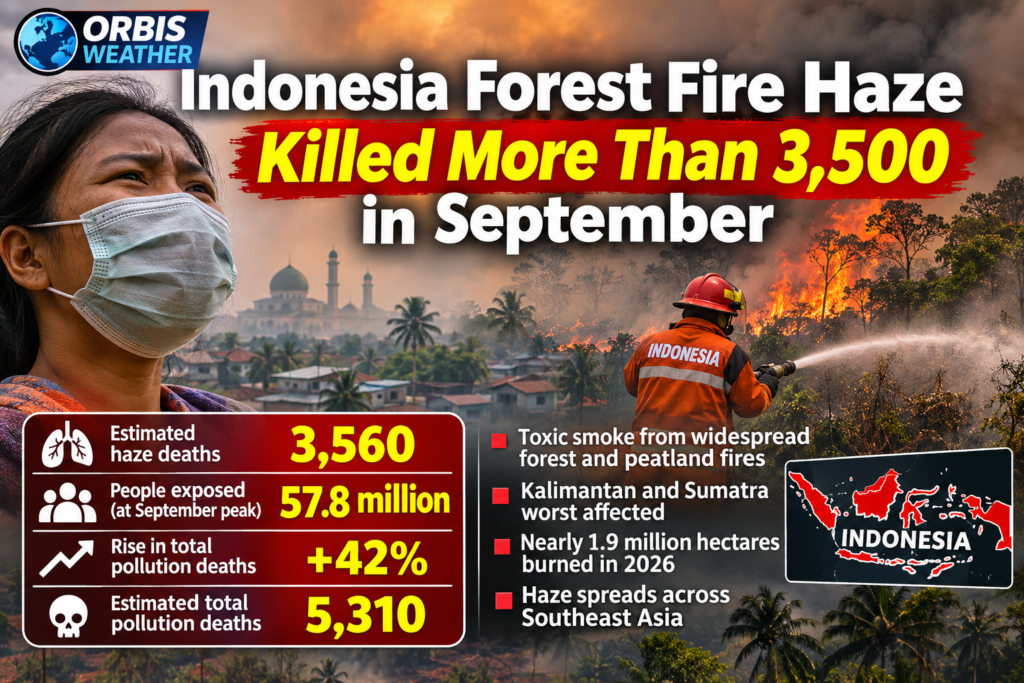
JAKARTA, INDONESIA — Toxic smoke from devastating forest and peatland fires across Indonesia is estimated to have caused 3,560 deaths during September 2026, according to a major new study highlighting the deadly consequences of the country’s worsening wildfire and air pollution emergency.
Research published on October 29 by the Centre for Research on Energy and Clean Air (CREA) found that total air pollution-related deaths increased by 42% between August and September, with millions of people exposed to dangerously polluted air.
The findings reveal the extraordinary human cost of fires intensified by prolonged drought and El Niño conditions, with hazardous smoke spreading across Indonesia and into neighboring Southeast Asian countries.
🔴 Indonesia’s Air Pollution Crisis: The Numbers
Estimated wildfire-smoke deaths
3,560
People exposed at September peak
57.8M
Rise in total pollution deaths
+42%
Estimated total pollution deaths
5,310
🌫️ Kalimantan and Sumatra Among the Worst-Affected Regions
The crisis has been particularly severe in Kalimantan, the Indonesian portion of Borneo, and across parts of Sumatra.
In four Kalimantan provinces, wildfire smoke accounted for approximately 94% to 99% of estimated air pollution-related deaths. Several provinces in Sumatra recorded fire-smoke contributions exceeding 80%.
Kalimantan’s average fine-particle pollution concentration increased from 57 micrograms per cubic meter in August to 120 in September.
On September 21, the region recorded a daily population-weighted PM2.5 concentration of approximately 196 micrograms per cubic meter.
These extremely high concentrations illustrate the dangerous conditions faced by communities living near burning forests and peatlands.
🔥 Why Are Indonesia’s Forest Fires So Severe?
Several factors have contributed to the 2026 wildfire emergency.
Prolonged drought associated with El Niño has dried vegetation and peatlands, creating conditions in which fires can ignite and spread rapidly.
Human land-clearing practices have also contributed to the problem. Fires used to clear land can escape into surrounding forests and dried peat deposits.
Peatland fires are especially difficult to extinguish because they can burn beneath the surface, producing thick smoke over extended periods.
According to figures reported by AFP, wildfires burned more than 1.9 million hectares across Indonesia during the first nine months of 2026.
🌏 Toxic Haze Spreads Across Southeast Asia
The consequences have extended beyond Indonesia’s borders.
Smoke has affected air quality in Malaysia, Singapore, the Philippines and Timor-Leste, raising concerns about respiratory health, transportation disruptions and regional environmental damage.
Fine particulate matter, known as PM2.5, is particularly dangerous because these microscopic particles can enter deep into the lungs and bloodstream.
Exposure can worsen asthma and other respiratory conditions and increase cardiovascular risks, particularly among children, older adults and people with existing illnesses.
🚒 Indonesia Mobilizes Thousands to Fight the Fires
Indonesia’s government says it has deployed substantial resources to combat the wildfire emergency.
According to its October 28 statement, authorities had mobilized more than 72,000 personnel for firefighting and cloud-seeding operations, activated over 2,100 healthcare workers and distributed approximately 5.3 million face masks.
However, environmental researchers have called for stronger prevention measures, including peatland restoration, stricter enforcement against illegal burning and improved pollution monitoring.
The Indonesian government had not confirmed or rejected CREA’s mortality estimate when AFP reported the findings on October 30.
⚠️ What Residents Should Know
During periods of unhealthy or hazardous air pollution, public health guidance generally recommends limiting outdoor exertion, keeping indoor air as clean as possible and using properly fitted N95 or equivalent respirators when outdoor exposure cannot be avoided.
Residents should follow official local air quality readings and public health advisories, especially in regions affected by persistent wildfire smoke.
🔎 Understanding the Death Toll
The figure of 3,560 represents a scientific estimate of deaths attributable to short-term wildfire-related PM2.5 exposure, not a verified count of individual death certificates.
CREA’s researchers combined air pollution measurements, population exposure estimates, established exposure-response relationships and baseline mortality data.
This distinction matters because wildfire smoke can contribute to deaths through respiratory and cardiovascular complications without appearing as the direct cause on official death records.
🌍 Orbis Weather Outlook
Indonesia’s wildfire disaster demonstrates how prolonged drought, land management and atmospheric conditions can combine to create a major public health emergency.
Although the latest findings describe September’s impacts, the broader threat from forest and peatland fires remains an important concern for Indonesia and Southeast Asia.
Future haze conditions will depend on rainfall, fire activity, wind direction and efforts to contain burning peatlands.
Orbis Weather will continue following significant wildfire activity, smoke transport and air quality developments across the region.
Sources and Editorial Information
Primary research: Centre for Research on Energy and Clean Air — October 29, 2026
Independent reporting: Agence France-Presse — October 30, 2026
Editorial methodology: This article uses published scientific estimates and independent news reporting. Estimated mortality figures are identified as estimates, and September exposure data should not be interpreted as current November air quality conditions.
Published by Orbis Weather | Paul Harrison
Orbis Weather provides independent coverage of extreme weather, natural hazards, climate-related events and environmental developments worldwide.
About the Author
Paul Harrison — Founder & Publisher, Orbis Weather
Paul Harrison founded Orbis Weather in 2026 to make global weather and natural-hazard information easier to find, follow and understand. His coverage includes tropical cyclones, severe weather, extreme temperatures, earthquakes, volcanoes, wildfires, flooding and significant natural disasters worldwide.
View all articles by Paul Harrison → | Editorial Standards →
Global Weather Tracker Hub
Explore weather maps, tropical systems, storms and natural hazards around the world.
No matching trackers found.