
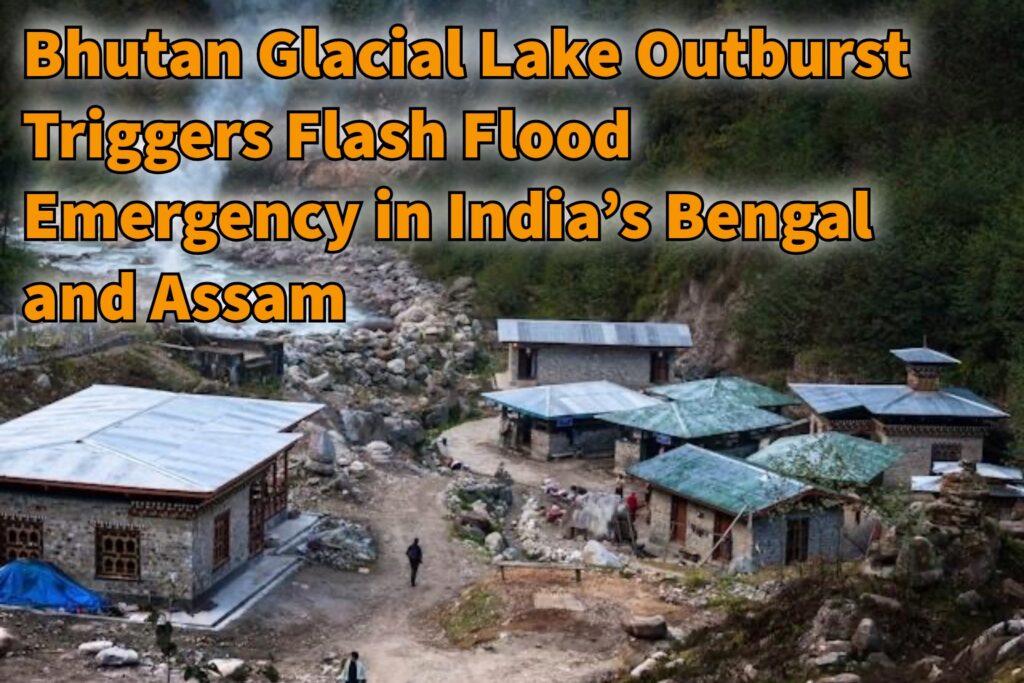
Bhutan Glacial Lake Outburst Triggers Flash Flood Emergency in India’s Bengal and Assam
By Paul Harrison | Founder & Publisher, Orbis Weather

- Europe’s Hot Spots This Week Oct 30 3:03 PM
- Central America Weather & Natural Hazards Today — Friday, October 30, 2026 2:47 PM
- Bhutan Glacial Lake Outburst Triggers Flash Flood Emergency in India’s Bengal and Assam 8:51 AM
- Cyclone Arnab Aftermath 8:33 AM
- Global Natural Disasters This Week — October 30, 2026 7:51 AM
- Daily Earthquakes, Storms, Fires & Floods Report — October 30, 2026 7:42 AM
- Western Pacific Tropical Weather Oct 30 7:27 AM
- Eastern & Central Pacific Tropical Weather Update: Friday, October 30, 2026 7:16 AM
- Tropical Atlantic Daily Report: Friday, October 30, 2026 7:05 AM





Bhutan Glacial Lake Outburst Triggers Flash Flood Emergency in India’s Bengal and Assam
ORBIS WEATHER | BREAKING NEWS | October 30, 2026
A sudden glacial lake outburst in the Himalayan kingdom of Bhutan has unleashed powerful floodwaters, destroying infrastructure and triggering emergency evacuations across parts of northern India. More than 10,000 people have reportedly been moved to safer locations as authorities monitor the threat of flooding downstream.
The disaster began on Thursday evening, October 29, when Shintaphu Lake, also known as Sintaphu Lake, in Bhutan’s mountainous Gasa district suffered a glacial lake outburst flood (GLOF).
The sudden release of water sent a destructive surge into the Mo Chhu River, sweeping away facilities at the popular Gasa Tshachu natural hot springs.
Fortunately, advance evacuations helped prevent casualties in Bhutan, with no deaths or injuries reported as of Friday.
🌊 Millions of Cubic Metres of Water Released
Initial reports suggested that approximately 7.4 million cubic metres of water may have escaped from the lake.
However, the International Centre for Integrated Mountain Development (ICIMOD) said the lake had been estimated to contain between 6 million and 7 million cubic metres before the outburst, and the actual volume released remains under assessment.
The floodwater travelled through Bhutan’s river system toward the Sankosh River, which flows into India.
Authorities warned that the sudden surge could cause dangerous increases in river levels, threatening low-lying communities, farmland, roads and infrastructure.
🚨 India Issues Flood Alerts and Orders Evacuations
Indian authorities placed vulnerable communities in West Bengal and Assam on high alert.
The main areas of concern include:
🔴 Alipurduar, West Bengal: Thousands evacuated from vulnerable riverbank communities.
🔴 Cooch Behar, West Bengal: Residents near the Sankosh River and its tributaries warned to move to higher ground.
🟠 Dhubri, Assam: Emergency teams monitoring possible downstream flooding.
🟠 Kokrajhar, Assam: Authorities coordinating flood preparedness.
🟡 Darjeeling hills and Jalpaiguri: Communities urged to remain vigilant.
In Alipurduar, reports indicated that approximately 4,000–5,000 people were accommodated in emergency shelters, while more than 6,000 others had moved to safer locations.
Schools and community buildings were converted into temporary shelters, with arrangements for food, drinking water and sanitation.
🏔️ Damage Reported Across Northern Bhutan
The flooding caused significant destruction near the Mo Chhu River.
The Gasa Tshachu hot spring complex was devastated, sections of mountain roads were washed away, and transport links were disrupted.
According to Reuters, two temporary Bailey bridges may also have been swept away.
The road toward Laya village became impassable, with traffic suspended while officials assessed the damage.
The same hot spring area suffered serious flooding in August 2021, highlighting its vulnerability to sudden Himalayan river surges.
❄️ What Is a Glacial Lake Outburst Flood?
A glacial lake outburst flood, commonly called a GLOF, occurs when water stored in a glacier-fed lake suddenly escapes.
Many Himalayan glacial lakes are held back by natural barriers of loose rock, sediment and ice known as moraines.
These barriers can fail because of slope collapses, ice avalanches, erosion, rising water levels or other disturbances.
When a barrier gives way, enormous quantities of water can rush downstream within minutes, carrying rocks, mud, trees and debris.
Unlike ordinary river flooding, a GLOF can develop rapidly and travel considerable distances, leaving communities with little time to respond.
🌡️ Why Himalayan Glacial Lakes Are a Growing Concern
Climate warming is contributing to glacier retreat across much of the Himalayas, creating and enlarging glacial lakes.
As these lakes expand, unstable natural barriers can become increasingly hazardous.
ICIMOD reports that 388 glacial lake outburst floods have been documented across the Hindu Kush Himalayan region.
The organization says the Bhutan incident demonstrates the importance of monitoring high-altitude lakes, improving early warning systems and sharing information between countries connected by major river systems.
⚡ Hydropower Infrastructure Under Watch
The flooding also raised concerns about hydropower facilities along Bhutan’s Punatsangchhu River system.
Reports indicated that the Punatsangchhu II hydropower plant temporarily stopped electricity generation and opened spillway gates to help manage floodwater and debris.
Bhutanese monitoring stations and Indian river-gauge networks were tracking water levels as the surge moved downstream.
📡 Latest Situation — October 30, 2026
Indicator | Reported status |
|---|---|
Location | Shintaphu Lake, Bhutan |
Incident | Glacial lake outburst flood |
Date | October 29, 2026 |
Water volume | Still being assessed |
Deaths in Bhutan | None reported |
Evacuations in West Bengal | More than 10,000 reported |
Indian flood alerts | West Bengal and Assam |
Main river concern | Mo Chhu–Sankosh system |
These figures reflect reports available October 30 and may change as authorities complete their assessments.
🛑 Safety Advice for Residents
People living along affected rivers should follow official evacuation instructions, avoid riverbanks and low-lying crossings, and never attempt to drive or walk through moving floodwater.
The Central Water Commission has warned that river levels can rise suddenly as floodwater moves through the Sankosh system.
🌍 Orbis Weather Analysis
The Bhutan disaster illustrates how a sudden event high in the Himalayas can create serious flood risks far beyond the mountains where it begins.
Although the immediate damage occurred in Bhutan, downstream communities in India faced potential flooding hours later.
The advance warnings and evacuations appear to have played an important role in reducing the danger to residents.
With glacial lakes continuing to evolve across the Himalayas, improved monitoring, faster emergency communications and international cooperation will remain essential.
Orbis Weather will continue following developments as authorities assess the damage and monitor downstream river conditions.
Sources: ICIMOD, Reuters, India Central Water Commission advisory, The Week.
Editorial note: This report combines attributed news reporting and regional hazard information. It is not a substitute for official emergency alerts or real-time river-level observations.
About the Author
Paul Harrison — Founder & Publisher, Orbis Weather
Paul Harrison founded Orbis Weather in 2026 to make global weather and natural-hazard information easier to find, follow and understand. His coverage includes tropical cyclones, severe weather, extreme temperatures, earthquakes, volcanoes, wildfires, flooding and significant natural disasters worldwide.
View all articles by Paul Harrison → | Editorial Standards →
Global Weather Tracker Hub
Explore weather maps, tropical systems, storms and natural hazards around the world.
No matching trackers found.