Coral Reefs Then and Now: 40 Years of Change.
By Paul Harrison | Founder & Publisher, Orbis Weather




Coral Reefs Have Declined Nearly 10% in Just 40 Years — Scientists Warn the Window for Recovery Is Shrinking
· @Paul
By Paul Harrison, Orbis Weather
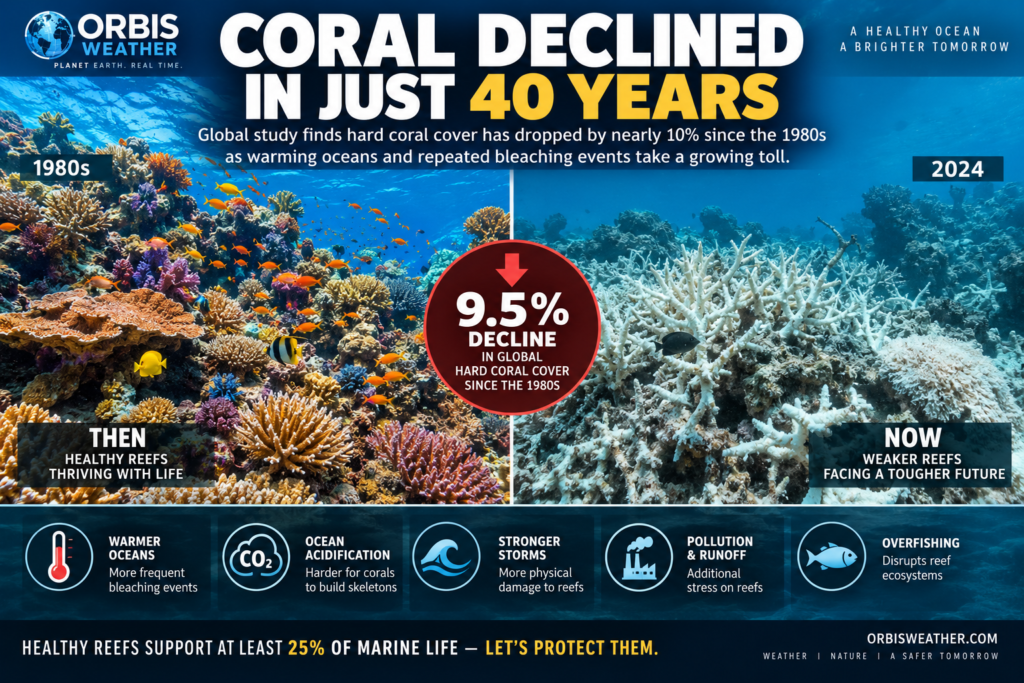
The world’s coral reefs have lost nearly a tenth of their living hard coral in four decades, according to the most comprehensive survey of reef health yet assembled. Average hard coral cover fell from 30.2% in the period 1980 to 2009 to 27.3% in 2020 to 2024, a relative decline of about 9.5%.
The finding comes from Status of Coral Reefs of the World: 2025, published on August 31, 2026, by the Global Coral Reef Monitoring Network. It draws on more than 21 million observations from nearly 37,000 reef sites in over 120 countries and territories.
The report’s sharper warning concerns time. Reefs can still regrow after they are damaged, but marine heat waves now return about every five years, where they once came about once a decade. “Today, they’re lucky to get five or six years,” said the lead author, Dr Manuel González Rivero. With a strong El Niño now building in the Pacific, reefs hit in 2024 may get little more than a year.
Key facts
Detail | |
|---|---|
The report | Status of Coral Reefs of the World: 2025, Global Coral Reef Monitoring Network (GCRMN), released August 31, 2026 |
Headline finding | Average hard coral cover fell from 30.2% (1980 to 2009) to 27.3% (2020 to 2024), a relative decline of about 9.5% |
Uncertainty range | Between 4.0% and 14.5% |
Cover in 2024 | 25.8%, after the largest single-year drop on record |
Seaweed | Macroalgae cover rose 44.1%, to 6.8% in 2024 |
Data behind it | 21.1 million observations from 87,299 surveys at 36,886 reef sites in 124 countries and territories, 1980 to 2024 |
Contributors | More than 600 partner organizations |
Main cause | Heat stress from a warming ocean |
Ocean warming over reefs | 0.81°C between 1985 and 2025 |
Time between major heat events | About 10 years before 2010; 4 to 6 years since |
Time reefs need | Recovery picks up sharply after about six years without bleaching |
What is at stake | Reefs cover less than 0.2% of the sea floor, support at least 25% of marine species, and about one billion people depend on them |
All figures from the GCRMN report and its executive summary unless stated otherwise in the text.
What the report found
Living hard coral now covers a little over a quarter of the reef surface that scientists survey, down from just under a third in the 1980s to 2000s.
Two ways to state the decline
The “nearly 10%” figure is a relative change. In plain percentage points, average hard coral cover fell by 2.9 points, from 30.2% to 27.3%. Both describe the same loss.
The single-year figure for 2024 is lower still, at 25.8%. Cover fell 8.9% between 2023 and 2024 alone, the steepest one-year drop in the record.
Why “hard coral cover” is the measure
Hard corals are the animals that build a reef’s limestone framework. Divers and cameras record what share of the reef surface they occupy. It is the most widely collected measure of reef health, which is what allows 40 years of surveys from different countries to be combined.
A staircase, not a slope
The decline has come in steps. Each of the four global bleaching events since 1998 knocked global coral cover down, and reefs regained only part of the loss before the next one arrived.
Global bleaching event | Estimated loss of global hard coral cover |
|---|---|
First, 1998 to 1999 | About 6.5% |
Second, 2010 to 2011 | About 9.9% |
Third, 2016 to 2017 | About 6.6% |
Fourth, 2023 to 2024 | About 8.9% |
Between the third and fourth events, from 2017 to 2019, coral cover grew back by about 6%. It did not return to its earlier level. The report says global cover has not been back at its reference level at any time since 2010.
More seaweed
As coral has declined, fleshy seaweed has spread. Macroalgae cover rose 44.1% over the same period, most of it after 2010. At 6.8% of reef surface in 2024 it remains low worldwide, but seaweed competes with young corals for space and can slow a reef’s recovery.
Probably an underestimate
Surveys from the 1980s are sparse, and many reefs had already been damaged before anyone measured them. The report says the true long-term loss is probably greater than the figures show.
The previous global assessment, published in 2021, found that 14% of the world’s coral had been lost between 2009 and 2018. The new report uses more than ten times as many reef sites and a longer baseline, so the two headline figures are not directly comparable.
The picture by region
The global average hides large differences. Four of the network’s ten regions show a strong long-term decline, four show no strong change, and two have recovered from a badly damaged starting point.
Trend since the 1980 to 2009 reference period | Regions |
|---|---|
Strong decline | Caribbean; Australia; Pacific; the ROPME Sea Area (the Persian Gulf, Gulf of Oman and adjoining waters) |
No strong long-term change | Brazil; East Asian Seas; Eastern Tropical Pacific; Red Sea and Gulf of Aden |
Strong recovery from a degraded state | South Asia; Western Indian Ocean |
Among the declining regions, the report’s summary lists relative losses ranging from about 11% to about 49%. The two recovering regions gained about 16% and 43%.
The Caribbean has been hit hardest and longest. A separate GCRMN report on the region, published in December 2025, found that hard coral cover there fell 48% between 1980 and 2024 while seaweed cover rose 85%. The sharpest drops came in 1998, 2005 and 2023. Sea surface temperature over Caribbean reefs rose 1.07°C from 1985 to 2024, and a fast-spreading illness called stony coral tissue loss disease has added to the damage.
South Asia and the Western Indian Ocean look better on paper for a reason. Both were devastated by the 1998 bleaching event, which falls inside the reference period, so they are being measured against a low starting point. Local studies show how fragile the gains are. In India’s Lakshadweep islands, coral cover fell from about 37% to under 20% between 1998 and the present, according to a 24-year study cited by Mongabay India.
Australia and the Pacific hold a large share of the world’s reefs, including the Great Barrier Reef, so their decline weighs heavily on the global figure.
The Eastern Tropical Pacific is where the current El Niño is felt first. Reefs off Panama “are severely bleached right now, and their fate following the current El Niño is uncertain,” said Derek Manzello, who coordinates the U.S. agency NOAA’s Coral Reef Watch program.
Why reefs are declining
Heat is the main cause. “Corals are declining globally and climate change is now the main driver of this change,” said Jérémy Wicquart, a marine ecologist and co-editor of the report.
How heat kills coral
Reef-building corals live in partnership with microscopic algae that sit inside their tissue. The algae make food from sunlight and give corals most of their energy, and their color.
When the water stays too warm for too long, the partnership breaks down. “The coral expels the algae as a mechanism to try to protect itself,” Mollie Asbury, a coral ecologist with National Geographic’s Pristine Seas project, told the magazine. The coral turns white, which is why the process is called bleaching.
A bleached coral is alive but starving. If the water cools within a few weeks it can take the algae back and recover. If the heat lasts, it dies.
The ocean is warmer
Sea surface temperature over the world’s reefs rose 0.81°C between 1985 and 2025, the report found. That raises the baseline, so each natural warm spell, such as an El Niño, now pushes more reefs past their limit.
The fourth global bleaching event, from 2023 to 2025, was the most intense on record. More than 80% of the world’s tropical reefs experienced extreme heat stress during it.
Local pressures make it worse
The report lists pressures that weaken reefs before the heat arrives and slow them afterward:
- overfishing, which removes the fish that graze seaweed;
- pollution and run-off from land, which cloud the water and feed algae;
- coastal development;
- coral disease;
- outbreaks of coral-eating animals.
More people are living beside reefs than ever. About 104 million people live within 5 km (3 miles) of one, a rise of 46% in two decades.
Why the window for recovery is shrinking
Reefs are not failing to recover. They are running out of time to do it.
Recovery takes years. After a bleaching event, surviving corals have to regrow and new ones have to settle and mature. The evidence gathered for the report shows recovery rates rising sharply once a reef has had about six years without bleaching.
The gaps are closing. Until about 2010, major heat stress struck a given region roughly once a decade. Since then it has returned every four to six years. The problem, González Rivero said, is “that we’re steadily eroding the conditions they need to recover”. He added: “Today, they’re lucky to get five or six years.”
Before 2010 | Since 2010 | |
|---|---|---|
Time between major heat stress events | About 10 years | 4 to 6 years |
Time a reef needs for strong recovery | About 6 years | About 6 years |
Margin | A few years to spare | None |
The next test has already begun. A strong El Niño is under way in the Pacific. The World Meteorological Organization says it is firmly established and almost certain to last through February 2027. The U.S. Climate Prediction Center said on October 8 that a strong to very strong event is likely.
That matters because of the record. “There have been four [global coral bleaching events], and each event has impacted more reefs than the previous event,” Manzello said. Every strong El Niño since 1998 has been associated with one.
Reefs that bleached in the heat waves of 2024 may therefore get little more than a year before the next round of heat, the report’s authors said. That is a fraction of the time they need.
The longer view. The Intergovernmental Panel on Climate Change has warned that 70% to 90% of today’s warm-water coral reefs would disappear at 1.5°C of global warming, a level the world is now close to reaching.
Why coral reefs matter
Reefs occupy a tiny part of the ocean and support a very large part of its life.
- Wildlife. Reefs cover less than 0.2% of the sea floor but support at least a quarter of all marine species.
- Food. They are nurseries for fish that feed coastal communities. About one billion people depend on reefs in some way.
- Protection. A healthy reef breaks waves before they reach shore, which reduces flooding and erosion during storms and hurricanes.
- Livelihoods. Fishing and tourism on reef coasts support millions of jobs.
- Neighbors. About 104 million people live within 5 km of a reef.
When coral cover falls, the reef’s structure slowly erodes. It shelters fewer fish and blunts less wave energy.
What can be done
The report’s central message is that reefs have not passed a point of no return. They can still recover if heat waves are spaced far enough apart and local damage is kept low.
Two things at once
- Cut greenhouse gas emissions. Ocean warming decides whether recovery is possible at all. The report says local action cannot replace it.
- Reduce local pressures. Reefs under less stress from fishing, pollution and construction resist heat better and regrow faster. “Local protection matters even more than maybe it did before,” said Beverley French, a researcher at the Scripps Institution of Oceanography.
The report also calls for Traditional Knowledge to be combined with scientific work, and for long-term monitoring to be funded, especially in developing countries where many reefs are and few surveys are done.
Evidence that recovery is real
- Global coral cover grew by about 6% in the two years after the third bleaching event.
- South Asia and the Western Indian Ocean have rebuilt coral from badly degraded states.
- In India’s Andaman Islands, only 11.5% of coral cover in one marine park was bleached or dead after the latest event, far less than in the hardest-hit areas.
- Several regions show reefs recovering where local threats are well managed, the MSC Foundation said in its summary of the report.
What the people behind it said
“It’s in our hands, basically, to save reefs,” said Thomas Dallison, a co-editor.
Ilana Seid, Palau’s ambassador to the United Nations, said: “The challenge before us is no longer identifying what needs to be done, but finding the collective will to do it.”
David Obura, who chairs the international science panel on biodiversity, IPBES, said the findings “must shake us out of our persistent inertia”.
What is uncertain
The direction of the trend is clear. Several of the details are not.
- The full toll of the fourth bleaching event. The report’s data end in 2024. The event is thought to have ended in mid-2025, and a global assessment of it is still under way.
- The size of the long-term loss. The 9.5% figure has a range of 4.0% to 14.5%, and the report says the true loss is probably larger because early surveys are few.
- What this El Niño will do. It is forecast to be strong. Whether it triggers a fifth global bleaching event will not be known until well into 2027.
- What coral cover leaves out. A reef can keep its cover while losing its variety, if fast-growing corals replace slow-growing ones. The report asks for more detailed monitoring for that reason.
- Unsurveyed reefs. Some regions with many reefs have little monitoring, so their trends are less certain.
About this article
This article reports the findings of Status of Coral Reefs of the World: 2025, produced by the Global Coral Reef Monitoring Network, an operational network of the International Coral Reef Initiative. It draws on the network’s announcement and executive summary, on reporting by National Geographic and Mongabay, and on statements from the U.S. and UN weather agencies about the current El Niño. It was written on October 9, 2026.
Terms used
Term | Meaning |
|---|---|
Hard coral | Reef-building corals that lay down a limestone skeleton. Also called stony coral. |
Hard coral cover | The share of the reef surface occupied by living hard coral. The standard measure of reef condition. |
Relative decline | A change expressed as a share of the starting value. A fall from 30.2% to 27.3% is 2.9 percentage points, or 9.5% in relative terms. |
Coral bleaching | A stress response in which corals expel the algae living in their tissue and turn white. |
Global bleaching event | A period in which bleaching is confirmed across all three tropical ocean basins. |
Marine heat wave | A spell of unusually warm sea temperature lasting days to months. |
Macroalgae | Seaweed large enough to see. It competes with coral for space. |
El Niño | A periodic warming of the tropical Pacific that raises sea temperatures across much of the tropics. |
Reference period | The baseline against which change is measured, here 1980 to 2009. |
GCRMN | The Global Coral Reef Monitoring Network, which compiles surveys from scientists and agencies worldwide. |
Notes on the figures
- “Nearly 10%” is the 9.5% relative decline in average hard coral cover between 1980 to 2009 and 2020 to 2024.
- “40 years” refers to the span of the data, 1980 to 2024.
- Bleaching-event losses are relative drops in global hard coral cover linked to each event, from the network’s announcement.
- Regional changes are given as ranges because the summary reviewed for this article did not make clear which figure belongs to which region. The Caribbean figure of 48% comes from the network’s separate regional report.
- Reef area. The network gives less than 0.2% of the sea floor. Other sources say about 1% of the ocean. The difference comes from what is counted.
Limits
- This article relies on the report’s executive summary and announcement. The full report was not reviewed.
- Figures for the 2023 to 2025 bleaching event are preliminary.
- Statements about the current El Niño reflect forecasts issued in early October 2026.
Frequently asked questions
How much coral has the world lost?
Average hard coral cover on the world’s reefs fell by about 9.5% in relative terms between the period 1980 to 2009 and the period 2020 to 2024. In percentage points, it went from 30.2% to 27.3%. In 2024 alone it stood at 25.8%.
Who measured it?
The Global Coral Reef Monitoring Network, which combined 21.1 million observations from nearly 37,000 reef sites in 124 countries and territories, supplied by more than 600 partner organizations.
Is 10% really that bad?
It is a global average over 40 years, and it hides much larger regional losses. The Caribbean has lost about 48% of its hard coral since 1980. The report also says the true global loss is probably higher, because early records are thin.
What is causing the decline?
Mainly heat stress from a warming ocean, which causes mass bleaching. Overfishing, pollution, coastal construction and disease make reefs less able to cope.
What does “window for recovery” mean?
Reefs need about six years without bleaching to recover strongly. Major heat events used to come about once a decade. They now return every four to six years, so reefs are hit again before they have regrown.
Can coral reefs still recover?
Yes. Global coral cover grew by about 6% between 2017 and 2019, and two regions have rebuilt coral from badly damaged states. The report says reefs have not passed a point of no return.
Will the current El Niño cause more bleaching?
It is likely. Every strong El Niño since 1998 has been linked to a global bleaching event, and this one is forecast to be strong. Reefs off Panama are already severely bleached.
Is the Great Barrier Reef included?
Yes. Australia is one of the ten regions in the report and is among the four showing a strong long-term decline.
What would save coral reefs?
Cutting the emissions that warm the ocean, and at the same time reducing local damage from fishing, pollution and development. The report says neither is enough alone.
How is this different from earlier warnings?
Earlier reports measured how much coral had been lost. This one also measures how much time reefs have between disasters, and finds that it has roughly halved.
About the Author
Paul Harrison — Founder & Publisher, Orbis Weather
Paul Harrison founded Orbis Weather in 2026 to make global weather and natural-hazard information easier to find, follow and understand. His coverage includes tropical cyclones, severe weather, extreme temperatures, earthquakes, volcanoes, wildfires, flooding and significant natural disasters worldwide.
View all articles by Paul Harrison → | Editorial Standards →
Live Lightning Map
Live U.S. Wildfire Tracker
Live Wildfire Smoke & Air Quality Tracker
Live Earthquake Map