
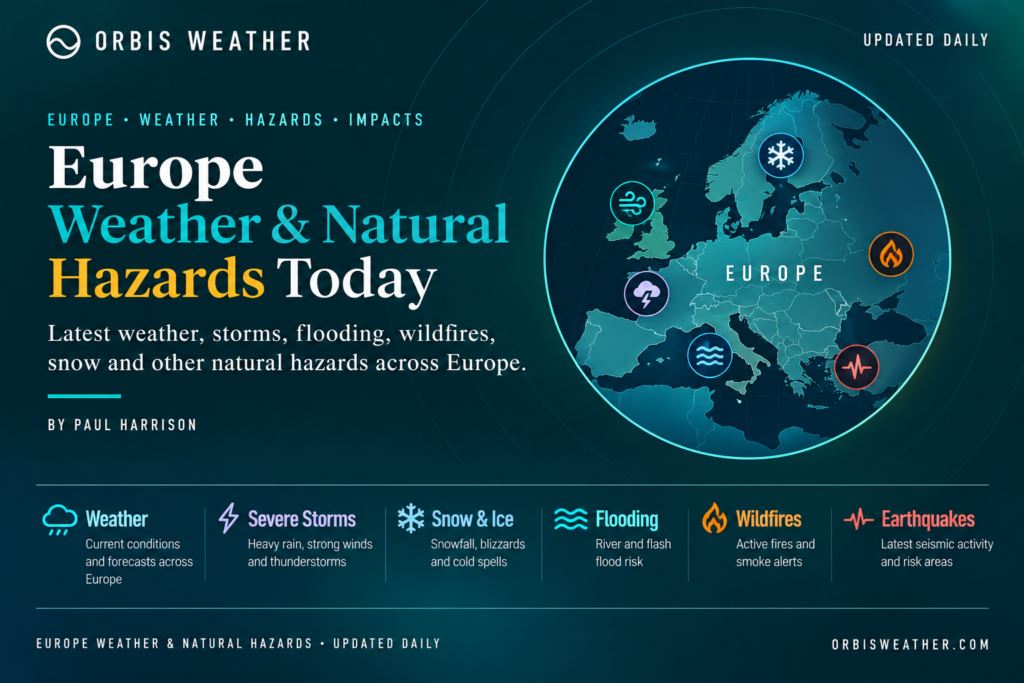
🌍 Europe Weather & Natural Hazards Today
By Paul Harrison | Founder & Publisher, Orbis Weather

- America’s Hot Spots This Week November 5, 2026 2:44 PM
- Southwest Indian Ocean Tropical Weather Update – November 6, 2026 12:48 PM
- Australian Region Tropical Weather Update — Friday, November 6, 2026 12:37 PM
- El Niño Heats Up the Pacific as Relentless Typhoons Batter East Asia 11:42 AM
- Australia, New Zealand & Oceania Weather & Natural Hazards Today Nov 6, 2026 10:59 AM
- Ocoee River Crests at Record Level in Copperhill, Triggering Catastrophic Flooding Across Tennessee and Georgia 10:12 AM
- North America Weather & Natural Hazards Today – November 5, 2026 8:31 AM
- Central America Weather & Natural Hazards Today – November 5, 2026 8:21 AM
- South America Weather & Natural Hazards Today – November 5, 2026 8:12 AM
- Daily Earthquakes, Storms, Fires & Floods Report – November 5, 2026 7:39 AM
- Weekly Global Climate Pulse: Thursday, November 5, 2026 7:31 AM
- Tropical Atlantic Daily Report: Thursday, November 5, 2026 7:17 AM
- Eastern & Central Pacific Tropical Weather Update: Thursday, November 5, 2026 7:06 AM
- Western Pacific Tropical Update: In-Fa & Invest 99W 6:53 AM





🌍 Europe Weather & Natural Hazards Today — Monday, November 2, 2026
ORBIS WEATHER | EUROPE DAILY REPORT
By Paul Harrison | Orbis Weather
Published: Monday, November 2, 2026 — European local date
Heavy rain, thunderstorms and strong winds threaten parts of southern Europe as colder air spreads across Italy, while Britain experiences a largely settled start to November.
🌦️ Europe Weather Overview
November begins with a contrasting weather picture across Europe. While parts of the Mediterranean and southeastern Europe face potentially hazardous conditions, the United Kingdom is enjoying a comparatively quiet spell of autumn weather.
The most significant concerns for Monday, November 2, include heavy rainfall, thunderstorms, strong winds and localized flooding, particularly across Italy, Greece and sections of the Balkans.
Weather-warning information published through Europe’s Meteoalarm network on November 1 identified red and orange warnings affecting several countries, including Italy and Greece. Some alerts extended into November 2.
Meanwhile, colder air is moving into Italy, bringing falling temperatures, mountain snowfall and potentially disruptive winds.
Across northern Europe, the seasonal transition toward winter continues, making frost, snow and icy conditions increasingly important hazards to monitor.
🚨 Today’s Main Weather Hazards
Hazard | Areas to watch | Concern |
|---|---|---|
🌧️ Heavy rain | Italy, Greece, Balkans | Flash flooding and surface water |
⛈️ Thunderstorms | Mediterranean, southeastern Europe | Lightning, hail and downpours |
💨 Strong winds | Adriatic and southern Italy | Travel and marine disruption |
❄️ Snow and ice | Alps, higher mountains | Slippery roads and mountain travel |
🌊 Coastal hazards | Mediterranean and Adriatic | Rough seas and hazardous winds |
🌍 Earthquakes | Greece, Italy, Balkans | Ongoing seismic monitoring |
🔥 Wildfires | Mediterranean region | Localized fire and smoke concerns |
These are regional monitoring priorities, not a declaration that every listed hazard is active across every location. Refer to national meteorological agencies for active warnings.
🇬🇧 United Kingdom & Ireland — A Quieter Start to November
The United Kingdom begins Monday under the influence of relatively settled weather.
According to the UK Met Office forecast issued November 1, high pressure is helping maintain largely dry conditions, although scattered showers remain possible.
Monday’s UK outlook:
🌤️ Mostly dry with sunny intervals after early fog clears.
🌧️ Showers possible in northern, eastern and southeastern areas.
🌫️ Morning mist and fog may temporarily reduce visibility.
🥶 Chilly starts, particularly in rural locations.
🌡️ Daytime temperatures generally near seasonal averages.
The Met Office expects a mixture of cloud, sunny spells and scattered showers through the middle of the week, with many places remaining dry.
For Ireland, Atlantic weather systems remain worth monitoring, although a specific nationwide severe-weather event for Monday has not been independently verified for this report.
Main concern: Early fog, localized showers and colder overnight conditions rather than a widespread severe storm.
🇮🇹 Italy — Heavy Rain, Strong Winds and Mountain Snow
Italy is among Europe’s more significant weather concerns for Monday.
A surge of colder air from the northeast is forecast to bring temperatures approximately 3–5°C (5–9°F) below seasonal averages in many areas.
A developing low-pressure system over southern Italy is expected to produce unsettled conditions.
🌧️ Rainfall and flooding
Forecasts indicate:
Central Adriatic areas: approximately 15–30 mm of rain in 24 hours.
Parts of southern Italy: locally 40–70 mm in 24 hours.
Thunderstorms and possible hail in some southern and Adriatic districts.
Where intense rain falls over saturated ground, localized flooding and landslides become concerns.
💨 Strong winds
Grecale and Bora winds could produce gusts of approximately 60–70 km/h (37–43 mph) along exposed Adriatic coastal areas and mountain ridges.
❄️ Mountain snowfall
Snow is possible above approximately 1,200–1,400 metres in parts of the central Apennines.
Northern Italy is expected to experience generally more stable weather, although early temperatures could fall to around 1–3°C (34–37°F) in some Alpine valleys.
Main concern: Heavy rain, strong winds, isolated flooding and hazardous mountain conditions.
🇬🇷 Greece — Severe Thunderstorms and Flash Flooding Threat
Greece faces another day of potentially severe weather, with heavy rainfall and thunderstorms forecast for Monday.
The Hellenic National Meteorological Service issued a special bulletin covering November 1–2, warning of localized intense rain, thunderstorms and possible hail.
Areas highlighted for Monday include:
🌧️ Ionian Islands — periods of heavy rain from the morning.
⛈️ Epirus and western Central Greece — storms developing during the afternoon.
🌊 Western Peloponnese — heavy showers and thunderstorms into the evening.
⚡ Dodecanese Islands — thunderstorms possible until the evening.
Greek Civil Protection authorities have urged residents to avoid flooded roads, streams and exposed coastal locations during storms.
Main concern: Flash flooding, lightning, hail and dangerous road conditions.
🇪🇸 Spain & Portugal — Rainfall and Atlantic Weather
Spain’s Canary Islands are another important area to monitor.
Weather-warning information from Spain’s meteorological agency, AEMET, includes orange rainfall alerts extending into Monday for La Palma, La Gomera and El Hierro.
These alerts are particularly important in mountainous island terrain, where intense rainfall can produce rapid runoff and localized flooding.
On the Iberian mainland, Atlantic fronts, coastal conditions and localized rainfall remain regular November monitoring priorities. However, a widespread severe-weather warning covering all of Spain or Portugal has not been established by the sources reviewed.
Portugal’s IPMA warning service also provides region-specific rainfall and coastal hazard information.
🇫🇷 France, Belgium & Netherlands — Autumn Conditions
Across western continental Europe, attention turns to the changing autumn weather pattern.
Areas to monitor include northern France, Belgium, the Netherlands and the Atlantic coast.
Typical early-November hazards include morning fog, slippery roads, passing frontal rain and stronger winds near exposed coastlines.
No specific widespread severe-weather event for these countries on November 2 was independently confirmed in the sources reviewed.
Residents and travelers should consult national forecasts before making weather-sensitive plans.
🇩🇪 Germany, Switzerland, Austria & Central Europe
Central Europe is entering the period when cold nights, valley fog and mountain snowfall become increasingly important.
In Germany, Switzerland, Austria, Czechia and Poland, conditions can differ substantially between lowland cities and higher elevations.
❄️ Alpine weather
Mountain travelers should monitor:
Snowfall and freezing-level forecasts.
Ice on exposed roads and passes.
Strong ridge-top winds.
Avalanche bulletins where snowpack conditions warrant them.
An avalanche risk cannot be determined from snowfall alone. Local snowpack assessments and official bulletins are essential.
No continent-wide Alpine snow emergency has been verified for Monday.
🇭🇷 Balkans — Strong Winds and Heavy Rain Alerts
Parts of southeastern Europe face more immediate weather concerns.
The Meteoalarm warning information reviewed for November 2 includes:
Country | Warning area | Hazard |
|---|---|---|
Croatia | Kvarner and Velebit Channel | Orange wind warnings |
Slovenia | Southwestern region and coastal waters | Orange wind warnings |
Montenegro | Adriatic coast | Orange wind warning |
Bulgaria | Razgrad | Orange heavy-rain warning |
These warnings have different validity periods throughout Monday.
Strong Adriatic winds can affect ferry operations, exposed bridges and coastal roads.
Main concern: Strong winds, rough seas and locally heavy rainfall.
🇳🇴 Scandinavia & Northern Europe — Winter Hazards Increasing
Across Norway, Sweden, Finland and the northern Baltic region, November marks an increasingly important transition toward winter.
Higher latitudes experience shorter daylight hours, colder nights and a growing potential for snow and ice.
Key hazards to monitor include:
❄️ Snowfall and icy roads.
🌫️ Freezing fog.
💨 Strong coastal winds.
🧊 Hazardous driving conditions.
🌊 Rough seas in northern waters.
These are seasonal monitoring priorities. Specific November 2 snow warnings or accumulation totals have not been verified for this report.
🌍 Europe Earthquake & Seismic Activity
Europe remains seismically active, particularly around the Mediterranean and southeastern Europe.
Areas of significant ongoing seismic interest include Greece, Italy, the Balkans, Iceland and parts of Türkiye.
Where earthquakes occur
Earthquake activity across southern Europe is largely associated with interactions between the African, Eurasian and neighboring tectonic plates.
Iceland’s earthquakes are associated with both volcanic activity and the Mid-Atlantic Ridge.
Earthquake status for November 2: No verified list of today’s significant European earthquakes was available from the sources reviewed. This report therefore does not claim that a major earthquake has occurred or that Europe is earthquake-free.
For live seismic activity, readers can consult the European-Mediterranean Seismological Centre.
Earthquakes cannot currently be predicted reliably by exact date, location and magnitude.
🔥 Europe Wildfire & Smoke Update
Although the main Mediterranean wildfire season has passed, fires can still occur during dry, windy weather.
The European Forest Fire Information System reported that approximately 692,419 hectares had burned across the European Union during 2026 through October 7.
That figure was below the equivalent 2025 total but above the longer-term average reported by EFFIS.
For November 2, no comprehensive, verified list of active European wildfire incidents was available from the reviewed material.
Satellite-detected hotspots should not automatically be treated as confirmed wildfires.
Readers can monitor current fire information through the European Forest Fire Information System.
🌊 Flooding, Landslides & Coastal Hazards
Flooding is among the most immediate natural hazards facing parts of southern Europe on Monday.
The combination of intense rainfall, mountainous terrain and fast-flowing streams can make flooding particularly dangerous.
Areas requiring close attention include southern Italy, western Greece and other locations under official heavy-rain warnings.
Landslides may occur where heavy rainfall destabilizes slopes, especially along mountain roads and in areas affected by previous ground movement.
Along the Adriatic and Mediterranean coasts, strong winds may also produce dangerous sea conditions.
Safety reminder: Never drive through floodwater, and avoid entering streams or drainage channels during heavy rainfall.
🌡️ Europe’s November Weather Pattern — What Happens Next?
Looking beyond Monday, seasonal outlooks indicate that Europe’s weather could become increasingly changeable during November.
A strong El Niño event is influencing global atmospheric circulation, although its effects on individual European weather systems are complex and less direct than in some other regions.
Long-range forecasts published October 30 discuss the possibility of changing European temperature and pressure patterns as winter approaches.
This does not mean that a particular storm, cold outbreak or snowfall event can already be guaranteed.
For the next several days, the most important developments to watch are the evolution of Mediterranean low pressure, the movement of colder air and whether further rainfall warnings are issued.
📅 Europe Weather Outlook: November 2–4
Date | Main developments to watch |
|---|---|
Monday, Nov. 2 | Heavy rain and storms in parts of Italy and Greece; strong Adriatic winds |
Tuesday, Nov. 3 | Rainfall gradually easing across parts of Italy, with lingering southern showers |
Wednesday, Nov. 4 | More settled weather forecast for much of mainland Italy; continued monitoring elsewhere |
This is a regional outlook based on available forecasts, not a country-by-country prediction for all of Europe.
🛡️ Weather Safety — What Residents and Travelers Should Know
People living in or traveling through affected areas should check official warnings before departure, allow extra time for journeys during severe weather, and avoid exposed coastlines and flooded roads.
For mountain travel, consult avalanche services and local forecasts. During thunderstorms, seek shelter indoors and stay away from exposed ridges, open water and isolated trees.
Red and orange weather warnings require particular attention because they indicate potentially dangerous conditions. Warning thresholds differ between countries.
📡 Official European Weather & Natural Hazard Sources
Orbis Weather encourages readers to consult official national and international services for the latest information.
Organization | Coverage |
|---|---|
European severe-weather warnings | |
European and global weather forecasting | |
UK forecasts and warnings | |
Spain | |
France | |
Germany | |
Greece | |
Earthquake monitoring | |
European wildfires | |
European flood awareness |
📰 Final Outlook — Europe Weather & Natural Hazards Today
Europe begins Monday, November 2, with a clear geographical contrast.
Southern and southeastern Europe face the greatest verified severe-weather concerns, with heavy rainfall, thunderstorms and strong winds affecting parts of Italy, Greece and the Balkans.
Further north and west, the United Kingdom is experiencing relatively settled weather, while colder seasonal conditions are becoming increasingly relevant across Europe’s mountainous and northern regions.
The key message for today is to take Mediterranean rainfall and wind warnings seriously, particularly in areas vulnerable to flash flooding.
Orbis Weather will continue covering significant weather and natural hazards across Europe, including storms, floods, snow, wildfires, earthquakes and other major environmental events.
About the Author
Paul Harrison — Founder & Publisher, Orbis Weather
Paul Harrison founded Orbis Weather in 2026 to make global weather and natural-hazard information easier to find, follow and understand. His coverage includes tropical cyclones, severe weather, extreme temperatures, earthquakes, volcanoes, wildfires, flooding and significant natural disasters worldwide.
View all articles by Paul Harrison → | Editorial Standards →
Global Weather Tracker Hub
Explore weather maps, tropical systems, storms and natural hazards around the world.
No matching trackers found.