
🌍 Africa Weather & Natural Hazards Today
By Paul Harrison | Founder & Publisher, Orbis Weather

- Middle East Weather & Natural Hazards Today — Friday, November 6, 2026 4:47 PM
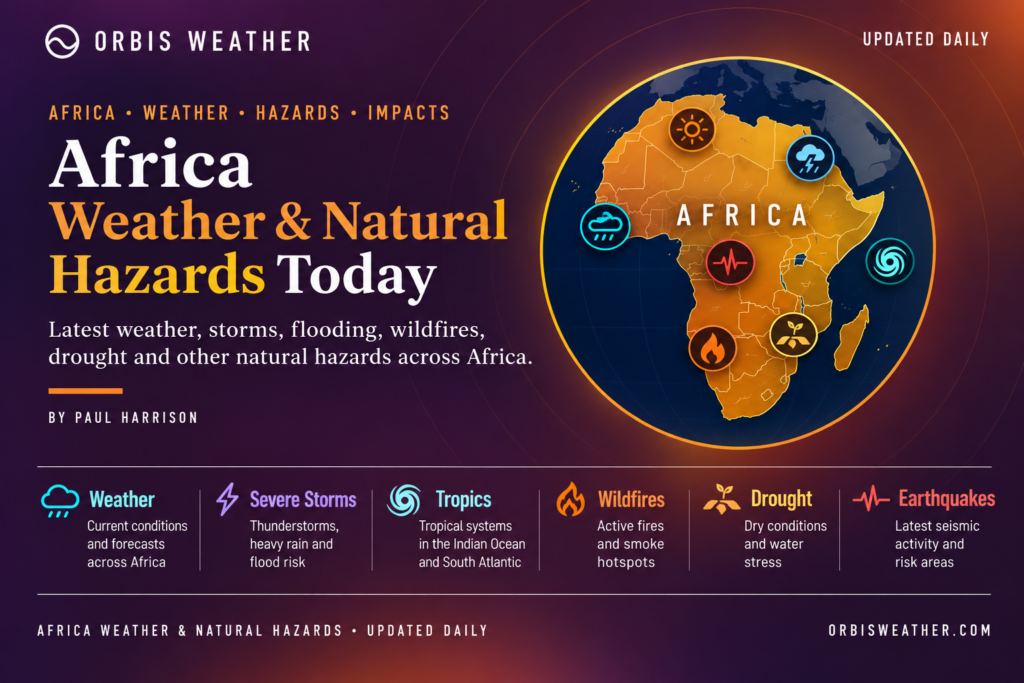
- Africa Weather & Natural Hazards Today — Friday, November 6, 2026 4:44 PM
- America’s Hot Spots This Week November 5, 2026 2:44 PM
- Southwest Indian Ocean Tropical Weather Update – November 6, 2026 12:48 PM
- Australian Region Tropical Weather Update — Friday, November 6, 2026 12:37 PM
- El Niño Heats Up the Pacific as Relentless Typhoons Batter East Asia 11:42 AM
- Australia, New Zealand & Oceania Weather & Natural Hazards Today Nov 6, 2026 10:59 AM
- Ocoee River Crests at Record Level in Copperhill, Triggering Catastrophic Flooding Across Tennessee and Georgia 10:12 AM
- North America Weather & Natural Hazards Today – November 5, 2026 8:31 AM
- Central America Weather & Natural Hazards Today – November 5, 2026 8:21 AM
- South America Weather & Natural Hazards Today – November 5, 2026 8:12 AM
- Daily Earthquakes, Storms, Fires & Floods Report – November 5, 2026 7:39 AM
- Weekly Global Climate Pulse: Thursday, November 5, 2026 7:31 AM
- Tropical Atlantic Daily Report: Thursday, November 5, 2026 7:17 AM
- Eastern & Central Pacific Tropical Weather Update: Thursday, November 5, 2026 7:06 AM
- Western Pacific Tropical Update: In-Fa & Invest 99W 6:53 AM





ORBIS WEATHER | AFRICA WEATHER DESK
🌍 Africa Weather & Natural Hazards Today — Friday, November 6, 2026
By Paul Harrison | Orbis Weather
Published: Friday, November 6, 2026 — African Local Date
Coverage: North Africa • West Africa • Central Africa • East Africa • Southern Africa • Madagascar • Southwest Indian Ocean
🌍 Africa Weather Overview: Severe Thunderstorms, Flooding, Dangerous Heat and Growing El Niño Concerns
Africa enters Friday, November 6, 2026, with a mixture of severe thunderstorms, heavy rainfall, flooding concerns, extreme fire-weather conditions and longer-term drought threats.
South Africa is the continent’s most clearly documented severe-weather concern today, with official forecasts warning of damaging thunderstorms, hail, lightning and potentially dangerous rainfall across parts of the country’s eastern provinces.
Meanwhile, East and Central Africa remain important regions for rainfall and flood monitoring, while West Africa continues its seasonal transition toward hotter and drier conditions.
Across the continent, the strengthening 2026–27 El Niño is raising concerns about agricultural production, water availability, food security and the possibility of further extreme weather.
The World Meteorological Organization (WMO) has warned that the current El Niño could strengthen considerably toward the end of 2026, potentially affecting weather patterns well into 2027.
🚨 1. Africa Natural Hazards Summary — November 6
Region | Main weather or natural hazard | Assessment |
|---|---|---|
🇿🇦 South Africa | Severe thunderstorms, hail, flooding | Official warnings reported |
🇰🇪 Kenya | Seasonal rainfall, flash flooding | Monitor local forecasts |
🇺🇬 Uganda | Thunderstorms, Lake Victoria hazards | Seasonal concern |
🇨🇩 DR Congo | Heavy tropical rainfall, river flooding | Seasonal concern |
🇲🇿 Mozambique | Rainfall variability, thunderstorms | Seasonal monitoring |
🇳🇬 Nigeria | Heat, localized storms, dry-season transition | Seasonal concern |
🌾 Sahel | Heat, dust, water stress | Seasonal concern |
🏜️ North Africa | Dust, wind, localized rainfall | Seasonal monitoring |
🇲🇬 Madagascar | Tropical disturbances, rainfall variability | Cyclone-season monitoring |
🌍 Southern Africa | Agricultural drought and heat | Longer-term El Niño concern |
Editorial note: These assessments distinguish published weather warnings from seasonal hazards. They are not a replacement for official national warning levels. The latest warning boundaries and validity periods should always be checked with the issuing meteorological service.
⛈️ 2. Southern Africa — Severe Thunderstorms and Fire Danger
🇿🇦 South Africa: Dangerous thunderstorms forecast for Friday
South Africa faces an unsettled Friday as thunderstorms develop across central and eastern parts of the country.
Forecast information attributed to the South African Weather Service indicates that severe thunderstorms could produce heavy downpours, hail, intense lightning and localized flooding.
Yellow Level 4 severe-thunderstorm warnings have been reported for northern KwaZulu-Natal, Gauteng and the southwestern Highveld of Mpumalanga.
Other areas face additional thunderstorm concerns, while extremely high fire-danger conditions are expected in several inland regions.
🚨 Areas requiring particular attention
Gauteng: Severe thunderstorms, intense rainfall, lightning and possible urban flooding.
KwaZulu-Natal: Heavy downpours, hail and dangerous lightning, particularly across northern areas.
Mpumalanga: Severe thunderstorms and localized flooding around the southwestern Highveld.
Free State: Hot, dry conditions and elevated fire danger in some areas.
North West: Heat, dry vegetation and dangerous fire-weather conditions.
Northern Cape: Extremely high fire danger in affected districts.
Limpopo: Hot conditions and elevated fire risk in several areas.
⚡ Potential impacts
Severe thunderstorms can produce rapid flooding of roads, damage to buildings, power interruptions and dangerous driving conditions.
Hail may damage vehicles, roofs and agricultural crops, while lightning poses a significant threat to people working outdoors.
Residents should monitor updates from the South African Weather Service.
🔥 Fire danger across inland South Africa
While thunderstorms threaten eastern districts, parts of the country’s interior face very different conditions.
High temperatures, dry vegetation and wind can allow vegetation fires to spread rapidly.
Fire danger is particularly important across exposed grassland and agricultural areas.
The presence of thunderstorms elsewhere in the country does not necessarily reduce fire risk in dry inland districts.
🇿🇼 Zimbabwe, 🇿🇲 Zambia and 🇲🇼 Malawi
The development of the southern African rainy season remains important for agriculture and water supplies.
As temperatures rise, afternoon thunderstorms may become more frequent in areas where sufficient atmospheric moisture is available.
However, rainfall distribution can vary considerably, and isolated heavy storms do not necessarily indicate a wetter-than-average season.
Farmers should monitor local rainfall totals, soil moisture and seasonal guidance.
🇲🇿 Mozambique
Mozambique is entering a period when tropical rainfall, thunderstorms and Indian Ocean weather systems become increasingly important.
The country’s river basins and low-lying coastal communities can be vulnerable to flooding during prolonged rainfall.
Longer-term concerns include the potential influence of El Niño on agricultural rainfall and water availability.
No specific nationwide flood emergency for November 6 has been independently confirmed in the sources reviewed.
🇧🇼 Botswana and 🇳🇦 Namibia
High daytime temperatures and variable rainfall remain important seasonal considerations.
Potential hazards include heat stress, dry vegetation, dust and isolated thunderstorms.
Water availability is particularly important for livestock and agricultural communities as the warmer season develops.
Southern Africa outlook: Severe thunderstorms in South Africa are the immediate priority, while fire danger, heat and developing seasonal rainfall patterns remain important across the wider region.
🌧️ 3. East Africa — Rainfall, Flooding and Lightning Concerns
🇰🇪 Kenya: Short-rains season continues
Kenya remains an important area for weather monitoring as the October–December short-rains season progresses.
Rainfall during this period can be highly variable, with some districts experiencing substantial thunderstorms while others receive limited precipitation.
Areas requiring attention include:
Nairobi and central Kenya: Urban flooding where heavy rainfall overwhelms drainage systems.
Western Kenya: Thunderstorms and potential rises in streams and rivers.
Lake Victoria Basin: Lightning, sudden wind changes and dangerous conditions for small boats.
Coastal Kenya: Tropical showers, humidity and localized flooding.
Highland areas: Landslides where prolonged rainfall saturates steep slopes.
These are seasonal and forecast-monitoring concerns, not confirmation that flooding is occurring in every listed location today.
🇺🇬 Uganda
Uganda’s equatorial climate supports frequent thunderstorm development during wetter periods.
Heavy rainfall can cause localized flooding, particularly in urban districts and communities near rivers and wetlands.
The Lake Victoria region is especially vulnerable to rapidly developing storms.
Fishing communities should pay close attention to marine and lake-weather advisories.
🇹🇿 Tanzania
Northern Tanzania and areas surrounding Lake Victoria remain sensitive to thunderstorms and localized heavy rainfall.
Lightning and sudden strong winds can pose hazards to transport, fishing and outdoor activities.
Elsewhere, conditions vary significantly between the coast, central plateau and mountainous districts.
🇪🇹 Ethiopia
Ethiopia’s weather varies considerably with elevation and regional seasonal patterns.
Mountainous terrain can experience localized rainfall and landslide hazards, while some lowland areas face hotter and drier conditions.
Rainfall deficits and water availability remain important agricultural concerns.
🇸🇴 Somalia
Somalia’s seasonal rainfall and river conditions require continued monitoring.
The Juba and Shabelle river basins are particularly important because heavy rainfall upstream can affect communities farther downstream.
However, river flooding should not be assumed without current gauge observations or official warnings.
El Niño adds uncertainty to the regional outlook, but its effects are not uniform across the Horn of Africa.
East Africa outlook: Monitor rainfall intensity, local flood warnings, river levels and lightning hazards. Seasonal climate uncertainty remains significant.
🌊 4. Central Africa — Tropical Rainfall and River Flooding
🇨🇩 Democratic Republic of the Congo
The Democratic Republic of the Congo remains vulnerable to intense tropical rainfall, especially across its equatorial regions.
Heavy thunderstorms can cause flooding in urban settlements, rural communities and river valleys.
Principal hazards include:
🌧️ Intense rainfall overwhelming drainage systems.
🌊 Rising rivers and localized flooding.
⛰️ Landslides in mountainous regions.
🚧 Road damage and disruption to rural transport.
💧 Contamination of drinking-water supplies following floods.
Kinshasa and other densely populated urban areas are particularly vulnerable when heavy rainfall coincides with inadequate drainage.
However, no new nationwide flood emergency for November 6 has been independently verified.
🇨🇲 Cameroon
Cameroon’s southern and central regions remain susceptible to tropical showers and thunderstorms.
Heavy rainfall can produce localized flooding and difficult road conditions, particularly in areas with steep terrain or poor drainage.
Northern Cameroon generally experiences a different seasonal pattern, with drier conditions becoming increasingly important.
🇨🇬 Republic of the Congo and 🇬🇦 Gabon
Equatorial rainfall remains a significant influence across both countries.
Thunderstorms may produce intense but localized rainfall, with potential impacts on roads, rivers and low-lying communities.
🇨🇫 Central African Republic
Changing seasonal rainfall patterns remain important for agriculture and transport.
Areas affected by earlier flooding may continue to experience difficult road conditions even after rainfall decreases.
Central Africa outlook: Tropical rainfall, river conditions and localized flooding remain the main hazards to monitor. No continent-scale flood emergency is implied by this seasonal assessment.
☀️ 5. West Africa — Heat, Dust and Seasonal Rainfall Changes
🇳🇬 Nigeria
Nigeria is experiencing its seasonal transition, with increasingly different weather conditions between northern and southern regions.
Across northern Nigeria, drier conditions become more established during November.
The principal concerns include rising daytime heat, dust, reduced humidity and agricultural water availability.
Southern Nigeria may continue to experience showers and thunderstorms, especially near coastal areas.
Urban flooding remains possible during intense rainfall, although no new nationwide November 6 flooding emergency has been independently confirmed.
🇬🇭 Ghana
Ghana is entering a period when changing rainfall patterns and rising temperatures become increasingly important.
Southern coastal districts can still experience occasional showers, while northern areas move further toward dry-season conditions.
Heat stress and agricultural water requirements are important longer-term considerations.
🇸🇳 Senegal, 🇲🇱 Mali, 🇳🇪 Niger and 🇧🇫 Burkina Faso
Across the Sahel, the retreat of seasonal rainfall shifts attention toward dry weather, dust and water resources.
Potential impacts include:
☀️ High daytime temperatures.
🌬️ Dust reducing visibility.
🌾 Agricultural water stress.
🐄 Pressure on livestock grazing and water supplies.
🌫️ Deteriorating air quality during dust episodes.
The arrival of drier conditions does not automatically indicate drought. Drought assessments require rainfall, soil-moisture and water-supply information over longer periods.
🇨🇮 Côte d’Ivoire, 🇧🇯 Benin and 🇹🇬 Togo
Coastal West Africa may continue to experience intermittent showers and thunderstorms during November.
Conditions can vary sharply over short distances, particularly near the Gulf of Guinea coastline.
West Africa outlook: Heat, dust, rainfall variability and water availability remain the primary seasonal concerns.
🏜️ 6. North Africa — Desert Winds, Dust and Mediterranean Weather
🇲🇦 Morocco
Morocco is progressing through its autumn weather season.
Atlantic weather systems can bring periods of cloud, rainfall and stronger winds to northern and western regions.
The Atlas Mountains are particularly sensitive to rapid temperature changes and localized heavy rainfall.
Flash flooding can occur when intense rain falls over steep terrain or normally dry watercourses.
🇩🇿 Algeria
Northern Algeria may experience Mediterranean weather systems bringing cooler temperatures, showers and gusty winds.
Farther south, desert conditions dominate, with blowing dust possible during strong wind events.
🇹🇳 Tunisia
Tunisia’s Mediterranean climate produces increasingly variable conditions during November.
Localized heavy rainfall, thunderstorms and strong coastal winds are seasonal hazards.
🇱🇾 Libya and 🇪🇬 Egypt
Coastal Libya and northern Egypt can experience occasional autumn rainfall and windy conditions.
Inland desert regions remain generally dry, although dust storms can develop when strong winds lift loose sand and soil.
🌬️ Sahara Desert
The Sahara remains one of the world’s major natural dust sources.
Dust can travel considerable distances, affecting visibility, aviation operations and air quality.
However, a significant dust outbreak affecting a particular country should not be assumed without satellite observations or official forecasts.
North Africa outlook: Mediterranean rainfall, desert winds, dust and localized flash-flood potential remain important seasonal hazards.
🌀 7. Madagascar and Southwest Indian Ocean — Tropical Cyclone Season
🇲🇬 Madagascar
November marks the beginning of the main southwest Indian Ocean tropical cyclone season.
Madagascar is particularly vulnerable to tropical systems developing over the Indian Ocean and Mozambique Channel.
Potential hazards include damaging winds, torrential rainfall, flash flooding, landslides and coastal inundation.
Eastern and northern Madagascar are especially exposed to tropical weather systems, while southern areas can experience prolonged rainfall shortages.
🇲🇺 Mauritius, 🇷🇪 Réunion and 🇰🇲 Comoros
Island communities should maintain awareness of tropical disturbances developing over the southwest Indian Ocean.
Even a tropical system that remains offshore can generate dangerous surf, strong winds and heavy rainfall.
Cyclone status for November 6: No specific active named cyclone or official cyclone warning has been independently verified for this edition. This does not establish that the basin is free of tropical disturbances.
Readers should check Météo-France La Réunion for official cyclone monitoring and warnings.
🌡️ 8. El Niño 2026–27 — Growing Climate Risks Across Africa
The strengthening El Niño is one of the most important longer-term climate developments affecting the African continent.
The World Meteorological Organization reported in September that El Niño was firmly established and expected to strengthen toward the end of 2026.
The organization warned that the event could influence rainfall, temperatures and extreme-weather risks into 2027.
🌍 Potential effects across Africa
Region | Potential El Niño influence |
|---|---|
Southern Africa | Increased agricultural drought risk |
East Africa | Changes in seasonal rainfall and flood risk |
Central Africa | Rainfall variability and humanitarian vulnerability |
West Africa | Heat and agricultural water stress |
Sahel | Potential drought and food-security pressure |
Madagascar | Rainfall variability and drought concerns |
These are broad climate-risk assessments, not predictions that every country will experience the same conditions.
🌾 Agriculture and food security
The European Commission’s Joint Research Centre has warned that a potentially historic El Niño could increase drought risks across southern Africa and the Sahel.
The assessment also identifies significant humanitarian vulnerabilities in countries already affected by conflict, displacement and food insecurity.
These combined pressures can make communities more vulnerable to weather-related disasters.
Reduced rainfall may affect crop yields, livestock grazing and drinking-water supplies.
Conversely, excessive rainfall can damage farmland, destroy infrastructure and interrupt food distribution.
Important distinction: El Niño changes the probability of certain weather patterns. It does not determine the weather on any particular day or guarantee drought or flooding in an individual location.
🌊 9. Africa Flood Risk — Friday, November 6
Flooding remains one of Africa’s most significant natural hazards.
🇿🇦 South Africa — Official severe-weather warnings
The South African Weather Service has issued warnings for severe thunderstorms affecting parts of Gauteng, Mpumalanga, KwaZulu-Natal and Limpopo.
A reported Yellow Level 4 warning for affected areas of Gauteng, Mpumalanga and southwestern Limpopo is valid from 1 p.m. until 11:59 p.m. South African time on November 6.
Heavy rain, hail and strong winds could cause localized flooding, property damage and transport disruption.
🇰🇪 Kenya — Rainfall forecast through November 9
The Kenya Meteorological Department’s November 3–9 forecast indicates rainfall across numerous counties.
Afternoon thunderstorms are expected during the forecast period in parts of western Kenya, including areas around Kisumu, Kakamega, Bungoma, Busia and other counties.
Coastal districts may experience morning showers, while parts of central Kenya face additional rainfall opportunities.
The forecast also indicates temperatures exceeding 35°C (95°F) in some northern and eastern counties.
🇨🇩 Central Africa — River and rainfall monitoring
Equatorial rainfall continues to present seasonal flood concerns across parts of the Congo Basin.
However, no new region-wide flood alert valid specifically for November 6 has been verified in the sources reviewed.
🚨 Flood safety
Residents in affected locations should avoid flooded roads, monitor river warnings and follow instructions from local emergency authorities.
🔥 10. Wildfires, Dust and Air Quality
🔥 Southern Africa — Fire-weather conditions
South Africa’s inland fire danger is particularly important today.
Official forecasts indicate extremely high fire danger across parts of the Northern Cape, Free State, North West, Limpopo, Gauteng and Mpumalanga.
Strong winds, dry vegetation and hot temperatures can contribute to rapidly spreading fires.
🌫️ West Africa — Dust and haze
The transition toward the dry season increases the importance of dust and haze monitoring.
Dust concentrations can vary substantially depending on wind direction and regional atmospheric conditions.
🌿 Central Africa — Smoke and vegetation fires
Agricultural burning and vegetation fires can contribute to localized smoke pollution.
Smoke may affect visibility and respiratory health, particularly in communities close to active burning.
No continent-wide air-quality emergency has been independently verified for November 6.
For atmospheric monitoring, consult the Copernicus Atmosphere Monitoring Service.
🌎 11. Earthquakes and Geological Hazards
Africa’s major earthquake-prone regions include the East African Rift System, parts of North Africa and offshore tectonic zones.
🌋 East African Rift
The East African Rift stretches through several countries and contains active faults and volcanic systems.
Earthquake and volcanic monitoring is particularly important in Ethiopia, Kenya, Tanzania and the Democratic Republic of the Congo.
🇲🇦 Morocco and North Africa
Parts of northern Morocco and the wider Mediterranean region are exposed to earthquake hazards associated with active tectonic boundaries.
🌋 Democratic Republic of the Congo
The Virunga volcanic region contains active volcanic systems requiring continuous scientific monitoring.
November 6 earthquake status: No specific significant earthquake or new volcanic eruption has been independently confirmed for this edition.
This is not a statement that no earthquakes have occurred.
For current earthquake observations, visit the US Geological Survey Earthquake Map.
📅 12. Africa Weather Outlook — November 6–8, 2026
Date | Main weather and hazard priorities |
|---|---|
Friday, Nov. 6 | Severe thunderstorms and fire danger in South Africa; rainfall in Kenya |
Saturday, Nov. 7 | Monitor continuing rainfall across East Africa and updated Southern African storm warnings |
Sunday, Nov. 8 | Monitor East African rainfall, southern African heat and thunderstorms, and Indian Ocean tropical activity |
The November 7–8 entries are monitoring priorities rather than independently verified daily forecasts for every listed region. Conditions and official warnings may change.
🛡️ 13. Weather and Natural Hazard Safety Advice
🌊 Flooding
Never drive or walk through moving floodwater. Water may conceal damaged roads, strong currents or open drains.
⚡ Severe thunderstorms
Move inside a substantial building when thunder is heard. Avoid exposed fields, isolated trees and open water.
☀️ Extreme heat
Drink water regularly, avoid strenuous outdoor activity during the hottest hours and check on vulnerable people.
🔥 Wildfires
Avoid outdoor burning during dangerous fire-weather conditions. Follow local evacuation instructions and emergency-service announcements.
🌫️ Dust and air pollution
People with respiratory conditions should monitor local air-quality information and reduce outdoor exposure when pollution levels become elevated.
🌀 Tropical cyclones
Residents of Madagascar and nearby islands should monitor official tropical cyclone bulletins and maintain basic emergency supplies throughout the cyclone season.
📚 14. Sources and Official Weather Information
Orbis Weather uses recognized meteorological, scientific and disaster-monitoring organizations to inform its reporting.
The following sources provide official forecasts, warnings, scientific assessments and regional hazard information.
Organization | Information provided |
|---|---|
El Niño, climate and global weather | |
South African forecasts and warnings | |
Kenyan rainfall and weather forecasts | |
African Centre of Meteorological Applications for Development | Continental meteorological information |
Drought, rainfall and food security | |
Southwest Indian Ocean cyclone information | |
Earthquake monitoring | |
Dust, smoke and atmospheric conditions | |
Food security and humanitarian impacts |
Additional reporting references
📝 15. Orbis Weather Editorial Methodology and Disclaimer
Report date: Friday, November 6, 2026, using the local calendar date across Africa.
Prepared by: Paul Harrison, Orbis Weather.
Reporting approach: This article combines published meteorological forecasts, official warnings, scientific climate assessments and regional hazard analysis.
Specific warnings are identified where supporting published information is available. General seasonal risks are presented separately and should not be interpreted as confirmation of active emergencies.
Forecasts may change as new observations become available.
Orbis Weather does not issue official meteorological warnings and is not a substitute for national meteorological services, emergency-management agencies or local authorities.
This edition does not include independently verified live weather observations for every African country. It also does not claim comprehensive real-time earthquake, wildfire or tropical cyclone coverage.
Corrections and updates
Orbis Weather aims to provide accurate, clearly sourced and regularly updated weather reporting.
Where new official information materially changes a forecast or hazard assessment, the relevant article should be reviewed and corrected.
Readers should always consult their national meteorological service for the latest warnings affecting their location.
🌍 16. Final Africa Weather Outlook — November 6, 2026
Africa faces a combination of immediate severe-weather threats and longer-term climate concerns.
The most urgent verified weather concern is South Africa, where severe thunderstorms threaten parts of the eastern provinces with heavy rainfall, hail, lightning and localized flooding. Dangerous fire-weather conditions are also forecast across several inland regions.
Kenya’s November 3–9 forecast indicates rainfall across numerous counties, keeping thunderstorms and localized flooding on the regional monitoring agenda.
Elsewhere, Central Africa remains vulnerable to seasonal tropical rainfall, West Africa is moving toward drier conditions, and North Africa faces the usual autumn combination of Mediterranean weather systems and desert dust.
Across southern Africa, the developing rainy season will be closely watched as El Niño strengthens and concerns grow about possible agricultural drought and heat into 2027.
Orbis Weather will continue following Africa’s changing weather patterns, natural hazards and climate developments, with particular attention to severe storms, flooding, drought, heat and tropical cyclone activity.
Africa Weather & Natural Hazards Today | Friday, November 6, 2026
By Paul Harrison | Orbis Weather
About the Author
Paul Harrison — Founder & Publisher, Orbis Weather
Paul Harrison founded Orbis Weather in 2026 to make global weather and natural-hazard information easier to find, follow and understand. His coverage includes tropical cyclones, severe weather, extreme temperatures, earthquakes, volcanoes, wildfires, flooding and significant natural disasters worldwide.
View all articles by Paul Harrison → | Editorial Standards →
Global Weather Tracker Hub
Explore weather maps, tropical systems, storms and natural hazards around the world.
No matching trackers found.