
Deadly Nor’easter Batters New York City: One Killed by Falling Tree as Coastal Flooding Sweeps Northeast
By Paul Harrison | Founder & Publisher, Orbis Weather

- Europe Weather & Natural Hazards Today — Sunday, November 8, 2026 7:15 PM
- Africa Weather & Natural Hazards Today — Sunday, November 8, 2026 7:06 PM
- Southeast Asia Weather & Natural Hazards Today: Sunday, November 8, 2026 6:57 PM
- Southeast Asia Natural Hazards This Week: Sunday, November 8, 2026 6:47 PM
- More Powerful Storms Heading for British Columbia as Heavy Rain, Damaging Winds and Flooding Threaten the Weekend 6:35 PM
- Deadly Nor’easter Batters New York City: One Killed by Falling Tree as Coastal Flooding Sweeps Northeast 6:24 PM
- Middle East Weather & Natural Hazards Today – Sunday, November 8, 2026 3:57 PM
- Earth’s Hot Spots This Week November 7, 2026 2:54 PM
- Season’s first lake-effect snow hammers Marquette, Michigan 1:06 PM
- Australian Region Tropical Weather Update — Sunday, November 8, 2026 12:20 PM
- Southwest Indian Ocean Tropical Weather Update – November 8, 2026 12:12 PM
- Australia, New Zealand & Oceania Weather & Natural Hazards Today Sunday, November 8, 2026 12:03 PM
- North America Weather & Natural Hazards Today — November 7, 2026 8:30 AM
- Central America Weather & Natural Hazards Today: Pacific Tropical Disturbance Brings Heavy Rain, Flooding and Landslide Threats 8:16 AM
- South America Weather & Natural Hazards Today – November 7, 2026 7:58 AM
- Daily Earthquakes, Storms, Fires & Floods Report — November 7, 2026 7:43 AM
- U.S. Weather Outlook (Next 7 Days): November 7–13, 2026 7:28 AM
- Deadly Flooding in North Georgia 7:21 AM
- Tropical Atlantic Daily Report: Saturday, November 7, 2026 7:06 AM
- Eastern & Central Pacific Tropical Weather Update: Saturday, November 7, 2026 6:56 AM
- WESTERN PACIFIC Tropical Weather Update: November 7, 2026 6:34 AM





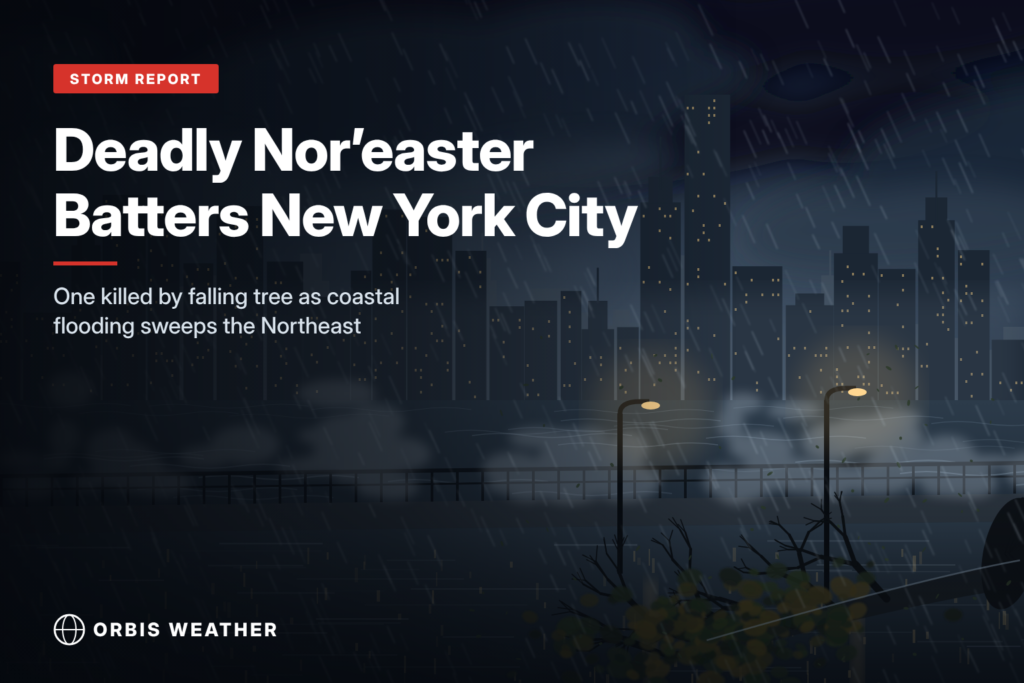
Deadly Nor’easter Batters New York City: One Killed by Falling Tree as Coastal Flooding Sweeps Northeast
Orbis Weather | U.S. Severe Weather & Natural Hazards
By Paul Harrison | November 7, 2026
A powerful nor’easter that struck the northeastern United States in late September left one man dead in New York City, toppled hundreds of trees, flooded coastal neighborhoods and caused widespread power outages from New Jersey to New England.
The slow-moving storm brought damaging wind gusts, heavy rainfall, dangerous surf and repeated tidal flooding, with some coastal communities experiencing significant disruption.
Editor’s note: This report covers the September 26–28, 2026 nor’easter. The flooding warnings described below were issued during that storm and are not current alerts for November 7.
Falling Tree Kills New York City Worker
The storm turned deadly on Saturday, September 26, when 56-year-old Leighton Brown, a longtime New York City Housing Authority maintenance employee, was struck by a falling tree at the Cypress Hills Houses in East New York, Brooklyn.
Brown was transported to Brookdale University Hospital, where he was pronounced dead.
Authorities investigated the incident amid the severe weather, although early reports did not conclusively establish whether the wind directly caused the tree to fall.
Elsewhere in Brooklyn, four people, including two young children, were injured when a tree branch fell at Kelly Park Playground. All four were hospitalized in stable condition.
Winds Reach 55 MPH as Trees Fall Across NYC
Wind gusts reached approximately 55 mph (89 km/h) at John F. Kennedy International Airport during the storm.
By Sunday evening, city officials had received more than 1,000 reports of downed trees across New York City’s five boroughs.
Fallen branches and trees blocked streets, damaged vehicles and brought down electrical infrastructure.
New York City Parks Department crews worked extended shifts to remove debris and restore access to affected neighborhoods.
Coastal Flooding Hits Queens, Staten Island and Long Island
Coastal flooding became one of the storm’s most destructive features.
Among the affected communities were Howard Beach, Hamilton Beach and Broad Channel in Queens, along with South Beach on Staten Island.
In some neighborhoods, seawater covered roads and entered residential properties. Residents moved vehicles to higher ground, while businesses used sandbags to protect entrances.
At Hamilton Beach, one household reported approximately eight inches of water entering its basement after a pump failed.
The National Weather Service warned during the storm that repeated high tides could produce additional flooding, even as the nor’easter gradually weakened.
More Than 130,000 Customers Lose Power
The nor’easter disrupted electricity supplies across a large section of the northeastern United States.
By Sunday morning, September 27, more than 130,000 customers across the Northeast and Mid-Atlantic were without electricity, according to outage figures reported by the Associated Press.
Particularly affected areas included the New Jersey shoreline, Long Island and coastal Connecticut.
Utility crews faced difficult working conditions as gusty winds, fallen trees and flooded roads complicated repairs.
Dangerous Surf and Travel Disruptions
The storm generated powerful surf along the Atlantic coastline, with forecasts warning of waves potentially reaching 20 feet (6.1 meters) in some exposed locations.
Beach erosion, strong rip currents and hazardous marine conditions created risks for swimmers, boaters and coastal residents.
Transportation was also disrupted. Hundreds of flights were canceled at Boston Logan International Airport, while flooding restricted access to North Carolina’s Hatteras Island.
Emergency crews in Sea Bright, New Jersey, rescued a woman and her dog after their vehicle became trapped in floodwater.
Why Was This Nor’easter So Dangerous?
A nor’easter is a powerful coastal storm that typically develops when contrasting air masses interact near the eastern United States.
Its name refers to the strong northeasterly winds that frequently affect coastal communities.
Three factors made the September storm particularly hazardous:
-
Slow movement: The storm remained near the coast long enough to expose communities to repeated periods of wind and rain.
-
High tides: Elevated water levels increased the risk of flooding in bays, harbors and low-lying neighborhoods.
-
Saturated ground and strong winds: Wet soil can reduce tree stability, increasing the potential for uprooted trees during damaging gusts.
Unlike a tropical hurricane, a nor’easter is generally an extratropical weather system, although both types of storms can produce destructive coastal flooding.
What Happened After the Storm?
By Monday, September 28, the nor’easter was weakening, but authorities continued clearing fallen trees and monitoring flood-prone communities.
Coastal flood advisories remained in effect during the morning high tide, with approximately 1 to 1.5 feet of water above ground level possible in vulnerable locations.
Emergency crews continued recovery operations while residents assessed damage to homes, vehicles and businesses.
Orbis Weather Safety Guidance
During future nor’easters, residents in affected coastal communities should avoid flooded roads, stay clear of downed power lines and remain indoors during periods of damaging winds.
Drivers should never attempt to cross floodwater when its depth or road condition is unknown.
Residents should monitor official National Weather Service warnings and follow local emergency management instructions.
Sources and Weather Information
This report was compiled using information from:
-
National Weather Service — Weather forecasts, warnings and coastal flooding information.
-
NYC Emergency Management — Storm response and public safety.
-
Associated Press — Regional storm impacts and fatalities.
-
Spectrum News NY1 — New York City damage and recovery reporting.
Orbis Weather provides independent weather reporting, natural hazards coverage and public safety information. Historical reports should not be interpreted as current warnings. For active alerts, consult the National Weather Service and local emergency authorities.
Orbis Weather — Tracking the World’s Weather and Natural Hazards
About the Author
Paul Harrison — Founder & Publisher, Orbis Weather
Paul Harrison founded Orbis Weather in 2026 to make global weather and natural-hazard information easier to find, follow and understand. His coverage includes tropical cyclones, severe weather, extreme temperatures, earthquakes, volcanoes, wildfires, flooding and significant natural disasters worldwide.
View all articles by Paul Harrison → | Editorial Standards →
Global Weather Tracker Hub
Explore weather maps, tropical systems, storms and natural hazards around the world.
No matching trackers found.