
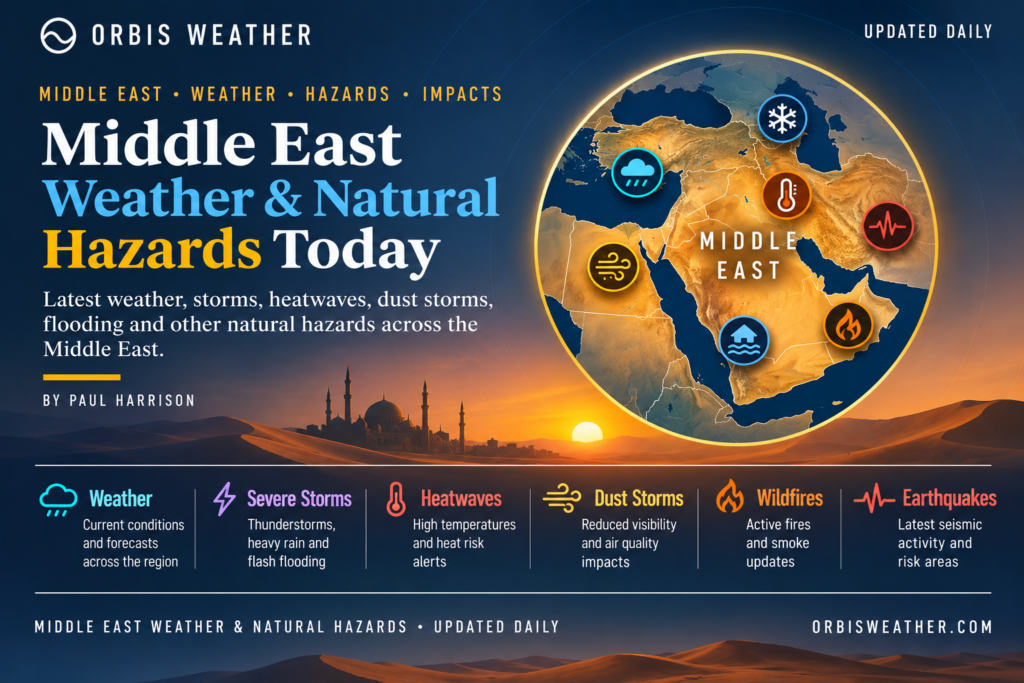
🌍 Middle East Weather & Natural Hazards Today
By Paul Harrison | Founder & Publisher, Orbis Weather

- Europe Weather & Natural Hazards Today — Sunday, November 8, 2026 7:15 PM
- Africa Weather & Natural Hazards Today — Sunday, November 8, 2026 7:06 PM
- Southeast Asia Weather & Natural Hazards Today: Sunday, November 8, 2026 6:57 PM
- Southeast Asia Natural Hazards This Week: Sunday, November 8, 2026 6:47 PM
- More Powerful Storms Heading for British Columbia as Heavy Rain, Damaging Winds and Flooding Threaten the Weekend 6:35 PM
- Deadly Nor’easter Batters New York City: One Killed by Falling Tree as Coastal Flooding Sweeps Northeast 6:24 PM
- Middle East Weather & Natural Hazards Today – Sunday, November 8, 2026 3:57 PM
- Earth’s Hot Spots This Week November 7, 2026 2:54 PM
- Season’s first lake-effect snow hammers Marquette, Michigan 1:06 PM
- Australian Region Tropical Weather Update — Sunday, November 8, 2026 12:20 PM
- Southwest Indian Ocean Tropical Weather Update – November 8, 2026 12:12 PM
- Australia, New Zealand & Oceania Weather & Natural Hazards Today Sunday, November 8, 2026 12:03 PM
- North America Weather & Natural Hazards Today — November 7, 2026 8:30 AM
- Central America Weather & Natural Hazards Today: Pacific Tropical Disturbance Brings Heavy Rain, Flooding and Landslide Threats 8:16 AM
- South America Weather & Natural Hazards Today – November 7, 2026 7:58 AM
- Daily Earthquakes, Storms, Fires & Floods Report — November 7, 2026 7:43 AM
- U.S. Weather Outlook (Next 7 Days): November 7–13, 2026 7:28 AM
- Deadly Flooding in North Georgia 7:21 AM
- Tropical Atlantic Daily Report: Saturday, November 7, 2026 7:06 AM
- Eastern & Central Pacific Tropical Weather Update: Saturday, November 7, 2026 6:56 AM
- WESTERN PACIFIC Tropical Weather Update: November 7, 2026 6:34 AM





Middle East Weather & Natural Hazards Today – Sunday, November 8, 2026
Orbis Weather | Regional Weather & Natural Hazards Report
By Paul Harrison | Orbis Weather
Sunday, November 8, 2026 – Middle East Local Date
The Middle East is entering the second week of November with the seasonal transition from summer heat toward cooler winter conditions increasingly important across the Arabian Peninsula, the Levant, Iraq and Iran.
November is a changing month for weather across the region. While much of the Arabian Peninsula remains relatively warm and dry, the eastern Mediterranean and mountainous areas of the northern Middle East become more susceptible to passing weather systems, rainfall, thunderstorms and colder overnight temperatures.
The main natural hazards to monitor at this time of year include flash flooding, dust storms, reduced visibility, mountain weather, deteriorating marine conditions and earthquakes.
This report covers Saudi Arabia, the United Arab Emirates, Oman, Qatar, Bahrain, Kuwait, Iraq, Iran, Yemen, Jordan, Israel, Palestine, Lebanon, Syria and the wider eastern Mediterranean.
Verification note: This November 8 regional briefing distinguishes seasonal weather risks from confirmed events. The available reporting does not establish a complete, verified set of live weather observations or active warnings for every country. No unverified storm, flood, earthquake or warning is presented as an event occurring today.
1. Middle East Weather Overview
The region’s weather is shaped by several distinct climatic zones, each with different risks during November.
Across the Arabian Peninsula, warm daytime temperatures remain common, although cooler nights become more noticeable, particularly in inland desert areas.
Farther north, the Levant, Iraq and western Iran are moving deeper into their wetter season. Weather systems crossing the Mediterranean can bring cloud cover, rainfall, thunderstorms and stronger winds.
Mountainous areas of Iran, Lebanon and surrounding countries experience greater temperature variations, with increasingly cold conditions at higher elevations.
The most important developments to monitor over the coming days are the movement of Mediterranean low-pressure systems, possible thunderstorm development, dust-producing winds and localized rainfall capable of overwhelming drainage systems.
These are regional monitoring priorities rather than confirmed forecasts of specific severe-weather events on November 8.
2. Saudi Arabia – Cooler Nights, Desert Winds and Rainfall Monitoring
Saudi Arabia experiences significant regional variations in weather during November.
Riyadh and central Saudi Arabia: Warm afternoons and increasingly cooler nights are characteristic of this period. Changes in wind direction and strength can occasionally produce blowing dust, particularly across exposed desert highways.
Jeddah and the Red Sea coast: Coastal areas generally remain warmer and more humid than the interior. November also marks a period when rainfall and thunderstorms can become more significant along parts of western Saudi Arabia.
Eastern Province: Dammam, Al Khobar and surrounding areas can experience variable winds, haze and occasional dust episodes.
Southwestern highlands: Higher elevations around Asir and Al Baha may experience cooler conditions, cloud development and localized rainfall.
Natural hazards to monitor
Flash flooding in wadis and poorly drained urban areas during heavy rain.
Reduced road visibility from blowing sand and dust.
Thunderstorms and lightning in western and southwestern districts.
Stronger winds and changing marine conditions along the Red Sea and Gulf of Mexico? No — the Arabian Gulf.
The greatest immediate danger during a desert thunderstorm is often not the rainfall total itself but how quickly runoff can collect in dry channels and low-lying roads.
3. United Arab Emirates – Seasonal Cooling and Changing Winds
November generally brings more comfortable conditions across Dubai, Abu Dhabi, Sharjah, Ajman, Ras Al Khaimah and Fujairah.
Daytime temperatures remain warm, but the extreme summer heat has usually subsided. Overnight temperatures are gradually declining, particularly away from the coast.
The UAE’s primary weather considerations during this seasonal transition include changing wind patterns, early-morning mist or fog, occasional dust and the possibility of localized rainfall.
Mountainous areas in the east can experience conditions different from those of the western desert and coastal cities.
Natural hazards to monitor
Fog and reduced visibility: Calm, humid conditions can support fog formation, affecting highways and airport approaches.
Dust and sand: Stronger northwesterly winds can carry airborne particles across exposed areas.
Heavy rainfall: Although significant rainfall is not an everyday occurrence, intense thunderstorms can produce rapid surface flooding when they develop.
Marine conditions: Wind changes can affect smaller vessels and recreational boating.
The UAE’s National Centre of Meteorology remains the primary source for current national weather alerts.
4. Oman – Mountain Flooding and Coastal Conditions
Oman’s diverse geography creates several distinct weather zones.
Muscat and northern coastal communities generally experience warm conditions during November, while the Hajar Mountains can be considerably cooler.
The interior desert regions experience greater differences between daytime and nighttime temperatures.
In southern Oman, the Dhofar region has moved beyond the main summer khareef monsoon season, with conditions typically becoming drier.
Natural hazards to monitor
The Hajar Mountains and surrounding wadis remain important locations for flash-flood monitoring whenever thunderstorms develop.
Even when rainfall occurs many miles upstream, floodwater can travel rapidly through dry riverbeds.
Along the Arabian Sea and Gulf of Oman, marine hazards depend on prevailing winds, wave conditions and any developing regional disturbances.
There is no verified tropical cyclone landfall or active cyclone warning established for Oman in this report.
5. Qatar, Bahrain and Kuwait – Dust, Visibility and Cooler Evenings
Across Qatar, Bahrain and Kuwait, November typically brings a gradual reduction in daytime heat.
Doha, Manama and Kuwait City generally remain relatively warm during the afternoon, with more comfortable evenings.
The main weather concerns include dust, changing winds, localized rainfall and occasional fog.
Northwesterly winds can transport dust across open desert terrain and into urban areas.
Periods of atmospheric instability can also produce thunderstorms, particularly as the region transitions toward winter.
Residents should monitor local meteorological services for any active wind, visibility, marine or rainfall warnings.
6. Iraq – Rainfall Season and Flood Risk
Iraq is entering a period when weather systems can bring increasing rainfall, particularly across northern and western districts.
Baghdad and central Iraq generally experience cooler conditions than during the summer months.
Northern areas, including the Kurdistan Region, can experience more substantial seasonal rainfall and colder mountain weather.
Main natural hazards
Flash flooding: Intense rainfall can create rapid runoff in urban areas, valleys and mountainous terrain.
Thunderstorms: Passing disturbances may generate lightning, heavy showers and gusty winds.
Dust storms: Dry soils and strong winds can still produce significant airborne dust, even outside the hottest months.
Mountain conditions: Higher elevations become increasingly vulnerable to cold weather as winter approaches.
Any significant rainfall event should be assessed using current observations and warnings rather than seasonal expectations alone.
7. Iran – Mountain Weather, Rainfall and Earthquake Exposure
Iran has one of the Middle East’s most varied climates.
Northern areas bordering the Caspian Sea generally experience wetter conditions than the central plateau, while the Zagros and Alborz mountain ranges become progressively colder during November.
Tehran can experience a combination of cool mornings, milder afternoons and periods of atmospheric pollution, particularly when winds are light.
Western Iran is more exposed to weather systems moving eastward from the Mediterranean and Iraq.
Natural hazards to monitor
Heavy rainfall and flash flooding in western and northern provinces.
Colder mountain temperatures and possible snowfall at higher elevations.
Urban air pollution during stagnant weather.
Earthquakes associated with the country’s active fault systems.
Iran lies within a highly active tectonic region. Earthquake preparedness remains important regardless of daily weather conditions.
No specific earthquake magnitude, location or casualty figure is reported here without a verified event record.
8. Israel, Palestine, Jordan, Lebanon and Syria – Eastern Mediterranean Weather
The eastern Mediterranean enters a more changeable weather period during November.
Coastal cities such as Beirut, Tel Aviv and Haifa typically become more susceptible to passing rain systems, while inland and elevated districts experience increasingly cool nights.
Jordan’s capital, Amman, can experience significant temperature differences between daytime and nighttime.
Across Lebanon and Syria, mountain communities are moving toward their winter season.
Natural hazards to monitor
Heavy rainfall and flooding: Short periods of intense rain can overwhelm urban drainage systems and produce dangerous runoff.
Flash flooding in Jordan: Desert valleys and wadis are particularly vulnerable when thunderstorms occur upstream.
Mountain weather: Higher elevations may experience low cloud, strong winds and colder conditions.
Coastal storms: Mediterranean low-pressure systems can generate rough seas and stronger winds.
Rainfall patterns vary considerably across this region. A weather system affecting the Mediterranean coast does not necessarily bring significant precipitation to inland desert areas.
9. Yemen – Flooding, Mountain Rainfall and Coastal Hazards
Yemen’s terrain produces significant differences between coastal, desert and highland weather.
The western highlands can experience localized rainfall and thunderstorms, while coastal areas remain relatively warm.
In mountainous communities, heavy rainfall can trigger dangerous runoff and landslides, particularly where slopes are unstable.
Flooding can also disrupt roads and access to essential services.
Natural hazards to monitor
Flash flooding, landslides, thunderstorms and coastal marine conditions remain important concerns.
Because local observing networks and communications may be limited in some areas, residents should prioritize information from reliable humanitarian, meteorological and emergency-management organizations.
10. Confirmed Weather Developments for November 8
Two developments deserve particular attention in the latest available forecasts.
Saudi Arabia: Thunderstorms, hail and flash-flood warnings
Saudi Arabia’s National Center for Meteorology issued warnings for thunderstorms, rainfall, hail and dust-producing winds across multiple regions on November 7.
The official November 8 alert listings include moderate-rain warnings for parts of Makkah Province, including Al Khurma, Al Muwayh, Ranyah and Turabah, with thunderstorms, hail, reduced visibility and torrential runoff among the identified hazards.
Qassim also has listed November 8 rainfall alerts. These are forecasts and warnings, not confirmation that flooding has already occurred.
United Arab Emirates: Stronger winds and rougher seas approaching
The UAE National Centre of Meteorology’s forecast, reported November 7, indicates generally fair to partly cloudy conditions on Sunday, November 8, with winds occasionally reaching 35 km/h (22 mph).
A change is forecast from Monday night into Wednesday, with possible light rainfall in western coastal areas and islands, falling temperatures, and winds potentially reaching 50 km/h (31 mph) by Wednesday.
The Arabian Gulf could become rough to very rough during this period.
11. Middle East Natural Hazards Watch
The following table separates confirmed forecast concerns from broader hazards requiring monitoring.
Hazard | Areas to monitor | Assessment |
|---|---|---|
Thunderstorms and flash flooding | Saudi Arabia | Official November 8 warnings issued |
Strong winds and rough seas | UAE | Deterioration forecast November 9–11 |
Dust and reduced visibility | Arabian Peninsula, Iraq | Ongoing seasonal concern |
Mountain rain and colder weather | Iran, Lebanon, northern Iraq | Seasonal monitoring |
Flash flooding in wadis | Oman, Yemen, Jordan | Conditional on heavy rainfall |
Earthquakes | Iran and surrounding tectonic zones | Persistent geological hazard |
Air pollution | Tehran and major urban centers | Monitor daily measurements |
Coastal and marine hazards | Red Sea, Arabian Gulf, Gulf of Oman | Check current marine bulletins |
These categories are not a uniform warning level for the entire Middle East.
12. Earthquake and Seismic Activity
The Middle East sits near several major tectonic boundaries, making earthquakes an important regional natural hazard.
The collision between the Arabian and Eurasian tectonic plates contributes to earthquake activity across Iran, northern Iraq and neighboring regions.
The Dead Sea Transform fault system is another important source of seismic risk, extending through parts of the Levant.
Earthquakes cannot currently be predicted reliably by date, time and location. Increased rainfall, dust storms or ordinary seasonal temperature changes should not be interpreted as evidence that a major earthquake is imminent.
For verified earthquake activity, including magnitude, depth and location, consult the USGS Latest Earthquakes Map.
13. Dust Storms and Air Quality
Dust and airborne particulate pollution are recurring environmental concerns across the Middle East.
Strong winds over dry, exposed soils can lift large quantities of sand and dust into the atmosphere.
The resulting conditions may reduce visibility on highways, disrupt aviation and worsen air quality.
Particulate pollution can be particularly problematic for people with asthma, other respiratory conditions or cardiovascular disease.
What residents should monitor
The most useful measurements include PM2.5, PM10, wind speed, visibility and the local Air Quality Index.
During significant dust events, residents should consider reducing prolonged outdoor exertion, closing windows and following local health guidance.
A properly fitted particulate respirator, such as an N95, can help reduce inhalation of airborne particles when outdoor exposure cannot be avoided.
Dust storms are not automatically associated with extreme heat. They can occur during cooler months whenever strong winds and sufficiently dry surface conditions coincide.
14. Marine Weather – Red Sea, Arabian Gulf and Gulf of Oman
Marine conditions across the Middle East can change quickly as wind patterns shift.
Red Sea: Mariners should monitor wind acceleration, thunderstorms and wave conditions, particularly near coastal mountain ranges and exposed waters.
Arabian Gulf: Northwesterly winds can produce rougher conditions, affecting fishing boats, commercial shipping and recreational vessels.
Gulf of Oman: Marine conditions are influenced by regional pressure systems and winds moving between the Arabian Sea and the Gulf.
Eastern Mediterranean: Passing low-pressure systems can bring stronger winds, higher waves and hazardous coastal conditions during autumn and winter.
For November 8, the UAE forecast indicates slight seas in both the Arabian Gulf and Gulf of Oman, with a deterioration expected in the Arabian Gulf early in the coming week.
Small-vessel operators should always check the latest official coastal and offshore forecasts before departure.
15. What to Watch Over the Next 72 Hours
Sunday, November 8 – Wednesday, November 11, 2026
The most important near-term developments are the continuing rainfall and thunderstorm risk in Saudi Arabia and the approaching wind and marine-weather changes in the UAE.
For Saudi Arabia, particular attention should be given to localized flooding, hail, lightning and reduced visibility in areas covered by official warnings.
For the UAE, the forecast points toward increasing cloud cover and possible light rain from Monday night, followed by stronger winds, blowing dust and rougher seas through midweek.
Elsewhere across the Middle East, updated national forecasts are necessary to establish whether significant rainfall, storms or hazardous winds will develop. No comparable country-specific warning has been independently verified for every location in this report.
16. Weather and Natural Hazard Safety Advice
During heavy rainfall, never drive into floodwater or attempt to cross a flooded wadi. Water depth and current speed can be difficult to judge, and roads may be damaged beneath the surface.
During dust storms, reduce driving speed, increase following distance and avoid unnecessary travel when visibility becomes dangerously low.
During thunderstorms, move indoors and avoid exposed mountain ridges, open water and isolated trees.
For earthquakes, remember the standard protective action: Drop, Cover and Hold On. After strong shaking, be alert for damaged buildings and possible aftershocks.
For marine activities, follow national weather warnings and harbor authority instructions.
17. Official Weather and Natural Hazard Sources
Orbis Weather recommends the following primary sources for verification and ongoing monitoring:
Saudi National Center for Meteorology — forecasts and severe-weather warnings.
UAE National Centre of Meteorology — weather, marine conditions and national alerts.
Oman Meteorology — national forecasts and warnings.
US Geological Survey — global earthquake monitoring.
Global Disaster Alert and Coordination System — major disaster alerts.
World Meteorological Organization — international meteorological information.
NASA FIRMS — satellite-based thermal anomalies and potential wildfire activity.
Orbis Weather uses meteorological agency forecasts, hazard monitoring systems and verified reporting to explain regional weather risks. The publication does not issue official warnings or replace national emergency-management authorities.
18. Orbis Weather Editorial Assessment
The Middle East’s transition toward winter brings an increasingly varied weather pattern, with cooler conditions across northern countries, continued warmth over much of the Arabian Peninsula and greater opportunities for rainfall.
For Sunday, November 8, Saudi Arabia’s thunderstorm and flash-flood warnings are the clearest verified immediate concern, while the UAE is preparing for stronger winds and potentially hazardous marine conditions during the first half of the coming week.
Elsewhere, seasonal risks remain important, but specific emergencies should not be assumed without supporting observations or official alerts.
The greatest regional weather dangers often arise from rapidly developing localized events rather than prolonged storms. A single intense thunderstorm can produce dangerous flash flooding in a desert wadi, while a sudden increase in wind speed can sharply reduce visibility or make coastal waters hazardous.
Residents, travelers and maritime operators should continue monitoring official local forecasts as conditions evolve.
Orbis Weather will continue following developments across the Middle East, including severe weather, earthquakes, flooding, dust storms and other natural hazards.
About the Author
Paul Harrison — Founder & Publisher, Orbis Weather
Paul Harrison founded Orbis Weather in 2026 to make global weather and natural-hazard information easier to find, follow and understand. His coverage includes tropical cyclones, severe weather, extreme temperatures, earthquakes, volcanoes, wildfires, flooding and significant natural disasters worldwide.
View all articles by Paul Harrison → | Editorial Standards →
Global Weather Tracker Hub
Explore weather maps, tropical systems, storms and natural hazards around the world.
No matching trackers found.