
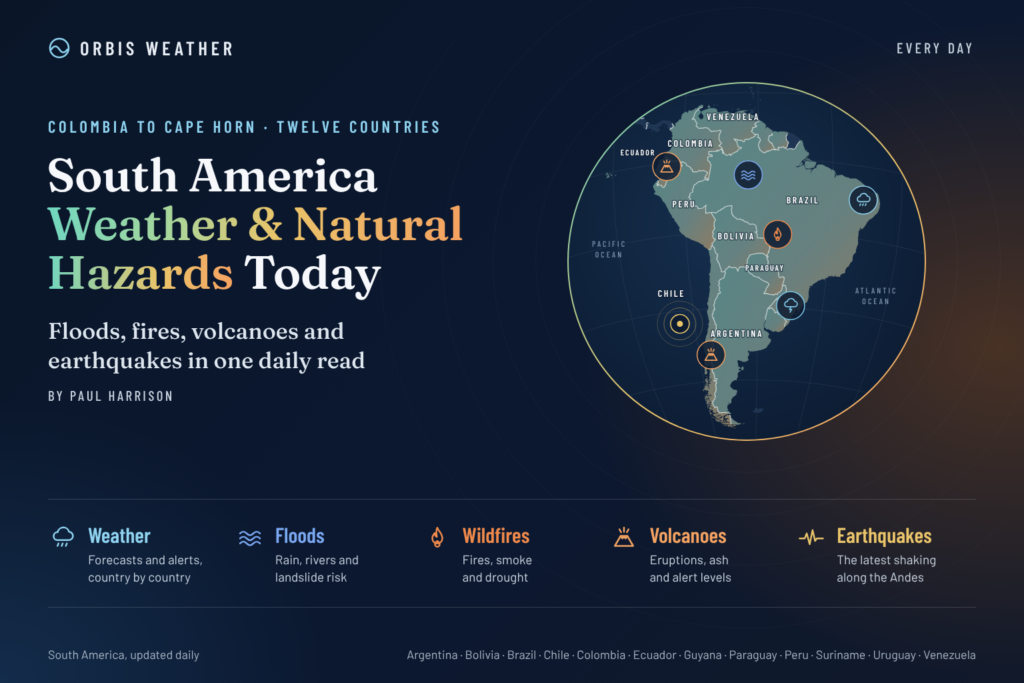
South America Weather & Natural Hazards Today
By Paul Harrison | Founder & Publisher, Orbis Weather

- Europe Weather & Natural Hazards Today — Sunday, November 8, 2026 7:15 PM
- Africa Weather & Natural Hazards Today — Sunday, November 8, 2026 7:06 PM
- Southeast Asia Weather & Natural Hazards Today: Sunday, November 8, 2026 6:57 PM
- Southeast Asia Natural Hazards This Week: Sunday, November 8, 2026 6:47 PM
- More Powerful Storms Heading for British Columbia as Heavy Rain, Damaging Winds and Flooding Threaten the Weekend 6:35 PM
- Deadly Nor’easter Batters New York City: One Killed by Falling Tree as Coastal Flooding Sweeps Northeast 6:24 PM
- Middle East Weather & Natural Hazards Today – Sunday, November 8, 2026 3:57 PM
- Earth’s Hot Spots This Week November 7, 2026 2:54 PM
- Season’s first lake-effect snow hammers Marquette, Michigan 1:06 PM
- Australian Region Tropical Weather Update — Sunday, November 8, 2026 12:20 PM
- Southwest Indian Ocean Tropical Weather Update – November 8, 2026 12:12 PM
- Australia, New Zealand & Oceania Weather & Natural Hazards Today Sunday, November 8, 2026 12:03 PM
- North America Weather & Natural Hazards Today — November 7, 2026 8:30 AM
- Central America Weather & Natural Hazards Today: Pacific Tropical Disturbance Brings Heavy Rain, Flooding and Landslide Threats 8:16 AM
- South America Weather & Natural Hazards Today – November 7, 2026 7:58 AM
- Daily Earthquakes, Storms, Fires & Floods Report — November 7, 2026 7:43 AM
- U.S. Weather Outlook (Next 7 Days): November 7–13, 2026 7:28 AM
- Deadly Flooding in North Georgia 7:21 AM
- Tropical Atlantic Daily Report: Saturday, November 7, 2026 7:06 AM
- Eastern & Central Pacific Tropical Weather Update: Saturday, November 7, 2026 6:56 AM
- WESTERN PACIFIC Tropical Weather Update: November 7, 2026 6:34 AM





South America Weather & Natural Hazards Today – November 7, 2026
Severe Storm Warnings in Brazil, Flooding Concerns Across the Southern Cone and El Niño’s Growing Influence on South America’s Weather
By Paul Harrison | Orbis Weather
Saturday, November 7, 2026 | Updated for South American local dates
🌎 South America Weather Overview
South America enters the weekend with significant weather concerns, particularly across southern Brazil, where authorities have issued their highest-level storm warnings. Heavy rainfall, destructive winds, hail and flash flooding are among the principal hazards.
Meanwhile, recent flooding across Paraguay, Uruguay and northeastern Argentina highlights the vulnerability of communities along major river systems. Across the Andes, seasonal rainfall and mountain weather remain important considerations, while the Amazon Basin continues its transition toward the wetter months in many areas.
The developing 2026–27 El Niño is another important factor influencing regional weather patterns, although its effects differ considerably between northern, central and southern South America.
🚨 Today’s Top Weather Headlines
🔴 Southern Brazil: Red-level storm warning for parts of Rio Grande do Sul, Santa Catarina and Paraná, with potentially destructive winds, hail and heavy rain.
⛈️ Southeastern Brazil: Thunderstorm warnings affecting areas of São Paulo and neighboring states.
🌊 Paraguay, Uruguay and Argentina: River flooding remains a major regional concern following significant rainfall in recent weeks.
🌧️ Amazon Basin: Tropical downpours and thunderstorms remain important seasonal hazards.
🏔️ Andean Region: Mountain communities should remain alert for localized landslides, changing temperatures and difficult travel conditions.
🌡️ El Niño: Pacific Ocean warming is influencing seasonal rainfall probabilities across the continent.
Brazil’s national meteorological agency, INMET, has issued a red warning for November 7 covering portions of southern Brazil. Its warning includes the potential for rainfall exceeding 100 mm (3.9 inches) in a day, wind gusts exceeding 100 km/h (62 mph) and hail. These are forecast hazard thresholds, not confirmed observations.
🔴 1. Brazil – Dangerous Storms Across the South
Southern Brazil is today’s most significant confirmed severe-weather concern.
The Brazilian National Institute of Meteorology (INMET) has issued a red-level storm alert valid from midnight until 11:59 p.m. local time on Saturday, November 7.
Areas of concern
Rio Grande do Sul: Northwestern, northeastern and mountainous districts are among the areas covered.
Santa Catarina: Western districts face the possibility of particularly intense storms.
Paraná: Western, southwestern, southeastern and south-central districts are included in the warning.
The principal hazards include:
🌧️ Intense rainfall and rapidly developing flash floods.
💨 Damaging winds capable of bringing down trees and power lines.
🧊 Hail that could damage vehicles, roofs and agricultural crops.
⚡ Frequent lightning and dangerous thunderstorms.
🚗 Road closures and transport disruption where flooding develops.
INMET has also issued orange-level storm warnings covering additional portions of southern, southeastern and central-western Brazil, including areas of São Paulo and Mato Grosso do Sul.
São Paulo, Rio de Janeiro and Southeastern Brazil
A cold front and associated low-pressure system are contributing to unsettled conditions across southeastern Brazil.
INMET’s yellow-level warnings cover parts of São Paulo, Minas Gerais, Rio de Janeiro and Espírito Santo. Forecast hazards include rain, wind gusts of approximately 40–60 km/h (25–37 mph) and possible hail.
Temperatures could also fall by approximately 3–5°C (5–9°F) in some areas early next week as cooler air moves through.
Orbis Weather assessment: Southern Brazil deserves the closest monitoring today. Residents should follow local civil defense instructions and avoid unnecessary travel through flood-prone areas during severe thunderstorms.
🌊 2. Argentina, Uruguay and Paraguay – Flooding and River Levels
REGIONAL FLOOD RISK | RECENTLY REPORTED EVENTS
The southern portion of South America continues to face the consequences of an unusually active rainfall pattern.
Heavy rainfall during October affected major river systems, including the Paraná and Uruguay rivers. Flooding has disrupted communities in Paraguay, northeastern Argentina and Uruguay.
Reuters documented significant flooding in Paraguay during October, while more recent reporting has described continued flood-management challenges along the Uruguay River.
🇵🇾 Paraguay
The Paraná River basin remains an important area to monitor following October’s flooding, particularly near Ciudad del Este and other low-lying communities.
Further rainfall upstream could prolong high-water conditions in vulnerable locations, even when local skies temporarily clear.
🇺🇾 Uruguay
Northwestern Uruguay, including areas near Salto and Paysandú, has experienced flood-related disruption.
River levels are influenced not only by local rainfall but also by upstream precipitation and water-management operations.
🇦🇷 Argentina
Northeastern Argentina, particularly areas near the Paraná and Uruguay river systems, remains sensitive to additional rainfall.
Communities in Misiones, Corrientes and Entre Ríos should monitor official river-level bulletins and local emergency information.
Important distinction: These are documented recent flooding concerns and continuing vulnerabilities, not confirmation that every location is under an active flood warning today.
🌧️ 3. Peru – Extreme Rainfall Threatens Northern Regions
Northern Peru is experiencing one of the continent’s most significant rainfall episodes.
Peru’s national weather service, SENAMHI, has warned of heavy to extreme rainfall in Tumbes, Piura and surrounding northern regions.
Forecast rainfall could exceed 90 mm (3.5 inches) in a day in some areas, with Tumbes particularly exposed to flooding.
Recent rainfall has already caused disruption, including flooded neighborhoods, rising rivers and damaged local infrastructure.
Areas requiring attention
Tumbes: Heavy rainfall, flooding and elevated river levels.
Piura: Intense rain and potential flash flooding in vulnerable communities.
Lambayeque: Recent heavy rainfall and concerns about local river crossings.
Cajamarca: Mountain rainfall and possible landslides.
Southern Andes: Rain, hail and snow at higher elevations.
Peru’s emergency management agency, INDECI, has also published a weather advisory for November 6–8 covering the southern highlands.
The advisory anticipates moderate to heavy precipitation, including hail above approximately 2,800 meters (9,186 feet) and snow above 3,800 meters (12,467 feet).
What residents should watch
The greatest danger may occur where heavy rain falls onto already saturated hillsides or into river catchments experiencing elevated water levels.
Travelers should avoid flooded roads, unstable slopes and river crossings during periods of intense rainfall.
⛈️ 4. Colombia – Heavy Rain and Landslide Concerns
Colombia faces another unsettled weekend, with significant rainfall expected across portions of the central and western regions.
According to forecasts attributed to Colombia’s meteorological agency, IDEAM, heavy rainfall is expected on Saturday in parts of Antioquia, Chocó, Nariño, Norte de Santander, Boyacá, Cundinamarca, Tolima and Meta.
Moderate rainfall is also possible across several Caribbean and Pacific coastal departments.
Principal hazards
🌧️ Heavy rainfall: Intense showers may produce localized urban flooding.
⛰️ Landslides: Mountainous districts and communities situated below steep terrain face particular vulnerability.
🌊 River flooding: Rapid increases in smaller rivers and streams are possible during prolonged rainfall.
⚡ Thunderstorms: Lightning remains a concern, particularly during afternoon and evening convection.
IDEAM publishes national hydrometeorological bulletins approximately every six hours, including updated information about rainfall, landslides, river conditions and wildfire threats.
Residents should monitor those bulletins because individual municipality warnings may change rapidly.
🇨🇱 5. Chile – Flood Alerts, Heat and Wildfire Concerns
Chile is experiencing several contrasting natural hazards, from flooding concerns in northern and central districts to heat and wildfire conditions farther south.
Chile’s national disaster prevention and response agency, SENAPRED, published several alerts on November 6–7.
Current areas of concern
🌊 Coquimbo Region: Flood-related alerts affecting communities including Monte Patria and the Elqui and Limarí river areas.
🌡️ Coquimbo: A yellow-level alert was issued for intense heat.
🔥 Valparaíso: Preventive measures are in place because of wildfire threats.
💨 Magallanes: A preventive warning was issued for strong winds.
🌋 Nevados de Chillán: Authorities continue monitoring volcanic activity.
These alerts reflect different hazards and should not be interpreted as evidence that all affected regions are experiencing severe weather simultaneously.
The Andes and southern Chile
Spring weather across the Andes can change rapidly. High elevations remain vulnerable to snow, freezing temperatures and strong winds, even when lower valleys experience relatively mild conditions.
For hikers, mountain drivers and visitors to remote areas, official forecasts are especially important.
🌿 6. Ecuador, Bolivia, Venezuela and the Guianas
Across northern and central South America, local weather conditions vary substantially with altitude, proximity to the equator and seasonal rainfall patterns.
The following is a regional hazard outlook rather than a list of confirmed active warnings for November 7.
🇪🇨 Ecuador
Tropical rainfall can affect coastal and Amazonian communities, while mountainous terrain creates localized landslide risks.
Residents in flood-prone communities should monitor river levels and official alerts, particularly during sustained rainfall.
🇧🇴 Bolivia
Bolivia’s diverse geography produces sharply contrasting weather.
The Amazonian lowlands are vulnerable to tropical downpours, while highland communities can experience colder conditions and thunderstorms.
Rainfall over steep terrain can also disrupt mountain roads.
🇻🇪 Venezuela
Tropical showers and thunderstorms remain possible in parts of Venezuela, particularly near mountainous terrain and river valleys.
Flooding and landslides are important hazards during prolonged periods of rainfall.
🇬🇾 Guyana, 🇸🇷 Suriname and 🇬🇫 French Guiana
Equatorial humidity and tropical convection can generate localized heavy showers and thunderstorms.
Low-lying coastal communities are especially sensitive when intense rainfall coincides with poor drainage or elevated tidal water levels.
No specific nationwide emergency warning for these territories has been independently confirmed for this edition.
🌡️ 7. El Niño – Why South America’s Weather Is Changing
The 2026–27 El Niño is one of the most important influences on South America’s seasonal climate outlook.
El Niño develops when sea surface temperatures become unusually warm across portions of the central and eastern equatorial Pacific Ocean.
These changes can influence atmospheric circulation, rainfall distribution and storm development thousands of miles away.
However, El Niño does not produce identical weather conditions everywhere.
Potential regional effects
Region | Typical El Niño influence |
|---|---|
Northern Peru and Ecuador | Increased potential for heavy rainfall and flooding |
Southern Brazil | Greater likelihood of above-normal rainfall |
Uruguay and northeastern Argentina | Increased risk of wet conditions and river flooding |
Northern Amazon Basin | Increased potential for below-normal rainfall |
Central Chile | Wetter conditions during certain seasons |
Northern Colombia | Greater potential for seasonal rainfall deficits in some periods |
Research on strong El Niño events suggests that seasonal rainfall patterns can become more pronounced, although individual storms and local outcomes remain uncertain.
Why this matters
El Niño can create contrasting hazards across South America.
One region may experience repeated flooding while another faces drought, wildfire conditions or water shortages.
For agriculture, transportation, hydroelectric power and water management, these differences can have major economic consequences.
Orbis Weather analysis: The key issue for the coming months is not simply whether South America becomes wetter or drier overall. It is how rainfall becomes distributed between regions, and whether repeated storms affect river systems before they have time to recover.
🌋 8. Earthquakes and Volcanoes – Andean Natural Hazards
South America lies along one of the world’s most active tectonic boundaries.
The Nazca Plate is moving beneath the South American Plate, producing earthquakes, volcanic activity and the geological forces responsible for much of the Andes mountain range.
Earthquake monitoring
Countries requiring ongoing seismic monitoring include:
🇨🇱 Chile – Frequent earthquakes along the Pacific subduction zone.
🇵🇪 Peru – Significant offshore and inland seismic hazards.
🇪🇨 Ecuador – Earthquake risks along the coast and Andes.
🇨🇴 Colombia – Active fault systems and regional seismic hazards.
🇧🇴 Bolivia – Deep earthquakes associated with the subducting Nazca Plate.
No specific earthquake magnitude, location or casualty figure is being reported as a newly confirmed November 7 event in this edition.
Volcanic monitoring
Important volcanoes and volcanic systems
Volcano | Country | Principal hazards |
|---|---|---|
Nevado del Ruiz | Colombia | Ashfall, volcanic gases and lahars |
Galeras | Colombia | Ashfall and explosive activity |
Cotopaxi | Ecuador | Ashfall and potential lahars |
Reventador | Ecuador | Explosive activity and ash |
Sabancaya | Peru | Ash emissions and explosive activity |
Villarrica | Chile | Explosive activity, ash and lahars |
Nevados de Chillán | Chile | Volcanic activity and associated mountain hazards |
These are volcanoes requiring routine scientific monitoring, not a claim that all are erupting today.
For current seismic and volcanic information, consult the USGS Earthquake Map and Smithsonian Global Volcanism Program.
🔥 9. Wildfire, Smoke and Air Quality Outlook
Wildfire risk across South America changes considerably with rainfall, vegetation, wind and seasonal temperature patterns.
Areas to monitor
Chile: Heat and dry vegetation can increase wildfire potential. SENAPRED has identified wildfire concerns in the Valparaíso Region.
Brazil: Fire activity in the Amazon and Cerrado is closely linked to seasonal rainfall, land use and vegetation conditions.
Bolivia: Grassland and forest fires can create significant regional smoke pollution during dry periods.
Argentina: Dry and windy conditions can increase fire spread in susceptible grassland, forest and mountain areas.
Health and environmental impacts
Wildfire smoke can reduce visibility, disrupt transportation and increase concentrations of fine particulate matter, particularly PM2.5.
Smoke may travel hundreds of miles from the original fire location.
A wildfire-risk discussion does not mean a major fire is currently burning in every region mentioned.
For current monitoring, consult NASA FIRMS active fire detections.
🌊 10. Coastal and Marine Conditions
South America’s extensive coastline experiences a wide variety of marine hazards.
Pacific Coast
Along Chile, Peru, Ecuador and Colombia, coastal conditions are influenced by Pacific swell, local winds and offshore weather systems.
Long-period swell can produce dangerous surf even when local weather is relatively calm.
Atlantic Coast
Brazil, Uruguay and Argentina may experience rough seas and strong coastal winds during frontal passages and developing low-pressure systems.
Caribbean Coast
Northern Colombia and Venezuela can experience thunderstorms, locally gusty winds and changing sea conditions.
Marine safety guidance
Boaters, fishermen and beachgoers should monitor local maritime forecasts for wave height, swell period, wind direction and coastal warnings.
This report does not establish that a tsunami warning is currently in effect.
For tsunami information, consult the U.S. Tsunami Warning System and the appropriate national tsunami authority.
📊 11. South America Natural Hazards Summary
November 7, 2026 – Confirmed warnings, reported events and regional monitoring priorities
Country / Region | Main concern | Assessment |
|---|---|---|
Southern Brazil | Severe storms, hail, damaging winds | 🔴 Red warning |
Northern Peru | Extreme rainfall and flooding | 🔴 High concern |
Colombia | Heavy rain and landslides | 🟠 Elevated concern |
Northern and central Chile | Flood alerts, heat and fire risk | 🟠 Active alerts |
Paraguay | Recent river flooding | 🟠 Continued monitoring |
Uruguay | Recent flooding and high river levels | 🟠 Continued monitoring |
Northeastern Argentina | River flooding vulnerability | 🟠 Continued monitoring |
Ecuador | Rainfall and mountain hazards | 🟡 Seasonal monitoring |
Bolivia | Thunderstorms and localized flooding | 🟡 Seasonal monitoring |
Venezuela and the Guianas | Tropical rainfall | 🟡 Seasonal monitoring |
These are editorial assessments, not a unified official warning scale. The severity and geographic extent of warnings vary by country. Conditions may change after publication.
📅 12. South America Weather Outlook – November 8–10, 2026
Sunday, November 8
🌧️ Peru: Heavy rainfall remains a concern in northern districts, while precipitation is also expected across portions of the southern highlands.
⛈️ Colombia: Heavy showers may affect parts of the northern Andes and central mountain regions.
🌊 Southern Cone: Communities affected by recent flooding should continue monitoring river levels.
Monday, November 9
🌡️ Southeastern Brazil: Cooler conditions are expected behind the frontal system, with temperatures potentially dropping several degrees.
🌧️ Northern South America: Tropical rainfall remains possible, although precise timing and intensity require updated local forecasts.
Tuesday, November 10
The broader regional outlook remains sensitive to the movement of frontal systems, tropical moisture and changing atmospheric conditions.
Updated national forecasts will be necessary to determine which areas face the greatest rainfall and storm risks.
🛡️ 13. Weather Safety – What Residents and Travelers Should Know
During heavy rainfall: Avoid flooded roads and low-water crossings. Water depth and road damage can be difficult to judge.
During thunderstorms: Seek shelter inside a substantial building or enclosed vehicle. Avoid exposed locations and isolated trees.
During landslide warnings: Watch for new cracks, unusual ground movement, falling rocks and rapidly changing stream conditions.
During extreme heat: Reduce strenuous outdoor activity during the hottest hours and maintain adequate hydration.
During volcanic activity: Follow evacuation instructions and official ashfall guidance.
During earthquakes: Drop, cover and hold on. In coastal earthquake zones, follow local tsunami evacuation instructions when necessary.
📚 14. Official Weather and Natural Hazard Sources
Orbis Weather prioritizes national meteorological agencies, emergency management authorities and established scientific monitoring organizations.
Country / Region | Official information |
|---|---|
Brazil | |
Argentina | |
Chile | |
Chile – Emergencies | |
Peru | |
Colombia | |
Ecuador | |
Bolivia | |
Paraguay | |
Uruguay | |
Venezuela | |
Global earthquakes | |
Global disaster monitoring | |
Global fire monitoring |
Editorial methodology and verification
This report combines recently published official weather warnings, national forecast information, documented news reports and established scientific knowledge about regional natural hazards.
Orbis Weather distinguishes between:
Confirmed warnings: Official alerts issued by recognized authorities.
Reported events: Floods, storms or other hazards documented by credible sources.
Forecast risks: Potential future weather hazards that have not necessarily occurred.
Seasonal hazards: Recurring regional risks that do not establish the existence of a current emergency.
No unverified city-level temperature, rainfall observation, earthquake magnitude or casualty total has been presented as a confirmed measurement.
Where current national warning details could not be independently established, the discussion is limited to regional monitoring priorities.
🌎 15. Final Outlook – A Continent Facing Contrasting Weather Extremes
South America is experiencing a complex weather pattern as the Southern Hemisphere moves deeper into spring.
Southern Brazil faces particularly dangerous thunderstorms today, with official red-level warnings highlighting the potential for damaging winds, hail and intense rainfall.
Northern Peru is dealing with significant rainfall and flooding concerns, while Colombia faces heavy showers and landslide risks across several regions.
Farther south, Chile is monitoring a combination of flooding, heat, strong winds and wildfire threats.
Across the continent, the 2026–27 El Niño adds another layer of uncertainty to rainfall patterns and the months ahead.
The main message for November 7 is clear: severe storms and flooding deserve particular attention, but the hazards vary greatly from one country to another.
Orbis Weather will continue examining the major weather systems, natural hazards and environmental developments affecting South America.
About the Author
Paul Harrison — Founder & Publisher, Orbis Weather
Paul Harrison founded Orbis Weather in 2026 to make global weather and natural-hazard information easier to find, follow and understand. His coverage includes tropical cyclones, severe weather, extreme temperatures, earthquakes, volcanoes, wildfires, flooding and significant natural disasters worldwide.
View all articles by Paul Harrison → | Editorial Standards →
Global Weather Tracker Hub
Explore weather maps, tropical systems, storms and natural hazards around the world.
No matching trackers found.