
Deadly Flooding in North Georgia
By Paul Harrison | Founder & Publisher, Orbis Weather

- Europe Weather & Natural Hazards Today — Sunday, November 8, 2026 7:15 PM
- Africa Weather & Natural Hazards Today — Sunday, November 8, 2026 7:06 PM
- Southeast Asia Weather & Natural Hazards Today: Sunday, November 8, 2026 6:57 PM
- Southeast Asia Natural Hazards This Week: Sunday, November 8, 2026 6:47 PM
- More Powerful Storms Heading for British Columbia as Heavy Rain, Damaging Winds and Flooding Threaten the Weekend 6:35 PM
- Deadly Nor’easter Batters New York City: One Killed by Falling Tree as Coastal Flooding Sweeps Northeast 6:24 PM
- Middle East Weather & Natural Hazards Today – Sunday, November 8, 2026 3:57 PM
- Earth’s Hot Spots This Week November 7, 2026 2:54 PM
- Season’s first lake-effect snow hammers Marquette, Michigan 1:06 PM
- Australian Region Tropical Weather Update — Sunday, November 8, 2026 12:20 PM
- Southwest Indian Ocean Tropical Weather Update – November 8, 2026 12:12 PM
- Australia, New Zealand & Oceania Weather & Natural Hazards Today Sunday, November 8, 2026 12:03 PM
- North America Weather & Natural Hazards Today — November 7, 2026 8:30 AM
- Central America Weather & Natural Hazards Today: Pacific Tropical Disturbance Brings Heavy Rain, Flooding and Landslide Threats 8:16 AM
- South America Weather & Natural Hazards Today – November 7, 2026 7:58 AM
- Daily Earthquakes, Storms, Fires & Floods Report — November 7, 2026 7:43 AM
- U.S. Weather Outlook (Next 7 Days): November 7–13, 2026 7:28 AM
- Deadly Flooding in North Georgia 7:21 AM
- Tropical Atlantic Daily Report: Saturday, November 7, 2026 7:06 AM
- Eastern & Central Pacific Tropical Weather Update: Saturday, November 7, 2026 6:56 AM
- WESTERN PACIFIC Tropical Weather Update: November 7, 2026 6:34 AM





Deadly Flooding in North Georgia
By Paul Harrison, Orbis Weather
Updated 7:15 a.m. EST (12:15 UTC), Saturday, November 7, 2026. Figures are from reports published November 5-6 and may change as officials release updates.
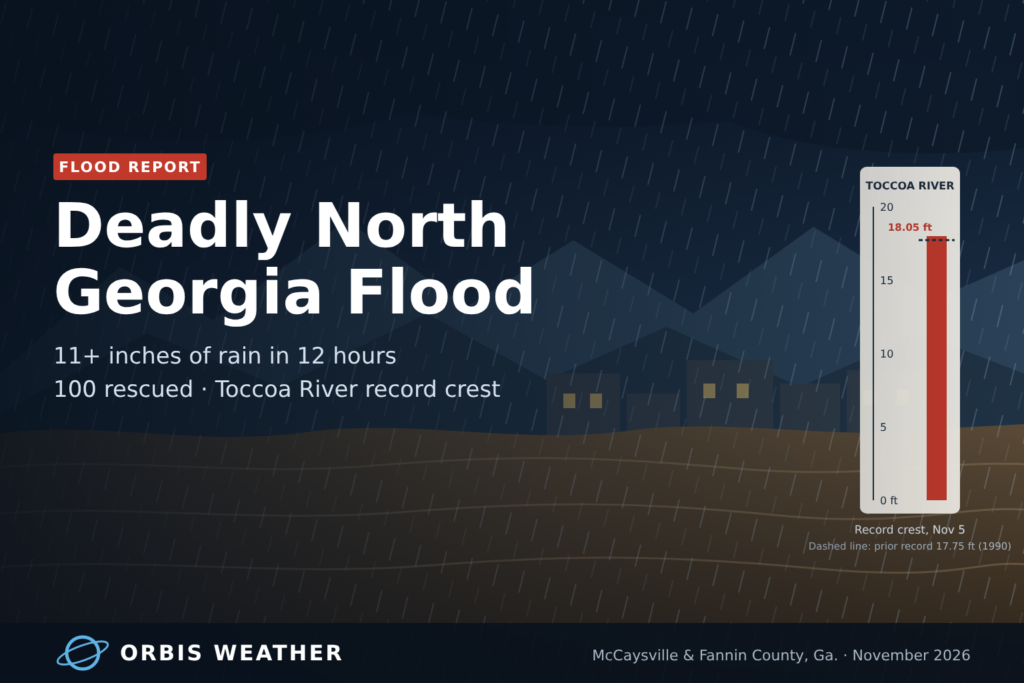
A flash flood in the North Georgia mountains killed one woman and led to about 100 water rescues after more than 11 inches [280 mm] of rain fell in 12 hours late Wednesday and early Thursday, November 4-5. The Toccoa River rose to a record crest of 18.05 feet [5.5 m] and swamped downtown McCaysville in Fannin County. The National Weather Service (NWS) called the downpour a “1 in 1000 Year Rainfall Event” over Blue Ridge, according to the Atlanta Journal-Constitution.
Gov. Brian Kemp placed Murray, Fannin, Gilmer and Union counties under a state of emergency, Atlanta News Firstreported on November 6. It was the second major flood this year for McCaysville and its Tennessee twin town, Copperhill, after flooding in August.
How the flood unfolded
The worst of the flooding came overnight, and the river crested within hours. Times below are Eastern, as reported.
When | What happened | Source |
|---|---|---|
Fri, Nov 6, about 1:30 p.m. | Evacuation order lifted in Copperhill, Tennessee | AJC |
Thu, Nov 5, about noon | Body of a missing Murray County driver found | AJC |
Thu, Nov 5, 9 a.m. | NWS flash flood emergency for McCaysville set to expire | Atlanta News First via WWSB |
Thu, Nov 5, 7 a.m. | Toccoa River crests at 18.05 ft, beating the 17.75-ft [5.4 m] record from February 1990 | AJC, citing NWS |
Thu, Nov 5, about 6 a.m. | Searchers find the driver’s car on Old CCC Camp Road | AJC |
Wed, Nov 4, shortly before 10 p.m. | A driver is swept away by floodwaters in Murray County | AJC, citing sheriff’s report |
The river rose 14 feet [4.3 m] in seven hours, a meteorologist told WSB Radio. Water stood 6 to 7 feet [1.8-2.1 m] deep in parts of downtown McCaysville on Thursday, Atlanta News First reported. Most of the water had receded by Friday, state emergency management (GEMA) Director Josh Lamb said.
Deaths, rescues and damage
One death and one injury had been confirmed as of Friday, November 6, both in Murray County.
The death. Julie Barrs, 56, of Ellijay died after floodwaters swept her car away on Old CCC Camp Road, the Murray County Medical Examiner’s Office said, as reported by Fox 5 Atlanta on November 6. A caller reported water reaching her chest before she was swept away, according to the sheriff’s incident report cited by the AJC. Lamb confirmed the death and a second, unexplained injury at a Friday news conference.
Rescues. Crews made 100 water rescues, 97 in Fannin County and three in Gilmer County, Lamb said on November 6. Earlier Thursday counts were lower, about 20 from Fannin County officials and more than 40 from McCaysville Police Chief Michael Earley, so early figures should be read as preliminary. Across the state line, first responders in Copperhill rescued more than 60 people, WSB Radio reported on November 6. Early reports, including WSB’s, said no deaths had occurred; those predate the Murray County confirmation.
Damage. Some houses were swept off their foundations, WSB Radio reported. The flood knocked out McCaysville’s drinking water system and cut off several communities with washed-out roads, Fox 5 reported. Hugh Rogers, owner of McCaysville Drug & Gun, estimated $200,000 to $300,000 in lost inventory, Now Georgia reported on November 6. Chief Earley said his department had “lost virtually everything.” Its station had reopened only the week before after August flood repairs. No total damage estimate had been published.
The rain behind the flood
Overnight thunderstorms dropped rain at a pace the NWS rates as roughly a one-in-1,000-year event for the area.
More than 10 inches [254 mm] of the total fell within six hours, NWS meteorologist Luke Culver told the AJC. The hardest-hit areas were south of McCaysville near the Fannin-Gilmer county line and around Blue Ridge. The Tennessee Valley Authority measured 8 to 10 inches [203-254 mm] overnight between Blue Ridge and Ellijay, Atlanta News First reported. The two figures cover different areas and time windows.
A one-in-1,000-year rainfall has about a 0.1% chance of happening in any given year at a given place. It does not mean the area is safe for another thousand years. The NWS classified McCaysville and Copperhill’s August flood as a 500-year event, Now Georgia reported. The Toccoa River becomes the Ocoee River at the Georgia-Tennessee line, where Copperhill sits.
Response and recovery
State and local agencies shifted from rescue to cleanup on Friday, with water service and shelter the main needs.
- Emergency declarations: the governor’s state of emergency covers four mountain counties. Gilmer County also declared a local emergency after flash flooding washed out roads and culverts, Fox 5 reported.
- Rescue teams: swiftwater crews from Cherokee, Union and Murray counties, the Tri-State Mutual Aid Group and the Georgia Department of Natural Resources helped trapped residents, according to Fox 5.
- Shelter: the American Red Cross opened a shelter at the Fannin County Recreation Center, 520 Winding Drive, Blue Ridge.
- Water and curfew: a boil water advisory remained in McCaysville on Friday, WSB Radio reported. Chief Earley set a 6 p.m. to 6 a.m. curfew for a designated downtown area, the AJC reported.
- Schools and airspace: Fannin County schools closed Friday while Gilmer County students returned, WSB reported. A federal temporary flight restriction covers the disaster zone, Fox 5 reported.
“Our hearts and prayers go out to all of those affected by this flood. We are here to help,” Lamb said on Friday. Earley struck a similar note: “McCaysville may be down right now, but we are not defeated.”
Staying safe and what comes next
The one death in this flood came after floodwater swept a car off a mountain road, and the safest choice is to avoid flooded roads entirely.
- Never drive or walk into floodwater. Moving water can sweep a car away, and the depth is hard to judge at night.
- Stay off closed roads. Washed-out roads and culverts are still cutting off communities in Gilmer and Fannin counties.
- In McCaysville, follow the boil water advisory until local officials lift it.
- Treat flooded buildings with care. Check for structural damage, and throw out food and supplies that touched floodwater.
- Watch for updates from GEMA, county emergency agencies and the NWS on road reopenings, water service and any damage assessments.
Sources
- Woman killed in North Georgia was swept away by floodwaters, officials say — Atlanta Journal-Constitution, November 6, 2026
- Woman who died after car swept away in North Georgia floods identified — Fox 5 Atlanta, updated 5:25 p.m. EST, November 6, 2026
- 1 killed after north Georgia floodwaters sweep vehicle away — Atlanta News First, 3:20 p.m. EST, November 6, 2026
- Flooding prompts state of emergency in Georgia as crews conduct more than 40 rescues — Atlanta News First and Gray News via WWSB, updated 12:43 p.m. EST, November 5, 2026
- North Georgia begins cleanup after historic flooding leaves widespread damage — WSB Radio, 8:55 a.m. EST, November 6, 2026
- Deadly North Georgia flood leaves families and businesses struggling to rebuild — Now Georgia, November 6, 2026
About the Author
Paul Harrison — Founder & Publisher, Orbis Weather
Paul Harrison founded Orbis Weather in 2026 to make global weather and natural-hazard information easier to find, follow and understand. His coverage includes tropical cyclones, severe weather, extreme temperatures, earthquakes, volcanoes, wildfires, flooding and significant natural disasters worldwide.
View all articles by Paul Harrison → | Editorial Standards →
Global Weather Tracker Hub
Explore weather maps, tropical systems, storms and natural hazards around the world.
No matching trackers found.