
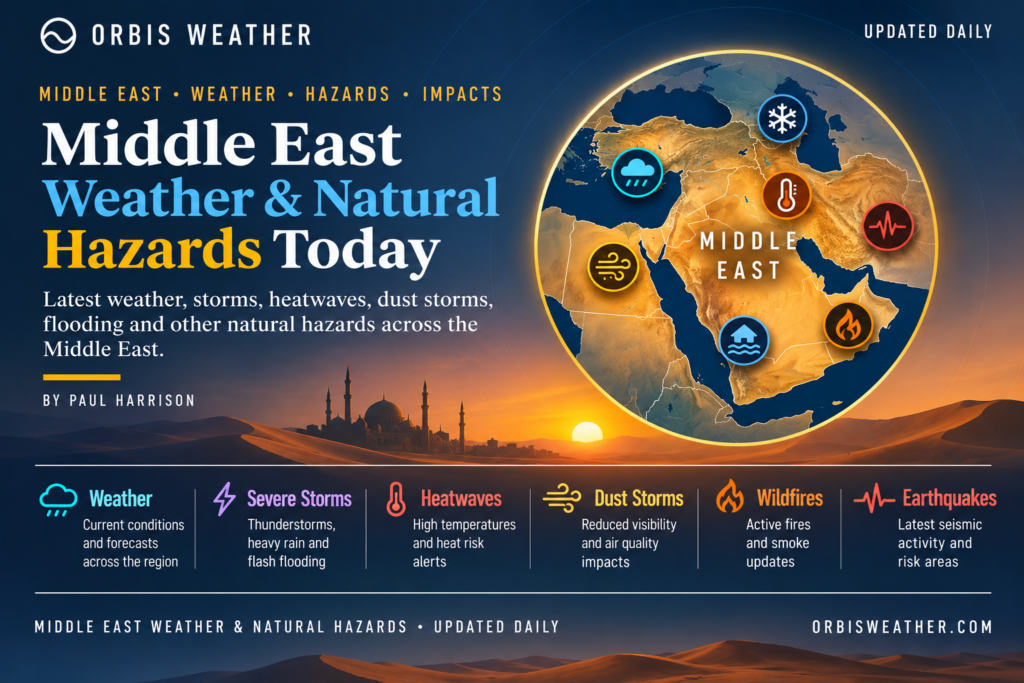
🌍 Middle East Weather & Natural Hazards Today
By Paul Harrison | Founder & Publisher, Orbis Weather

- Europe Weather & Natural Hazards Today — Saturday, November 7, 2026 7:10 PM
- Southeast Asia Weather & Natural Hazards Today: Saturday, November 7, 2026 7:01 PM
- Indonesia Volcanoes and Live Eruptions This Week: Saturday, November 7, 2026 6:51 PM
- Africa Weather & Natural Hazards Today — Saturday, November 7, 2026 5:36 PM
- Northeast Monsoon 2026/2027 Begins, With Heavy Rain, Floods and Rough Seas Possible Until March 2027 4:39 PM
- Middle East Weather & Natural Hazards Today – Saturday, November 7, 2026 4:17 PM
- Europe’s Hot Spots This Week Nov 6, 2026 2:51 PM
- Australian Region Tropical Weather Update — Saturday, November 7, 2026 11:23 AM
- Southwest Indian Ocean Tropical Weather Update – November 7, 2026 11:13 AM
- Australia, New Zealand & Oceania Weather & Natural Hazards Today Saturday, November 7, 2026 11:05 AM
- More than 80 rescued as catastrophic flood hits Fannin County, Georgia 8:57 AM
- North America Weather & Natural Hazards Today: East Coast Flood Threat, Canadian Storms and Pacific Weather Systems 8:39 AM
- Central America Weather & Natural Hazards Today: Heavy Rain, Flash Flooding and Tropical Development Threaten the Region 8:30 AM
- South America Weather & Natural Hazards Today — November 6, 2026 8:21 AM
- Daily Earthquakes, Storms, Fires & Floods Report — November 6, 2026 8:12 AM
- Global Natural Disasters This Week — November 6, 2026 8:03 AM
- Tropical Atlantic Daily Report: Friday, November 6, 2026 7:49 AM
- Eastern & Central Pacific Tropical Weather Update: Friday, November 6, 2026 7:39 AM
- WESTERN PACIFIC Tropical Weather Update: New Cyclone Threat Developing Near Guam as In-Fa Moves Away 7:25 AM





🌍 Middle East Weather & Natural Hazards Today – Saturday, November 7, 2026
Regional Weather Outlook: Seasonal Cooling, Desert Dust, Flash Flood Risks, Earthquake Monitoring and Changing Conditions Across the Middle East
By Paul Harrison | Orbis Weather | November 7, 2026
The Middle East is moving deeper into its autumn-to-winter transition, bringing changing weather patterns across the Arabian Peninsula, the eastern Mediterranean, Iraq, Iran and surrounding countries.
While much of the region typically experiences drier and more comfortable conditions during November, the season also brings an increased opportunity for passing weather systems, isolated thunderstorms, mountain snowfall and potentially dangerous flash flooding.
For Saturday, November 7, the main hazards worth monitoring include localized rainfall, reduced visibility from dust and haze, changing marine conditions and earthquake activity along the region’s major fault systems.
Important forecast note: A search of currently available information did not establish a complete set of verified, country-specific forecasts or active warnings for November 7. This report therefore distinguishes seasonal weather expectations and potential hazards from confirmed live conditions. It should not be interpreted as confirmation that a particular storm, flood, earthquake or dust event is occurring.
🌤️ Middle East Weather Overview
November marks an important transition across the Middle East.
The intense summer heat has generally eased across much of the Arabian Peninsula, although daytime temperatures can remain relatively warm in coastal and desert locations.
Farther north, countries including Turkey, Syria, Lebanon, Jordan, Iraq and Iran experience increasingly variable conditions as autumn weather systems become more influential.
The most important regional weather considerations are:
-
🌡️ Temperature changes: Cooler nights and greater differences between daytime and nighttime temperatures.
-
🌧️ Rainfall: Increasing seasonal opportunities for rain across the eastern Mediterranean and northern Middle East.
-
⛈️ Thunderstorms: Localized downpours remain a concern in parts of the Arabian Peninsula and mountainous regions.
-
🌪️ Dust and sand: Gusty winds can reduce visibility across exposed desert areas.
-
🌊 Marine conditions: Wind shifts may produce rougher seas in the Arabian Gulf, Gulf of Oman and Red Sea.
-
🏔️ Mountain weather: Higher elevations in Turkey and Iran can experience increasingly cold conditions and snowfall.
These are regional seasonal characteristics rather than verified conditions at every location today.
🇸🇦 Saudi Arabia – Desert Conditions, Cooler Nights and Rainfall Monitoring
Saudi Arabia experiences considerable weather differences between its western mountains, central deserts, eastern coastline and northern provinces.
Riyadh and central Saudi Arabia
November typically brings more manageable daytime temperatures than the summer months, with noticeably cooler conditions overnight.
Dust and blowing sand remain potential hazards when stronger winds develop across exposed desert terrain.
Jeddah and the Red Sea coast
Coastal areas can remain warm, with humidity influencing how comfortable conditions feel.
The western mountains and nearby drainage systems deserve particular attention during periods of convective rainfall. Heavy rain over elevated terrain can send runoff into normally dry channels.
Northern Saudi Arabia
The northern provinces generally experience a more pronounced autumn cooling trend, particularly overnight.
⚠️ Main hazards to monitor: Localized thunderstorms, flash flooding in wadis, blowing dust and reduced road visibility.
Outlook: November brings greater seasonal variability, but no specific active Saudi Arabian weather warning has been independently confirmed for this report.
🇦🇪 United Arab Emirates – Pleasant Seasonal Transition with Dust and Coastal Hazards
The United Arab Emirates is entering one of its more comfortable periods of the year.
Dubai, Abu Dhabi, Sharjah and surrounding coastal communities typically experience lower daytime temperatures than during summer, although humidity can still be noticeable near the coast.
Inland desert areas may experience larger day-to-night temperature differences.
Weather considerations
🌤️ Generally milder seasonal conditions are typical.
🌫️ Mist or fog can form during suitable overnight and early-morning conditions, particularly where moisture and light winds combine.
🌪️ Dust can affect visibility during stronger wind episodes.
⛈️ Isolated showers and thunderstorms are possible when suitable weather systems develop.
⚠️ Main hazards to monitor: Early-morning fog, dust-related visibility reductions, isolated heavy rainfall and changing marine conditions.
For current alerts, residents should consult the UAE National Center of Meteorology.
🇴🇲 Oman – Mountain Rainfall, Coastal Weather and Flash Flood Awareness
Oman’s varied geography creates different weather conditions across Muscat, the Hajar Mountains, interior deserts and southern coastal regions.
November is part of the transition toward the country’s cooler season.
Muscat and northern coastal communities generally experience more comfortable temperatures than during summer, while inland areas can cool significantly after sunset.
Mountain and wadi hazards
The Hajar Mountains can enhance rainfall when moisture and atmospheric instability are present.
Even localized thunderstorms can create dangerous runoff through steep valleys and normally dry riverbeds.
Flash flooding can occur some distance downstream from the heaviest rainfall.
Arabian Sea monitoring
Although tropical cyclone activity generally becomes less common as the season progresses, November remains within the broader North Indian Ocean tropical cyclone season.
Any developing system in the Arabian Sea would require assessment of its projected track, intensity and potential effects on Oman or Yemen.
⚠️ Main hazards to monitor: Wadi flooding, mountain thunderstorms, strong coastal winds and marine disturbances.
No active tropical cyclone threatening Oman has been verified in the information reviewed for this edition.
🇶🇦 🇧🇭 🇰🇼 Qatar, Bahrain and Kuwait – Cooler Weather and Visibility Concerns
Across Qatar, Bahrain and Kuwait, November typically brings a welcome reduction in summer heat.
Doha and Manama may continue to experience coastal humidity, while Kuwait often sees greater temperature variation as cooler air masses move across the northern Gulf.
Regional concerns
-
🌫️ Overnight mist and fog where atmospheric conditions permit.
-
🌪️ Blowing dust during gusty wind events.
-
🌊 Choppy coastal waters during stronger northwesterly winds.
-
🌡️ Cooler evenings, particularly in inland Kuwait.
Outlook: Seasonal cooling is the dominant climatological trend. Specific dust, fog or wind advisories should be checked through national meteorological authorities.
🇮🇶 Iraq – Increasing Rainfall Opportunities and Cooler Northern Weather
Iraq’s weather becomes increasingly changeable during November as cooler air and passing weather disturbances affect the country.
Baghdad and central Iraq generally experience lower temperatures than in the summer, while northern provinces can see a greater likelihood of rain.
Northern Iraq and Kurdistan
Mountainous areas around Erbil, Sulaymaniyah and Duhok are more exposed to colder weather systems.
Rainfall can increase river and stream levels, particularly where heavier precipitation affects steep terrain.
At higher elevations, snowfall becomes increasingly possible as winter approaches.
Central and southern Iraq
Dust remains a recurring concern, especially during dry and windy conditions.
Urban drainage problems may become significant if heavy rain develops over Baghdad or other populated areas.
⚠️ Main hazards to monitor: Localized flooding, thunderstorms, dust storms, mountain snowfall and reduced visibility.
🇮🇷 Iran – Mountain Snow Potential, Rainfall and Seismic Risk
Iran has one of the Middle East’s most geographically diverse climates.
The Alborz and Zagros mountain ranges influence temperature, rainfall and snowfall patterns, while central and eastern desert regions remain comparatively dry.
Tehran and northern Iran
Autumn brings cooler weather, with increasing opportunities for rain and colder conditions at higher elevations.
Western Iran and the Zagros Mountains
Passing weather systems can produce rain and, at sufficiently high elevations, snow.
Southern Iran
Areas near the Persian Gulf and Gulf of Oman generally remain warmer than northern and mountainous regions.
Earthquake monitoring
Iran lies within a highly active tectonic region shaped by the interaction of the Arabian and Eurasian plates.
Earthquakes can occur without warning, and a lack of reported major activity does not eliminate seismic risk.
⚠️ Main hazards to monitor: Mountain snowfall, localized flooding, dust, changing marine conditions and earthquakes.
No specific significant earthquake on November 7 has been independently verified for inclusion in this report.
🇹🇷 Turkey – Autumn Rain, Mountain Snow and Earthquake Awareness
Turkey’s weather becomes increasingly unsettled during November, particularly across northern, western and mountainous areas.
Istanbul and the Marmara region can experience periods of rain, wind and cooler temperatures.
Along the Black Sea coast, moist weather systems may produce persistent rainfall.
Eastern Anatolia experiences a much colder seasonal pattern, with snow increasingly possible in elevated areas.
Natural hazards
🌧️ Heavy rainfall can trigger localized flooding.
🏔️ Snow and ice can affect mountain transportation routes.
⛰️ Landslides remain a concern in steep, rain-soaked terrain.
🌍 Earthquakes remain a major long-term natural hazard because of Turkey’s active fault systems.
Outlook: Monitor official Turkish meteorological and disaster-management bulletins for any active November 7 warnings.
🇸🇾 🇱🇧 🇯🇴 Syria, Lebanon and Jordan – Eastern Mediterranean Weather Changes
The eastern Mediterranean enters a wetter part of its annual weather cycle during autumn.
Lebanon
Coastal areas, including Beirut, can experience periods of rain as Mediterranean weather systems become more frequent.
Mountain communities face cooler conditions, with snow increasingly possible at higher elevations as winter approaches.
Syria
Western and northern Syria generally experience more seasonal rainfall than the eastern desert regions.
Heavy rainfall can cause localized flooding, especially where drainage systems are damaged or inadequate.
Jordan
Amman and northern Jordan typically become cooler during November.
The country’s steep valleys and desert wadis present a significant flash-flood hazard when intense rainfall develops.
⚠️ Main hazards to monitor: Heavy rain, flash flooding, slippery roads, landslides and colder mountain conditions.
🇮🇱 🇵🇸 Israel and Palestinian Territories – Mediterranean Rainfall and Flash Flood Risk
November generally marks the developing rainy season across Israel and the Palestinian territories.
Coastal locations such as Tel Aviv and Gaza can experience increasingly variable conditions as Mediterranean weather systems become more active.
Jerusalem and surrounding higher terrain typically experience cooler nights.
Key hazards
🌧️ Heavy rain can produce urban flooding.
⛈️ Thunderstorms may develop with passing weather systems.
🌊 Strong winds can create hazardous coastal conditions.
🏜️ Desert valleys, particularly around the Dead Sea and southern areas, can experience rapid flash flooding when heavy rainfall occurs upstream.
People living in damaged buildings, temporary shelters or areas with limited drainage can face heightened exposure to rain, wind and cold weather.
Outlook: Any active severe-weather warnings must be confirmed through local meteorological and emergency authorities.
🇾🇪 Yemen – Mountain Rainfall and Arabian Sea Monitoring
Yemen’s mountainous geography creates considerable variations in weather conditions.
Higher elevations around Sana’a can experience cool nights, while coastal communities remain considerably warmer.
Heavy rainfall in mountainous areas can cause rapid runoff and dangerous flooding in valleys and low-lying settlements.
The country’s infrastructure and humanitarian challenges can increase the consequences of weather-related emergencies.
⚠️ Main hazards to monitor: Flash flooding, mountain thunderstorms, coastal winds and possible Arabian Sea tropical disturbances.
🌊 Marine Weather – Arabian Gulf, Red Sea and Arabian Sea
Marine conditions across the Middle East can change rapidly during November, particularly when stronger regional wind systems develop.
|
Marine region |
Main weather hazards to monitor |
|---|---|
|
Arabian Gulf |
Northwesterly winds, choppy seas, reduced visibility |
|
Red Sea |
Strong winds, rough seas, localized thunderstorms |
|
Gulf of Oman |
Coastal wind changes, swell and occasional unsettled weather |
|
Arabian Sea |
Tropical disturbances, swell and heavy rain |
|
Eastern Mediterranean |
Autumn storms, stronger winds and higher waves |
Mariners, fishing vessels and coastal communities should consult official marine forecasts before departure.
No verified wave heights or active marine warnings are available for this edition.
🌍 Earthquake and Seismic Activity – Middle East Monitoring
The Middle East is home to several major earthquake zones, including the Zagros Mountains, the North and East Anatolian fault systems, the Dead Sea Transform and parts of the eastern Mediterranean.
Earthquakes can occur at any time, regardless of prevailing weather conditions.
Areas requiring continued seismic monitoring
|
Region |
Primary seismic concern |
|---|---|
|
Turkey |
North and East Anatolian fault systems |
|
Iran |
Zagros, Alborz and other active fault zones |
|
Iraq–Iran border |
Active Zagros mountain fault systems |
|
Syria and Lebanon |
Dead Sea Transform and regional faults |
|
Israel, Palestine and Jordan |
Dead Sea Transform fault system |
|
Gulf of Oman |
Makran subduction zone |
November 7 earthquake status: No verified list of significant earthquakes occurring today was available from the sources reviewed. This does not mean that no earthquakes have occurred.
Readers can check the USGS Live Earthquake Map for recent events, magnitudes, depths and locations.
🌧️ Flash Flood Risk – Why November Matters
Flash flooding is one of the Middle East’s most dangerous weather hazards.
Although many areas receive relatively little annual rainfall, intense thunderstorms can produce large amounts of rain in a short period.
Dry riverbeds, known as wadis, can fill rapidly with fast-moving water.
Mountainous areas are particularly vulnerable because steep slopes accelerate runoff into valleys and settlements.
Areas with notable geographical vulnerability
-
Western Saudi Arabia and the Red Sea mountain foothills.
-
Northern Oman and the Hajar Mountains.
-
Jordan’s steep valleys and desert drainage systems.
-
Yemen’s mountainous regions.
-
Western Iran and the Zagros Mountains.
-
Eastern Mediterranean urban and mountain communities.
These are geographical areas of potential vulnerability, not locations under confirmed flood warnings today.
Never attempt to drive across a flooded road or wadi. Water depth, road damage and current speed can be difficult to judge.
🌪️ Dust Storms and Air Quality
Dust and sandstorms remain important hazards across much of the Middle East, even outside the peak summer season.
Dry soils, exposed desert landscapes and strong winds can combine to produce substantial reductions in visibility.
Potentially affected areas include Saudi Arabia, Iraq, Kuwait, Qatar, the UAE and parts of Iran.
Airborne dust can increase particulate pollution and create difficulties for people with asthma or other respiratory conditions.
Air quality precautions
🌫️ Check local air quality readings before prolonged outdoor activity.
🚗 Reduce driving speeds during poor visibility.
🏠 Keep windows closed during significant dust events.
😷 Consider a well-fitting particulate respirator when outdoor exposure cannot be avoided.
Dust storm activity has not been confirmed across all these locations for November 7.
🌡️ Climate Watch – El Niño and the Middle East
The World Meteorological Organization reported in September 2026 that El Niño had become established and was expected to strengthen, with potential implications for global rainfall and temperature patterns into 2027.
El Niño can influence atmospheric circulation and weather patterns well beyond the tropical Pacific.
However, its effects on the Middle East are complex and differ between countries, seasons and individual weather systems.
It would be misleading to attribute any particular Middle Eastern rainstorm, drought or temperature anomaly to El Niño without a specific scientific analysis.
The WMO has also documented the broader impacts of exceptional heat and extreme weather across parts of the Middle East during 2026.
Long-term climate monitoring remains important for water resources, agriculture, infrastructure planning and disaster preparedness.
📊 Middle East Natural Hazards Summary – November 7, 2026
The following table summarizes hazards requiring attention. It is a monitoring guide rather than a live warning bulletin.
|
Natural hazard |
Regional outlook |
Verification status |
|---|---|---|
|
🌧️ Heavy rainfall |
Possible with autumn weather systems |
No active warning verified |
|
🌊 Flash flooding |
Potential in wadis and mountainous areas |
No active warning verified |
|
🌪️ Dust storms |
Recurring risk across desert regions |
No active warning verified |
|
🌡️ Extreme heat |
Seasonal heat generally easing |
No current heat alert verified |
|
🏔️ Mountain snow |
Increasing seasonal possibility in Turkey and Iran |
No current snowfall warning verified |
|
🌍 Earthquakes |
Persistent tectonic hazard |
No event list verified |
|
🌀 Tropical cyclones |
Arabian Sea monitoring remains relevant |
No active system verified |
|
🌊 Rough seas |
Possible during stronger wind events |
No active marine warning verified |
🔭 Middle East Weather Outlook – November 8–10, 2026
Looking ahead to Sunday through Tuesday, November 8–10, several seasonal weather developments deserve continued monitoring.
Arabian Peninsula: Cooler overnight conditions should become increasingly characteristic of the season. Forecasters should watch for localized convective rainfall, fog and changes in desert wind conditions.
Iraq and Iran: Autumn weather disturbances may bring periods of rain and colder conditions, particularly in northern and mountainous areas.
Turkey and the eastern Mediterranean: The advancing autumn season increases the potential for rain-bearing weather systems, stronger winds and colder conditions at higher elevations.
Arabian Sea: Continued tropical weather monitoring is warranted, although no specific cyclone development is confirmed in this report.
These are seasonal monitoring priorities, not a verified three-day forecast. Exact rainfall amounts, temperatures, storm tracks and warning levels require updated meteorological model guidance.
🛡️ Weather Safety and Preparedness
Residents and travelers throughout the Middle East should remain aware of rapidly changing local conditions.
During heavy rainfall, avoid low-lying roads, drainage channels and wadis. In dusty conditions, reduce unnecessary travel and check visibility reports. Mountain travelers should prepare for colder temperatures and possible winter weather.
Coastal residents and mariners should follow national marine bulletins, especially during periods of strong winds or unsettled weather.
In earthquake-prone areas, identify safe shelter locations and maintain an emergency plan. Earthquakes cannot be predicted reliably by daily weather forecasts.
📡 Official Weather and Natural Hazard Sources
Orbis Weather recommends consulting the following authoritative organizations for current forecasts, observations and emergency information.
|
Organization |
Coverage and information |
|---|---|
|
Global meteorological guidance and climate monitoring |
|
|
Saudi Arabian weather forecasts and alerts |
|
|
UAE weather, fog, dust and marine information |
|
|
Official Omani meteorological services |
|
|
Turkey forecasts and meteorological warnings |
|
|
Regional earthquake monitoring |
|
|
Global earthquake observations |
|
|
International disaster event monitoring |
|
|
Visual weather model forecasts and atmospheric conditions |
Editorial Methodology and Transparency
This Orbis Weather report combines regional meteorological knowledge, seasonal climate characteristics, established geographical hazards and publicly available scientific information.
Reporting date: Saturday, November 7, 2026, using the local calendar date across the Middle East.
Information reviewed: November 6, 2026.
Forecast limitations: A comprehensive set of real-time November 7 observations, national warnings and model forecasts could not be independently verified. Accordingly, no unverified city temperatures, rainfall totals, wind speeds, earthquake magnitudes or active disaster alerts have been presented as confirmed facts.
Editorial distinction: Seasonal weather patterns, potential natural hazards and actual observed events are different categories of information. Orbis Weather aims to identify those differences clearly.
Corrections policy: Material factual errors should be corrected promptly, with significant changes identified where appropriate. Forecasts are subject to revision as new observations and official warnings become available.
Orbis Weather is an independent weather information publisher and is not an official meteorological or emergency management agency. Its reports supplement rather than replace government warnings.
🌍 Final Outlook – A Changing Season Across the Middle East
The Middle East continues its transition toward winter, with cooler nights, greater opportunities for seasonal rainfall and increasingly variable weather across northern and mountainous areas.
Across the Arabian Peninsula, dust, localized thunderstorms, coastal conditions and flash-flood vulnerability remain important considerations.
Farther north, Turkey, Iran, Iraq and the eastern Mediterranean are entering a period when rain-bearing systems and colder mountain weather become more influential.
Earthquake preparedness also remains essential across the region’s active tectonic zones, independently of daily weather conditions.
The main message for November 7 is preparedness and continued monitoring, rather than any confirmed region-wide weather emergency.
For continuing coverage of tropical weather, earthquakes, flooding, severe storms and other natural hazards worldwide, visit Orbis Weather.
By Paul Harrison – Orbis Weather
Independent weather reporting, natural hazard awareness and global environmental monitoring
About the Author
Paul Harrison — Founder & Publisher, Orbis Weather
Paul Harrison founded Orbis Weather in 2026 to make global weather and natural-hazard information easier to find, follow and understand. His coverage includes tropical cyclones, severe weather, extreme temperatures, earthquakes, volcanoes, wildfires, flooding and significant natural disasters worldwide.
View all articles by Paul Harrison → | Editorial Standards →
Global Weather Tracker Hub
Explore weather maps, tropical systems, storms and natural hazards around the world.
No matching trackers found.