
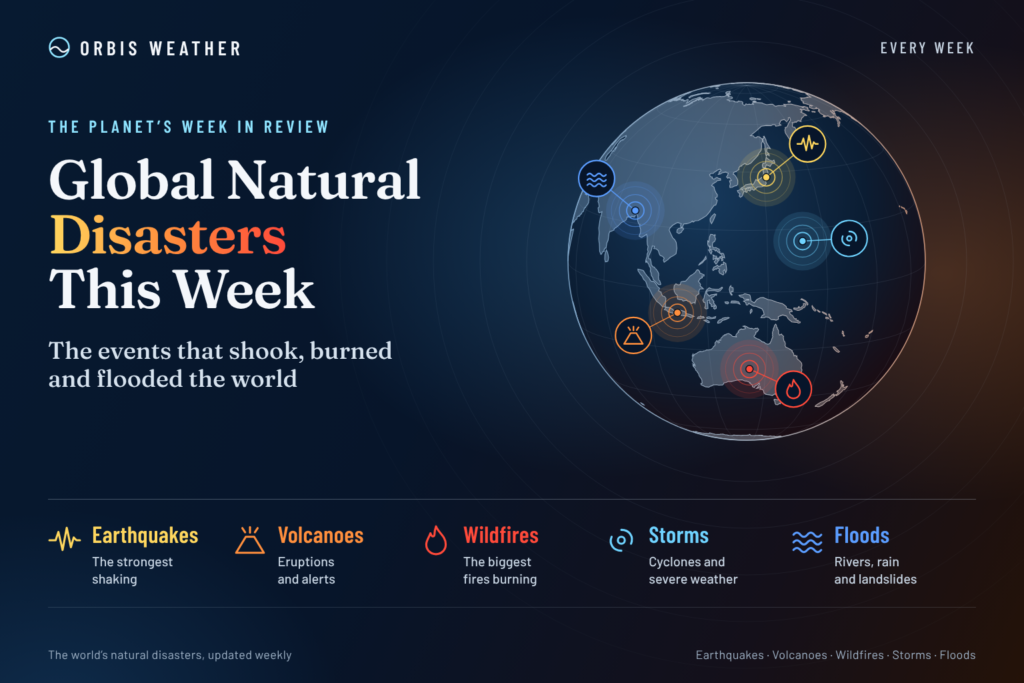
🌎 Global Natural Disasters This Week
By Paul Harrison | Founder & Publisher, Orbis Weather

- Europe Weather & Natural Hazards Today — Saturday, November 7, 2026 7:10 PM
- Southeast Asia Weather & Natural Hazards Today: Saturday, November 7, 2026 7:01 PM
- Indonesia Volcanoes and Live Eruptions This Week: Saturday, November 7, 2026 6:51 PM
- Africa Weather & Natural Hazards Today — Saturday, November 7, 2026 5:36 PM
- Northeast Monsoon 2026/2027 Begins, With Heavy Rain, Floods and Rough Seas Possible Until March 2027 4:39 PM
- Middle East Weather & Natural Hazards Today – Saturday, November 7, 2026 4:17 PM
- Europe’s Hot Spots This Week Nov 6, 2026 2:51 PM
- Australian Region Tropical Weather Update — Saturday, November 7, 2026 11:23 AM
- Southwest Indian Ocean Tropical Weather Update – November 7, 2026 11:13 AM
- Australia, New Zealand & Oceania Weather & Natural Hazards Today Saturday, November 7, 2026 11:05 AM
- More than 80 rescued as catastrophic flood hits Fannin County, Georgia 8:57 AM
- North America Weather & Natural Hazards Today: East Coast Flood Threat, Canadian Storms and Pacific Weather Systems 8:39 AM
- Central America Weather & Natural Hazards Today: Heavy Rain, Flash Flooding and Tropical Development Threaten the Region 8:30 AM
- South America Weather & Natural Hazards Today — November 6, 2026 8:21 AM
- Daily Earthquakes, Storms, Fires & Floods Report — November 6, 2026 8:12 AM
- Global Natural Disasters This Week — November 6, 2026 8:03 AM
- Tropical Atlantic Daily Report: Friday, November 6, 2026 7:49 AM
- Eastern & Central Pacific Tropical Weather Update: Friday, November 6, 2026 7:39 AM
- WESTERN PACIFIC Tropical Weather Update: New Cyclone Threat Developing Near Guam as In-Fa Moves Away 7:25 AM





Global Natural Disasters This Week — November 6, 2026
By Paul Harrison, Orbis Weather ·
At a glance
Flooding was the week’s deadliest hazard: rain killed at least three people across Florida and the US Southwest, with a fourth death suspected, while Cyclone Murasu killed at least two in India. The week covered runs from Saturday, October 31, to Friday, November 6, 2026.
Event | Place | Dates | Human toll | Source, date reported |
|---|---|---|---|---|
Cyclone Murasu | Andhra Pradesh, India | Landfall Nov 3 | At least 2 dead | National Herald (PTI, state officials), Nov 3 |
Flash floods | Brevard County, Florida, US | Nov 1–3 | 2 dead | ABC News, Nov 3 |
Flash floods | Four Corners, US Southwest | Nov 1–2 | 1 dead, a second death suspected | AP via KUER, Nov 2–3 |
Mayon eruption | Albay, Philippines | Alert Level 3 since Oct 30 | 3,903 people evacuated, no casualties | Daily Tribune (Albay emergency office), Nov 3 |
Urban flooding | Varna, Bulgaria | Nov 2 | No casualties reported | Ground News, Nov 2 |
M6.1 earthquake | Off Chiba, Japan | Nov 6 | No damage or tsunami warning reported | Xinhua (JMA), Nov 6 |
Typhoon In-fa | Western North Pacific | Through Nov 5 | No land impacts reported | Philstar (PAGASA), Nov 5 |
Tropical cyclones
Cyclone Murasu was the only storm to strike land this week. The Atlantic and eastern Pacific had no active storms as of November 5, according to the National Hurricane Center.
Storm | Basin | Status during the week | Land threat |
|---|---|---|---|
Murasu | North Indian Ocean (Bay of Bengal) | Severe cyclonic storm; landfall near Ongole, Andhra Pradesh, about 1 a.m. local time Nov 3 | Struck India; GDACS red alert |
In-fa (30W) | Western North Pacific | Typhoon, then tropical storm; JTWC final warning Nov 5 | None; moving northeast over open ocean |
Invest 99W | Western North Pacific | Disturbance, 408 nautical miles (470 miles) northeast of Guam on Nov 6; development chance “high” | Moving west-northwest toward Guam |
Invest 94S | South Indian Ocean | Disturbance, 404 nautical miles (465 miles) southeast of the Seychelles on Nov 5; chance “medium” | None stated; slow southwest drift |
Cyclone Murasu, India. Murasu came ashore near Ongole in Prakasam district, the India Meteorological Department said, as reported by Al Jazeera on November 3. Winds reached 100–110 km/h (62–68 mph), with gusts to 120 km/h (75 mph), per the National Herald. The state disaster agency counted 312 houses affected, 2,750 power poles damaged and 12,230 people in shelters (PTI, November 3). Crops were affected across 52,459 hectares (about 129,600 acres) in 15 districts. The Tribune cited an official release giving 30,661 acres of damaged crops and 10,805 people evacuated. Bapatla recorded 22 cm (8.7 inches) of rain in 24 hours. GDACS put 1.5 million people in the storm’s path. Murasu followed Cyclone Arnab, which hit the same coast in late October and killed at least six people, per Earthweek.
Typhoon In-fa. On November 4 at 4 p.m., PAGASA placed In-fa 1,780 km (1,106 miles) east of extreme northern Luzon, with winds of 130 km/h (81 mph), per Philstar. It was not expected to enter the Philippine area of responsibility. The Joint Typhoon Warning Center last placed it about 366 nautical miles (421 miles) south-southeast of Yokosuka, Japan, on November 5, moving northeast.
Invest 99W. The Joint Typhoon Warning Center raised the chance of a significant tropical cyclone forming within 24 hours to “high” early on November 6. The system had winds of 23–28 knots (26–32 mph) and was moving toward Guam. National weather services and local authorities issue the official warnings.
Floods and landslides
The United States had the week’s two deadliest floods, both driven by days of heavy rain from slow-moving upper-air disturbances. No major landslide disaster was reported this week.
Florida, United States. Up to 2 feet of rain fell on southern Brevard County on November 1–2, causing flash flooding in Palm Bay, West Melbourne and Grant-Valkaria. Joshua Bennett, 34, and Archie Richards, 78, died in Palm Bay, ABC News reported on November 3. Sheriff Wayne Ivey reported more than 200 high-water rescues, and the county estimated at least 250 homes damaged, per WUSF on November 6. The Weather Prediction Center measured 612 mm (24.10 inches) near Malabar, per The Watchers. Governor Ron DeSantis declared a state of emergency for seven counties on November 2. The cause was an upper-air disturbance over the eastern Gulf combined with moist onshore winds from the Atlantic.
US Southwest (Arizona, Colorado, New Mexico). Storms on November 1–2 forced hundreds to evacuate and left one person dead. Flagstaff police found the body of Williams Singavarapu, 73, who had fallen into floodwaters, and a second death is suspected to be weather-related, AP reported via KUER on November 2–3. Dozens were rescued, some by helicopter. Flagstaff had 5.15 inches (13 cm) of rain over two days, its wettest November 1 on record. The San Juan River at Pagosa Springs, Colorado, crested at 16.81 feet (5.1 m), a foot below its historic level, according to the National Weather Service. A county spokesperson had given about 14 feet by Sunday evening, per AP via AJC. Arizona declared a statewide emergency, and New Mexico and Colorado sought a federal major disaster declaration.
Bulgaria. Torrential rain flooded streets and underpasses in Varna on November 2, with 76.5 liters per square meter (about 3 inches) recorded, per Ground News. No casualties were reported. The national weather bureau issued Code Orange warnings for Bourgas, Yambol and Sliven for November 4, per The Sofia Globe.
- Syria: Flash floods in late October killed at least seven people, with five missing, per the Center for Disaster Philanthropy on November 3. This event began before the week covered.
Earthquakes
It was a quiet week for earthquakes: four of magnitude 5.5 or greater, none damaging. All four carried a green USGS PAGER alert and no tsunami flag, per the USGS catalog.
Time (UTC) | Magnitude | Location | Depth |
|---|---|---|---|
Nov 6, 10:39 | 6.1 | 144 km (89 miles) SE of Hasaki, Japan | 29 km (18 miles) |
Nov 5, 17:21 | 6.1 | Fiji region | 535 km (332 miles) |
Nov 1, 11:47 | 6.0 | 165 km (103 miles) NW of Port-Olry, Vanuatu | 10 km (6 miles) |
Oct 31, 22:15 | 6.0 | 58 km (36 miles) SSE of Shima, Japan | 352 km (219 miles) |
The November 6 quake off Japan’s east coast was felt in central Tokyo. The Japan Meteorological Agency gave a preliminary magnitude of 6.1 at a depth of about 10 km and intensity 3 on its 7-point scale in parts of Miyagi, Fukushima and Ibaraki, per Xinhua. No tsunami warning was issued and no damage was reported. The deep Fiji quake affected few people, per GDACS.
Volcanoes
Mayon in the Philippines was the week’s main volcanic threat to people. It entered what PHIVOLCS called “a new phase of magmatic eruption” after a moderately explosive eruption on October 30 sent ash about 3,000 m (9,800 ft) high, per The Manila Times. On November 3, a minor Strombolian event produced a 1,600 m (5,250 ft) ash plume drifting southwest. By noon that day, 1,083 families had left their homes in Tabaco, Malilipot, Camalig and Ligao, per the Daily Tribune. Entry within 6 km (3.7 miles) of the crater is banned, and schools were suspended, per Earthweek. No deaths or injuries were reported. PHIVOLCS and local authorities issue the official warnings.
Volcano | Country | Change or activity | Date | Source |
|---|---|---|---|---|
Mayon | Philippines | Alert Level raised from 2 to 3 (of 5); 6 km danger zone | Oct 30 | The Star (Xinhua), Nov 1 |
Mayon | Philippines | Ash plume 1,600 m (5,250 ft); ashfall warning for six towns | Nov 3 | Daily Tribune, Nov 3 |
Wildfires, heat and drought
No wildfire this week was reported to have caused deaths. All fires on the GDACS feed carried green alerts, the lowest level. The largest, in Australia, covered 38,247 hectares (about 94,500 acres) on November 4–5, with no population in the area. Fires in Burkina Faso and Bolivia burned near settlements; one Burkina Faso fire of 5,219 hectares (12,900 acres) had 5,915 people in the affected area on November 5.
The week’s highest temperature was 46°C (115°F) at Mandora Station, Western Australia, according to World Meteorological Organization data cited by Earthweek. Drought continues to drive hunger in South Sudan, where nearly four million people have been affected, per a UN update cited by the Center for Disaster Philanthropy.
What to watch next week
A possible tropical cyclone near Guam is the main hazard to watch. National weather services and local authorities issue the official warnings.
Dates | Hazard | Area | Why it matters |
|---|---|---|---|
Nov 6–8 | Invest 99W, possible tropical cyclone | Guam and the Mariana Islands | JTWC rated development chance “high” on Nov 6, with the system tracking toward Guam |
Nov 6–8 | Invest 94S | South Indian Ocean, southeast of the Seychelles | JTWC expected weak development over 48 hours |
Nov 9–12 | Polar vortex disruption | Northern Hemisphere stratosphere | NASA forecasts showed winds at 60°N briefly reversing, per The Watchers; surface effects, if any, take two to six weeks |
Ongoing | Mayon eruption | Albay, Philippines | PHIVOLCS warned of possible lava flows and pyroclastic density currents in the coming days to weeks |
Ongoing | Flood recovery | Brevard County, Florida, and the Four Corners | Damage assessments and disaster declarations are pending |
About this report
This report covers natural disasters worldwide from Saturday, October 31, to Friday, November 6, 2026. It draws on GDACS alerts, the USGS earthquake catalog, the Joint Typhoon Warning Center, the National Hurricane Center, national agencies and news reports. Each casualty figure carries its source and the date it was reported. Early tolls often change as damage assessments continue, and remote or conflict-affected areas may be under-reported.
- GDACS: The Global Disaster Alert and Coordination System, a UN and European Commission service that rates disasters green, orange or red by likely impact.
- Invest: A weather disturbance that forecasters are watching for possible development into a tropical cyclone.
- PAGER alert: A USGS rating of an earthquake’s likely deaths and losses; green is the lowest level.
- Pyroclastic density current: A fast, ground-hugging flow of hot gas, ash and rock from a volcano.
- Sudden stratospheric warming: A rapid warming high above the Arctic that weakens the polar vortex and can later bring cold air to lower latitudes.
Frequently asked questions
What was the deadliest disaster this week? No single event stood out. Flash floods in Florida and Cyclone Murasu in India each killed at least two people, and floods in the US Southwest killed at least one.
How much rain fell in Florida? The Weather Prediction Center measured more than 24 inches near Malabar in about a day and a half. A Brevard County official called it “a once-in-1,000-year flood,” per WUSF.
Is Mayon about to erupt more strongly? Mayon remains at Alert Level 3 of 5. PHIVOLCS warned of a greater chance of lava flows and pyroclastic density currents on its upper and middle slopes in the coming days to weeks.
Will a typhoon hit Guam? Not yet certain. On November 6 the Joint Typhoon Warning Center gave Invest 99W a high chance of becoming a significant tropical cyclone within 24 hours, moving toward Guam. Residents should follow the National Weather Service in Guam.
Did the earthquake off Japan cause a tsunami? No. The Japan Meteorological Agency issued no tsunami warning after the magnitude 6.1 quake on November 6, and no damage was reported.
Sources
- USGS earthquake catalog, M5.5+ since Oct 29 — accessed Nov 6, 2026
- GDACS alert feed — Nov 6, 2026
- GDACS: Tropical Cyclone Murasu-26 — accessed Nov 6, 2026
- GDACS: Fiji earthquake — Nov 5, 2026
- JTWC Western and South Pacific advisory — Nov 6, 2026
- JTWC Indian Ocean advisory — Nov 5, 2026
- National Hurricane Center — Nov 5, 2026
- Al Jazeera: Cyclone Murasu makes landfall — Nov 3, 2026
- National Herald: Cyclone Murasu kills two — Nov 3, 2026
- The Tribune: Cyclone Murasu makes landfall in Andhra — Nov 3, 2026
- Philstar: In-fa intensifies into typhoon — Nov 5, 2026
- ABC News: 2 dead, hundreds rescued in Florida — Nov 3, 2026
- The Watchers: Florida declares emergency — Nov 3, 2026
- ClickOrlando: How much rain fell across Central Florida — Nov 3, 2026
- WUSF: Could Brevard’s flash flood be a sign of things to come? — Nov 6, 2026
- AP via AJC: Flash flooding triggers evacuations in Southwest — Nov 2, 2026
- AP via KUER: Flood risk remains high in Four Corners — Nov 2, 2026 (updated Nov 3)
- Ground News: Heavy rainfall flooded Varna — Nov 2, 2026
- The Sofia Globe: Bulgaria issues new weather warnings — Nov 3, 2026
- Xinhua: 6.1-magnitude earthquake hits eastern Japan coast — Nov 6, 2026
- The Manila Times: Mayon spews massive ash cloud — Nov 4, 2026
- Daily Tribune: Mayon evacuees rise to almost 4,000 — Nov 3, 2026
- The Star (Xinhua): Over 1,400 displaced after Mayon eruption — Nov 1, 2026
- Earthweek: Week ending November 6, 2026 — Nov 6, 2026
- Center for Disaster Philanthropy: Weekly disaster update, November 2, 2026 — Nov 3, 2026
- The Watchers: Polar vortex winds drop in rare November disruption — Nov 5, 2026
Sources & Methodology
Weekly Global Weather Watch is compiled by Orbis Weather using information from official national and international meteorological agencies, including NOAA, the National Weather Service, National Hurricane Center, Weather Prediction Center, Climate Prediction Center, World Meteorological Organization and relevant national weather agencies worldwide.
Orbis Weather reviews these official observations, forecasts, warnings and outlooks to identify the most significant global weather patterns and hazards for the week ahead. Forecast conditions can change as new observations and model guidance become available.
About the Author
Paul Harrison — Founder & Publisher, Orbis Weather
Paul Harrison founded Orbis Weather in 2026 to make global weather and natural-hazard information easier to find, follow and understand. His coverage includes tropical cyclones, severe weather, extreme temperatures, earthquakes, volcanoes, wildfires, flooding and significant natural disasters worldwide.
View all articles by Paul Harrison → | Editorial Standards →
Global Weather Tracker Hub
Explore weather maps, tropical systems, storms and natural hazards around the world.
No matching trackers found.