
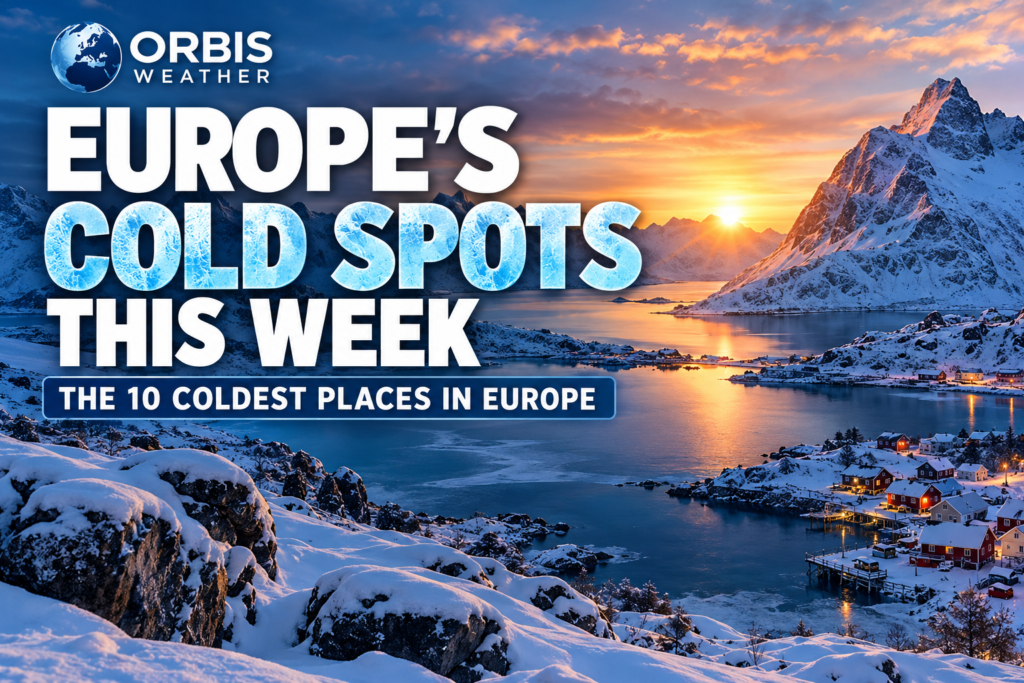




Europe’s Cold Spots This Week: The 10 Coldest Places in Europe
Orbis Weather | October 20–26, 2026
By Paul Harrison | Orbis Weather
Europe’s autumn chill is strengthening as October moves toward its final week, with the Arctic, northern Scandinavia, Iceland and Europe’s high mountain regions entering a period of increasingly wintry conditions.
From the remote Norwegian archipelago of Svalbard to the frozen landscapes of Finnish Lapland, the continent’s traditional cold-weather hotspots are preparing for shorter days, longer nights and the growing possibility of accumulating snow.
But where are Europe’s coldest places this week?
Orbis Weather examines ten locations particularly vulnerable to freezing temperatures during October 20–26, 2026, explaining the geography, weather patterns and seasonal changes behind their cold climates.
Important temperature note: A complete, comparable set of verified weekly minimum temperatures is not yet available for all European weather stations. The following is a watchlist of ten notable cold-weather locations, rather than a confirmed ranking of Europe’s ten lowest measured temperatures this week.
Europe’s 10 cold spots to watch
Locations are grouped for cold-weather monitoring, not ranked by verified weekly temperature.
Location | Country | Why it gets cold |
|---|---|---|
1. Ny-Ålesund, Svalbard | Norway | High-Arctic latitude |
2. Longyearbyen, Svalbard | Norway | Arctic air and long nights |
3. Kautokeino | Norway | Inland Arctic climate |
4. Karasjok | Norway | Strong nighttime cooling |
5. Kilpisjärvi | Finland | Northern latitude and elevation |
6. Utsjoki | Finland | Remote northern Lapland |
7. Kiruna | Sweden | Inland subarctic climate |
8. Nikkaluokta | Sweden | Mountain-valley cold |
9. Hveravellir | Iceland | Exposed highland location |
10. Jungfraujoch | Switzerland | High Alpine elevation |
These locations are all plausible candidates for significant October cold, but their order does not establish which recorded the lowest temperature during October 20–26.
Verified observations and temperature outlook
Although the complete week’s rankings cannot yet be established, recent observations and forecasts provide useful evidence of the developing cold season.
Karasjok, Norway
October 13 observation
10.6°F / −11.9°C
A substantial overnight freeze was recorded in northern Norway earlier this month.
Kautokeino, Norway
October 13 observation
11.5°F / −11.4°C
Another example of the intense radiational cooling possible in inland Finnmark.
Jungfraujoch, Switzerland
October 19 observation
23.7°F / −4.6°C
The high-altitude station recorded a freezing minimum, with strong winds and gusts reaching 87 km/h (54 mph).
These are dated observations, not measurements of the entire October 20–26 reporting period.
Why northern Europe gets so cold in October
Three major factors explain why temperatures can drop sharply across the continent’s northernmost regions.
1. Rapidly decreasing daylight. Above the Arctic Circle, daylight decreases dramatically through October. Longer nights allow the ground to lose more heat, particularly under clear skies.
2. Arctic air masses. Cold air originating over northern Scandinavia and the Arctic can spread southward when atmospheric circulation patterns become favorable.
3. Snow cover and elevation. Snow-covered ground reflects sunlight and can reinforce cold conditions. Meanwhile, Europe’s highest mountains remain cold enough for freezing weather even when lower elevations experience mild autumn temperatures.
The difference between coastal and inland temperatures can be considerable. Norwegian coastal towns benefit from relatively mild maritime influences, while inland locations such as Karasjok and Kautokeino can experience much stronger nighttime cooling.
The Arctic versus the Alps: Where is Europe’s coldest air?

Arctic Europe
Svalbard, northern Norway, Sweden and Finland experience prolonged seasonal cooling driven by latitude and decreasing sunlight.

High European Alps
Alpine observatories can register extremely low temperatures because of elevation, regardless of conditions in surrounding valleys.
The coldest location on any particular day depends on the prevailing weather pattern. A high Alpine station may be colder than an Arctic settlement, especially when northern Europe experiences relatively mild maritime air.
What to watch through October 26
Forecasters will be monitoring whether cold continental air becomes established across northern Scandinavia, whether snowfall expands across Lapland and whether Alpine freezing levels fall.
For residents and travelers, the principal concerns include icy roads, early-season snowfall, reduced daylight and potentially hazardous wind chill in exposed locations.
Northern Finland provides a useful example of how quickly October conditions can change. In October 2025, the Finnish Meteorological Institute reported a monthly minimum of −13.4°C (7.9°F) and accumulating snow in parts of Lapland, despite unusually warm conditions overall.
This historical comparison illustrates the region’s cold-weather potential, but does not establish the conditions for October 2026.
Orbis Weather analysis
Europe’s coldest weather is not always found in the same place. Arctic latitude, high elevation, snow cover and local terrain all contribute to significant temperature differences.
For October 20–26, the most important areas to monitor are the high Arctic, the interior of northern Scandinavia and the highest Alpine weather stations.
As winter approaches, these regions will increasingly influence Europe’s cold-weather picture. However, determining the week’s actual ten coldest locations requires comparing quality-controlled minimum temperatures over the same reporting period.
Orbis Weather will distinguish confirmed measurements from forecasts and historical comparisons rather than presenting estimated temperatures as observed records.
Sources and methodology
This report draws on publicly available meteorological observations, climate records and weather forecasts, including:
Norwegian Meteorological Institute — Arctic and Norwegian weather information.
Finnish Meteorological Institute — Finnish climate observations and historical records.
Swedish Meteorological and Hydrological Institute — Swedish weather monitoring.
Icelandic Meteorological Office — Icelandic weather observations.
MeteoSwiss — Swiss mountain weather.
European Climate Monitor — Station climate comparisons.
Editorial methodology: Locations were selected based on their known cold-weather exposure and geographic characteristics. The list is not a statistically verified top-ten ranking. Forecasts, observed temperatures and historical records are identified separately. All temperatures are expressed in Fahrenheit and Celsius.
Published by Orbis Weather. Written by Paul Harrison. October 20, 2026.