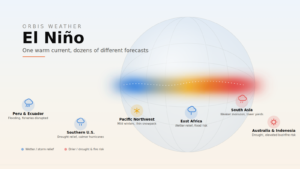
El Niño’s effects vary a lot by region because it works by shifting where the Pacific’s warm water and storm-triggering convection sit, which then reroutes the jet streams. Here’s how the pros and cons tend to break down around the world.
Western South America (Peru, Ecuador, northern Chile) This is ground zero for El Niño, and the “cons” pile up fast: warmer coastal waters drive torrential rain and flooding in normally arid areas, and the nutrient-poor warm water pushes anchovy and other fish stocks away or deeper, devastating Peru’s fishing industry. On the plus side, the same rains can replenish reservoirs and boost agriculture in a region that’s often drought-stressed, and warmer waters occasionally bring in different, sometimes commercially valuable fish species.
Southern United States and the Gulf Coast Pros dominate here. El Niño typically strengthens the subtropical jet stream across the southern U.S., bringing wetter winters that ease drought in places like California, Texas, and the Southeast, and it tends to suppress Atlantic hurricane activity by increasing wind shear that tears storms apart. The downside is that “wetter” can tip into flooding and mudslides, particularly on California’s already fire-scarred hillsides, and some of those winter storms bring damaging wind and heavy snow to interior areas.
Northern U.S., Canada, and the Pacific Northwest Mostly cons: El Niño winters tend to be warmer and drier than normal, which is bad news for ski resorts and mountain snowpack that regions like the Pacific Northwest and northern Rockies rely on for summer water supply. A milder winter is a mixed bag for ordinary residents (lower heating bills, easier commutes) but can also mean drier conditions heading into the next wildfire season.
Australia and Indonesia Largely cons. El Niño usually means weaker monsoon rains and a higher risk of drought and bushfires across eastern and southern Australia, and Indonesia often sees reduced rainfall that increases wildfire and haze risk, especially in peatland areas. Farmers in these regions frequently face lower crop yields. The only real upside is that drier conditions can mean fewer disruptive tropical cyclones making landfall in some parts of the region.
India and South Asia Mostly cons. El Niño is statistically linked to a weaker Indian monsoon, which matters enormously since monsoon rains are the backbone of Indian agriculture; weaker monsoons can mean lower crop yields, water shortages, and knock-on effects on food prices. It’s not an ironclad rule (some El Niño years still bring decent monsoons), but it raises the odds of a bad one.
East Africa (Kenya, Somalia, Ethiopia, Tanzania) More pros than the global pattern would suggest. El Niño tends to bring above-average short-rains to East Africa, which can be a relief after La Niña-driven droughts. The con is that “more rain” can flip into flooding and displacement, as the region has seen in past El Niño events, and heavy rains can also fuel locust outbreaks and waterborne disease.
Southern Africa Mostly cons. El Niño is associated with drier conditions and drought risk across Zimbabwe, Zambia, Mozambique, and South Africa’s summer rainfall regions, which can hit maize production hard in economies where subsistence farming is widespread.
Europe The effects here are the weakest and least consistent of any major region, since Europe sits outside El Niño’s most direct influence pathways. Some studies link El Niño winters to a modestly higher chance of a colder, drier start to winter followed by a milder end, but the “pro or con” framing barely applies — it’s more noise than signal compared to the Pacific Rim.
A general upside worth naming separately: because El Niño tends to suppress Atlantic hurricane formation, it’s often a net positive for the U.S. East Coast and Caribbean in terms of tropical storm risk, even in years when it’s a headache elsewhere.
A general downside worth naming separately: El Niño years tend to be some of the warmest on record globally, since the extra heat released from the Pacific adds to background warming — so while it’s not itself “the cause” of long-term climate trends, it tends to be an amplifier in the years it occurs.