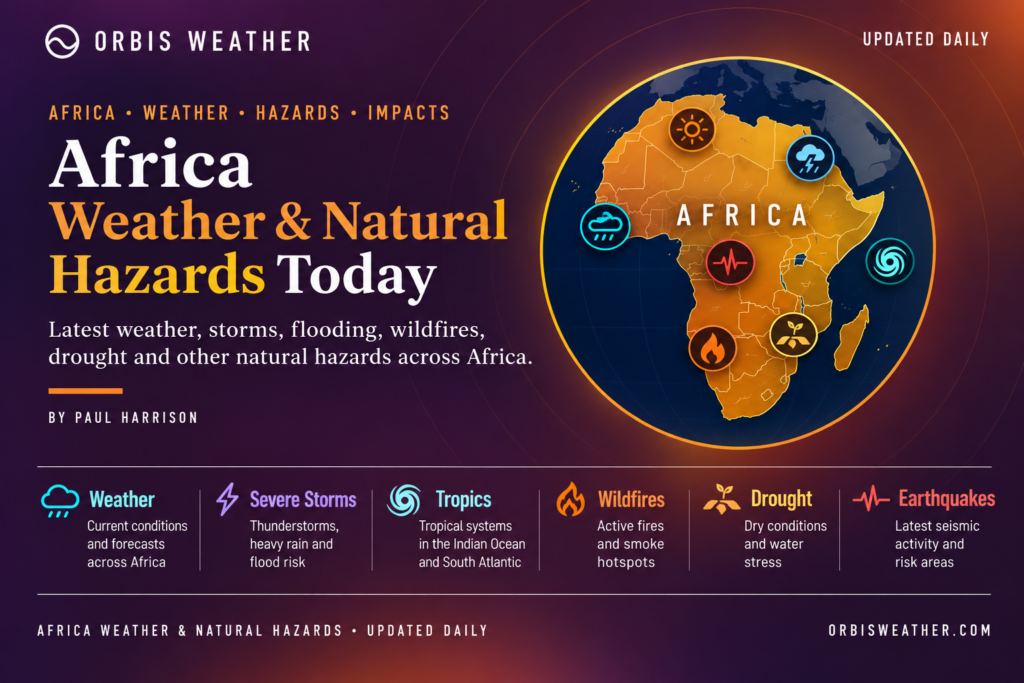
🌍 Africa Weather & Natural Hazards Today
By Paul Harrison | Founder & Publisher, Orbis Weather

- Europe Weather & Natural Hazards Today — Wednesday, November 4, 2026 7:14 PM
- Southeast Asia Weather & Natural Hazards Today: Wednesday, November 4, 2026 7:05 PM
- Singapore Lightning & Thunderstorms This Week — Wednesday, November 4, 2026 6:57 PM
- Africa Weather & Natural Hazards Today — Wednesday, November 4, 2026 6:44 PM
- Middle East Weather & Natural Hazards Today – Wednesday, November 4, 2026 3:54 PM
- Europe’s Cold Spots This Week Nov 3, 2026 2:51 PM
- Australia, New Zealand & Oceania Weather & Natural Hazards Today — Wednesday, November 4, 2026 11:26 AM
- Eastern Australia Weather Update: Dangerous Storms, Giant Hail and Destructive Winds 10:26 AM
- Mount Semeru Erupts in Indonesia, Sending Dangerous Pyroclastic Flow Down Its Slopes 8:34 AM
- South America Weather & Natural Hazards Today — November 3, 2026 8:09 AM
- Central America Weather & Natural Hazards Today: Heavy Rain, Flooding and Landslide Concerns Continue Across the Region 8:00 AM
- North America Weather & Natural Hazards Today — November 3, 2026 7:50 AM
- Weekly Tropical Storm Tracker: Tuesday, November 3, 2026 7:39 AM
- Daily Earthquakes, Storms, Fires & Floods Report November 3, 2026 7:30 AM
- Tropical Atlantic Daily Report: Tuesday, November 3, 2026 7:11 AM
- Eastern & Central Pacific Tropical Weather Update: Tuesday, November 3, 2026 7:02 AM
- Western Pacific Tropical Weather Nov 3 6:51 AM




🌍 Africa Weather & Natural Hazards Today — Wednesday, November 4, 2026
By Paul Harrison | Orbis Weather
Published: Wednesday, November 4, 2026 (Africa local date)
Coverage: North Africa • West Africa • Central Africa • East Africa • Southern Africa • Madagascar • Southwest Indian Ocean
🌍 Africa Weather Overview: Severe Storms Ease in South Africa as Flooding, Heat and El Niño Risks Remain
Africa enters Wednesday, November 4, with contrasting weather conditions across the continent. Severe thunderstorms have affected parts of South Africa, seasonal rainfall continues to raise flooding concerns in East and Central Africa, and a strengthening El Niño remains an important influence on the outlook for the months ahead.
The most immediate weather developments include:
-
⛈️ Southern Africa: Severe thunderstorms, hail and lightning have affected eastern South Africa, although Wednesday’s outlook indicates a reduction in widespread storm activity.
-
🌧️ East Africa: Kenya’s November rainfall outlook raises concerns about flash flooding, landslides and disruption to transport.
-
🌊 Central Africa: Heavy tropical rainfall and river flooding remain important monitoring priorities.
-
☀️ West Africa: Heat, dry-season conditions and agricultural water availability are becoming increasingly important across the Sahel.
-
🏜️ North Africa: Seasonal temperature changes, Mediterranean rainfall and occasional desert dust remain the principal weather concerns.
-
🌀 Southwest Indian Ocean: Madagascar and neighboring islands are entering the tropical cyclone season.
-
🌡️ Continental climate outlook: A strong El Niño could influence rainfall, drought and extreme temperatures into 2027.
The World Meteorological Organization has warned that the developing El Niño could have significant consequences for rainfall patterns, temperatures and extreme-weather risks across multiple regions.
Reporting note: This report is dated November 4 for African readers. Confirmed warnings from November 3 are identified separately from November 4 forecasts. Regional seasonal hazards are not presented as active emergency warnings unless verified.
🚨 Africa Natural Hazards Summary — November 4
|
Region |
Primary hazard |
Current assessment |
|---|---|---|
|
🇿🇦 South Africa |
Thunderstorms, lightning and heat |
Recent severe warnings; storms more isolated Wednesday |
|
🇰🇪 Kenya |
Heavy seasonal rainfall and flooding |
Elevated November risk |
|
🌍 Horn of Africa |
Flooding and rainfall variability |
Seasonal monitoring |
|
🌿 Central Africa |
Heavy rain and river flooding |
Regional monitoring |
|
☀️ West Africa |
Heat and agricultural stress |
Seasonal concern |
|
🏜️ North Africa |
Dust, wind and localized heavy rain |
Seasonal monitoring |
|
🌾 Southern Africa |
El Niño-related drought risk |
Longer-term concern |
|
🏝️ Madagascar |
Tropical cyclones and heavy rainfall |
Seasonal monitoring |
These assessments combine recent official forecasts, published seasonal outlooks and general hazard monitoring. They are not a live warning map.
🇿🇦 1. Southern Africa — Thunderstorms, Heat and Fire Danger
⛈️ South Africa: Severe storms followed by a changing weather pattern
South Africa has experienced an unsettled start to November, with severe thunderstorm warnings issued for several eastern provinces.
For Tuesday, November 3, the South African Weather Service issued a Yellow Level 4 severe-thunderstorm warning affecting northern KwaZulu-Natal, the far eastern Free State and the Mpumalanga Highveld.
The hazards included intense rainfall, hail, excessive lightning and possible localized flooding.
A separate Yellow Level 2 warning covered additional parts of KwaZulu-Natal, the Free State, Gauteng, Limpopo and Mpumalanga.
☀️ Wednesday, November 4 forecast
The latest available Wednesday outlook indicates a shift toward generally warmer and drier conditions across central and western South Africa.
-
Gauteng: Warmer conditions, with localized afternoon cloud and storm potential requiring monitoring.
-
KwaZulu-Natal: Cooler conditions in some eastern areas, with possible drizzle and isolated showers.
-
Mpumalanga: Morning cloud and drizzle near eastern high ground, with isolated afternoon thunderstorms possible.
-
Limpopo: Warm to hot conditions, with localized thunderstorms possible.
-
Free State and Northern Cape: Predominantly warm to very hot weather across central and western areas.
-
Western Cape: Generally dry conditions, with heat and sun exposure remaining important considerations.
This represents a forecast for Wednesday rather than confirmation of observed conditions.
🔥 Fire-weather concerns
Recent forecasts have also identified extremely high fire danger in parts of the North West, Northern Cape and Limpopo.
Hot temperatures, dry vegetation and wind can increase the speed at which grassland fires spread.
Residents in fire-prone areas should avoid outdoor burning during dangerous conditions and follow local fire-service guidance.
Wednesday assessment: The immediate focus shifts from widespread severe thunderstorms toward localized showers, afternoon storm development and heat. Tuesday’s warnings should not be assumed to remain active on Wednesday.
🌾 Zimbabwe, Zambia, Malawi and Mozambique
Across neighboring Southern African countries, attention is increasingly focused on the developing rainy season and the possible effects of El Niño.
Important seasonal concerns include reduced rainfall, higher temperatures, agricultural water shortages and potential crop stress.
These are forecast vulnerabilities, not confirmation that drought is currently affecting every country.
FEWS NET continues to monitor the possible agricultural and food-security consequences of the 2026–27 El Niño.
🇰🇪 2. East Africa — Kenya Faces Widespread Rainfall and Flooding Threat
🌧️ Kenya: New November 3–10 rainfall forecast
Kenya is among the most important African countries to monitor this week.
A weekly forecast issued by the Kenya Meteorological Service on November 3 anticipates rainfall across numerous counties through November 10.
The forecast follows a monthly outlook predicting above-average rainfall across much of Kenya during November and December.
Areas identified in the weekly outlook include Nairobi, Mombasa, Kisumu, Nakuru, Garissa, Mandera, Marsabit, Kiambu, Machakos and numerous western and central counties.
🌊 Flooding and landslide concerns
The principal risks include flash flooding in urban areas, river flooding, landslides in highland districts and damage to transport infrastructure.
Heavy rainfall can overwhelm drainage systems in Nairobi and other cities, while prolonged wet conditions may make rural roads impassable.
Water contamination and mosquito breeding following flooding are additional public-health concerns.
🌡️ Kenya temperature outlook
Kenya’s November forecast also anticipates above-average temperatures.
In parts of northern and northeastern Kenya, daytime temperatures could reach approximately 38°C (100°F), particularly around Turkana, Marsabit, Mandera, Wajir and Garissa.
Coastal counties could experience daytime maximum temperatures of approximately 25–35°C (77–95°F).
These are monthly forecast ranges, not observed November 4 temperatures.
🇺🇬 Uganda and 🇹🇿 Tanzania
Uganda and northern Tanzania remain within an important seasonal rainfall period.
Thunderstorms, intense rainfall and rising rivers are hazards to monitor, particularly around Lake Victoria and in highland communities.
However, no specific November 4 severe-weather warning for these countries was independently verified for this report.
🇪🇹 Ethiopia and 🇸🇴 Somalia
Rainfall conditions across the Horn of Africa remain highly variable.
Some areas may experience enhanced seasonal rainfall, while others face continued vulnerability to rainfall deficits.
In Somalia, the Juba and Shabelle river systems remain important flood-monitoring locations.
The effects of El Niño can differ significantly across East Africa, and seasonal predictions should not be interpreted as confirmation of flooding or drought in individual communities.
🌿 3. Central Africa — Equatorial Flooding Risk Remains Elevated
🌊 FEWS NET highlights high flood risk through November 4
Central Africa remains a significant focus of continental hazard monitoring.
A FEWS NET Global Weather Hazards Outlook, valid October 29 through November 4, identifies a high risk of flooding in parts of equatorial Africa.
The outlook provides a regional assessment of potential flooding and weather-related impacts, rather than confirmation that all locations within the highlighted area are flooded.
🇨🇩 Democratic Republic of the Congo
Heavy tropical rainfall is an important seasonal concern across the Congo Basin.
Repeated downpours can produce urban flooding, rising rivers and landslides in mountainous terrain.
Communities near steep slopes and poorly drained urban areas are particularly vulnerable when rainfall accumulates over several days.
🇨🇲 Cameroon
Southern and central Cameroon can experience substantial rainfall during this period, while northern regions are moving toward drier seasonal conditions.
Localized flooding and road disruption remain possible where heavy thunderstorms develop.
🇨🇬 Republic of the Congo, 🇬🇦 Gabon and 🇨🇫 Central African Republic
Rainfall and river-level monitoring remain important across equatorial river basins.
Low-lying settlements, agricultural areas and unpaved roads may be vulnerable to flooding following prolonged rainfall.
November 4 assessment: FEWS NET’s regional flood-risk outlook remains relevant through Wednesday. No individual flood emergency in these countries is independently confirmed by this report.
☀️ 4. West Africa — Heat, Dry-Season Transition and Agricultural Conditions
🌾 Sahel region
Much of the Sahel is transitioning away from its principal rainy season.
Countries including Mali, Niger, Burkina Faso and Chad face changing seasonal conditions, with attention shifting toward soil moisture, water supplies, crop performance and grazing conditions.
Where rainfall has been insufficient, agricultural impacts can continue after the rainy season ends.
🇳🇬 Nigeria
Southern Nigeria can still experience localized showers and thunderstorms during November.
Urban flooding remains possible where intense rainfall develops over poorly drained areas, particularly in densely populated coastal cities.
Northern Nigeria is generally moving further into the dry season, with heat and dust becoming more important weather considerations.
🇬🇭 Ghana, 🇨🇮 Côte d’Ivoire, 🇧🇯 Benin and 🇹🇬 Togo
The Gulf of Guinea region can experience occasional rainfall and thunderstorms during the transition toward drier conditions.
Short-duration heavy rainfall may create localized flooding, but no specific widespread November 4 severe-weather event has been verified for these countries.
🌡️ Heat and food-security concerns
FEWS NET’s October assessment identifies West Africa as one of the regions potentially exposed to indirect food-security impacts from El Niño, including changes in international food markets.
Weather-related agricultural risks can be amplified by economic pressures and other existing vulnerabilities.
🏜️ 5. North Africa — Mediterranean Weather and Desert Conditions
🇲🇦 Morocco, 🇩🇿 Algeria and 🇹🇳 Tunisia
North Africa’s Mediterranean coastline is moving further into its autumn rainfall season.
Weather systems approaching from the Mediterranean or Atlantic can bring cooler temperatures, gusty winds and occasional heavy rainfall.
Mountain regions, including the Atlas Mountains, can experience significant temperature differences between daytime and nighttime.
Flash flooding is possible when intense rainfall affects steep valleys or normally dry riverbeds.
No specific November 4 severe-weather warning for Morocco, Algeria or Tunisia has been verified in the reviewed material.
🇱🇾 Libya and 🇪🇬 Egypt
Coastal areas experience more moderate seasonal temperatures than inland desert regions.
The principal hazards to monitor include strong winds, blowing dust and localized heavy rainfall associated with passing weather systems.
🌬️ Sahara Desert
Dry weather remains dominant across much of the Sahara.
However, strong winds can occasionally produce blowing sand and dust, reducing visibility on highways and affecting air quality.
These are established regional hazards, not confirmation of a major November 4 dust storm.
🏝️ 6. Madagascar and Southwest Indian Ocean — Cyclone Season Monitoring
🌀 Tropical cyclone season begins
November marks the beginning of the main southwest Indian Ocean tropical cyclone season.
Madagascar, Mauritius, Réunion, Comoros and surrounding islands face an increasing seasonal need to monitor tropical disturbances.
Potential hazards include damaging winds, torrential rainfall, flash flooding, landslides, dangerous surf and disruption to marine transport.
Tropical cyclone status: No active named storm or cyclone warning in the southwest Indian Ocean has been independently verified for November 4 in this report. This is a seasonal risk assessment, not an active cyclone alert.
🇲🇬 Madagascar
Madagascar faces two contrasting seasonal vulnerabilities.
Northern and eastern coastal regions are exposed to tropical rainfall and cyclone hazards during the warmer months.
Southern Madagascar also faces the possibility of rainfall deficits associated with the developing El Niño.
The actual severity of these risks will depend on the evolution of regional weather systems and seasonal rainfall patterns.
🌡️ 7. El Niño 2026–27 — Major Climate Concern for Africa
The strengthening El Niño remains one of the most important longer-term weather developments affecting Africa.
The World Meteorological Organization reported in September that El Niño was firmly established and expected to intensify, potentially producing significant effects on rainfall, temperatures and extreme weather into 2027.
FEWS NET’s October 6 special report also warned that food-security consequences could continue or intensify months after the initial rainfall disruptions.
🌍 Potential African impacts
|
Region |
Potential seasonal impact |
|---|---|
|
Eastern Horn of Africa |
Increased rainfall and flood risk in some areas |
|
Southern Africa |
Below-average rainfall and agricultural drought risk |
|
Southern Madagascar |
Possible rainfall deficits |
|
Equatorial Africa |
Rainfall variability and flooding concerns |
|
West Africa |
Agricultural and food-market vulnerability |
These are broad climate tendencies, not guaranteed outcomes for individual countries.
🌾 Agriculture and food supplies
El Niño-related rainfall changes can affect crop production, pasture conditions, livestock health and water availability.
A significant concern is the delay between weather impacts and food-security consequences.
Poor rainfall during a growing season may not produce its greatest economic or humanitarian effects until harvests decline or food reserves become depleted months later.
This makes seasonal preparedness particularly important across vulnerable agricultural regions.
🌊 8. Africa Flood Risk — Wednesday, November 4
Flooding remains a major natural-hazard concern across several parts of the continent.
The most significant monitoring priorities are:
-
Equatorial Africa: FEWS NET’s high-risk flooding outlook remains valid through November 4.
-
Kenya: Above-average November rainfall and a November 3–10 forecast create continued concern about localized flooding.
-
South Africa: Recent severe thunderstorms have produced flood-risk warnings, although Wednesday’s weather pattern is expected to be less widely unsettled.
-
Horn of Africa: Rainfall variability and river flooding remain important seasonal considerations.
The highest risks occur where intense rainfall combines with saturated soil, steep terrain, vulnerable infrastructure or elevated river levels.
🌋 9. Volcanoes and Earthquakes — Africa Geological Hazards
Africa contains several geologically active regions, particularly along the East African Rift.
🌋 Volcano monitoring
Important volcanic regions include:
-
Mount Nyiragongo and Nyamuragira, Democratic Republic of the Congo: Active volcanic systems capable of producing lava flows and volcanic gas hazards.
-
Erta Ale, Ethiopia: An active volcanic system within the Afar Depression.
-
Mount Cameroon, Cameroon: An active volcano requiring long-term monitoring.
-
Ol Doinyo Lengai, Tanzania: An unusual active volcano within the East African Rift.
No specific new eruption on November 4 has been independently confirmed for these volcanoes in this report.
🌍 Earthquake monitoring
The East African Rift, Afar region and parts of North Africa are important seismic zones.
Earthquakes can occur without warning, with potential impacts including ground shaking, structural damage and landslides.
November 4 status: No specific major African earthquake has been independently verified for this report. Readers should consult the live USGS earthquake catalog rather than interpreting this as confirmation that no earthquakes have occurred.
🔥 10. Wildfire, Dust and Air Quality Outlook
Wildfire and air-quality risks vary significantly across Africa.
🔥 Southern Africa
Hot temperatures, dry vegetation and strong winds can create dangerous fire conditions.
Recent South African forecasts highlighted extremely high fire danger in parts of the country’s interior.
🌫️ West and North Africa
Dust and haze can reduce visibility and affect air quality during dry and windy conditions.
The Sahel’s transition toward the dry season increases the importance of monitoring dust transport and local air-quality conditions.
🌿 Central Africa
Vegetation fires, smoke and agricultural burning can contribute to regional air pollution, although conditions vary substantially by location and season.
No continent-wide active wildfire emergency or major November 4 smoke outbreak has been verified in this report.
📅 11. Africa Weather Outlook — November 4–6, 2026
|
Date |
Main weather priorities |
|---|---|
|
Wednesday, Nov. 4 |
South African heat and isolated storms; Kenyan rainfall; equatorial flooding risk |
|
Thursday, Nov. 5 |
Updated African flood outlooks; East African rainfall; Southern African storm development |
|
Friday, Nov. 6 |
Continued monitoring of Kenyan rainfall, seasonal heat and Indian Ocean tropical activity |
These are monitoring priorities, not confirmed daily severe-weather warnings. The November 5–6 outlook requires updated national forecasts as new information becomes available.
🛡️ 12. Weather Safety Advice Across Africa
🌊 Flood safety
Never attempt to drive through flooded roads. Fast-moving water can sweep vehicles away, while floodwater may conceal damaged road surfaces and drainage channels.
Residents near rivers should monitor water levels and follow evacuation instructions from local authorities.
⚡ Thunderstorm safety
Seek shelter inside a substantial building during thunderstorms. Avoid isolated trees, open fields and exposed high ground when lightning is present.
☀️ Heat safety
Drink water regularly, reduce strenuous outdoor activity during the hottest hours and pay particular attention to children, older adults and outdoor workers.
🌀 Cyclone preparedness
Residents of Madagascar and neighboring Indian Ocean islands should review emergency plans and monitor official tropical cyclone bulletins throughout the season.
📡 13. Official Weather and Natural Hazard Sources
Orbis Weather recommends the following organizations for authoritative forecasts, warnings and monitoring information.
|
Organization |
Information provided |
|---|---|
|
Global climate and extreme-weather assessments |
|
|
South African forecasts and warnings |
|
|
Kenyan forecasts and rainfall outlooks |
|
|
Weather hazards, drought and food-security analysis |
|
|
Southwest Indian Ocean tropical cyclone monitoring |
|
|
Earthquake observations |
|
|
Volcano activity and eruption records |
|
|
Significant natural disaster alerts |
Specific reports referenced
The principal dated sources supporting this edition include the November 3 South African weather forecasts, the November 3–10 Kenyan rainfall outlook, FEWS NET’s October 29–November 4 Global Weather Hazards Outlook and the October 6 El Niño special report.
These sources distinguish the immediate weather forecast from longer-term climate and natural-hazard concerns.
📝 14. Orbis Weather Editorial Methodology
Orbis Weather produces regional weather and natural-hazard reports using information from national meteorological agencies, international scientific organizations and recognized disaster-monitoring services.
Our editorial approach distinguishes between four categories of information:
Observed conditions: Weather or natural events supported by reported measurements or confirmed agency observations.
Official warnings: Alerts issued by authorized meteorological, geological or emergency-management agencies. These apply only to their published locations and validity periods.
Forecast conditions: Weather developments predicted by meteorological agencies. Forecasts remain subject to uncertainty and revision.
Seasonal risk assessments: Longer-term climate patterns and known hazards that may influence future conditions but do not establish that an emergency is currently occurring.
Orbis Weather does not independently issue meteorological warnings, earthquake alerts or evacuation orders.
Reports may cover different time zones and source-publication dates. Where a warning was issued on an earlier date, it is identified as historical unless its continuing validity has been established.
Corrections and updates
Orbis Weather aims to correct factual inaccuracies and update significant developments as reliable new information becomes available.
Readers should use the latest official national meteorological or emergency-management bulletin when making safety-related decisions.
✍️ 15. About the Author
Paul Harrison — Founder & Publisher, Orbis Weather
Paul Harrison founded Orbis Weather in 2026 to make global weather and natural-hazard information more accessible, understandable and useful.
His coverage includes tropical cyclones, severe thunderstorms, extreme temperatures, earthquakes, volcanoes, wildfires, flooding and significant natural disasters around the world.
Orbis Weather combines regional reporting with links to official scientific and meteorological information to help readers understand developing weather threats.
🌍 Africa Weather — Final Outlook for Wednesday, November 4
Africa’s weather picture remains divided between wet-season flooding risks, developing dry-season conditions and longer-term climate concerns.
The most immediate developments are Kenya’s expanding rainfall outlook, the high flood risk highlighted across parts of equatorial Africa and the changing thunderstorm pattern over South Africa.
Beyond the daily forecast, the developing El Niño remains a major issue for agriculture, water supplies and food security across several African regions.
Orbis Weather will continue monitoring Africa’s weather and natural hazards, with attention to official warnings, regional rainfall trends, tropical cyclone development and significant geological events.
Orbis Weather — Sometimes the greatest danger is not the storm itself, but how quickly conditions can change
About the Author
Paul Harrison — Founder & Publisher, Orbis Weather
Paul Harrison founded Orbis Weather in 2026 to make global weather and natural-hazard information easier to find, follow and understand. His coverage includes tropical cyclones, severe weather, extreme temperatures, earthquakes, volcanoes, wildfires, flooding and significant natural disasters worldwide.
View all articles by Paul Harrison → | Editorial Standards →
Global Weather Tracker Hub
Explore weather maps, tropical systems, storms and natural hazards around the world.
No matching trackers found.