
South America Flood Emergency: Colombia and Argentina Face Deadly Disasters as Rivers Overflow
By Paul Harrison | Founder & Publisher, Orbis Weather

- Violent Storms, Heavy Rain Forecast for Thailand from November 5 Through 9 10:11 PM
- South America Flood Emergency: Colombia and Argentina Face Deadly Disasters as Rivers Overflow 9:57 PM
- Malaysia Flood Alert: Johor Identifies 337 Flood Hotspots as Northeast Monsoon Begins 9:33 PM
- Europe Weather & Natural Hazards Today — Wednesday, November 4, 2026 7:14 PM
- Southeast Asia Weather & Natural Hazards Today: Wednesday, November 4, 2026 7:05 PM
- Singapore Lightning & Thunderstorms This Week — Wednesday, November 4, 2026 6:57 PM
- Africa Weather & Natural Hazards Today — Wednesday, November 4, 2026 6:44 PM
- Middle East Weather & Natural Hazards Today – Wednesday, November 4, 2026 3:54 PM
- Europe’s Cold Spots This Week Nov 3, 2026 2:51 PM
- Australia, New Zealand & Oceania Weather & Natural Hazards Today — Wednesday, November 4, 2026 11:26 AM
- Eastern Australia Weather Update: Dangerous Storms, Giant Hail and Destructive Winds 10:26 AM
- Mount Semeru Erupts in Indonesia, Sending Dangerous Pyroclastic Flow Down Its Slopes 8:34 AM
- South America Weather & Natural Hazards Today — November 3, 2026 8:09 AM
- Central America Weather & Natural Hazards Today: Heavy Rain, Flooding and Landslide Concerns Continue Across the Region 8:00 AM
- North America Weather & Natural Hazards Today — November 3, 2026 7:50 AM
- Weekly Tropical Storm Tracker: Tuesday, November 3, 2026 7:39 AM
- Daily Earthquakes, Storms, Fires & Floods Report November 3, 2026 7:30 AM
- Tropical Atlantic Daily Report: Tuesday, November 3, 2026 7:11 AM
- Eastern & Central Pacific Tropical Weather Update: Tuesday, November 3, 2026 7:02 AM
- Western Pacific Tropical Weather Nov 3 6:51 AM





South America Flood Emergency: Colombia and Argentina Face Deadly Disasters as Rivers Overflow
ORBIS WEATHER | SOUTH AMERICA NATURAL HAZARDS
By Paul Harrison | Orbis Weather
Published: November 3, 2026
BOGOTÁ / BUENOS AIRES — Two devastating flood emergencies are unfolding across South America, with Colombia and Argentina battling widespread inundation, deadly river flooding and the displacement of thousands of families.
In Colombia, exceptional rainfall has overwhelmed communities, destroyed agricultural land and prompted an extensive government emergency response. Farther south, Argentina’s Paraná River has surged beyond evacuation thresholds, flooding towns and forcing residents to abandon their homes.
The disasters are unfolding in different climatic and geographic settings, but both illustrate the enormous vulnerability of South American communities to prolonged rainfall and overflowing river systems.
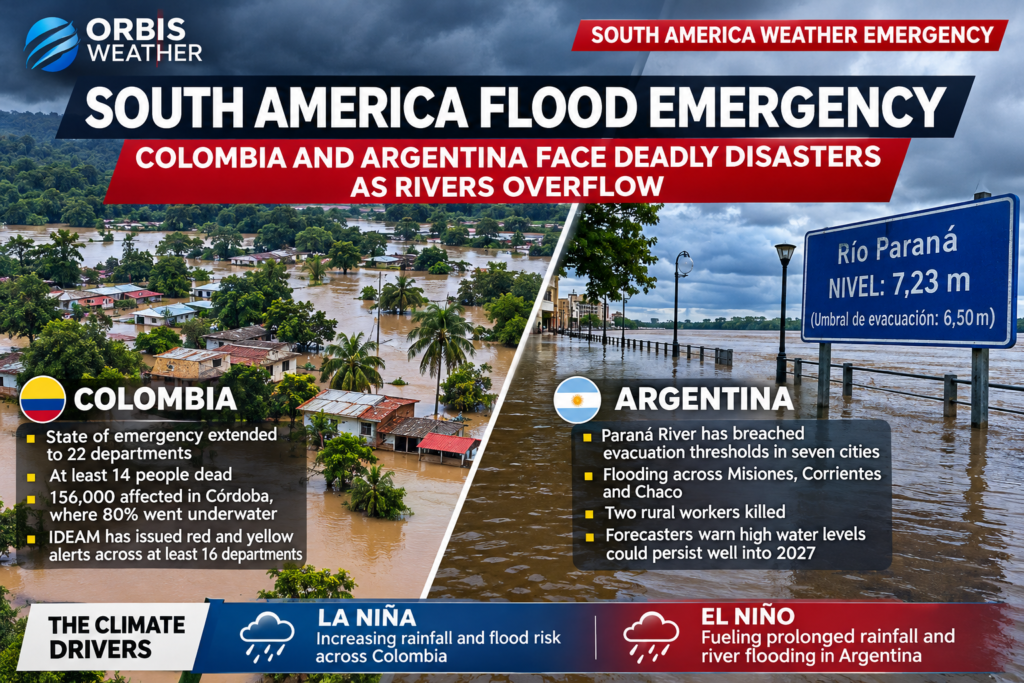
Reports indicate that more than 156,000 people have been affected by flooding in Colombia, while thousands have evacuated or left their homes in northeastern Argentina. The two figures represent different measures of humanitarian impact and should not be combined into a single displacement total.
🇨🇴 Colombia: Flooding Devastates Córdoba and Northern Communities
Colombia’s Córdoba department has experienced some of the most destructive flooding, with entire neighborhoods submerged, roads rendered impassable and thousands of families requiring emergency assistance.
An emergency declaration issued by President Gustavo Petro in February covered eight departments following flooding that had affected more than 156,000 people. More recent reporting describes additional flooding and a wider emergency response, although the reported expansion to 22 departments and the latest death toll require further official confirmation.
Communities Cut Off by Floodwaters
The flooding has created serious difficulties for communities along rivers and low-lying agricultural areas.
Some of the hardest-hit locations reported in Córdoba include Tierralta, Puerto Libertador and Montelíbano, where rising waterways have threatened homes, farmland and essential transportation routes.
Flooding can create a second emergency after the initial rainfall ends. Contaminated drinking water, damaged sanitation systems and limited access to medical services increase the risks facing displaced residents.
Agricultural losses are another major concern. Córdoba is an important livestock and farming region, and prolonged inundation can damage crops, destroy grazing land and disrupt local food supplies.
Why Is Colombia Experiencing Such Severe Rainfall?
Colombia’s rainfall patterns are influenced by several interacting atmospheric systems, including tropical moisture from the Caribbean, the movement of the Intertropical Convergence Zone and intraseasonal weather variations.
La Niña conditions are historically associated with increased rainfall across significant portions of Colombia. However, the precise contribution of individual climate drivers to the current flooding requires analysis of observed atmospheric and ocean conditions.
The immediate concern is continued heavy rainfall over already saturated watersheds, where additional precipitation can produce rapid river rises, flash flooding and landslides.
🇦🇷 Argentina: Paraná River Flooding Forces Thousands From Their Homes
Argentina’s northeastern provinces are confronting a major river-flooding emergency as prolonged rainfall across the Paraná basin pushes water levels beyond established warning and evacuation thresholds.
The provinces of Corrientes, Chaco and Misiones have experienced evacuations, flooded roads and disruption to communities along the Paraná, Uruguay and Iguazú rivers.
An October 27 report from the Pan American Health Organization documented 1,290 evacuees and 500 people who evacuated independently in Chaco, 1,387 evacuees in Corrientes and 154 evacuees in Misiones.
Seven Communities Face Dangerous River Levels
The reported high-water emergency has affected locations including Ituzaingó, Itá Ibaté, Itatí, Paso de la Patria and Corrientes city, as well as Barranqueras in Chaco and communities in Misiones.
In late October, river measurements at Corrientes and Barranqueras exceeded local evacuation thresholds. At Barranqueras, the Paraná reached approximately 7.23 meters, compared with an evacuation threshold of 6.50 meters.
The flooding has also affected transport links, river crossings and rural communities, with emergency crews assisting displaced residents and monitoring vulnerable riverbanks.
Two Rural Workers Killed During Flood Emergency
Two agricultural workers died near Bella Vista in Corrientes province while attempting to move livestock away from rising floodwaters.
The deaths highlight the danger of attempting to cross flooded rural terrain, where strong currents, submerged obstacles and rapidly changing water levels can make even familiar routes hazardous.
Iguazú Falls and Regional Infrastructure Affected
Flooding has extended into the wider river system surrounding Iguazú Falls, one of South America’s most important natural attractions.
Elevated river flows prompted temporary closures of visitor access areas, while high water levels affected river transport and border crossings elsewhere in northeastern Argentina.
The flooding also threatens agricultural production, particularly livestock operations located on low-lying islands and floodplains.
🌎 El Niño and La Niña: Understanding the Climate Connection
An important distinction has emerged in the reporting of these disasters.
Although some accounts attribute Colombia’s flooding to La Niña and Argentina’s flooding to El Niño, Colombia’s meteorological agency, IDEAM, officially confirmed El Niño conditions on October 8, 2026.
IDEAM also emphasized that El Niño does not eliminate heavy rainfall or flooding. October and November remain part of Colombia’s seasonal rainy period, and damaging storms can still occur even when the broader climate pattern favors below-average precipitation.
El Niño and La Niña are opposite phases of the El Niño–Southern Oscillation, or ENSO. They cannot both be the prevailing phase of the same Pacific climate system simultaneously.
In northeastern Argentina, El Niño can increase the likelihood of substantial rainfall across the Paraná basin, contributing to prolonged river flooding.
The critical distinction is that individual flood events depend on regional rainfall, atmospheric circulation, soil saturation and river conditions—not ENSO alone.
📅 Flood Outlook: November 2026 Through Early 2027
Colombia
Additional rainfall during November could prolong flooding in vulnerable communities, particularly where rivers remain elevated and soils are saturated.
Residents should monitor updated warnings from IDEAM and Colombia’s National Unit for Disaster Risk Management.
Argentina
The longer-term outlook is particularly concerning for northeastern Argentina.
An October 31 report indicated that flooding could occur in further waves as El Niño influences regional rainfall through the Southern Hemisphere summer and into early autumn 2027.
Areas facing continued flood exposure include Corrientes, Resistencia, Itatí, Paso de la Patria and lower-lying communities farther downstream along the Paraná River.
These projections do not mean continuous flooding is guaranteed through 2027. River levels will depend on rainfall across the wider basin and the movement of floodwaters downstream.
🚨 Flood Safety: What Residents Should Know
🌊 Avoid floodwaters: Never attempt to drive or walk through fast-moving water.
⚡ Electrical hazards: Stay away from submerged power equipment and damaged electrical installations.
🚰 Drinking water: Follow local boil-water advisories and use safe drinking water supplies.
🏠 Evacuations: Follow instructions issued by civil defense and emergency management authorities.
🦟 Health precautions: Reduce exposure to contaminated water and take precautions against mosquitoes.
📱 Official alerts: Check current government warnings before traveling through affected districts.
The Bigger Picture: South America’s Growing Flood Emergency
The simultaneous emergencies demonstrate how extreme rainfall can overwhelm communities separated by thousands of miles.
For Colombia, the immediate challenge is protecting vulnerable populations and restoring access to flooded communities.
For Argentina, the concern extends beyond the current emergency. Repeated rises along the Paraná could disrupt agriculture, river transportation, tourism and residential areas for months.
With the Southern Hemisphere approaching summer, continued monitoring will be essential.
Orbis Weather will continue following flood conditions, major river levels and natural-hazard developments across South America.
Official Sources and Further Reading
Editorial note: Information reflects reports available through November 3, 2026. Some Colombian emergency figures cited in recent coverage could not be independently reconciled with official records. Flood impacts, evacuation figures and forecasts may change. Orbis Weather provides independent weather reporting and analysis and is not an official warning authority
About the Author
Paul Harrison — Founder & Publisher, Orbis Weather
Paul Harrison founded Orbis Weather in 2026 to make global weather and natural-hazard information easier to find, follow and understand. His coverage includes tropical cyclones, severe weather, extreme temperatures, earthquakes, volcanoes, wildfires, flooding and significant natural disasters worldwide.
View all articles by Paul Harrison → | Editorial Standards →
Global Weather Tracker Hub
Explore weather maps, tropical systems, storms and natural hazards around the world.
No matching trackers found.