
🌍 Middle East Weather & Natural Hazards Today
By Paul Harrison | Founder & Publisher, Orbis Weather

- Africa Weather & Natural Hazards Today — Wednesday, November 4, 2026 6:44 PM
- Middle East Weather & Natural Hazards Today – Wednesday, November 4, 2026 3:54 PM
- Europe’s Cold Spots This Week Nov 3, 2026 2:51 PM
- Australia, New Zealand & Oceania Weather & Natural Hazards Today — Wednesday, November 4, 2026 11:26 AM
- Eastern Australia Weather Update: Dangerous Storms, Giant Hail and Destructive Winds 10:26 AM
- Mount Semeru Erupts in Indonesia, Sending Dangerous Pyroclastic Flow Down Its Slopes 8:34 AM
- South America Weather & Natural Hazards Today — November 3, 2026 8:09 AM
- Central America Weather & Natural Hazards Today: Heavy Rain, Flooding and Landslide Concerns Continue Across the Region 8:00 AM
- North America Weather & Natural Hazards Today — November 3, 2026 7:50 AM
- Weekly Tropical Storm Tracker: Tuesday, November 3, 2026 7:39 AM
- Daily Earthquakes, Storms, Fires & Floods Report November 3, 2026 7:30 AM
- Tropical Atlantic Daily Report: Tuesday, November 3, 2026 7:11 AM
- Eastern & Central Pacific Tropical Weather Update: Tuesday, November 3, 2026 7:02 AM
- Western Pacific Tropical Weather Nov 3 6:51 AM





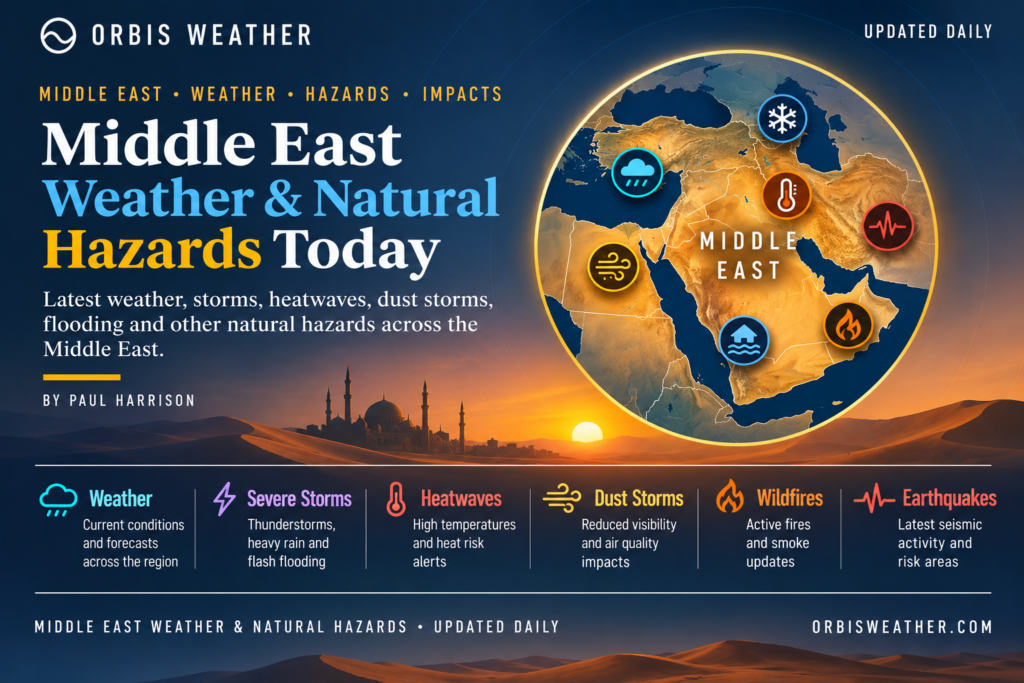
🌍 Middle East Weather & Natural Hazards Today – Wednesday, November 4, 2026
By Paul Harrison | Founder & Publisher, Orbis Weather
Published: November 4, 2026 — Middle East local date
Coverage: Saudi Arabia, United Arab Emirates, Qatar, Bahrain, Kuwait, Oman, Yemen, Iraq, Iran, Türkiye, Syria, Lebanon, Jordan, Israel and the Palestinian territories.
🌤️ Regional Weather Overview
The Middle East enters Wednesday, November 4, with warm autumn conditions across much of the Arabian Peninsula, the possibility of localized rainfall in the United Arab Emirates, and continuing seasonal concerns involving thunderstorms, fog, dust and flash flooding.
The most clearly documented forecast development concerns the United Arab Emirates, where the National Centre of Meteorology expects partly cloudy conditions and possible rainfall across northern and eastern areas. Increasing humidity could also produce fog or mist overnight into Thursday morning.
Elsewhere, November’s seasonal transition is bringing increasing attention to rainfall systems across the eastern Mediterranean, cooler mountain weather in Türkiye and Iran, and the potential for thunderstorms across parts of the Arabian Peninsula.
Although summer’s most extreme heat has generally subsided, daytime temperatures can still exceed 30°C (86°F) across several Gulf countries.
The region’s most important natural hazards to monitor include sudden flooding in normally dry valleys, dust-related visibility problems, hazardous mountain weather and earthquakes along active tectonic boundaries.
Editorial note: This report distinguishes dated forecasts from seasonal hazards. Where a November 4 forecast or official warning could not be independently verified, the information is identified as a monitoring priority rather than a confirmed weather event.
🚨 Middle East Weather Headlines
🌦️ United Arab Emirates: Showers possible in northern and eastern areas, with fog or mist developing overnight.
🌡️ Arabian Gulf: Warm daytime conditions continue, with Dubai and Abu Dhabi forecast to reach approximately 35°C (95°F).
⛈️ Saudi Arabia: Thunderstorms, hail and flash flooding remain important November monitoring priorities.
🌬️ Iraq and Kuwait: Dust storms and reduced visibility remain significant seasonal hazards.
🌧️ Eastern Mediterranean: Autumn rainfall and changing mountain conditions warrant attention.
🇴🇲 Oman: Wadi flooding remains a serious danger wherever heavy thunderstorms develop.
🌍 Iran and Türkiye: Earthquake preparedness remains important in tectonically active areas.
📊 Middle East Weather & Natural Hazards Summary
Country / Region | November 4 outlook or monitoring focus | Main hazard |
|---|---|---|
🇸🇦 Saudi Arabia | Monitor regional rainfall and thunderstorm forecasts | Flash floods, lightning |
🇦🇪 UAE | Partly cloudy; possible northern and eastern showers | Fog, localized rain |
🇶🇦 Qatar | Monitor local cloud, wind and rain forecasts | Visibility, marine conditions |
🇧🇭 Bahrain | Monitor coastal winds and humidity | Marine conditions |
🇰🇼 Kuwait | Monitor changing winds and rain potential | Dust, thunderstorms |
🇴🇲 Oman | Monitor mountain and coastal weather | Wadi flooding |
🇮🇶 Iraq | Autumn weather disturbances | Rain, dust |
🇮🇷 Iran | Mountain weather and seismic monitoring | Cold conditions, earthquakes |
🇾🇪 Yemen | Western highland weather | Flooding, landslides |
🇹🇷 Türkiye | Autumn rain and mountain conditions | Storms, earthquakes |
🇸🇾 Syria | Seasonal rainfall monitoring | Local flooding |
🇱🇧 Lebanon | Coastal and mountain weather | Heavy rain if storms develop |
🇯🇴 Jordan | Desert valley rainfall monitoring | Flash flooding |
🇮🇱 Israel / Palestinian territories | Seasonal rain and drainage conditions | Urban and desert flooding |
This table identifies weather forecasts and geographical monitoring priorities. It does not represent a complete list of active national weather warnings.
🇦🇪 United Arab Emirates – Showers Possible, Warm Temperatures and Overnight Fog
The UAE has one of the clearest published forecasts for Wednesday.
According to a November 3 report citing the National Centre of Meteorology, fair to partly cloudy weather is expected, with convective cloud development possible across northern and eastern areas.
Some of these clouds could produce localized rainfall.
Dubai high
35°C
95°FAbu Dhabi high
35°C
95°FSharjah high
34°C
93°F🌬️ Wind and marine conditions
Winds are expected to range from approximately 10–25 km/h (6–16 mph), occasionally reaching 35 km/h (22 mph).
Seas in the Arabian Gulf may become slight to moderate at times, while the Gulf of Oman is forecast to remain generally slight.
🌫️ Fog and visibility
Humidity is expected to increase overnight into Thursday morning, particularly across coastal and inland districts.
Fog or mist could affect road visibility, especially during early-morning travel.
Drivers should reduce speed, maintain greater following distances and use appropriate lighting.
Source: UAE National Centre of Meteorology forecast, reported November 3, 2026.
🇸🇦 Saudi Arabia – November Rainfall and Thunderstorm Monitoring
Saudi Arabia is entering a period when changing weather systems can bring thunderstorms to parts of the country.
The Saudi National Center for Meteorology’s early-November outlook has highlighted rainfall potential across several regions, including parts of Makkah, Asir, Jazan, Al-Baha, Riyadh and the Eastern Province.
However, a seasonal rainfall outlook does not establish that thunderstorms will occur in those locations on Wednesday.
⛈️ Hazards to monitor
Thunderstorms can produce intense localized rainfall, lightning, hail and strong wind gusts.
Mountainous areas in southwestern Saudi Arabia are particularly vulnerable to rapidly accumulating runoff, while desert valleys may experience sudden flooding.
Travelers should avoid entering wadis during rainfall and consult the latest National Center for Meteorology bulletins.
A specific nationwide November 4 severe-weather warning has not been independently established for this report.
🇶🇦 Qatar – Warm Conditions and Changing Winds
Qatar remains under the influence of the seasonal transition from summer heat toward more variable autumn weather.
Daytime conditions can remain warm, while occasional cloud development and passing disturbances can introduce showers.
The main monitoring priorities for Wednesday are local rainfall forecasts, wind changes and offshore conditions.
Coastal activities should be planned using current Qatar Meteorology Department marine forecasts.
No widespread severe-weather event for November 4 has been independently confirmed.
🇧🇭 Bahrain and 🇰🇼 Kuwait – Coastal Conditions and Dust Monitoring
Bahrain and Kuwait experience changing atmospheric conditions during November as weather systems become more active across the northern Arabian Peninsula.
In Bahrain, humidity, coastal winds and sea conditions are important considerations for marine operators.
In Kuwait, strong winds can occasionally lift dust across exposed desert areas, reducing visibility on major highways.
Autumn thunderstorms can also produce brief heavy rainfall and localized surface flooding.
These are established seasonal hazards, not confirmation that a dust storm or flooding event is occurring Wednesday.
🇴🇲 Oman – Mountain Weather and Flash-Flood Awareness
Oman’s mountains and dry river valleys create significant flash-flood risks when intense thunderstorms develop.
The Al Hajar Mountains in northern Oman can experience localized rainfall that produces runoff far downstream from the original storm.
Even relatively short periods of heavy rainfall can cause normally dry wadis to fill rapidly.
Coastal communities should also monitor wind and marine forecasts for the Gulf of Oman and Arabian Sea.
There is no independently verified evidence in the sources reviewed of a widespread November 4 flooding emergency in Oman.
Safety reminder: Never drive through a flooded wadi or attempt to judge the depth of fast-moving water from the roadside.
🇶🇦 Qatar – Updated Thunderstorm Outlook Through the End of the Week
A further weather update issued Tuesday provides stronger evidence of unsettled conditions developing across Qatar.
According to reporting on the Qatar Meteorology Department’s latest weather charts, localized rain clouds could continue forming through the end of the week, occasionally producing thunderstorms and strong downdraft winds.
This means Wednesday’s main concern is not necessarily widespread rainfall, but the possibility of sudden weather changes in isolated locations.
Strong downdrafts can create hazardous driving conditions, particularly when accompanied by blowing dust or rapidly deteriorating visibility.
Residents should monitor official forecasts before outdoor activities.
The outlook does not indicate that every part of Qatar will experience rain or thunderstorms.
🇸🇦 Saudi Arabia – Updated Severe-Weather Developments
Additional information from the Saudi National Center for Meteorology confirms that thunderstorms were forecast across several regions on Tuesday, November 3.
Orange weather alerts covered parts of Al-Jouf, Makkah, the Northern Borders and Asir, with hazards including heavy rainfall, hail, strong winds and potential flash flooding.
The national forecast also identified thunderstorm potential across Jazan, Al-Baha, Hail and portions of the Eastern Province.
These alerts were issued for Tuesday and should not be presented as automatically continuing into Wednesday.
Nevertheless, the recent unsettled conditions make updated forecasts particularly important for residents traveling through mountain districts, desert roads and flood-prone valleys.
🇮🇶 Iraq – Autumn Rainfall and Dust Hazards
Iraq is entering a season when approaching weather systems can produce increasing rainfall across northern and western areas.
Northern mountainous districts generally experience cooler conditions during November, while Baghdad and central Iraq can remain comparatively warm.
The country’s principal weather concerns include blowing dust, thunderstorms, localized flooding and reduced visibility.
Heavy rainfall can also overwhelm drainage infrastructure in urban areas.
For Wednesday, specific rainfall totals and active severe-weather warnings have not been independently verified.
🇮🇷 Iran – Mountain Weather, Dust and Earthquake Monitoring
Iran’s diverse geography creates substantial differences in weather conditions.
The Zagros and Alborz mountain ranges become increasingly vulnerable to colder temperatures and seasonal precipitation as November progresses.
Western and northern areas can experience unsettled weather, while central and eastern desert regions remain susceptible to dry conditions and dust.
🌍 Earthquake hazards
Iran lies along an active tectonic boundary associated with the collision of the Arabian and Eurasian plates.
Significant earthquakes are possible throughout the region, particularly along major fault systems.
However, seismic vulnerability does not mean a damaging earthquake is imminent.
No specific major earthquake in Iran on November 4 has been independently confirmed for this report.
🇾🇪 Yemen – Highland Flooding and Landslide Vulnerability
Yemen’s western highlands remain vulnerable to flash flooding when heavy rainfall develops.
Steep mountain slopes can accelerate runoff into villages, roads and agricultural areas.
Heavy rain can also destabilize slopes, increasing the danger of landslides.
The principal monitoring priorities include localized thunderstorms, mountain road conditions and rapid flooding in low-lying communities.
No widespread November 4 flood disaster has been independently verified in the reviewed sources.
🇹🇷 Türkiye – Autumn Weather and Seismic Hazards
Türkiye experiences increasingly variable weather during November.
Coastal regions can receive rainfall from Mediterranean and Black Sea weather systems, while higher elevations become colder.
Eastern mountain districts may experience increasingly wintry conditions as the season progresses.
Travelers should monitor forecasts for mountain passes, particularly where freezing temperatures and precipitation coincide.
🌍 Earthquake preparedness
Türkiye remains one of the world’s most seismically active countries, with major fault systems including the North Anatolian and East Anatolian faults.
Earthquake activity cannot be reliably predicted by exact date, location and magnitude.
No specific damaging earthquake on November 4 has been independently established in the sources reviewed.
🇸🇾 Syria, 🇱🇧 Lebanon and 🇯🇴 Jordan – Eastern Mediterranean Weather
The eastern Mediterranean is moving into its wetter part of the year.
Across Syria and Lebanon, passing weather systems can bring coastal rainfall, mountain precipitation and occasional thunderstorms.
Jordan’s most serious weather-related danger during heavy rainfall is flash flooding in desert valleys and steep drainage basins.
Locations around the Dead Sea can experience dangerous runoff, sometimes originating from rainfall several kilometers away.
The key hazards to monitor are changing rainfall forecasts, mountain weather, slippery roads and sudden flooding.
These are seasonal monitoring priorities rather than confirmed November 4 severe-weather warnings.
🇮🇱 Israel and the Palestinian Territories – Seasonal Rainfall and Flood Awareness
November typically marks increasing opportunities for rainfall across the eastern Mediterranean.
Coastal cities can experience localized flooding when intense rainfall overwhelms drainage systems.
Farther inland, desert landscapes are vulnerable to sudden runoff through normally dry channels.
Flood risks can be especially serious where drainage systems, roads or emergency infrastructure have been damaged.
No widespread November 4 flood warning has been independently verified for this section.
🌍 Natural Hazards Across the Middle East
🌊 Flash Flooding
Flash flooding is one of the region’s most dangerous weather hazards.
Desert terrain can generate rapid runoff because dry, compacted surfaces may absorb rainfall slowly.
Mountain valleys can concentrate large volumes of water in a short period.
Floodwaters can arrive unexpectedly, even when rainfall is not occurring directly overhead.
🌬️ Dust Storms and Air Quality
Dust storms can affect Saudi Arabia, Iraq, Kuwait, Iran and other parts of the Middle East.
Potential impacts include reduced highway visibility, airport disruption and elevated airborne particulate concentrations.
People with respiratory conditions should monitor air-quality guidance and reduce outdoor exposure during significant dust events.
🌡️ Extreme Temperatures
Although November generally brings cooler conditions, parts of the Arabian Peninsula can remain hot.
Recent Saudi forecasts have included daytime temperatures near 38°C (100°F) in Dammam, demonstrating that substantial heat can persist into autumn.
🌍 Earthquakes
The Middle East includes several active seismic zones, particularly across Iran, Türkiye and the eastern Mediterranean.
Earthquakes are natural geological events and cannot be forecast reliably with precise timing.
During shaking, the recommended protective action is to Drop, Cover and Hold On.
🌊 Marine Hazards
The Red Sea, Arabian Gulf, Gulf of Oman, Arabian Sea and eastern Mediterranean can experience rapidly changing winds and wave conditions.
Small-vessel operators should consult official marine forecasts before departure.
📅 Middle East Weather Outlook – November 4–6, 2026
Date | Main developments to monitor |
|---|---|
Wednesday, Nov. 4 | UAE localized rain and overnight fog potential; Qatar localized showers and thunderstorms possible |
Thursday, Nov. 5 | Qatar thunderstorm potential continues; UAE overnight visibility concerns |
Friday, Nov. 6 | Qatar local rain-cloud development remains possible; monitor updated regional forecasts |
The Qatar outlook is supported by the November 3 meteorological update. Conditions elsewhere may change as new national forecasts become available.
🛡️ Weather and Natural Hazard Safety
🌊 Flooding: Never enter floodwater or attempt to cross a flooded wadi.
⛈️ Thunderstorms: Move indoors when lightning threatens and avoid exposed locations.
🌫️ Fog: Reduce driving speed and increase following distance.
🌬️ Dust: Avoid unnecessary travel when visibility deteriorates significantly.
🌡️ Heat: Stay hydrated and limit strenuous outdoor activity during unusually hot conditions.
🌍 Earthquakes: Know evacuation procedures and follow official emergency instructions.
🚤 Marine conditions: Check local wind, wave and visibility forecasts before sailing.
🔎 Official Weather and Natural Hazard Sources
The following agencies provide authoritative information for residents and travelers.
Organization | Information |
|---|---|
Saudi forecasts and warnings | |
UAE weather and marine forecasts | |
Qatar forecasts and advisories | |
Oman forecasts and warnings | |
Türkiye weather forecasts | |
Earthquake observations | |
Major disaster monitoring | |
International meteorological information |
📝 Orbis Weather Editorial Methodology and Data Transparency
Report date: Wednesday, November 4, 2026 (Middle East local date)
Prepared: November 3, 2026 (U.S. Eastern Time)
Author: Paul Harrison
Publisher: Orbis Weather
Report type: Regional weather forecast and natural-hazards analysis
How this report was prepared
This report combines dated meteorological forecasts, national weather agency information, regional reporting and established scientific knowledge about natural hazards.
The most specific verified November 4 information concerns the UAE’s temperature, rainfall and visibility outlook, along with Qatar’s multi-day rainfall potential.
Saudi Arabia’s November 3 forecasts and alerts provide recent context but have not been represented as active November 4 warnings.
Where country-specific daily forecasts could not be independently confirmed, the report identifies relevant monitoring priorities rather than inventing weather observations or emergencies.
Forecast uncertainty
Weather forecasts can change rapidly, especially during localized thunderstorms.
This article is not a comprehensive real-time inventory of all national weather warnings.
A seasonal hazard does not necessarily indicate an active emergency. Forecast rainfall is not confirmation that rainfall has occurred, and earthquake vulnerability does not constitute an earthquake prediction.
Corrections and updates
Orbis Weather aims to distinguish confirmed information from forecasts, developing risks and background explanations.
Material errors should be corrected when reliable evidence becomes available. Significant revisions should be identified with an update date and an explanation of what changed.
Readers should prioritize current instructions from their national meteorological and emergency authorities.
🌍 Final Outlook – Middle East, Wednesday, November 4, 2026
The Middle East enters Wednesday with localized rainfall opportunities, warm Gulf temperatures and changing autumn weather.
The most significant verified forecast developments include possible showers in northern and eastern UAE districts, continuing thunderstorm potential in Qatar and recent severe-weather activity across parts of Saudi Arabia.
Across the wider region, flash flooding, blowing dust, reduced visibility and hazardous mountain conditions remain important monitoring priorities.
The main message for Wednesday is to remain alert to rapidly changing local conditions, particularly thunderstorms, fog and sudden flooding in normally dry valleys.
Orbis Weather continues to cover significant weather developments, earthquakes, flooding, extreme temperatures, tropical cyclones and other natural hazards worldwide.
About the Author
Paul Harrison — Founder & Publisher, Orbis Weather
Paul Harrison founded Orbis Weather in 2026 to make global weather and natural-hazard information easier to find, follow and understand. His coverage includes tropical cyclones, severe weather, extreme temperatures, earthquakes, volcanoes, wildfires, flooding and significant natural disasters worldwide.
View all articles by Paul Harrison → | Editorial Standards →
Global Weather Tracker Hub
Explore weather maps, tropical systems, storms and natural hazards around the world.
No matching trackers found.