
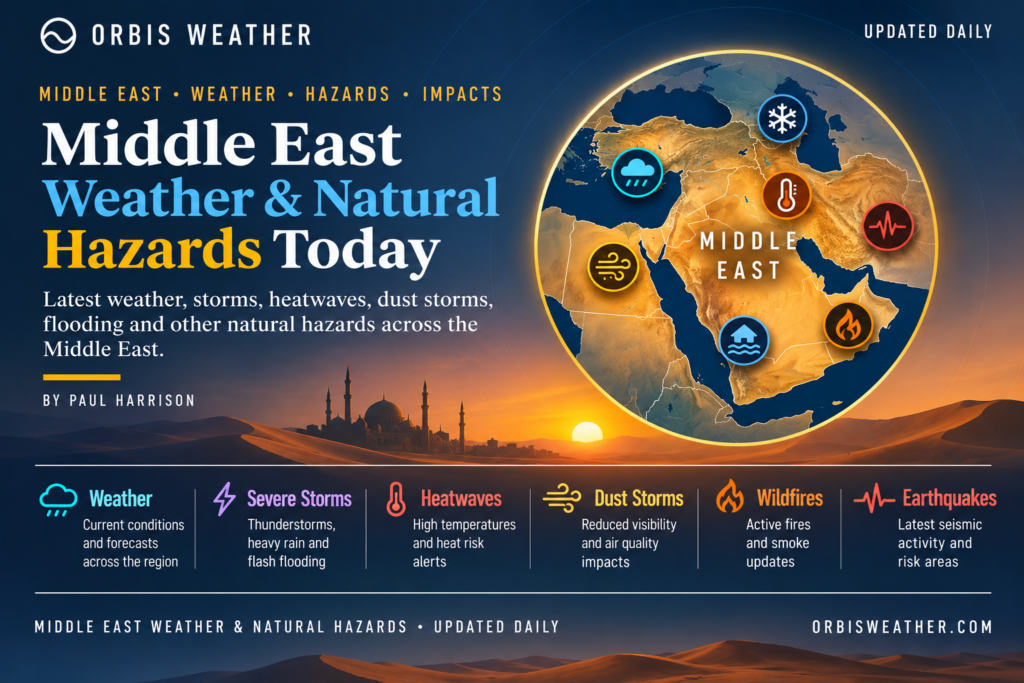
🌍 Middle East Weather & Natural Hazards Today
By Paul Harrison | Founder & Publisher, Orbis Weather

- Europe Weather & Natural Hazards Today — Wednesday, November 11, 2026 7:14 PM
- Southeast Asia Weather & Natural Hazards Today: Wednesday, November 11, 2026 7:04 PM
- Singapore Lightning & Thunderstorms This Week — Wednesday, November 11, 2026 6:56 PM
- Africa Weather & Natural Hazards Today — Wednesday, November 11, 2026 5:48 PM
- Middle East Weather & Natural Hazards Today – Wednesday, November 11, 2026 3:58 PM
- Europe’s Cold Spots This Week Nov 10, 2026 3:16 PM
- Fog turns morning commute into deadly pileups on Bulgaria highway 1:06 PM
- Australian Region Tropical Weather Update — Wednesday, November 11, 2026 12:06 PM
- Southwest Indian Ocean Tropical Weather Update – Wednesday, November 11, 2026 11:58 AM
- Australia, New Zealand & Oceania Weather & Natural Hazards Today — Wednesday, November 11, 2026 11:09 AM
- North America Weather & Natural Hazards Today — November 10, 2026 10:43 AM
- Central America Weather & Natural Hazards Today – Tuesday, November 10, 2026 10:35 AM
- South America Weather & Natural Hazards Today – November 10, 2026 10:27 AM
- Daily Earthquakes, Storms, Fires & Floods Report — November 10, 2026 10:15 AM
- Weekly Tropical Storm Tracker: Tuesday, November 10, 2026 10:07 AM
- Tropical Atlantic Daily Report: Tuesday, November 10, 2026 9:56 AM
- Eastern & Central Pacific Tropical Weather Update: Tuesday, November 10, 2026 9:49 AM
- WESTERN PACIFIC Tropical Weather Update – November 10, 2026 9:42 AM





Middle East Weather & Natural Hazards Today – Wednesday, November 11, 2026
By Paul Harrison | Orbis Weather
Published: November 11, 2026 (Middle East local date)
Coverage: Saudi Arabia, United Arab Emirates, Qatar, Bahrain, Kuwait, Oman, Yemen, Iraq, Iran, Israel, Palestine, Jordan, Lebanon, Syria and Türkiye.
Middle East Weather Overview: Severe Rainfall, Flash Flood Threats and Thunderstorms
The Middle East enters Wednesday, November 11, following a period of dangerous weather, with severe thunderstorms, flash flooding and strong winds affecting several countries.
The most significant developments are the deadly flooding in northern Iraq, widespread heavy-rain alerts in Saudi Arabia and an official thunderstorm watch extending into Wednesday morning in Kuwait.
In Saudi Arabia, authorities issued red alerts across parts of seven regions on November 10, warning of heavy rainfall, flash flooding, hail and strong winds capable of raising dust and sand.
Meanwhile, northern Iraq is recovering from destructive flooding that killed two people. Erbil experienced an estimated 80 millimeters (3.1 inches) of rainfall during the recent storms, considerably more than initially forecast.
Across the wider region, November’s transition toward winter brings increasingly variable weather. Rainfall and thunderstorms become more important hazards in northern areas, while desert dust, coastal winds, reduced visibility and localized flooding remain concerns throughout the Arabian Peninsula.
Forecast verification: This report uses confirmed recent events and official alerts available during preparation on November 10. Where November 11 forecasts or active warnings could not be independently confirmed, conditions are described as monitoring priorities rather than verified forecasts. Previous-day warnings should not be assumed to remain active after their expiry.
1. Saudi Arabia – Red Alerts Following Widespread Heavy Rain
Saudi Arabia is one of the principal weather concerns entering Wednesday.
On November 10, Saudi Civil Defense reported red alerts affecting parts of seven regions:
Riyadh
Makkah
Madinah
Asir
Jazan
Hail
Qassim
The National Center for Meteorology forecast moderate to heavy thunderstorms in several areas, with the potential for flash floods, hail and strong dust-producing winds.
Additional rainfall was forecast in parts of the Eastern Province, Tabuk, Al-Jouf and the Northern Borders region.
Areas requiring particular attention
Riyadh and central Saudi Arabia: Intense rainfall can quickly overwhelm urban drainage systems, creating hazardous driving conditions.
Makkah and Madinah: Valleys, drainage channels and low-lying roads are vulnerable to rapid runoff during thunderstorms.
Asir and Jazan: Mountainous terrain increases the danger of sudden flooding in wadis and steep valleys.
Eastern Province: Thunderstorms, reduced visibility and changing coastal winds can affect road and marine travel.
Hail and Qassim: Heavy showers, hail and gusty winds were among the reported hazards on November 10.
November 11 outlook
The immediate priority is monitoring whether the unsettled weather persists or redevelops. Areas affected by Tuesday’s storms may remain vulnerable to standing water and damaged roads even after rainfall ends.
The November 10 red alerts are confirmed historical warnings, not independently verified active alerts for November 11.
Residents should consult the Saudi National Center for Meteorology for updated warnings.
2. Iraq – Deadly Flooding and Continuing Recovery Concerns
Northern Iraq has experienced one of the region’s most serious recent weather disasters.
Severe thunderstorms produced destructive flash flooding around Erbil, inundating streets and damaging homes and businesses.
According to reporting published November 9, two people died after torrential rainfall affected the region. Approximately 80 mm (3.1 inches) of rain fell in Erbil, compared with an earlier forecast of around 30 mm (1.2 inches).
Main hazards
Flooded roads and underpasses.
Damage to buildings and drainage infrastructure.
Rapid runoff through valleys and seasonal watercourses.
Additional flooding if thunderstorms develop over already affected locations.
Disruption to transport and essential services.
Regional assessment
Erbil and northern Iraq: Flood recovery and any renewed rainfall deserve particular attention.
Mosul and Kirkuk: Monitor official forecasts for further thunderstorms and changes in river or drainage conditions.
Baghdad and central Iraq: Localized heavy rainfall and reduced visibility are seasonal concerns, but no specific November 11 severe-weather warning has been verified for the capital.
What happens next?
Even after a major storm moves away, floodwater can remain dangerous.
Residents should avoid damaged roads, flooded basements, unstable structures and fast-flowing drainage channels.
Further rainfall would increase the risk in locations where drainage systems have already been overwhelmed.
3. Kuwait – Official Thunderstorm Watch Extends Into Wednesday
Kuwait has a confirmed weather watch covering the overnight period into November 11.
The Kuwait Meteorological Center issued a moderate-level weather watch for possible scattered light to moderate rainfall, occasionally accompanied by thunderstorms.
Official Kuwait weather watch
| Start | November 10, 9:00 PM |
| End | November 11, 9:00 AM |
| Primary hazard | Thunderstorms and rain |
| Wind | May exceed 50 km/h (31 mph) |
| Additional concerns | Reduced visibility and rough seas |
Southern Kuwait was specifically highlighted for possible thundery rainfall.
Motorists should be alert for reduced visibility and standing water, while marine operators should check current wind and sea conditions.
The watch expires at 9:00 AM local time unless extended or replaced.
4. United Arab Emirates – Fog, Coastal Humidity and Rainfall Monitoring
Across the United Arab Emirates, November normally marks a transition toward cooler and more comfortable weather.
Dubai, Abu Dhabi, Sharjah, Ajman, Ras Al Khaimah and Fujairah can experience different conditions because of coastal humidity, desert terrain and mountain influences.
Main weather considerations
Morning fog and mist: Humidity and overnight cooling can create reduced visibility, particularly on inland roads.
Rainfall: Occasional weather disturbances may produce localized showers or thunderstorms.
Dust and haze: Strong winds can lift sand and dust, affecting road visibility and air quality.
Marine conditions: Changing winds can generate choppy seas along exposed coastal areas.
No nationwide severe-weather alert specifically for November 11 has been independently verified for this report.
Motorists should follow any updated visibility warnings from the UAE National Center of Meteorology.
5. Oman – Mountain Flooding and Arabian Sea Conditions
Oman’s varied geography creates several distinct weather hazards.
The Hajar Mountains, coastal settlements, desert interior and Dhofar region can experience sharply different weather.
Areas to monitor
Muscat: Coastal humidity, localized rainfall and changing sea conditions.
Hajar Mountains: Mountain thunderstorms can produce rapid runoff through wadis.
Northern Oman: Stronger winds or rainfall disturbances may affect mountain roads.
Dhofar and southern coastal waters: Monitor marine forecasts for changes in wind and swell.
Flash flood safety
Wadis can become dangerous even when rain falls many kilometers upstream.
Drivers should never attempt to cross flowing water, particularly on mountain roads or through normally dry channels.
No specific November 11 tropical cyclone threat has been independently confirmed in the sources reviewed.
6. Qatar and Bahrain – Visibility, Winds and Marine Conditions
Qatar and Bahrain are entering their cooler seasonal period, although coastal humidity and occasional dust remain important weather considerations.
Qatar
Doha and surrounding areas should monitor morning visibility, changing winds and local marine forecasts.
Bahrain
Coastal humidity, mist and occasional stronger winds can affect roads, bridges and maritime activities.
For both countries, thunderstorms are possible during suitable weather disturbances, but this report does not establish that storms are forecast for November 11.
No verified nationwide severe-weather warning is presented for either country.
7. Iran – Recent Storms, Mountain Weather and Earthquake Exposure
Parts of Iran were affected by the recent regional thunderstorm activity that also brought destructive flooding to northern Iraq.
Iran’s varied terrain produces significant weather contrasts between the Caspian coast, Zagros Mountains, central plateau and southern coastal areas.
Western Iran
Rainfall associated with passing weather systems can create localized flooding, particularly in mountainous terrain and urban drainage corridors.
Northern Iran
Autumn rainfall and cooler temperatures become increasingly important, especially around the Caspian coast and higher elevations.
Zagros Mountains
Mountain roads may become hazardous during periods of heavy rain, freezing temperatures or snowfall.
Southern Iran
Warm coastal conditions, humidity and occasional dust remain important environmental considerations.
Geological hazards
Iran is located within an active tectonic region where earthquakes are a persistent natural hazard.
However, the presence of active faults does not indicate that a particular earthquake is imminent.
No specific November 11 earthquake magnitude, location or damage report has been verified for inclusion.
8. Israel and Palestine – Rainfall, Flooding and Vulnerable Infrastructure
The eastern Mediterranean is entering its wetter season, when passing weather systems can produce thunderstorms and localized flooding.
Israel
Coastal cities, inland valleys and desert drainage channels can experience different flood hazards.
Areas requiring seasonal monitoring include Tel Aviv, Jerusalem, Haifa, the Negev and locations near normally dry watercourses.
Gaza and the West Bank
Heavy rainfall can be especially dangerous where drainage systems, roads and buildings are damaged or inadequate.
In Gaza, displacement and limited shelter can increase the humanitarian consequences of rain, wind and falling temperatures.
Potential impacts include:
Flooding of temporary shelters.
Contamination of standing water.
Disruption to access roads.
Exposure to cold and wet conditions.
Damage to vulnerable structures.
These are important risk factors rather than confirmation of new flooding on November 11.
Residents should rely on current local weather and emergency information for active conditions.
9. Jordan – Flash Flood Risk in Valleys and Desert Terrain
Jordan’s most significant seasonal weather hazards include thunderstorms, flash flooding and sudden changes in mountain and desert conditions.
Areas to monitor
Amman: Urban flooding and reduced road visibility during intense rainfall.
Petra: Narrow canyons and drainage channels can become dangerous during thunderstorms.
Wadi Rum: Desert runoff may occur far from the location of the heaviest rainfall.
Dead Sea region: Steep terrain can direct floodwater rapidly toward lower elevations.
Northern Jordan: Rainfall and cooler conditions become increasingly common as winter approaches.
No active November 11 national flash flood warning has been independently confirmed for this report.
Visitors to Petra and other canyon environments should check official guidance before entering flood-prone routes.
10. Lebanon and Syria – Autumn Rainfall and Winter Preparedness
Lebanon
Lebanon’s Mediterranean coastline and mountainous interior experience contrasting weather conditions.
Coastal areas may experience heavy rainfall and thunderstorms as weather systems move eastward across the Mediterranean.
Higher elevations become increasingly vulnerable to cold weather, frost and eventually snowfall.
Potential hazards include urban flooding, landslides, poor mountain-road visibility and strong coastal winds.
Syria
Western Syria typically receives more rainfall during the cooler months, while inland and eastern areas are generally drier.
Damaged infrastructure and displacement can increase vulnerability to flooding and falling temperatures.
Particular concerns include poor drainage, exposed accommodation and disruption to roads or essential services.
Specific severe-weather alerts for November 11 have not been verified for either country.
11. Türkiye – Mountain Weather and Eastern Mediterranean Storms
Türkiye’s weather becomes increasingly variable during November.
Although much of the country lies outside the Arabian Peninsula, its southeastern provinces and Mediterranean coast are closely connected to regional weather systems.
Southeastern Türkiye
Rainfall, thunderstorms and changing temperatures may affect communities near the Syrian and Iraqi borders.
Eastern Anatolia
Higher elevations face an increasing seasonal risk of frost, snowfall and icy roads.
Mediterranean coastline
Passing weather systems can generate heavy rain, thunderstorms and hazardous marine conditions.
Earthquake risk
Türkiye remains exposed to significant seismic hazards associated with major fault systems.
Earthquake preparedness remains important throughout the year, regardless of weather conditions.
No specific November 11 earthquake or active nationwide severe-weather warning is asserted without current confirmation.
12. Yemen – Flood Vulnerability and Humanitarian Concerns
Yemen remains particularly vulnerable to natural hazards because of its mountainous geography, exposed settlements and fragile infrastructure.
Western highlands
Heavy rainfall can trigger flash flooding and landslides in steep terrain.
Coastal areas
Strong winds, rough seas and occasional intense rainfall may disrupt fishing and coastal transport.
Inland valleys
Floodwater can travel rapidly downstream, threatening communities even when rainfall occurs elsewhere.
For displaced populations, relatively modest weather events can create serious consequences where shelter, drainage and access to emergency assistance are limited.
No specific November 11 severe-weather alert or tropical cyclone impact has been independently verified.
13. Middle East Natural Hazards Risk Monitor
The following assessment separates recently confirmed hazards from persistent regional risks. It is not a live warning map.
Hazard | Areas of concern | Status |
|---|---|---|
Heavy rain and flash flooding | Saudi Arabia | Red alerts reported Nov. 10; reassessment needed Nov. 11 |
Flood recovery | Northern Iraq, Erbil | Confirmed deadly flooding |
Thunderstorms and strong winds | Kuwait | Official watch through 9 AM Nov. 11 |
Flash flooding | Oman, Yemen, Jordan | Seasonal exposure; no current warning verified |
Dust and reduced visibility | Arabian Peninsula, Iraq, Iran | Monitoring priority |
Mountain snow and frost | Iran, eastern Türkiye, Lebanon | Seasonal possibility |
Earthquakes | Iran, Türkiye, Syria, surrounding fault zones | Persistent geological hazard |
Rough seas | Arabian Gulf, Red Sea, eastern Mediterranean | Check local marine advisories |
Tropical cyclones | Arabian Sea | Current system status not independently established |
14. Earthquake and Geological Activity
The Middle East lies within one of the world’s most geologically active regions.
Important tectonic structures include the Zagros fold-and-thrust belt, the Dead Sea Transform, the East Anatolian Fault and the Arabian–Eurasian collision zone.
Earthquakes can produce structural damage, landslides, utility failures and transport disruption.
Earthquake monitoring resources
Important: No complete, independently verified November 11 earthquake event list was available during preparation. This section does not imply that no earthquakes occurred.
Earthquakes cannot currently be predicted reliably by exact date, time, location and magnitude.
15. Dust Storms, Air Quality and Public Health
Dust is a major environmental hazard across the Middle East, particularly in Iraq, Saudi Arabia, Kuwait, Iran and other desert regions.
Strong winds can lift fine particles into the atmosphere and transport them across national borders.
Potential impacts
Reduced visibility on highways.
Respiratory irritation.
Poorer air quality for sensitive groups.
Disruption to aviation and outdoor activities.
Reduced visibility at sea.
People with respiratory conditions should follow local public-health advice when particulate pollution increases.
Current city-level Air Quality Index readings have not been independently verified for this report.
Air quality monitoring is available through IQAir and national environmental agencies.
16. Marine Weather – Arabian Gulf, Red Sea and Mediterranean
Marine conditions remain an important concern, particularly following the recent unsettled weather.
Saudi Arabia’s November 9 official forecast described winds exceeding 50 km/h in parts of the Red Sea and exceeding 60 km/h in the northern Arabian Gulf, with wave heights above two meters possible in some areas. These were conditions forecast for November 9, not verified observations for November 11.
Marine area | Hazards to monitor |
|---|---|
Arabian Gulf | Thunderstorms, gusty winds, rough seas |
Red Sea | Wind-driven waves, reduced visibility |
Gulf of Oman | Coastal winds, swell, thunderstorms |
Arabian Sea | Large swell and tropical disturbances |
Eastern Mediterranean | Strong winds, thunderstorms, rough seas |
Fishing vessels, ferries, recreational boaters and commercial operators should obtain updated marine forecasts before departure.
Kuwait’s official weather watch specifically highlighted rough seas during the overnight period into Wednesday morning.
17. Middle East Weather Outlook – November 11–13, 2026
This is a regional hazard-planning outlook, not a verified three-day numerical weather forecast for every country.
Date | Regional focus | Key concerns |
|---|---|---|
Wednesday, Nov. 11 | Saudi storm follow-up, Iraq flood recovery, Kuwait overnight watch | Flooding, thunderstorms, wind, visibility |
Thursday, Nov. 12 | Monitor changing rainfall and wind patterns | Renewed alerts, dust, marine conditions |
Friday, Nov. 13 | Autumn-to-winter transition across northern areas | Mountain weather, rainfall, cooler conditions |
The timing, location and intensity of any new storms require confirmation through updated national forecasts.
18. Weather Safety – Important Advice
Flash flooding: Never drive or walk through moving floodwater. Dry riverbeds and wadis can flood suddenly.
Thunderstorms: Seek shelter in a substantial building or enclosed vehicle. Avoid exposed mountain ridges and open terrain.
Dust storms: Reduce driving speed, increase following distance and follow official visibility warnings.
Mountain travel: Check for rain, frost, snow and road closures before entering high-elevation routes.
Marine activities: Review official wind, wave and thunderstorm forecasts before departure.
After flooding: Avoid damaged buildings, exposed electrical equipment and contaminated standing water.
19. Official Weather and Natural Hazard Sources
Orbis Weather recommends the following authoritative sources for updated information:
Organization | Information |
|---|---|
Saudi forecasts and weather alerts | |
Kuwait warnings and forecasts | |
UAE weather and marine forecasts | |
Oman weather information | |
Türkiye forecasts and warnings | |
Weather observations and warnings | |
Earthquake monitoring | |
Regional earthquake reports | |
International meteorological coordination |
20. Orbis Weather Editorial Methodology and Transparency
This report is prepared by Orbis Weather as a regional weather and natural hazards news briefing.
Information is assessed using official meteorological agencies, recognized geological monitoring organizations and established news reporting.
How information is classified
Confirmed events: Weather incidents supported by identifiable reporting or official information.
Official alerts: Warnings or watches with a stated issuing authority and, where available, a defined validity period.
Forecast risks: Potential future weather conditions requiring confirmation from current forecasts.
Seasonal hazards: Risks associated with geography or climate that should not be mistaken for active warnings.
Limitations
The Middle East covers a large and geographically diverse region. Conditions can vary considerably between countries, cities and even nearby districts.
Not every country’s live weather data or alert service was available for independent verification during preparation.
Orbis Weather therefore avoids presenting unverified temperature readings, rainfall totals, earthquake reports or warning levels as established facts.
The absence of a confirmed warning in this report does not mean that no warning exists.
Readers should consult national meteorological services and local emergency authorities before making safety-critical decisions.
Corrections and updates
Orbis Weather aims to distinguish confirmed information from developing situations. Reports may be updated when new authoritative information becomes available. Material errors should be corrected transparently, with the updated information clearly identified.
Middle East Weather Summary – November 11, 2026
The Middle East begins Wednesday with several significant weather developments demanding attention.
Saudi Arabia is monitoring the aftermath of widespread heavy rainfall warnings, with flash flooding, hail and strong winds among the principal concerns.
Northern Iraq continues to face the consequences of deadly flooding, particularly around Erbil.
Kuwait has an official thunderstorm watch extending into Wednesday morning, with possible reduced visibility and rough seas.
Elsewhere, the seasonal transition toward winter is increasing the importance of rainfall, mountain weather and localized flooding across parts of the region.
For residents, travelers and maritime operators, the most important advice is to monitor current official warnings and avoid flood-prone areas during periods of heavy rainfall.
Orbis Weather will continue following major weather developments and natural hazards across the Middle East.
By Paul Harrison | Orbis Weather
Independent global weather reporting, natural hazard monitoring and regional weather analysis.
About the Author
Paul Harrison — Founder & Publisher, Orbis Weather
Paul Harrison founded Orbis Weather in 2026 to make global weather and natural-hazard information easier to find, follow and understand. His coverage includes tropical cyclones, severe weather, extreme temperatures, earthquakes, volcanoes, wildfires, flooding and significant natural disasters worldwide.
View all articles by Paul Harrison → | Editorial Standards →
Global Weather Tracker Hub
Explore weather maps, tropical systems, storms and natural hazards around the world.
No matching trackers found.