
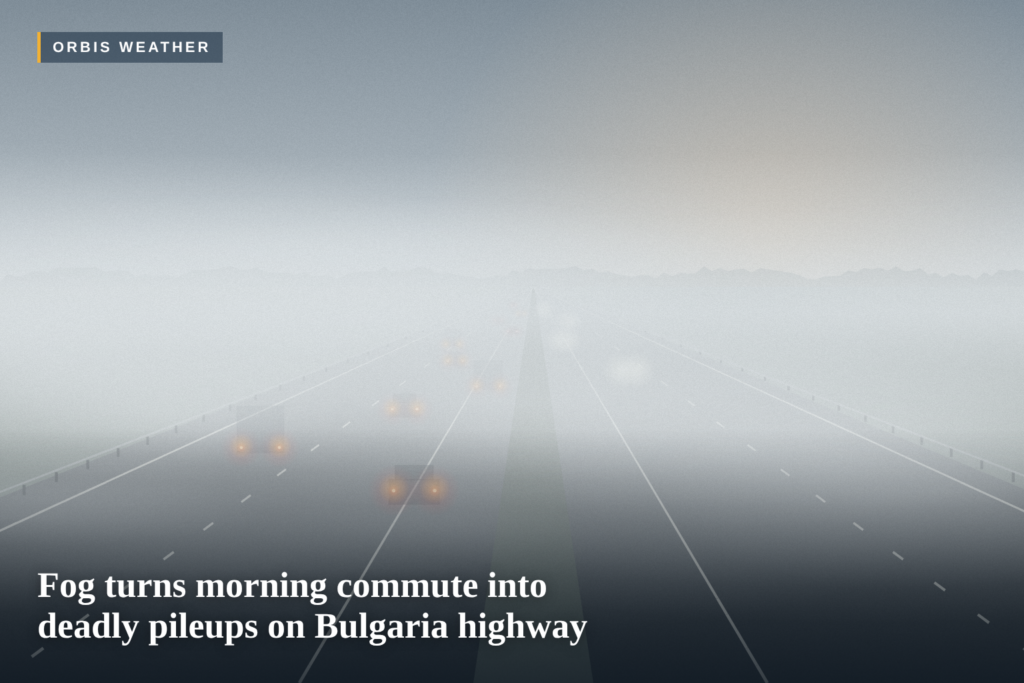
Fog turns morning commute into deadly pileups on Bulgaria highway
By Paul Harrison | Founder & Publisher, Orbis Weather

- Europe Weather & Natural Hazards Today — Wednesday, November 11, 2026 7:14 PM
- Southeast Asia Weather & Natural Hazards Today: Wednesday, November 11, 2026 7:04 PM
- Singapore Lightning & Thunderstorms This Week — Wednesday, November 11, 2026 6:56 PM
- Africa Weather & Natural Hazards Today — Wednesday, November 11, 2026 5:48 PM
- Middle East Weather & Natural Hazards Today – Wednesday, November 11, 2026 3:58 PM
- Europe’s Cold Spots This Week Nov 10, 2026 3:16 PM
- Fog turns morning commute into deadly pileups on Bulgaria highway 1:06 PM
- Australian Region Tropical Weather Update — Wednesday, November 11, 2026 12:06 PM
- Southwest Indian Ocean Tropical Weather Update – Wednesday, November 11, 2026 11:58 AM
- Australia, New Zealand & Oceania Weather & Natural Hazards Today — Wednesday, November 11, 2026 11:09 AM
- North America Weather & Natural Hazards Today — November 10, 2026 10:43 AM
- Central America Weather & Natural Hazards Today – Tuesday, November 10, 2026 10:35 AM
- South America Weather & Natural Hazards Today – November 10, 2026 10:27 AM
- Daily Earthquakes, Storms, Fires & Floods Report — November 10, 2026 10:15 AM
- Weekly Tropical Storm Tracker: Tuesday, November 10, 2026 10:07 AM
- Tropical Atlantic Daily Report: Tuesday, November 10, 2026 9:56 AM
- Eastern & Central Pacific Tropical Weather Update: Tuesday, November 10, 2026 9:49 AM
- WESTERN PACIFIC Tropical Weather Update – November 10, 2026 9:42 AM





Fog turns morning commute into deadly pileups on Bulgaria highway
By Paul Harrison, Orbis Weather · Tuesday, November 10, 2026
Sudden dense fog set off two chain-reaction crashes on Bulgaria’s Trakia motorway near Yambol on Tuesday morning, November 10. At least 11 people were killed and dozens were injured, according to the latest government figures reported by the state news agency BTA. Some earlier reports put the death toll at 12. The Interior Ministry said 86 vehicles were involved, and the government declared Wednesday, November 11, a day of national mourning.
What happened
The crashes happened at about 7 a.m., the Associated Press reported, on opposite carriageways at the same stretch of road. Bulgarian broadcaster BNT placed the site near kilometer 291 of the Trakia motorway, which links Sofia with the Black Sea port of Burgas.
The first pile-up was on the Burgas-bound carriageway. According to Lyubomir Nikolov, acting chief secretary of the Interior Ministry, a lorry cut across a passenger bus. A lorry carrying wheat then swerved into it, and a passenger car hit the back of that lorry. More vehicles piled in behind. Nikolov said all of the dead were travelling toward Burgas.
A second pile-up followed on the Sofia-bound side. Officials believe drivers there may have been distracted by the crash across the road. Deputy Interior Minister Kaloyan Kaloyanov said 63 vehicles were caught up heading to Burgas and 23 heading to Sofia. AP reported that many were heavy trucks.
Figure | Count | Who reported it |
|---|---|---|
Vehicles involved | 86 (63 toward Burgas, 23 toward Sofia) | Deputy Interior Minister Kaloyan Kaloyanov; the Yambol regional governor earlier estimated about 50 |
Deaths | At least 11 | BTA and BNT, evening of Nov 10; Prime Minister Rumen Radev and Health Minister Katya Ivkova gave 12 earlier in the day; later official figures gave 11 |
Injured | 46 taken to hospital; 48 reported by Radev; 51 reported by BNT | Health Ministry, Radev, BNT |
The figures changed through the day and may change again. Xinhua reported that, of the 11 dead, 10 died at the scene and one later in hospital. Earlier, Ivkova had said two died on the way to hospital.
How the fog closed in
The fog thickened within moments, leaving drivers almost no time to react. Eyewitnesses told police that visibility was about 70 to 80 meters (230 to 260 feet), then suddenly dropped to about 10 meters (33 feet), Nikolov said. Interior Minister Ivan Demerdzhiev told BNT that the mist thickened sharply just before the first crash.
Police said initial assessments pointed to “reduced visibility due to fast-forming dense fog, wet road surface and speeds unsuitable for the conditions,” AP reported. The fog was still thick enough later that morning to hamper the rescue. A medical helicopter sent from Sliven could not land, and its air ambulance crew reached the scene by police car, according to The Sofia Globe. Radev said police teams also had difficulty reaching the site because visibility was so poor.
Rescue, investigation and political fallout
The Trakia motorway was closed in both directions near Yambol, and by Tuesday evening there was still no word on when it would reopen, BNT reported. Ukrainian outlet UNN reported that 15 fire engines and hundreds of police, medical and military personnel were deployed. The Health Ministry said later in the day that half the site had been cleared. It said the hardest stage, cutting apart and removing the stacked vehicles, was still ahead.
The injured were taken to hospitals in Sliven, Yambol and Burgas, the Health Ministry said. Two Spartan military transport planes carrying stretchers and medical teams were sent to the region, and hospitals in Sofia, Plovdiv, Stara Zagora and Haskovo prepared to take patients.
Investigation. Ten investigators from the National Investigation Service, with forensic specialists and a mobile laboratory, took over the case under the supervision of the Yambol District Prosecution Office, according to BNT and BTA. Acting service director Marian Marinov said the fog “was a contributing factor.” He said the absence of a fog warning sign on the motorway was outside the investigation’s scope for now. The Road Infrastructure Agency took samples of the road surface, BTA reported.
Reaction. Radev left a meeting with European Commission President Ursula von der Leyen in Varna and went to the scene. He called for an in-depth analysis of the causes and urged drivers to adjust their speed to the weather, BTA reported. President Iliana Yotova cut short a trip to Paris. A Cabinet meeting set for Tuesday, whose agenda included changes to the Road Traffic Act, was cancelled.
The crash comes against a grim background. Bulgaria recorded 71 road deaths per million inhabitants in 2025, the highest rate in the European Union, according to European Commission figures cited by AFP.
Why fog is so dangerous on fast roads
Fog is most deadly when it forms suddenly, because drivers are still travelling at speeds set for clear air. At motorway speed, a car covers many times the distance it can see in very dense fog. A driver who brakes hard can then be struck by the vehicle behind, and chain-reaction crashes like Tuesday’s follow.
Fog forms when air near the ground cools to its dew point and the moisture condenses into tiny droplets. On calm, clear nights in autumn, the ground loses heat quickly, so radiation fog often settles in valleys and low plains by dawn. It usually lifts as the sun warms the ground later in the morning.
Driving advice from road safety agencies is broadly the same everywhere:
- Slow down before you enter fog, and drive at a speed that lets you stop within the distance you can see.
- Use dipped headlights and fog lights. High beams reflect off the fog and make it harder to see.
- Leave a much larger gap to the vehicle in front, and do not follow its tail lights closely.
- Do not stop in a running lane. If you must stop, pull well off the road and switch on hazard lights.
- If you see a crash ahead, keep your eyes on your own lane rather than on the scene.
What happens next
- National mourning: Wednesday, November 11, is a day of national mourning, the Council of Ministers said. Sofia’s mayor, Vassil Terziev, cancelled the city’s public, cultural and entertainment events.
- The motorway: the Road Infrastructure Agency warned that restrictions could last a long time because of the damaged vehicles and the investigation, UNN reported. Drivers should check official traffic updates before travelling between Sofia and Burgas.
- The investigation: witness interviews and forensic examinations are continuing under the Yambol District Prosecution Office.
- Road safety policy: Radev said the government plans a unified national road-information centre in 2027, BTA reported.
- Fog: autumn fog can return on calm, clear nights. Bulgaria’s National Institute of Meteorology and Hydrology issues the official fog warnings.
Frequently asked questions
Where did the crashes happen? On the Trakia motorway near Yambol in southeastern Bulgaria, around kilometer 291, according to BNT. The motorway is the main route between Sofia and the Black Sea coast at Burgas.
Why do the death tolls differ? Officials gave 12 deaths earlier on Tuesday. By the evening, BTA and BNT were reporting at least 11. Early tolls after large crashes often change as victims are identified and counted.
What caused the pile-ups? Investigators have not given a final cause. Police point to fast-forming dense fog, a wet road and speeds unsuitable for the conditions, and the investigation service calls the fog a contributing factor.
Is the Trakia motorway open? It was closed in both directions near Yambol on Tuesday, with no reopening time given. Drivers should check Bulgaria’s Road Infrastructure Agency and traffic police before travelling.
Sources
- BTA: Cabinet declares Wednesday a day of national mourning
- BTA: Lack of danger sign not subject of investigation
- BNT: 10 investigators to seek the causes of the Trakia crash (Bulgarian)
- AP via Arab News: At least 12 killed in crashes on a foggy Bulgarian motorway
- AFP and AP via Al Jazeera: At least 12 killed in motorway crash
- AFP via Kyiv Post: Bulgaria motorway pileup
- Xinhua: At least 11 killed, 48 injured in two pile-ups
- The Sofia Globe: 86-vehicle chain crash on Trakia Motorway
- UNN: 86 vehicles collided in Bulgaria
About the Author
Paul Harrison — Founder & Publisher, Orbis Weather
Paul Harrison founded Orbis Weather in 2026 to make global weather and natural-hazard information easier to find, follow and understand. His coverage includes tropical cyclones, severe weather, extreme temperatures, earthquakes, volcanoes, wildfires, flooding and significant natural disasters worldwide.
View all articles by Paul Harrison → | Editorial Standards →
Global Weather Tracker Hub
Explore weather maps, tropical systems, storms and natural hazards around the world.
No matching trackers found.