
Magnitude 5.7 Earthquake Rattles Central Japan, Injuring More Than a Dozen
By Paul Harrison | Founder & Publisher, Orbis Weather






Magnitude 5.7 Earthquake Rattles Central Japan, Injuring More Than a Dozen
By Paul Harrison, Orbis Weather ·
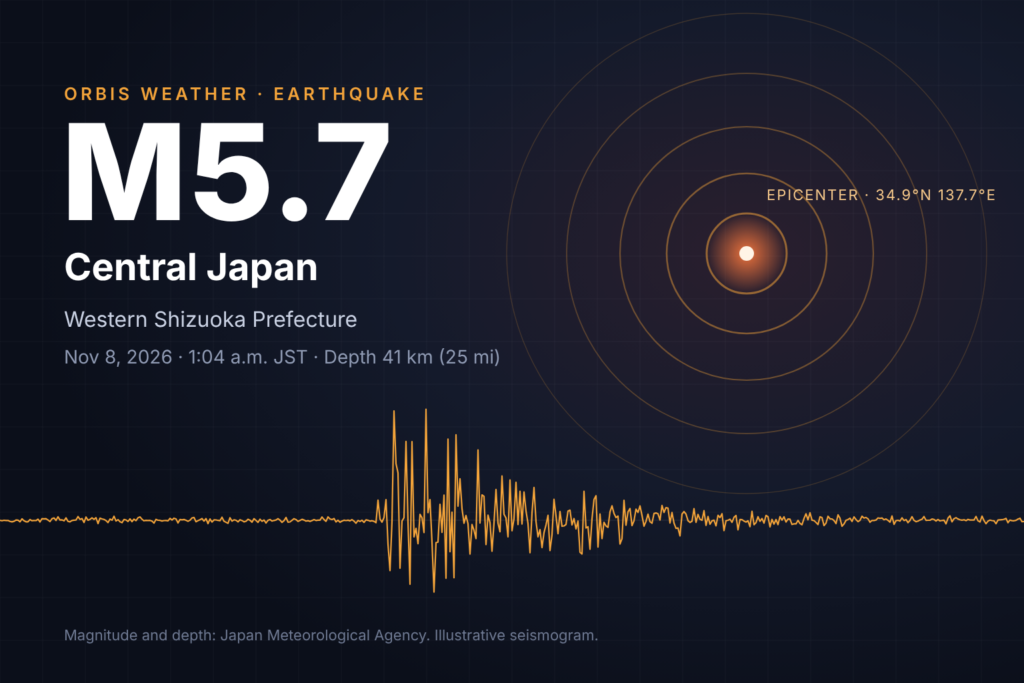
A magnitude 5.7 earthquake struck western Shizuoka Prefecture in central Japan at 1:04 a.m. local time on Sunday, November 8, 2026, according to the Japan Meteorological Agency (JMA). Shaking reached upper 5 on Japan’s 7-level intensity scale in Chita, Aichi Prefecture. More than a dozen people were injured in Aichi and Shizuoka, many from hitting their heads or falling, and no deaths were reported. No tsunami warning was issued.
JMA has warned of possible strong aftershocks over the coming week, especially in the next two to three days.
What happened
The quake struck about 25 miles (40 km) underground beneath western Shizuoka, near the city of Hamamatsu. In the US it was 11:04 a.m. EST on Saturday, November 7. JMA and the US Geological Survey (USGS) gave slightly different figures, as agencies using different methods often do.
|
Measure |
Japan Meteorological Agency |
US Geological Survey |
|---|---|---|
|
Magnitude |
5.7 (confirmed in a revision at 3:05 a.m. JST) |
5.5 (moment magnitude) |
|
Time |
1:04 a.m. JST, Nov 8 |
16:04 UTC, Nov 7 |
|
Depth |
41 km (25 mi) |
38 km (24 mi) |
|
Location |
Western Shizuoka Prefecture, 34.9°N 137.7°E |
10 km (6 mi) northwest of Hamakita |
USGS issued a green PAGER alert for both deaths and economic losses, its lowest level. It estimated that about 1.4 million people felt moderate shaking.
Shaking, injuries and damage
The strongest shaking was in Aichi Prefecture, west of the epicenter, rather than in Shizuoka itself. JMA recorded these intensities on its 0-to-7 scale:
|
JMA intensity |
What it means |
Where it was recorded |
|---|---|---|
|
Upper 5 |
Hard to move without support; unsecured furniture likely to tip |
Western Aichi, including Chita |
|
Lower 5 |
Frightens many; items fall from shelves |
Western Shizuoka, eastern Aichi, southern Nagano, eastern Gifu |
|
4 |
One step below lower 5 |
Nagoya, central Shizuoka, central and western Gifu, northern Mie |
Shaking was also felt as far away as Kyoto, Osaka and Nara. The intensity descriptions come from JMA’s scale as summarized on Wikipedia.
Injuries. Reported counts differ. Al Jazeera, citing the Kyodo news agency, reported more than 20 people injured in Aichi and Shizuoka. Korea’s SBS reported at least 12 injured in Aichi, mostly from hitting their heads, and 3 in Shizuoka. The Associated Press reported that some people fell on stairs as they tried to flee. No deaths were reported.
Damage. Shop windows shattered and books fell from shelves, according to Al Jazeera. No collapsed buildings had been reported in the sources reviewed. USGS rated the risk of liquefaction, where shaken ground loses strength, at yellow.
Transport and power. Some local train lines were suspended. JR Central reported Tokaido Shinkansen delays between Shizuoka and Gifu-Hashima stations during safety checks. Chubu Electric Power reported no abnormalities at the Hamaoka nuclear plant, according to The Nation. Japan’s government set up a liaison office to coordinate its response.
Tsunami
No tsunami warning was issued, Kyodo reported. The USGS catalog also carries no tsunami flag for the event. The epicenter lay inland, beneath western Shizuoka.
Why this region shakes
Shizuoka sits above one of the world’s most closely watched fault zones, the Nankai Trough. There, the Philippine Sea plate slides beneath the part of Japan that lies on the Eurasian plate. The last large earthquake on the trough struck off the Kii Peninsula in 1944.
A March 2025 Japanese government estimate put the possible toll of a future Nankai Trough megaquake at about 298,000 deaths, according to Kyodo. JMA official Ayataka Ebita said no apparent change had been detected in the Nankai Trough after Sunday’s quake, Al Jazeera reported. The Nation reported that JMA considered a link to a major Nankai Trough earthquake unlikely.
The region has seen similar quakes before:
|
Earthquake |
Magnitude |
Depth |
Toll |
|---|---|---|---|
|
6.4 (moment magnitude) |
26 km (16 mi) |
1 dead, 134 injured, 6,000 buildings damaged |
|
|
6.0 (moment magnitude) |
9 km (6 mi) |
80 injured |
What comes next
JMA urged people to be ready for strong shaking for about a week, especially in the next two to three days. SBS quoted the agency as saying caution is needed for quakes of up to around upper 5 intensity. “Please be on the lookout for mudslides, falling rocks and the possible effects from rainfall,” Ebita told reporters, according to Al Jazeera.
One small aftershock was recorded in the first hours: a magnitude 3.3 in eastern Aichi at 2:06 a.m., with a maximum intensity of 2, according to JMA.
People in the shaken area should follow JMA and their local authorities. Practical steps include securing heavy furniture, keeping shoes and a flashlight near the bed, and avoiding steep slopes after rain.
Frequently asked questions
Why do JMA and USGS give different magnitudes? JMA reported 5.7 and USGS 5.5. The agencies use different methods and station networks, and differences of a few tenths are common. This article leads with JMA’s figure because it is Japan’s national agency.
Is this the Nankai Trough megaquake? No. A JMA official said no apparent change had been detected in the Nankai Trough. A megaquake there would be far larger than this event.
How many people were hurt? Reports differ. Kyodo, cited by Al Jazeera, reported more than 20 injured, while SBS counted 15. No deaths were reported.
Could a stronger quake follow? JMA warned that strong shaking is possible over the coming week, especially in the first two to three days. Most aftershocks are smaller than the main quake, but residents should stay prepared.
Sources
Agencies:
- Japan Meteorological Agency earthquake list
- JMA seismic intensity report, 1:12 a.m. JST
- JMA hypocenter revision, 3:05 a.m. JST
- USGS event us7000twt0
News:
- Al Jazeera: Earthquake hits central Japan, injuring more than 20 people
- SBS: Magnitude 5.7 earthquake hits western Shizuoka Prefecture
- The Nation: Japan earthquake injures over 20 in Aichi and Shizuoka
Background:
About the Author
Paul Harrison — Founder & Publisher, Orbis Weather
Paul Harrison founded Orbis Weather in 2026 to make global weather and natural-hazard information easier to find, follow and understand. His coverage includes tropical cyclones, severe weather, extreme temperatures, earthquakes, volcanoes, wildfires, flooding and significant natural disasters worldwide.
View all articles by Paul Harrison → | Editorial Standards →
Global Weather Tracker Hub
Explore weather maps, tropical systems, storms and natural hazards around the world.
No matching trackers found.