

🌀 Atlantic Hurricane Drought Nears Historic Record as Peak Season Arrives
September 6, 2026 — Orbis Weather
The 2026 Atlantic hurricane season is approaching an unusual milestone: the latest first hurricane of the season in the modern satellite era.
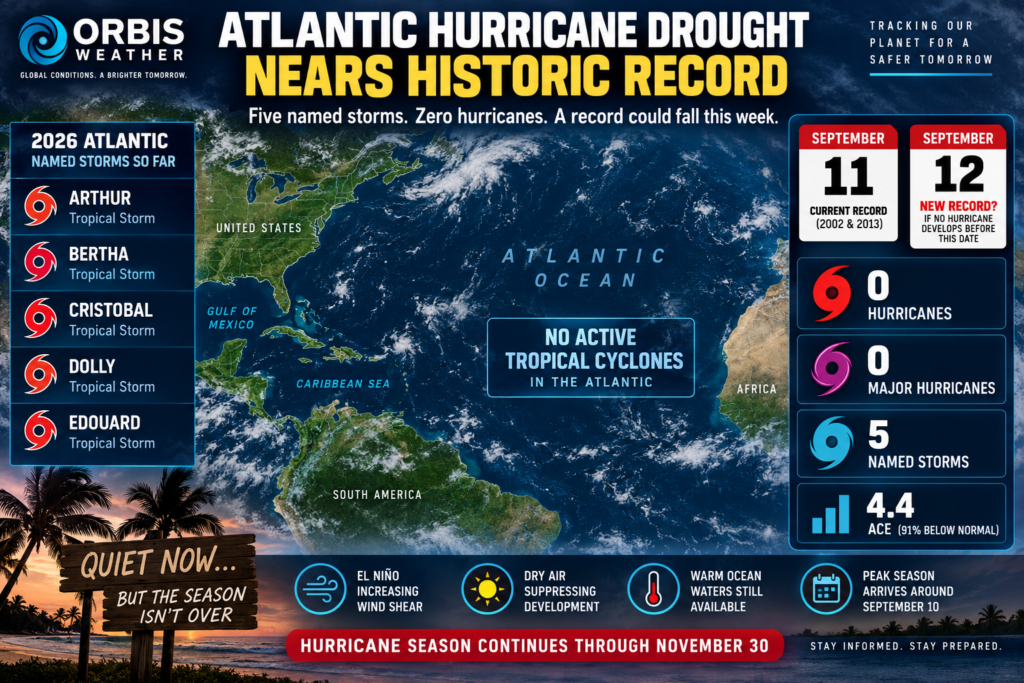
As of September 6, the Atlantic has produced five named storms — Arthur, Bertha, Cristobal, Dolly and Edouard — but not a single hurricane. The National Hurricane Center’s season summary shows the basin running two hurricanes and one major hurricane below the 1991–2020 normal to date.
Even more striking is the basin’s extremely low overall activity. Accumulated Cyclone Energy, or ACE, stands at just 4.4 units — about 91% below normal for this point in the season.
📅 A Record Could Fall This Week
The modern satellite-era record for the latest arrival of an Atlantic season’s first hurricane is September 11, reached in both 2002 and 2013.
If the Atlantic fails to produce a hurricane before September 12, the 2026 season would establish a new record for the latest first hurricane since routine satellite monitoring began in 1966.
That is remarkable considering the climatological peak of Atlantic hurricane season occurs around September 10.
Instead of watching a major hurricane churn across the tropical Atlantic, forecasters are currently looking at an unusually quiet basin.
As of Sunday morning, September 6, the National Hurricane Center reported no active tropical cyclones in the Atlantic.
🌀 Five Tropical Storms — Zero Hurricanes
The season hasn’t been completely inactive.
The Atlantic has produced:
Arthur — Tropical Storm
Bertha — Tropical Storm
Cristobal — Tropical Storm
Dolly — Tropical Storm
Edouard — Tropical Storm
Edouard became the fifth named storm when it developed in the Gulf of Mexico at the end of August. It made landfall near Johnson Bayou, Louisiana, on September 1 with maximum sustained winds around 60 mph, producing heavy rain, flooding concerns and power outages in parts of Louisiana and Texas.
But none of the five storms has crossed the 74 mph threshold required to become a hurricane.
🌊 Why Has the Atlantic Been So Quiet?
One of the biggest factors appears to be the strengthening El Niño in the tropical Pacific.
El Niño can increase upper-level winds across portions of the Atlantic, creating stronger vertical wind shear.
Wind shear is often destructive to developing tropical cyclones because it pushes thunderstorms away from a storm’s circulation and makes it difficult for the system to organize vertically.
Dry and sinking air across portions of the tropical Atlantic has also helped suppress development this season.
The contrast between the world’s two major hurricane basins has been dramatic.
While the Atlantic remains hurricane-free, the Pacific recently had multiple hurricanes active simultaneously, highlighting just how unusual the Atlantic’s lack of hurricanes has become.
⚠️ Don’t Assume Hurricane Season Is Over
The record-setting quiet period could easily create a false sense of security.
It shouldn’t.
Some historically destructive hurricane seasons have experienced long periods of inactivity before suddenly becoming extremely active.
2022 is an excellent example. That season didn’t produce its first hurricane until September. It subsequently generated four September hurricanes, including Fiona and Ian.
There is also plenty of warm ocean water available across portions of the western Atlantic and Gulf of Mexico.
With relatively few tropical cyclones churning up deeper, cooler water this summer, substantial ocean heat remains available. If atmospheric conditions become more favorable later in September or October, tropical activity could increase quickly.
🌡️ Late September and October Could Be Important
The traditional peak of hurricane season may be arriving quietly, but the season still has nearly three months remaining.
Atlantic hurricane season officially continues through November 30, and late-season storms frequently develop in the Caribbean Sea and Gulf of Mexico.
That makes the next several weeks particularly important for Florida, the Gulf Coast, the Caribbean and the southeastern United States.
Even if 2026 ultimately finishes well below normal, it only takes one hurricane making landfall to turn a quiet season into a disastrous one for a particular community.
🌀 Orbis Weather Outlook
Atlantic Status — September 6
🌊 Named Storms: 5
🌀 Hurricanes: 0
🔴 Major Hurricanes: 0
📊 ACE: 4.4 — approximately 91% below normal
📅 Modern record for latest first hurricane: September 11
⚠️ Potential new record: September 12, 2026
For now, the Atlantic remains remarkably calm.
But with the statistical peak of hurricane season arriving and plenty of warm water still available, the hurricane-free streak should be viewed as an unusual delay — not an all-clear for the remainder of the season.
Orbis Weather will continue monitoring the Atlantic, Caribbean Sea and Gulf of Mexico for any signs that the unusually quiet 2026 hurricane season is finally beginning to wake up.