
🌍 Africa Weather & Natural Hazards Today
By Paul Harrison | Founder & Publisher, Orbis Weather
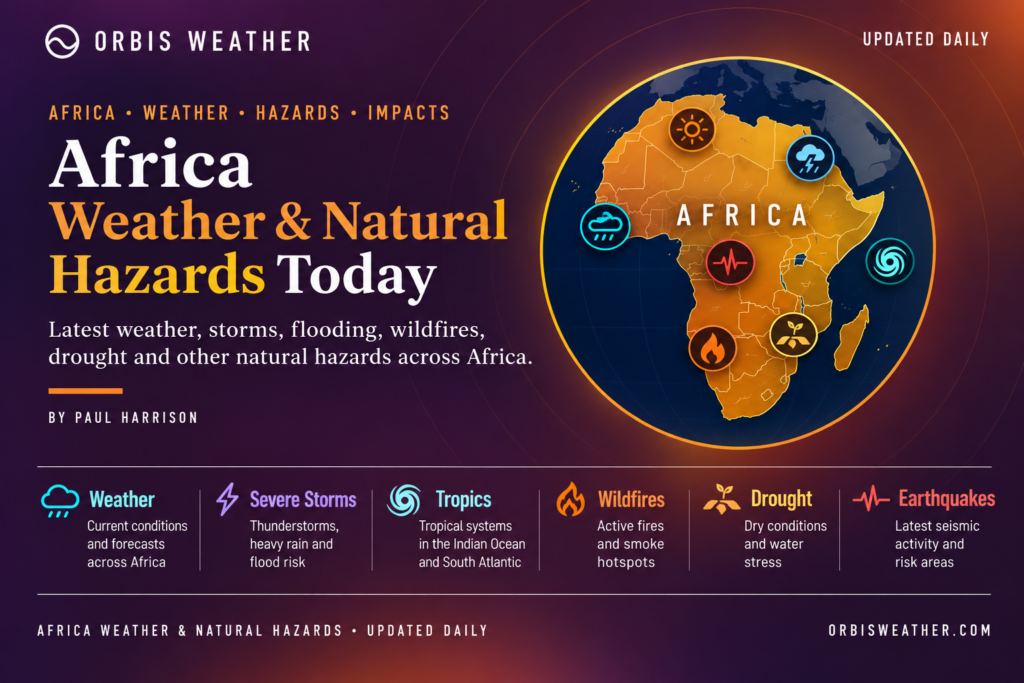





🌍 Africa Weather & Natural Hazards Today — Monday, November 9, 2026
By Paul Harrison | Orbis Weather
Published: Monday, November 9, 2026
Coverage: North Africa • West Africa • Central Africa • East Africa • Southern Africa • Madagascar • Southwest Indian Ocean
🌍 Africa Weather Overview: Flooding, Severe Thunderstorms, Heat and El Niño Concerns
Africa begins Monday, November 9, with sharply contrasting weather and natural hazards. Heavy rainfall threatens parts of Central and Southern Africa, flooding remains a concern in East Africa, and prolonged rainfall shortages are affecting communities in several regions.
The most significant weather concerns entering Monday include flooding potential in eastern South Africa and Eswatini, persistent heavy rainfall across parts of equatorial Central Africa, and a combination of heat and drought-related conditions across the Sahel and portions of East Africa.
The strengthening 2026–27 El Niño event adds another layer of uncertainty to Africa’s rainfall patterns. The World Meteorological Organization (WMO) has warned that the event could become very strong, raising the risk of extreme rainfall, drought and heat in different parts of the world.
Today’s main weather concerns:
🌧️ Southern Africa: Elevated flooding risk in eastern South Africa and Eswatini, with thunderstorms and localized heavy rainfall.
⛈️ Central Africa: Persistent rainfall and flooding concerns across southern Cameroon, Equatorial Guinea, the Republic of the Congo and eastern DR Congo.
🌊 East Africa: Seasonal flood potential in Kenya, Somalia and neighboring countries, alongside existing drought conditions in parts of Uganda and South Sudan.
☀️ West Africa: High temperatures across the Sahel and rainfall deficits in portions of the Gulf of Guinea region.
🏜️ North Africa: Seasonal temperature changes, desert dust and occasional Mediterranean weather systems.
🌀 Madagascar and the Southwest Indian Ocean: Early tropical cyclone season monitoring.
This report combines the latest available regional hazard assessment covering November 5–11 with seasonal outlooks. It distinguishes forecast risks from confirmed emergencies and does not imply that every location mentioned is under an active weather warning.
🚨 1. Africa Natural Hazards Summary — November 9
Region | Main concern | Assessment |
|---|---|---|
🇿🇦 Eastern South Africa | Heavy rain and flooding | Elevated forecast risk |
🇸🇿 Eswatini | Heavy rainfall and runoff | Elevated forecast risk |
🇨🇩 Eastern DR Congo | Persistent heavy rainfall | Elevated flood risk |
🇨🇲 Southern Cameroon | Heavy rainfall | Elevated flood risk |
🇨🇬 Republic of the Congo | Rainfall and flooding | Elevated flood risk |
🇬🇶 Equatorial Guinea | Persistent rainfall | Elevated flood risk |
🇰🇪 Kenya | Seasonal heavy rain | Flood monitoring |
🇸🇴 Somalia | Seasonal rainfall variability | Flood monitoring |
🇸🇸 South Sudan | Inundation and drought | Ongoing mixed hazards |
🇺🇬 Northern Uganda | Rainfall deficits | Drought concern |
🇬🇭 Southern Ghana | Rainfall shortages | Dryness concern |
🇱🇷 Liberia | Below-average rainfall | Dryness concern |
🌾 Sahel | High temperatures | Heat concern |
🇲🇬 Madagascar | Tropical season approaching | Seasonal monitoring |
Source: FEWS NET Global Weather Hazards Summary, November 5–11, 2026, supplemented by WMO seasonal climate guidance. These are regional assessments, not a list of newly issued national warnings.
⛈️ 2. Southern Africa — Heavy Rainfall and Flooding Threat
🇿🇦 South Africa: Eastern provinces face elevated flooding risk
Eastern South Africa remains one of the continent’s most important areas to monitor for potentially disruptive weather on Monday.
The November 5–11 regional hazards assessment identifies an increased flooding risk over eastern South Africa, associated with forecast heavy rainfall.
Areas to monitor include:
KwaZulu-Natal, particularly flood-prone river valleys and urban drainage systems.
Eastern Cape communities exposed to heavy downpours.
Mpumalanga and other eastern districts where thunderstorms may produce localized runoff.
The main potential impacts are flooded roads, rapidly rising streams, lightning and travel disruption. Where thunderstorms become particularly intense, strong gusts and localized hail may also occur.
The regional assessment establishes an elevated flooding threat but does not confirm that every province or district will experience severe weather on Monday.
🇸🇿 Eswatini: Heavy rainfall and rapid runoff
Eswatini is also included in the regional forecast for increased flooding risk.
Mountainous terrain can accelerate runoff during intense rainfall, making low-lying roads, river crossings and settlements particularly vulnerable.
Residents should monitor the Eswatini Meteorological Service and national disaster-management announcements for locally issued warnings.
🇲🇿 Mozambique, 🇿🇼 Zimbabwe, 🇿🇲 Zambia and 🇲🇼 Malawi
The developing Southern African rainy season is increasingly important for agriculture, water supplies and food security.
Rainfall distribution will be particularly important in Mozambique and Zimbabwe, where individual heavy-rain events can occur even during a season that ultimately produces below-average precipitation.
Across Zambia and Malawi, seasonal thunderstorms and changes in soil moisture will influence planting conditions, river levels and agricultural planning.
Southern Africa outlook: Flooding in eastern South Africa and Eswatini is the clearest documented short-term regional threat. Elsewhere, rainfall variability, thunderstorms and longer-term El Niño impacts warrant continued monitoring.
🌧️ 3. East Africa — Flooding Risks and Contrasting Drought Conditions
🇰🇪 Kenya: Short-rains season remains important
Kenya is in its October–December short-rains season, when thunderstorms and periods of heavy rainfall can affect large parts of the country.
Locations to monitor include Nairobi, the Lake Victoria Basin, western highland districts, northeastern Kenya and coastal communities.
Potential hazards include flash flooding, lightning, landslides in susceptible terrain and interruptions to transport.
However, a seasonal flood outlook does not mean that heavy rainfall is occurring everywhere in Kenya on November 9.
🇸🇴 Somalia: River flooding remains a concern
The Juba and Shabelle river systems remain important areas for flood preparedness.
Rainfall in upstream catchments, including parts of Ethiopia, can influence downstream river levels. Flooding can also develop away from the heaviest local rainfall when water moves through river networks.
Potential consequences include crop damage, contaminated drinking water and disruption to roads and settlements.
🇪🇹 Ethiopia: Different rainfall conditions across the country
Ethiopia’s mountainous geography produces substantial differences in rainfall, temperature and flood exposure.
Southern areas require monitoring during the regional rainy season, while highland communities can be vulnerable to landslides and rapid runoff following intense thunderstorms.
Localized forecasts should take priority over broad regional expectations.
🇺🇬 Uganda and 🇸🇸 South Sudan: Drought and flooding coexist
One of East Africa’s most important weather stories is the simultaneous presence of too much water in some areas and too little in others.
The November 5–11 FEWS NET assessment identifies continuing inundation in South Sudan’s Sudd wetlands. It also documents persistent rainfall deficits and deteriorating vegetation across southern and southeastern South Sudan and northern Uganda.
These accumulated dry conditions have contributed to drought concerns, even while other communities remain exposed to flooding.
🇹🇿 Tanzania, 🇷🇼 Rwanda and 🇧🇮 Burundi
The Great Lakes region remains vulnerable to localized thunderstorms, lightning and heavy downpours.
Steep terrain in Rwanda and Burundi can increase landslide exposure during prolonged or intense rainfall, while communities near Lake Victoria should monitor local marine and thunderstorm advisories.
East Africa outlook: Seasonal rainfall and flooding potential remain important, but the ongoing dryness affecting parts of Uganda and South Sudan must not be overlooked.
🌊 4. Central Africa — Persistent Heavy Rainfall and Flooding
Central Africa remains a major rainfall-monitoring region on Monday.
The November 5–11 regional hazards assessment identifies persistent heavy rainfall and elevated flooding risk across southern Cameroon, Equatorial Guinea, the Republic of the Congo and eastern Democratic Republic of the Congo.
🇨🇲 Cameroon and 🇬🇶 Equatorial Guinea
Heavy tropical rainfall can overwhelm urban drainage systems, flood low-lying neighborhoods and disrupt transport.
Southern Cameroon and Equatorial Guinea are particularly important areas for monitoring rainfall accumulation.
🇨🇬 Republic of the Congo
Persistent rainfall may increase runoff into streams and rivers, with potential consequences for communities in flood-prone areas.
Urban flooding can occur rapidly where drainage systems are inadequate or blocked.
🇨🇩 Democratic Republic of the Congo
Eastern DR Congo remains vulnerable to intense rainfall, flash flooding and landslides, particularly in steep or densely settled terrain.
Repeated rainfall can saturate soils, increasing slope instability and the possibility of landslides.
🇬🇦 Gabon and neighboring equatorial areas
Gabon and nearby equatorial regions experience substantial tropical rainfall at this time of year.
Localized flooding remains a general seasonal hazard, although the available regional assessment does not establish a specific new emergency in Gabon for November 9.
Central Africa outlook: Persistent rainfall and flooding are among the continent’s leading documented hazards this week, especially in the southern Cameroon–Equatorial Guinea–Congo corridor and eastern DR Congo.
☀️ 5. West Africa — Sahel Heat and Rainfall Deficits
🇳🇬 Nigeria: Seasonal transition underway
Nigeria is progressing toward its dry-season weather pattern, although conditions vary considerably between the humid south and the more arid north.
Northern Nigeria typically experiences increasing dryness during November, while southern coastal and inland regions can still experience showers and thunderstorms.
Heat exposure, dust and reduced visibility may become increasingly important as the dry season develops.
🇬🇭 Ghana, 🇨🇮 Côte d’Ivoire and 🇱🇷 Liberia
Rainfall deficits are a notable concern in parts of the Gulf of Guinea region.
The November 5–11 FEWS NET assessment identifies persistent below-average rainfall affecting central and eastern Liberia, southern Côte d’Ivoire and southern Ghana.
Further below-average rainfall is expected in the assessment period, potentially increasing pressure on agriculture, vegetation and water resources.
🌾 Mali, Niger, Chad and Burkina Faso
Hot conditions remain a concern across substantial parts of the Sahel.
The regional hazards assessment identifies elevated temperatures across a broad area of the Sahel, where daytime heat can place additional stress on people working outdoors and communities with limited access to cooling or reliable water supplies.
Dry vegetation and strong winds can also increase the potential for rapidly spreading fires, although this does not constitute confirmation of an active wildfire.
West Africa outlook: Heat and accumulated rainfall shortages are the principal documented concerns. The gradual seasonal transition toward drier conditions will remain important over the coming weeks.
🏜️ 6. North Africa — Autumn Weather, Desert Dust and Coastal Rainfall
🇲🇦 Morocco and 🇩🇿 Algeria
November brings a transition toward cooler and potentially wetter weather along parts of North Africa’s Mediterranean and Atlantic-facing coastlines.
Weather systems moving across the Mediterranean can occasionally produce significant rainfall, particularly near mountainous terrain.
The Atlas Mountains can experience substantially cooler conditions than surrounding lowlands, with snow possible at higher elevations during sufficiently cold weather systems.
🇹🇳 Tunisia and 🇱🇾 Libya
Mediterranean weather systems remain important during autumn.
Heavy rainfall can occasionally produce rapid flooding in normally dry channels and urban areas, especially where drainage infrastructure is limited.
However, no specific November 9 flash-flood warning for these countries has been independently confirmed in the sources reviewed.
🇪🇬 Egypt
Egypt continues its seasonal transition toward cooler winter conditions.
Desert dust, wind-driven reductions in visibility and occasional coastal rainfall remain hazards to monitor.
Northern coastal areas and the Nile Delta generally have different weather conditions from the much hotter and drier interior.
North Africa outlook: Seasonal weather changes, desert dust and occasional Mediterranean rainfall remain the primary monitoring priorities. No continent-wide North African emergency is established by the available information.
🌀 7. Madagascar and the Southwest Indian Ocean — Tropical Cyclone Season Monitoring
🇲🇬 Madagascar
November marks the beginning of the main Southwest Indian Ocean tropical cyclone season, which generally runs from November through April.
Madagascar is particularly vulnerable to tropical cyclones because of its exposure to storms developing over the warm waters of the Indian Ocean.
Potential hazards during the season include destructive winds, torrential rainfall, coastal flooding and landslides.
🇲🇺 Mauritius, 🇷🇪 Réunion and 🇾🇹 Mayotte
The Mascarene Islands and surrounding territories should continue routine tropical weather monitoring as the season develops.
Even systems that remain offshore can sometimes produce hazardous surf, strong swells and dangerous marine conditions.
🇲🇿 Mozambique Channel
The Mozambique Channel is another important tropical cyclone monitoring area.
Storms developing or passing through this region can threaten western Madagascar and the Mozambique coastline.
Tropical cyclone status for November 9: The available sources do not establish a verified active named tropical cyclone or an official landfall warning. This is not confirmation that the basin is storm-free.
For current storm classifications, tracks and warnings, consult the official Météo-France La Réunion tropical cyclone forecasting service.
🌡️ 8. Africa Temperature and Heat Outlook
Africa’s temperature patterns vary considerably across the continent in November.
Region | General temperature pattern | Main concern |
|---|---|---|
Sahara | Warm days, cooler nights | Dust and exposure |
Sahel | Hot and increasingly dry | Heat stress |
Equatorial Central Africa | Warm and humid | Heat and heavy rain |
East African Highlands | Cooler at elevation | Rainfall and landslides |
Southern Africa | Spring warming | Heat and thunderstorms |
Madagascar | Warm tropical conditions | Rainfall and humidity |
These are seasonal characteristics, not measured November 9 temperatures.
The FEWS NET assessment specifically identifies hot conditions across much of the Sahel, western East Africa and west-central Southern Africa during November 5–11.
Why temperature monitoring matters
Extreme heat can increase dehydration risk, reduce outdoor working capacity, affect livestock and increase demand for electricity and water.
The combination of heat and rainfall deficits can also worsen agricultural stress, particularly where communities depend on rain-fed farming.
🌍 9. El Niño 2026–27 — Why Africa Is Watching Closely
One of the most important developments influencing Africa’s longer-term weather outlook is the strengthening El Niño event.
The WMO reported in September that El Niño was firmly established and could become very strong in the months ahead, increasing the potential for extreme weather worldwide.
El Niño changes tropical Pacific Ocean temperatures and atmospheric circulation. These changes can influence rainfall patterns thousands of miles away, including in Africa.
Potential consequences for Africa
Eastern Africa: Some areas may experience increased seasonal rainfall and flooding potential, although the response varies by location and season.
Southern Africa: Certain areas may face increased chances of below-average seasonal rainfall, affecting agriculture and water supplies.
Agriculture: Unreliable rainfall timing can complicate planting and harvesting.
Water security: Both prolonged dryness and flooding can affect drinking-water availability.
Food security: Extreme weather can damage crops, disrupt transportation and increase pressure on vulnerable households.
El Niño does not guarantee a particular weather outcome in every country. Local geography, ocean conditions and shorter-term weather systems remain important.
The Famine Early Warning Systems Network continues to monitor the 2026–27 El Niño event and its implications for food security.
🌋 10. Africa Earthquake and Volcanic Hazards
Weather is only one component of Africa’s natural hazard environment.
🌋 East African Rift System
The East African Rift is one of the world’s major tectonically active regions.
Earthquakes and volcanic activity occur along portions of the rift, which extends through several countries in eastern Africa.
Important volcanic monitoring areas include:
🇨🇩 DR Congo — Nyiragongo and Nyamuragira.
🇪🇹 Ethiopia — Afar Depression and associated volcanic systems.
🇹🇿 Tanzania — Ol Doinyo Lengai.
These are established geological hazard areas, not confirmation of new eruptions on November 9.
🌍 Earthquake monitoring
Earthquakes can occur without warning and may cause damage through ground shaking, landslides or infrastructure failure.
No specific major African earthquake on November 9 has been verified for this report.
For the latest recorded seismic events, consult the USGS Earthquake Map.
For volcano information, consult the Smithsonian Global Volcanism Program.
📅 11. Africa Weather Outlook — November 9–11, 2026
Date | Weather and hazard priorities |
|---|---|
Monday, Nov. 9 | Monitor heavy rainfall and flooding potential in eastern South Africa, Eswatini and equatorial Central Africa. |
Tuesday, Nov. 10 | Continue flood monitoring in Central and Southern Africa, alongside East African rainfall and drought conditions. |
Wednesday, Nov. 11 | Review accumulated rainfall, river conditions, Sahel heat and evolving Southern African seasonal rainfall patterns. |
The outlook is based on the November 5–11 FEWS NET regional hazards assessment. It describes monitoring priorities rather than independently verified day-by-day local forecasts.
🛡️ 12. Weather and Natural Hazard Safety Advice
🌊 Flooding: Never drive through flooded roads or attempt to cross fast-moving water. Floodwater can conceal damaged pavement and dangerous currents.
⚡ Thunderstorms: Seek shelter inside a substantial building when thunder is heard. Avoid exposed fields, isolated trees and open water.
☀️ Extreme heat: Drink water regularly, limit strenuous activity during the hottest hours and check on vulnerable people.
🏜️ Dust storms: Reduce unnecessary travel when visibility deteriorates. People with respiratory sensitivities should minimize exposure to airborne dust.
🌋 Earthquakes: Drop, cover and hold on during shaking. Stay away from windows and unstable structures.
🌀 Tropical cyclones: Follow official meteorological warnings and prepare for potential disruptions to electricity, communications and transportation.
🔎 13. What Orbis Weather Is Monitoring Next
The most important developments to watch over the next 24–72 hours are the evolution of heavy rainfall in eastern South Africa and Eswatini, flood conditions across equatorial Central Africa, and the contrasting rainfall patterns affecting East Africa.
Rainfall deficits in northern Uganda, South Sudan and portions of West Africa will also remain important, especially for agriculture and food security.
Meanwhile, the developing Southern African rainy season and the strengthening El Niño event will influence longer-term weather monitoring across the continent.
The Southwest Indian Ocean tropical cyclone season is also entering a period when daily monitoring becomes increasingly important.
📰 14. Africa Weather Summary — November 9, 2026
Africa begins Monday with flooding and heavy rainfall among its leading weather threats, while other regions face heat, rainfall shortages and drought-related stress.
Eastern South Africa and Eswatini remain important areas for flood preparedness. Central Africa faces persistent heavy rainfall, especially around southern Cameroon, Equatorial Guinea, the Republic of the Congo and eastern DR Congo.
East Africa continues to experience contrasting conditions, with seasonal flooding potential in some areas and established drought concerns in others.
Across West Africa, hot conditions in the Sahel and rainfall deficits along parts of the Gulf of Guinea remain significant concerns.
The strengthening El Niño event adds uncertainty to rainfall and agricultural conditions as the continent moves further into November.
Orbis Weather will continue monitoring Africa’s changing weather patterns, tropical systems, earthquakes, volcanic activity and other natural hazards.
About the Author
Paul Harrison — Founder & Publisher, Orbis Weather
Paul Harrison founded Orbis Weather in 2026 to make global weather and natural-hazard information easier to find, follow and understand. His coverage includes tropical cyclones, severe weather, extreme temperatures, earthquakes, volcanoes, wildfires, flooding and significant natural disasters worldwide.
View all articles by Paul Harrison → | Editorial Standards →
Global Weather Tracker Hub
Explore weather maps, tropical systems, storms and natural hazards around the world.
No matching trackers found.