
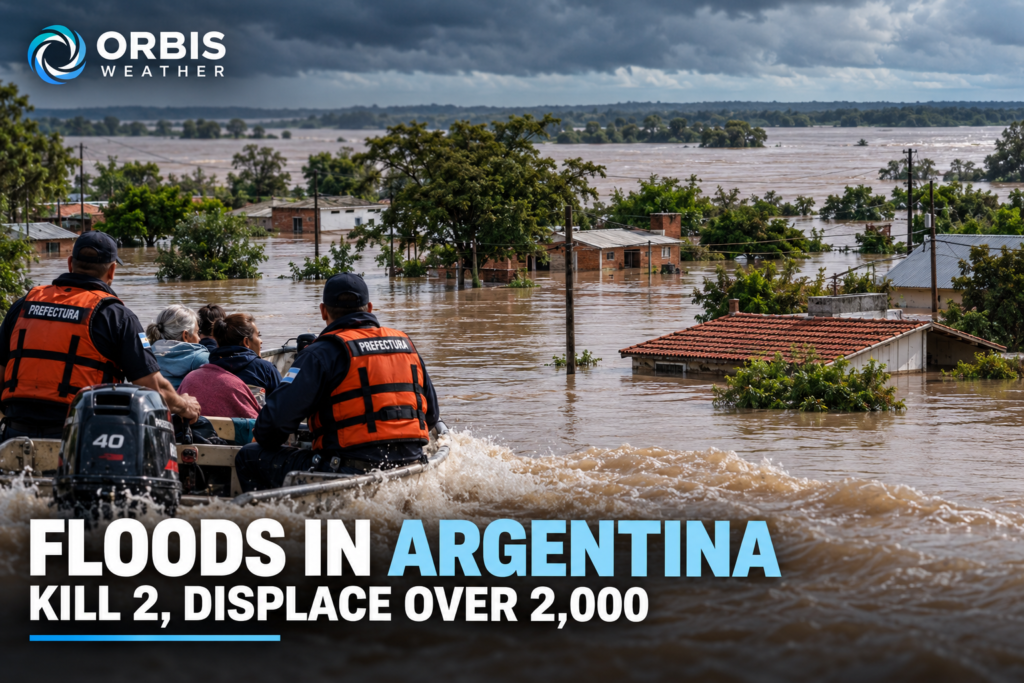





Deadly Floods in Argentina Kills 2, Force More Than 2,000 From Their Homes as Rivers Continue to Rise
ORBIS WEATHER | GLOBAL NATURAL DISASTERS
By Paul Harrison | Orbis Weather
Saturday, October 24, 2026
Severe flooding across northeastern Argentina has claimed two lives and displaced more than 2,000 residents, with authorities warning that rising rivers and additional rainfall could prolong the emergency for months.
Thousands Evacuated as Floodwaters Swallow Communities
Northeastern Argentina is facing a serious flooding emergency after weeks of heavy rainfall sent major rivers surging beyond their banks, inundating neighborhoods, damaging homes and forcing thousands of residents to seek safer ground.
The disaster has particularly affected the provinces of Chaco, Corrientes and Misiones, where communities along the Paraná, Uruguay and Iguazú rivers are struggling with rapidly changing water levels.
According to reports published October 23–24, at least two people have died and more than 2,000 residents have been evacuated or forced to abandon their homes.
Two Workers Die While Attempting to Save Livestock
The two fatalities occurred in Corrientes Province, where rural workers drowned while attempting to move cattle between islands threatened by rising floodwaters.
The men were reportedly swept away by powerful currents while working to protect livestock.
Police and Argentine Naval Prefecture personnel conducted a search operation before their bodies were recovered.
The tragedy highlights the dangers posed by swollen rivers, particularly in agricultural communities where residents depend on boats, horses and low-lying crossings.
Chaco and Corrientes Among the Hardest-Hit Areas
REPORTED IMPACT | OCTOBER 24, 2026
2
Deaths
2,000+
Displaced
100+
Homes damaged in Misiones
In Chaco Province, approximately 1,200 to 1,300 people have evacuated or left their homes voluntarily, particularly around Puerto Vilelas and Barranqueras.
Neighboring Corrientes has reported more than 1,000 displaced residents.
In Paso de la Patria, a tourist destination along the Paraná River, floodwaters overwhelmed a protective embankment, allowing water to rush into residential neighborhoods.
Some homes have been submerged almost to their rooftops, while residents who remain face difficult living conditions.
In Misiones Province, storms on October 22 and 23 damaged more than 100 homes and forced road and bridge closures.
Iguazú Falls Experiences Extraordinary River Flow
The flooding has also affected one of South America’s most famous natural attractions: Iguazú Falls.
During mid-October, the Iguazú River’s flow reportedly reached approximately ten times its seasonal average.
The enormous volume of water has affected tourism operations, although several visitor circuits have reopened.
Access to the famous Devil’s Throat section remains closed, according to the latest reports.
El Niño Contributing to Extreme Rainfall
The flooding is occurring during an intensifying El Niño climate pattern.
El Niño develops when ocean surface temperatures across the central and eastern equatorial Pacific become unusually warm, altering atmospheric circulation and rainfall patterns around the world.
Across parts of southeastern South America, El Niño can increase the likelihood of unusually heavy rainfall and river flooding.
However, individual flood events are also influenced by local rainfall intensity, soil saturation, river basin conditions and flood defenses.
Recent heavy rainfall across the upper Paraná, Uruguay and Iguazú watersheds has contributed to the current emergency.
Authorities Warn Flooding Could Continue for Months
Officials are concerned that the flooding may not be a short-lived event.
Chaco’s provincial Civil Protection deputy secretary, Gustavo Santos, warned that river levels could continue fluctuating for several months.
Additional rainfall forecast across the upper Paraná and Uruguay river basins could send another surge of water downstream during the coming week.
This means some communities could face repeated flooding even after initial waters begin to recede.
What Happens Next?
The immediate concerns are continued river rises, additional evacuations and damage to homes, roads and agricultural land.
Authorities and residents will need to monitor rainfall upstream as well as local river levels. In major river systems such as the Paraná, flooding can continue downstream long after the heaviest rainfall has ended.
Residents in affected areas should follow local Civil Defense instructions, avoid flooded roads and never attempt to cross fast-moving water.
Orbis Weather Outlook
The flooding in Argentina is another example of how extreme rainfall and rising rivers can create prolonged humanitarian emergencies.
With more than 2,000 people displaced, two confirmed fatalities and additional rainfall threatening already saturated watersheds, northeastern Argentina remains vulnerable to further flooding.
Orbis Weather will continue following developments across Argentina and the wider South American region.