
Singapore Haze & Air Quality Tracker
By Paul Harrison | Founder & Publisher, Orbis Weather

No news articles published today yet.





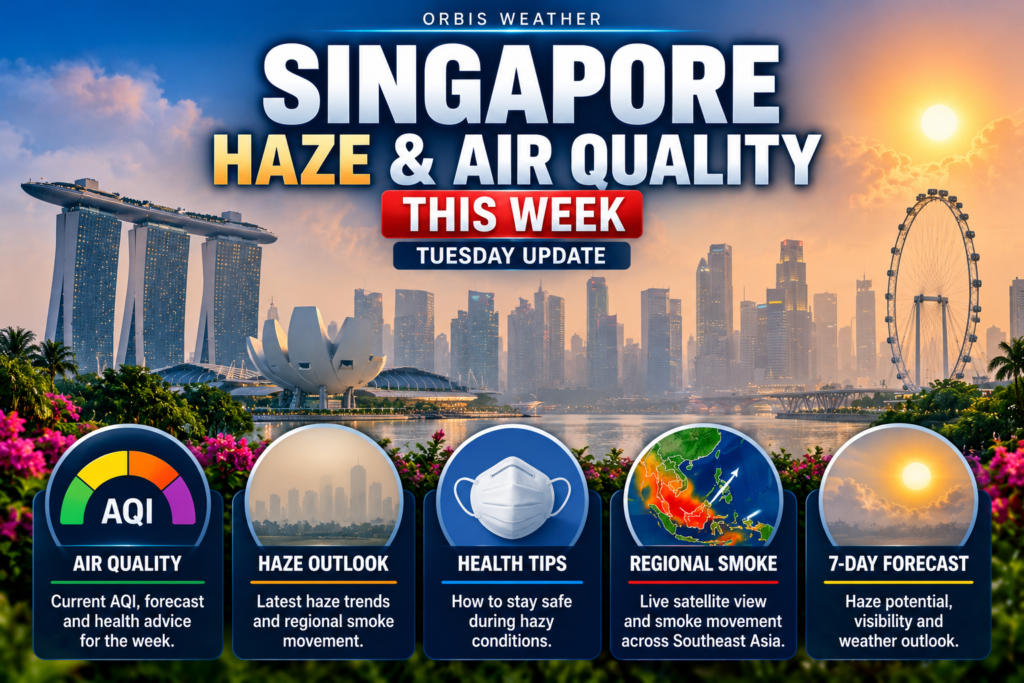
Singapore Haze & Air Quality This Week: Tuesday, October 27, 2026
By Paul Harrison, Orbis Weather
At a glance
Singapore’s haze eased to the Moderate range by Monday after a second Unhealthy spell from Friday to Sunday, and showers are expected to keep smoke away this week.
Current to 7:10am SGT (UTC+8) Tuesday, October 27, 2026, which is 7:10pm US Eastern (EDT) Monday, October 26. Latest NEA readings: 6pm SGT Monday, October 26. NEA’s Tuesday update had not been issued.
- Latest readings: the 24-hour PSI was 67–74 (Moderate) and the 1-hour PM2.5 was 28–40 µg/m³ (Band 1, Normal) at 6pm Monday.
- The past week: the 24-hour PSI was Unhealthy (above 100) somewhere on the island in five of seven evening updates. It peaked at 151 on Saturday, October 24.
- Cause: smoke from fires in Kalimantan and then Sumatra, carried by southeasterly and southerly winds. NEA said on Monday the smoke was “confined over Kalimantan”.
- Outlook: NEA forecasts a 24-hour PSI of 60–90 (Moderate) for Tuesday. MSS expects afternoon thundery showers from Tuesday to Friday.
- Johor and measures: Johor reopened schools in phases from October 26 after a third week of closures. Singapore’s Haze Subsidy Scheme, in place since October 12, has no announced end date.
The National Environment Agency (NEA) and the Meteorological Service Singapore (MSS) issue Singapore’s official air quality readings, forecasts and health advisories.
Latest readings
Air quality was in the Moderate range across Singapore on Monday, down from Unhealthy levels in every region on Saturday.
Region | 24-hr PSI, Sat Oct 24, 7am | 24-hr PSI, Mon Oct 26, morning |
|---|---|---|
North | 115 | 68 |
South | 115 | not reported |
East | 117 | not reported |
West | 142 | 74 |
Central | 133 | not reported |
Island-wide | 115–142 | 69–76 at 7am; 67–74 at 6pm (NEA) |
Saturday figures are from Yahoo News Singapore. Monday morning regional figures are from AsiaOne (no time given) and the 7am range from The Star, citing The Straits Times. The 6pm range is NEA’s.
The 1-hour PM2.5 was 28–40 µg/m³ at 6pm Monday, in Band 1 (Normal, 0–55 µg/m³), according to NEA.
The 24-hour PSI averages pollution over the past day and guides planning for the next day. The 1-hour PM2.5 reading shows current fine-particle levels and guides activities over the next hour.
The past week
The haze came in two waves, with the worst air on Saturday, before showers and a wind change cleared it by Monday.
Southeasterly winds carried smoke from Kalimantan early in the week, according to NEA. Air briefly improved on Thursday as northeasterly and easterly winds kept smoke south of Singapore. Smoke from Sumatra then drifted in on Friday and Saturday. Westerly winds and showers from Sunday limited it. The week stayed below the season high: the 24-hour PSI reached 230 in the West at 10am on October 18, The Star reported, citing The Straits Times.
Forecast and outlook
MSS expects thundery showers every day from Tuesday to Friday, with light winds that are not forecast to bring smoke.
MSS four-day outlook, issued 5:15am SGT Monday, October 26:
Day | Forecast | Temperature | Wind |
|---|---|---|---|
Tue Oct 27 | Afternoon thundery showers | 24–34°C (75–93°F) | Variable, 5–15 km/h (3–9 mph) |
Wed Oct 28 | Afternoon thundery showers | 24–34°C (75–93°F) | Variable, 5–15 km/h (3–9 mph) |
Thu Oct 29 | Late morning and early afternoon thundery showers | 24–33°C (75–91°F) | Southeast, 5–15 km/h (3–9 mph) |
Fri Oct 30 | Late morning and early afternoon thundery showers | 25–34°C (77–93°F) | South-southeast, 5–15 km/h (3–9 mph) |
NEA forecasts a 24-hour PSI of 60–90 (Moderate) for Tuesday. It expects northeasterly or southeasterly winds with showers, so smoke haze is unlikely to affect Singapore. Winds should turn variable, with showers, on Wednesday and Thursday.
The MSS fortnightly outlook for October 16 to November 1 expects below-average rainfall over most of the island, with daily highs of 33–35°C (91–95°F) on most days. ASMC’s subseasonal outlook for October 26 to November 8 predicts drier than usual conditions over much of the southern and eastern Maritime Continent. The official day-by-day forecast does not extend beyond Friday.
Where the smoke comes from
Hotspot counts in Indonesia fell sharply at the end of the week, but fires continue in Central Kalimantan and South Sumatra.
Source | What it counts | Latest figure | Date |
|---|---|---|---|
Ministry of Forestry (SiPongi) | High-confidence hotspots, all Indonesia | 317, down from 1,336 a day earlier; South Sumatra 102, Central Kalimantan 60 | Oct 24, 9pm WIB |
BMKG Pekanbaru station | Hotspots in Sumatra (confidence not stated) | 441, down from 2,084; South Sumatra 336 | Oct 26 |
BMKG weekly outlook | High-confidence hotspots over the previous 10 days | Central Kalimantan 3,794; South Sumatra 1,595 | Issued Oct 22 |
GoodStats, citing SiPongi | Hotspots, all Indonesia (confidence not stated) | 4,361 | As of Oct 25 |
Counts from different sources use different methods and are not comparable.
ASMC’s Alert Level 3 for the southern ASEAN region, activated on August 26, remains in force. Central Kalimantan reported 20,385 hectares burned as of October 25, according to Antara. The Ministry of Forestry said on October 25 that 49 aircraft were on standby, including 32 for water bombing. It said the drop in hotspots was not yet a reason to ease operations. BMKG’s head said rain was possible in Central Kalimantan from October 26 and in South Sumatra from October 27, each for five days.
Health advice and measures in place
With the 24-hour PSI in the Moderate range, NEA advises everyone to continue normal activities.
Group | Good to Moderate (PSI 0–100) | If the PSI returns to Unhealthy (101–200) |
|---|---|---|
Healthy persons | Continue normal activities | Reduce prolonged or strenuous outdoor physical exertion |
Elderly, pregnant women and children | Continue normal activities | Minimise prolonged or strenuous outdoor physical exertion |
Persons with chronic lung or heart disease | Continue normal activities | Avoid prolonged or strenuous outdoor physical exertion |
NEA advises checking the 1-hour PM2.5 for immediate plans. In Band 2 (Elevated, 56–150 µg/m³), healthy persons should reduce, and vulnerable persons avoid, strenuous outdoor activity for the next hour.
- Haze Subsidy Scheme: since October 12, eligible Singapore Citizens pay at most $10 (less for some groups) at Public Health Preparedness Clinics and polyclinics for haze-related conditions. MOH has announced no end date.
- Schools: MOE would consider closing schools if the next-day 24-hour PSI forecast is above 300, with a decision around 8pm the day before.
- Workplaces: MOM’s guidance, updated October 21, asks employers to reduce strenuous outdoor work and provide fit-tested masks where it cannot be avoided. Above a PSI of 300, outdoor work should be minimised.
- Flights: Firefly planned to resume its full Subang–Seletar schedule from October 22 after haze cancellations, The Star reported.
Johor and the region
Johor’s air improved to below the Unhealthy level by Monday, while the remaining Unhealthy readings in Malaysia were in Sarawak.
Malaysian Air Pollutant Index (API) readings from the Department of Environment:
Station | Sat Oct 24, 4pm | Latest reported |
|---|---|---|
Batu Pahat, Johor | 166 | Not Unhealthy, Mon Oct 26, 7am |
Larkin, Johor | 165 | Not Unhealthy, Mon Oct 26, 7am |
Pasir Gudang, Johor | 161 | 152, Sun Oct 25, 6pm |
Kota Tinggi, Johor | 151 | Not Unhealthy, Mon Oct 26, 7am |
Seremban, Negeri Sembilan | 172 | Not listed as Unhealthy, Mon Oct 26, 5pm |
Serian, Sarawak | not reported | 156, Mon Oct 26, 5pm |
Saturday figures are from Malay Mail, Sunday’s from The Edge, and Monday’s from Business Today and The Star.
Johor closed its schools from October 19 to 23, the third closure this month. Only students sitting exams attended on October 26 and 27, with all schools due to operate fully from October 28, subject to API readings. Singapore served preventive measure notices on 10 Indonesian firms on October 16 and 19, including three linked to Kalimantan fires. Malaysia said it would raise the haze at the ASEAN Foreign Ministers’ Meeting in Manila in early November.
What to watch this week
Rain at the fire areas and a change of monsoon are the main factors to watch.
Date | What happens | Source |
|---|---|---|
Tue Oct 27 | Northeast monsoon expected to begin in Malaysia, lasting until March 2027 | MetMalaysia |
Tue Oct 27 to Sat Oct 31 | High rain potential over South Sumatra | BMKG |
Wed Oct 28 | All Johor schools due to operate fully, subject to API readings | Johor state government |
Wed Oct 28 to Thu Oct 29 | Variable winds with showers over Singapore | NEA |
Early November | ASEAN Foreign Ministers’ Meeting in Manila, where Malaysia plans to raise the haze | Malay Mail |
NEA said wet conditions should keep hotspot and smoke haze activity suppressed. ASMC still expects drier than usual weather to November 8, and BMKG says El Niño has delayed Indonesia’s rainy season by about 20 to 30 days.
About this report
This weekly report covers Tuesday to Monday and looks ahead to the following Monday. Times are SGT (UTC+8) unless marked WIB (UTC+7, western Indonesia). Readings change through the day, so check NEA for the latest figures before making plans.
- PSI (Pollutant Standards Index): Singapore’s air quality index. 0–100 is Good to Moderate, 101–200 Unhealthy, 201–300 Very Unhealthy.
- PM2.5: fine particles 2.5 micrometres across or smaller, measured in µg/m³.
- API (Air Pollutant Index): Malaysia’s air quality index.
- Hotspot: a satellite-detected area of high surface temperature that may be a fire.
- ASMC: the ASEAN Specialised Meteorological Centre in Singapore, which monitors regional haze.
Frequently asked questions
Is the haze over? Readings were back in the Moderate range on Monday, and NEA expects Moderate air on Tuesday. ASMC’s Alert Level 3 remains in force, and fires are still burning in Kalimantan and Sumatra.
Is it safe to exercise outdoors? NEA advises everyone to continue normal activities while the 24-hour PSI is Moderate. Check the 1-hour PM2.5 before strenuous activity.
Why did the haze return on Friday and Saturday? NEA said smoke from Sumatra drifted towards Singapore on southerly winds. Southwesterly and westerly winds with showers then limited the smoke from Sunday.
Is the Haze Subsidy Scheme still available? Yes. It began on October 12 at Public Health Preparedness Clinics and polyclinics, and MOH has not announced an end date.
When will the rain return to Indonesia? BMKG expects rain potential this week in Central Kalimantan and South Sumatra. It says the rainy season is delayed by about 20 to 30 days, with some areas starting in November or December.
Sources
Singapore readings and advisories (NEA)
- NEA haze situation updates, evenings of Oct 20, Oct 21, Oct 22, Oct 23, Oct 24, Oct 25 and Oct 26, 2026
- Yahoo News Singapore: regional PSI, Oct 24, 7am
- AsiaOne: haze situation improves, Oct 26, 9:47am
- AsiaOne: haze situation, Oct 26, 6:47pm
- The Star / The Straits Times: Normal PM2.5 readings, Oct 26, 12:14pm
Forecasts and outlooks
- MSS four-day outlook, issued Oct 26, 5:15am
- MSS fortnightly outlook, Oct 16 to Nov 1, 2026
- ASMC subseasonal outlooks (Oct 26 to Nov 8 summary)
- MetMalaysia: northeast monsoon statement, Oct 23, 2026 (PDF)
- IDN Times: BMKG head on rain and cloud seeding, Oct 26
Fires and hotspots
- ASMC alerts
- Ministry of Forestry: hotspots down 1,019, Oct 25
- BMKG weekly outlook, Oct 23–29, issued Oct 22
- Riaunews: Sumatra hotspots fall to 441, Oct 26
- GoodStats: hotspots by province, Oct 26
- Antara: Central Kalimantan fire response, Oct 26
Health advice and measures
- MOH: Haze Subsidy Scheme from Oct 12, published Oct 11
- Mothership: MOE school closure threshold, Oct 10
- MOM haze guidance, updated Oct 21
- The Star: Firefly to resume Subang–Seletar flights, Oct 20
Malaysia and diplomacy
- Malay Mail: API readings, Oct 24, 4pm
- The Edge: API readings, Oct 25, 6pm
- Business Today: API readings, Oct 26, 7am
- The Star: API readings, Oct 26, 5pm
- The Star: Johor schools to reopen, Oct 24
- Media Digital Johor: phased school reopening, Oct 25
- Eco-Business: notices to 10 Indonesian firms, Oct 19
- Malay Mail: Malaysia to raise haze at ASEAN meeting, Oct 22
Air Quality Scale — U.S. AQI
Pollutant Snapshot
Official Singapore Reporting Regions
Haze Context
Official & Related Sources
Global Weather Tracker Hub
Explore weather maps, tropical systems, storms and natural hazards around the world.
No matching trackers found.
Singapore Haze & Air Quality Tracker – Live PM2.5 & AQI
Monitor haze, fine-particle pollution and air-quality conditions across Singapore with the Orbis Weather Singapore Haze & Air Quality Tracker.
The dashboard provides a quick view of PM2.5, PM10 and other atmospheric pollutants while helping visitors understand whether regional smoke and haze may be affecting Singapore.
Air quality can change significantly depending on local pollution, rainfall, wind direction and regional fire activity. During transboundary haze episodes, smoke from vegetation and peat fires elsewhere in Southeast Asia can travel hundreds of kilometres and affect air quality across Singapore and neighbouring countries.
The Orbis Weather tracker is designed for situational awareness. For Singapore’s official Pollutant Standards Index (PSI), 1-hour PM2.5 readings and public-health guidance, always follow Singapore’s National Environment Agency.
🌫️ What Causes Haze in Singapore?
Singapore can experience haze when fine particles and smoke accumulate in the atmosphere.
Local pollution sources can contribute to air-quality changes, but some of Singapore’s most significant haze episodes have been associated with smoke transported from fires elsewhere in Southeast Asia.
Vegetation and peat fires can release enormous quantities of smoke containing fine particulate matter.
When regional winds transport that smoke toward Singapore, visibility may decrease and concentrations of PM2.5 can increase.
The severity of any haze episode depends on several factors, including the number and intensity of fires, wind direction, atmospheric stability and rainfall.
🔥 What Is Transboundary Haze?
Transboundary haze is air pollution that crosses national borders.
In Southeast Asia, the term is commonly associated with smoke from large vegetation and peat fires that is carried into neighbouring countries.
Singapore’s air quality can therefore be influenced by events occurring far beyond the country’s borders.
A fire does not have to be close to Singapore to affect the atmosphere over the island. If winds and atmospheric conditions are favorable for long-range smoke transport, pollution can travel considerable distances.
This is why understanding haze requires looking at both Singapore’s air-quality observations and the broader weather and fire situation across Southeast Asia.
🇮🇩 Why Indonesian Fires Matter to Singapore
Indonesia contains large areas of tropical forest and peatland.
During dry conditions, vegetation and peat fires can produce substantial smoke.
Peat fires are particularly important because they can burn beneath the surface and may be difficult to extinguish.
When prevailing winds carry smoke from affected parts of Sumatra or other areas toward Singapore and Peninsular Malaysia, regional air quality can deteriorate.
However, the presence of fires in Indonesia does not automatically mean Singapore will experience haze.
Wind direction and weather conditions determine where smoke travels.
🌧️ How Rain Affects Haze
Rain can temporarily improve air quality by removing some airborne particles from the atmosphere.
Heavy tropical showers and thunderstorms may therefore produce noticeable short-term improvements during polluted periods.
However, rainfall over Singapore does not necessarily stop the regional source of a haze event.
If fires continue burning and winds continue transporting smoke toward Singapore, pollution can return after the rain ends.
Rainfall over fire-affected areas can be more important because persistent rain may help suppress vegetation and peat fires.
💨 Why Wind Direction Matters
Wind is one of the most important factors determining whether regional smoke reaches Singapore.
A large number of fires may be burning somewhere in Southeast Asia while Singapore continues to experience relatively clean air because the smoke is being transported in another direction.
A change in regional winds can alter that situation.
This is why haze monitoring should consider air quality together with weather patterns, regional fire activity and smoke transport.
🧭 The Southwest Monsoon and Haze
Singapore’s Southwest Monsoon generally occurs during the middle portion of the year.
During some periods, regional wind patterns can transport smoke from fires in parts of Indonesia toward Singapore and Malaysia.
Dry weather across fire-prone areas can increase the possibility of vegetation and peat fires.
However, every Southwest Monsoon season is different.
Rainfall patterns, fire activity and wind direction determine whether significant transboundary haze develops.
🌬️ What Is PM2.5?
PM2.5 refers to airborne particles with diameters of approximately 2.5 micrometres or smaller.
These particles are extremely small — much smaller than the width of a human hair.
PM2.5 can originate from vehicle exhaust, industrial activity, combustion and smoke from vegetation or peat fires.
Because these particles are so small, they can penetrate deeply into the respiratory system.
PM2.5 is therefore one of the most important pollutants monitored during significant haze events.
💨 What Is PM10?
PM10 refers to inhalable particles with diameters of approximately 10 micrometres or smaller.
These particles include PM2.5 as well as larger airborne particles.
Dust, construction activity, road particles, smoke and other sources can contribute to PM10 concentrations.
PM10 measurements provide useful information about overall particulate pollution, while PM2.5 is particularly important when monitoring smoke and combustion-related pollution.
📊 What Is Singapore’s PSI?
Singapore uses the Pollutant Standards Index, or PSI, as an official measure for communicating air-quality conditions.
The PSI incorporates several major air pollutants into an index designed to help the public understand overall air quality.
Singapore’s National Environment Agency publishes official PSI information along with other air-quality observations and health guidance.
The Orbis Weather dashboard should not be confused with Singapore’s official PSI reporting system.
🇸🇬 Singapore’s Five Air-Quality Regions
Singapore’s official air-quality reporting divides the country into five regions:
North, South, East, West and Central.
Conditions can vary somewhat across the island because of wind direction, rainfall, traffic and the movement of pollution.
During a widespread regional haze episode, however, elevated particulate pollution may affect much of Singapore.
The five-region reporting system provides residents with a more localized picture than a single national measurement.
📊 U.S. AQI vs Singapore PSI
One particularly important distinction on the Orbis Weather tracker is the difference between U.S. AQI and Singapore PSI.
They are not interchangeable.
The U.S. Air Quality Index uses methodology developed for communicating air quality in the United States.
Singapore’s PSI is calculated according to Singapore’s official methodology.
A numerical U.S. AQI value displayed by a third-party dataset should therefore not be presented as Singapore’s official PSI.
For official Singapore readings and health recommendations, use NEA information.
🟢 What Does Good Air Quality Mean?
When particulate pollution is low, most people can generally participate in normal outdoor activities.
Air-quality conditions can nevertheless vary over time.
A relatively clear morning does not guarantee that conditions will remain unchanged throughout the day, particularly during a regional haze episode.
Monitoring trends can sometimes be more informative than looking at a single reading.
🟡 What Happens When Air Quality Worsens?
As concentrations of fine particles increase, air-quality agencies may recommend changes in outdoor activity, particularly for people more vulnerable to air pollution.
Official health recommendations depend on measured pollution levels and the reporting system being used.
Rather than relying solely on a color displayed by a third-party tracker, Singapore residents should consult current NEA guidance whenever pollution becomes elevated.
😷 Who Can Be More Sensitive to Haze?
Air pollution can affect people differently.
Children, older adults and people with certain heart or respiratory conditions may be more sensitive to elevated particulate pollution.
People who spend extended periods exercising or working outdoors can also inhale larger quantities of polluted air simply because they breathe more heavily during physical activity.
During significant haze episodes, follow official Singapore health recommendations regarding outdoor exposure.
👀 Why Does Haze Reduce Visibility?
The tiny particles contained in smoke scatter and absorb light.
When large concentrations accumulate in the atmosphere, distant buildings and landscapes can appear faded or obscured.
This produces the characteristic gray or brown appearance associated with haze.
Visibility can sometimes provide an obvious visual indication that conditions have changed, but appearance alone is not a reliable measurement of air quality.
Pollution instruments provide much more useful information.
☀️ Can It Be Hazy on a Sunny Day?
Yes.
Haze and clouds are completely different phenomena.
A day can have relatively little cloud cover while still experiencing elevated concentrations of airborne particles.
Sunlight passing through smoke or pollution can sometimes create a muted or reddish appearance, particularly near sunrise or sunset.
Air-quality readings are therefore more useful than simply looking at the sky.
🛰️ How Satellites Track Regional Smoke
Satellites are extremely valuable for monitoring vegetation fires and smoke across Southeast Asia.
Sensors aboard Earth-observing satellites can detect thermal anomalies associated with fires and observe large smoke plumes moving through the atmosphere.
Meteorologists and environmental agencies combine satellite observations with ground measurements and weather forecasts to understand where smoke may travel.
Satellite-detected hotspots are useful indicators of possible fire activity, but not every hotspot represents a major uncontrolled wildfire.
🔥 What Are Fire Hotspots?
A hotspot is an area where satellite instruments detect unusually high thermal energy.
Hotspots can indicate vegetation fires, agricultural burning or other heat sources.
During regional haze episodes, the number and location of hotspots can help authorities understand where significant burning may be occurring.
Hotspot counts should still be interpreted carefully because clouds, satellite coverage and other factors can affect detection.
🌏 Haze Across Southeast Asia
Transboundary haze is not exclusively a Singapore issue.
Smoke can affect parts of Indonesia, Malaysia, Singapore, Brunei and other areas depending on regional atmospheric conditions.
Because the problem crosses national borders, understanding a haze episode requires a regional perspective.
Orbis Weather’s broader Southeast Asia Natural Hazards dashboard can help visitors monitor weather and environmental conditions beyond Singapore.
✈️ Haze and Aviation
Significant haze can reduce visibility and affect aviation operations.
Singapore’s airports are equipped to operate in a wide variety of weather conditions, but severe regional smoke can still affect visibility or disrupt flights elsewhere in Southeast Asia.
Regional fires may also occur near airports or along important air routes.
Travelers should check directly with their airline and airport for operational information during major haze episodes.
🏃 Outdoor Activities During Haze
Running, cycling, outdoor sports and other physical activities increase breathing rates.
During poor air-quality conditions, this can increase exposure to fine particles.
The appropriate response depends on pollution levels, individual health circumstances and official health guidance.
Before strenuous outdoor activity during a significant haze episode, check the latest NEA air-quality information.
🏠 Indoor Air During Haze
Outdoor smoke can enter buildings through open doors, windows and ventilation.
During significant haze events, indoor air quality can therefore also be affected.
Official Singapore authorities may provide recommendations for reducing exposure when pollution becomes elevated.
People should follow current government health guidance rather than relying on generic advice when conditions become serious.
📍 Is Singapore Hazy Right Now?
The Orbis Weather Singapore Haze & Air Quality Tracker provides a quick way to examine current particulate-pollution information.
Check PM2.5 and PM10 levels and compare changing conditions over time.
For confirmation of Singapore’s official PSI and 1-hour PM2.5 readings, use information published by Singapore’s National Environment Agency.
During a developing regional haze episode, also monitor weather patterns, wind direction and official haze advisories.
🔎 Where Does Orbis Weather Get Air-Quality Data?
The current browser-based Orbis Weather Singapore tracker uses Open-Meteo air-quality data to provide live values.
Singapore’s official PSI and 1-hour PM2.5 observations are published by the National Environment Agency.
The tracker also directs visitors to Singapore’s official haze information and the Meteorological Service Singapore for additional environmental and weather information. (Orbis Weather)
Orbis Weather organizes these resources for situational awareness but does not independently measure air pollution or issue Singapore air-quality warnings.
🇸🇬 Monitor Singapore Haze & Air Quality
Singapore’s air quality can change as local pollution, rainfall, wind and regional smoke conditions evolve.
During significant Southeast Asian fire seasons, monitoring PM2.5 alongside wind direction and regional hotspot activity can provide valuable context.
Use the Orbis Weather Singapore Haze & Air Quality Tracker for a quick overview, then consult official Singapore sources when air-quality conditions become elevated.
For broader regional monitoring, explore Singapore Weather & Natural Hazards, Singapore Monsoon & Flood Tracker, Southeast Asia Natural Hazards and the Daily Southeast Asia Weather & Natural Hazards Briefing.
Important Air-Quality Disclaimer
The Orbis Weather Singapore Haze & Air Quality Tracker is provided for general information, education and situational awareness.
Live values displayed by the current browser-based tracker come from third-party air-quality data and are not Singapore’s official PSI readings. Singapore’s official PSI, 1-hour PM2.5 information, haze advisories and public-health recommendations are issued by the National Environment Agency. (Orbis Weather)
Air-quality information can change rapidly and individual monitoring systems can differ in methodology and update frequency.
Do not use the Orbis Weather tracker as a substitute for official health or emergency guidance.