
Spain's Deadly DANA Storm: Five Killed as Historic Flooding Devastates Valencia and Alicante
By Paul Harrison | Founder & Publisher, Orbis Weather
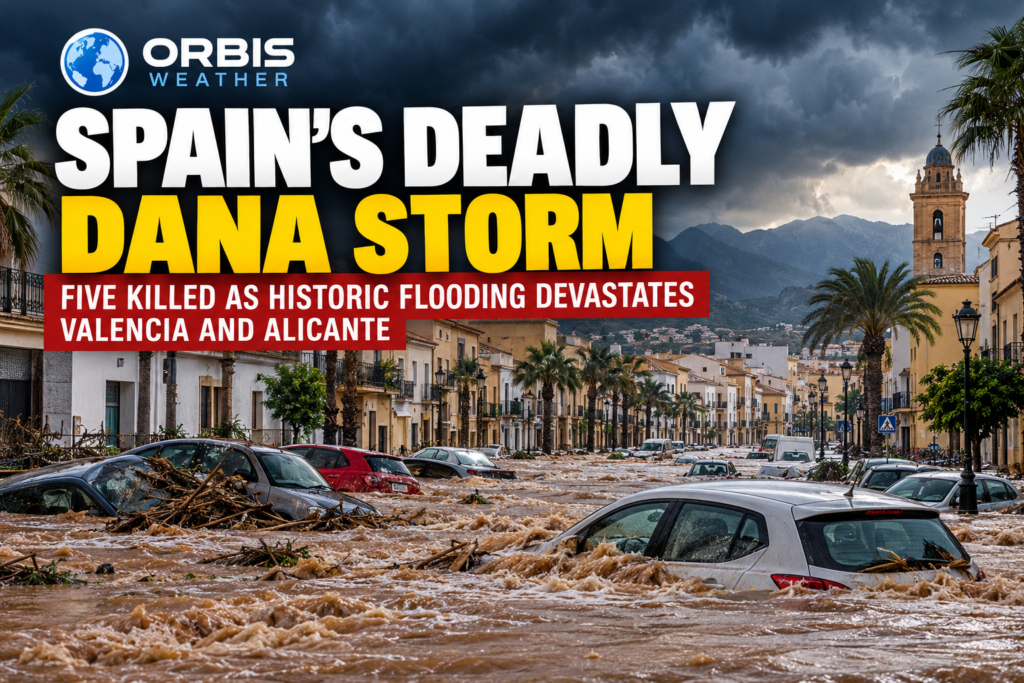




Spain’s Deadly DANA Storm: Five Killed as Historic Flooding Devastates Valencia and Alicante
By Paul Harrison | Orbis Weather
Published: October 21, 2026
VALENCIA, SPAIN — A powerful Mediterranean storm has left at least five people dead, forced thousands from their homes and submerged entire streets across eastern Spain, as an intense weather phenomenon known as a DANA unleashed extraordinary rainfall across the Valencia and Alicante regions.
The storm, named Adam, brought some of the heaviest rainfall recorded in parts of eastern Spain in decades. Floodwaters swept vehicles through streets, overwhelmed rivers and drainage systems, and forced emergency responders to rescue residents trapped inside homes and stranded on rooftops.
Spain’s national meteorological agency, AEMET, described the rainfall as exceptional, with some communities recording more than 600 millimeters (23.6 inches) of precipitation during the storm.
The disaster has renewed concerns about the Mediterranean region’s vulnerability to extreme rainfall and raised questions about how a warming climate may influence the severity of future flooding events.
Five Dead as Storm Adam Triggers Widespread Flooding
According to reports published October 20 and 21, at least five people have died during the severe weather episode.
The coastal municipality of Oliva, south of Valencia, was among the hardest-hit communities.
Floodwaters entered residential buildings, submerged roads and stranded residents. Emergency services deployed helicopters, boats and specialist rescue teams to reach people trapped by rapidly rising water.
Spain’s Civil Guard reported:
More than 2,100 people evacuated in the Valencia region.
Nearly 500 rescues carried out during the emergency.
More than 1,300 Civil Guard officers deployed.
Widespread road closures and transportation disruptions.
School closures affecting more than 100,000 students.
In several communities, residents sought refuge on upper floors and rooftops as floodwaters inundated ground-level properties.
The storm also affected parts of Catalonia and the Balearic Islands, including Ibiza and Formentera.
Extraordinary Rainfall: More Than 28 Inches Recorded
Rainfall measurements illustrate the extraordinary intensity of Storm Adam.
According to figures reported by AEMET and regional authorities:
| Location | Reported rainfall |
|---|---|
| L’Atzúvia, Alicante | 713 mm (28.1 inches) during the episode |
| Pego, Alicante | 632 mm (24.9 inches) in 36 hours |
| Pego, peak six-hour period | 430 mm (16.9 inches) |
| Oliva, Valencia | Approximately 600 mm (23.6 inches) in 24 hours |
In Pego, more than 16 inches of rain fell within just six hours, an extraordinary amount capable of overwhelming even well-developed drainage systems.
Rivers and waterways, including the Girona and Vernisa rivers, overflowed as runoff accumulated across surrounding watersheds.
The flooding left streets impassable, damaged homes and businesses, and swept vehicles into piles of debris.
What Is Spain’s DANA Weather Phenomenon?
DANA stands for Depresión Aislada en Niveles Altos, a Spanish meteorological term meaning Isolated Depression at High Levels.
Meteorologists elsewhere commonly describe the phenomenon as a cut-off low-pressure system.
A DANA develops when a pocket of relatively cold air high in the atmosphere becomes separated from the main jet stream.
The jet stream is a band of powerful upper-atmospheric winds that generally moves weather systems from west to east.
When a section of this atmospheric circulation becomes isolated, the resulting low-pressure system can move slowly or remain near the same geographical area for an extended period.
If warm, moisture-rich air from the Mediterranean Sea moves beneath the cold upper-level air, atmospheric instability can increase dramatically.
The resulting conditions may support powerful thunderstorms, intense rainfall and flash flooding.
However, not every DANA produces severe weather. Some bring relatively modest rainfall, while others generate destructive flooding depending on atmospheric moisture, instability, storm organization and local geography.
Why Does Eastern Spain Experience Such Dangerous Flooding?
Eastern Spain is particularly vulnerable to intense Mediterranean rainfall because of its geography and seasonal weather patterns.
1. Warm Mediterranean waters
During late summer and autumn, the Mediterranean Sea retains considerable heat accumulated throughout the warmer months.
Warm seawater supports evaporation, supplying moisture to developing weather systems.
2. Cold air high in the atmosphere
When a DANA moves into the region, cold upper-level temperatures can increase instability above the warmer, humid lower atmosphere.
This creates favorable conditions for deep thunderstorm development.
3. Mountains close to the coastline
Eastern Spain contains mountain ranges that can force moisture-rich winds upward, encouraging condensation and rainfall.
4. Slow-moving thunderstorms
A DANA can move slowly, allowing thunderstorms to repeatedly develop or pass over the same communities.
This process, sometimes called thunderstorm training, can produce extreme rainfall totals.
5. Rapidly responding rivers and ravines
Steep terrain, narrow valleys and normally dry drainage channels can funnel rainfall runoff toward towns and coastal communities.
Water levels may rise rapidly, leaving residents with little time to escape.
These factors help explain why parts of Valencia and Alicante have experienced repeated destructive flooding.
Memories of the Catastrophic 2024 Valencia Floods
Storm Adam has revived painful memories of the devastating October 2024 floods that struck eastern Spain.
That disaster also involved a DANA weather system and resulted in more than 230 deaths, according to subsequent reporting.
Some locations experienced rainfall comparable to an entire year’s precipitation within a single day.
Entire neighborhoods were inundated, vehicles were swept away and major transportation infrastructure suffered extensive damage.
The 2024 disaster also prompted scrutiny of emergency warning procedures and public communication.
During Storm Adam, authorities again issued high-level weather alerts and instructed residents to avoid unnecessary travel, stay away from rivers and seek higher ground.
Mobile-phone emergency warnings and shelter-in-place orders were among the protective measures used.
Although Storm Adam’s reported death toll is substantially lower than that of the 2024 disaster, the latest flooding demonstrates that the underlying meteorological threat remains significant.
Is Climate Change Making DANA Flooding More Dangerous?
Scientists distinguish between the formation of a DANA and the rainfall that can accompany it.
DANAs are naturally occurring atmospheric systems that have affected the Mediterranean region for generations.
However, human-caused climate change can influence the environmental conditions in which these systems develop.
A warmer atmosphere can hold more moisture
As global temperatures rise, the atmosphere can contain more water vapor.
Under suitable conditions, this additional moisture can contribute to heavier rainfall.
A commonly used atmospheric relationship indicates that the moisture-holding capacity of air increases by approximately 7% for each 1°C (1.8°F) of warming.
This does not mean every storm produces 7% more rainfall, but it helps explain why warmer conditions can support more intense precipitation.
Mediterranean sea temperatures matter
Warmer Mediterranean waters can increase evaporation and provide additional moisture for storms.
When that moisture interacts with unstable atmospheric conditions, the potential for intense rainfall may increase.
What research found after the 2024 floods
A preliminary analysis by scientists associated with World Weather Attribution suggested that human-caused climate change made the extreme rainfall associated with the October 2024 Spanish floods approximately 12% heavier.
The rapid analysis also suggested that comparable extreme rainfall conditions had become more likely.
Those findings were preliminary and should not be interpreted as a completed attribution study of Storm Adam in October 2026.
The scientific evidence supports concern about intensifying extreme rainfall, but it does not establish that every DANA will become stronger or more frequent.
Spain Begins Recovery as Authorities Announce Financial Assistance
As floodwaters began receding, authorities turned their attention toward cleanup, infrastructure repairs and assistance for affected residents.
On October 21, reports indicated that the Valencian regional government had approved an initial €23.5 million emergency assistance package.
The measures included proposed direct assistance of:
€6,000 for qualifying damage to a primary residence.
€3,000 for qualifying damage to a second home.
€800 per month for up to one year for eligible households that lost their homes.
Regional authorities also allocated funding to help municipalities address immediate damage and emergency needs.
Spanish Prime Minister Pedro Sánchez visited the affected Valencia region and pledged government support for reconstruction.
The full economic cost of Storm Adam has not yet been established.
Can DANA Storms Be Predicted?
Modern weather forecasting systems can often identify developing upper-level low-pressure systems several days before they reach the Mediterranean.
Meteorologists use satellite observations, numerical weather prediction models, radar and atmospheric measurements to monitor their evolution.
However, forecasting the exact location and intensity of extreme rainfall remains challenging.
A relatively small shift in thunderstorm development or storm movement can determine whether one community receives moderate rainfall while another experiences catastrophic flooding.
Spain’s national meteorological agency, AEMET, issues weather alerts based on expected hazards.
Residents should follow official warnings, particularly when heavy rainfall threatens flood-prone areas.
What Should Residents Do During a DANA Warning?
During extreme rainfall or flash-flood warnings, emergency officials recommend several precautions.
Avoid driving through flooded roads, even when the water appears shallow.
Stay away from rivers, drainage channels, ravines and low-water crossings.
Move to higher ground or upper floors when instructed by emergency services.
Never enter fast-moving floodwater on foot.
Keep mobile phones charged and emergency alerts enabled.
Follow official evacuation instructions and local emergency updates.
Floodwaters can rise rapidly, and roads that appear passable may become dangerous within minutes.
Orbis Weather Analysis: A Warning for the Mediterranean
Storm Adam illustrates the destructive potential of a DANA when several atmospheric and geographical factors combine.
The system’s isolated upper-level circulation, abundant Mediterranean moisture, intense thunderstorm development and vulnerable terrain produced exceptional rainfall over densely populated communities.
The disaster also highlights an important distinction in climate science.
A DANA is not a new weather phenomenon created by global warming. However, a warmer atmosphere and warmer Mediterranean waters can provide additional moisture that may intensify rainfall when favorable storm conditions develop.
For Spain, improving rainfall forecasting, emergency warning systems, drainage infrastructure and flood preparedness will remain essential.
As eastern Spain begins the difficult process of recovery, Storm Adam serves as another reminder that extreme rainfall can become a deadly natural disaster in a matter of hours.
Orbis Weather will continue following significant weather events across Europe and the Mediterranean, including extreme rainfall, flooding and severe storm developments.
Sources and Editorial Methodology
This report was prepared using publicly available meteorological information and news reporting published through October 21, 2026.
Primary and supporting references:
AEMET — Spain’s State Meteorological Agency: Meteorological definitions, DANA classification and weather warnings. https://www.aemet.es/
Reuters — October 19, 2026: Emergency rescues, fatalities, flooding and rainfall reports from eastern Spain.
Euronews — October 20–21, 2026: Storm Adam death toll, evacuations, rainfall totals and explanation of DANA.
Royal Meteorological Society: Scientific explanation of cut-off lows and Mediterranean rainfall.
European Commission Joint Research Centre: Background research on DANA-related flooding.
Editorial note: Casualty figures, emergency response totals and damage estimates reflect reporting available on October 21, 2026, and may change as authorities release additional information. Rainfall measurements refer to different reporting periods and should not be interpreted as directly comparable 24-hour totals.
About the Author
Paul Harrison — Founder & Publisher, Orbis Weather
Paul Harrison founded Orbis Weather in 2026 to make global weather and natural-hazard information easier to find, follow and understand. His coverage includes tropical cyclones, severe weather, extreme temperatures, earthquakes, volcanoes, wildfires, flooding and significant natural disasters worldwide.
View all articles by Paul Harrison → | Editorial Standards →
Global Weather Tracker Hub
Explore weather maps, tropical systems, storms and natural hazards around the world.
No matching trackers found.