
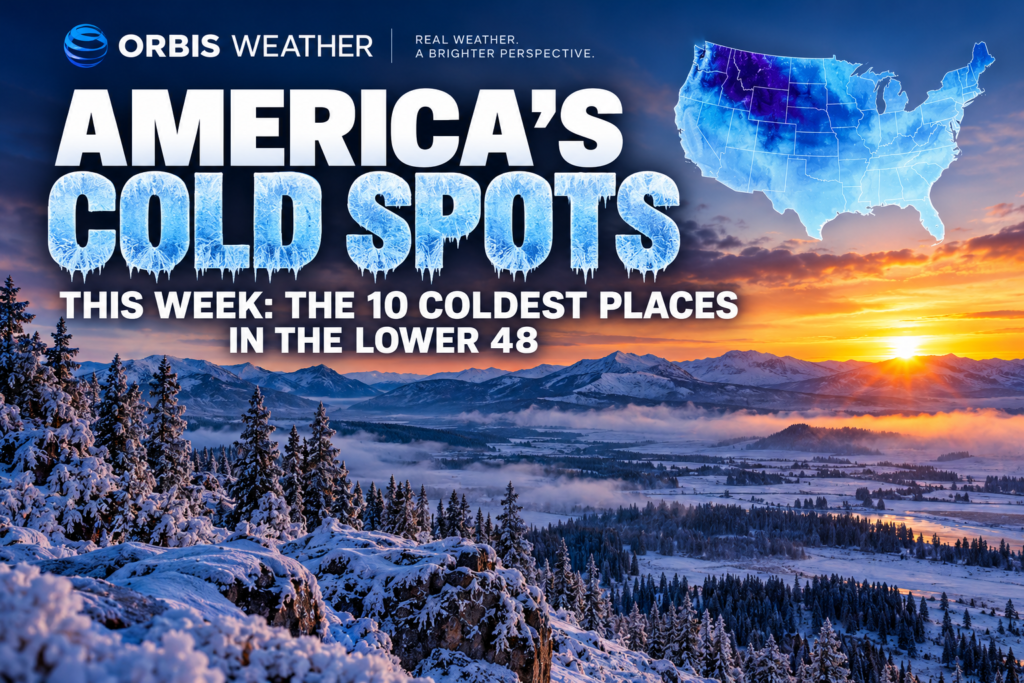




America’s Cold Spots This Week: The 10 Coldest Places in the Lower 48
October 19–25, 2026 | By Paul Harrison | Orbis Weather
Autumn’s chill is spreading across the United States as freezing temperatures threaten parts of the Rockies, Great Plains, Midwest and Northeast. From high mountain valleys to northern border communities, some of America’s coldest locations are preparing for another round of October cold.
October Cold Spreads Across the Lower 48
As the second half of October unfolds, the transition toward winter is becoming increasingly noticeable across the continental United States.
The National Weather Service’s Weather Prediction Center has highlighted widespread frost and freeze concerns extending from the Plains into the Midwest and eastern United States, along with the potential for higher-elevation snowfall in the West.
One particularly notable reading came from Angel Fire, New Mexico, where the temperature fell to just 8°F (-13.3°C) on October 17, according to the Weather Prediction Center’s national temperature report.
That is a reminder that the nation’s coldest locations are not always found along the Canadian border. High-elevation valleys in the Southwest can experience exceptionally cold nights, even while surrounding lower-elevation communities remain considerably warmer.
For the week of October 19–25, Orbis Weather examines ten locations across the Lower 48 that are especially vulnerable to cold autumn mornings.
Important data note: The following is a watchlist of ten notable cold-prone locations, not a verified ranking of the ten lowest observed temperatures for October 19–25. The full week’s observations are not yet available, and assigning precise weekly rankings or temperatures would be premature.
The 10 Cold Spots to Watch This Week
1. Angel Fire, New Mexico
Angel Fire recorded 8°F (-13.3°C) on October 17. Its high-elevation valley setting makes it particularly susceptible to intense nighttime cooling under clear skies.
2. Peter Sinks, Utah
This remote limestone basin is famous for trapping dense, cold air. The surrounding terrain allows temperatures to plunge dramatically during calm, clear nights.
3. West Yellowstone, Montana
Situated near Yellowstone National Park, this high-elevation community frequently experiences freezing autumn mornings. Snow-covered terrain can further intensify overnight cooling.
4. Fraser, Colorado
Known for its cold mountain climate, Fraser sits in a valley where nighttime temperature inversions can produce especially chilly conditions.
5. Stanley, Idaho
The Sawtooth Valley is one of Idaho’s best-known cold-air drainage environments. Clear October nights can bring freezing temperatures well before winter officially begins.
6. Daniel, Wyoming
The Upper Green River Basin is vulnerable to strong radiational cooling, especially when winds diminish overnight.
7. International Falls, Minnesota
This northern border city is famous for its long, cold winters. October often marks the transition toward more persistent freezing mornings.
8. Mount Washington, New Hampshire
High elevation, powerful winds and rapidly changing weather make this summit one of the Northeast’s most severe cold-weather environments. Wind chills can be much lower than measured air temperatures.
9. Embarrass, Minnesota
Low-lying terrain and sheltered valleys make this northeastern Minnesota community particularly prone to cold-air pooling.
10. Saranac Lake, New York
Located in the Adirondack Mountains, Saranac Lake is known for cold nights, with valley terrain and clear skies often contributing to early-season frost.
Why Some Places Become Much Colder Than Their Surroundings
The coldest places in America are not necessarily the northernmost.
Several geographical and meteorological factors determine how quickly temperatures fall overnight.
1. Cold-air pooling
Cold, dense air naturally sinks into valleys and enclosed basins. Places such as Peter Sinks, Fraser and Stanley are particularly susceptible to this phenomenon.
2. High elevation
Air temperatures generally decrease with altitude through the lower atmosphere. Mountain communities can therefore experience freezing conditions while nearby lowlands remain much warmer.
3. Clear skies and calm winds
Cloud-free skies allow heat to escape rapidly from the ground after sunset. Light winds help cold air accumulate near the surface.
4. Snow cover
Fresh snow reflects sunlight and can encourage additional nighttime cooling, particularly during calm weather.
5. Canadian cold fronts
Cold air masses moving south from Canada can bring sharp temperature declines across the northern Plains, Great Lakes and Northeast.
These mechanisms help explain why America’s coldest daily observations frequently originate in mountain valleys or exposed northern locations rather than major cities.
What to Expect October 19–25
The Weather Prediction Center’s extended discussion identifies a broad period of frost and freeze concerns, particularly across the northern and central United States, with colder conditions spreading eastward. A developing western weather system may also bring precipitation and high-elevation snow.
The main areas to watch include:
Northern Rockies: Mountain valleys remain vulnerable to freezing overnight temperatures.
Central Plains and Midwest: Frost and freeze conditions may affect vegetation and late-season agricultural activities.
Great Lakes and Northeast: Cold air following frontal passages could produce additional chilly mornings.
Western mountains: Higher elevations may experience snow as Pacific weather systems move inland.
Actual temperatures will depend on cloud cover, wind speed, elevation and the timing of individual weather systems.
How Cold Can October Get?
October represents an important transition month across the continental United States.
In the northern states, temperatures can drop below freezing during the first half of autumn, while some mountain valleys experience frost even during summer.
For agricultural communities, the first widespread freeze can effectively end the growing season.
For travelers, the combination of cold temperatures, precipitation and mountain elevation can create hazardous road conditions.
And for residents in colder regions, October is often the month when heating systems, winter clothing and freeze protection become essential.
Why This Matters: The Risks Beyond the Temperature
Cold weather is not simply about the lowest number on a thermometer.
Even moderately cold conditions can create problems when they arrive unexpectedly.
Agriculture: Frost can damage sensitive crops and ornamental plants.
Transportation: Freezing temperatures combined with moisture can produce slippery bridges and elevated road surfaces.
Outdoor recreation: Hikers and campers may encounter rapidly changing temperatures, especially in mountain environments.
Energy demand: Colder mornings can increase residential heating needs.
Health and safety: Prolonged exposure to cold and wind can increase the risk of hypothermia, particularly without adequate protective clothing.
Residents should monitor local National Weather Service forecasts and any frost or freeze advisories issued for their communities.
Orbis Weather Analysis: The Cold Season Is Taking Shape
October’s developing cold pattern illustrates the differences between regional climates across the Lower 48.
High-elevation valleys in the Rockies can experience winterlike temperatures while the southern United States remains relatively warm.
At the same time, stronger autumn cold fronts can carry freezing air into populated areas of the Midwest and Northeast.
The key story this week is not necessarily a single extreme temperature. It is the increasing geographical reach of overnight freezing conditions as autumn progresses.
One important distinction is that an isolated low reading does not automatically indicate a record-breaking cold outbreak. To establish a record, observations must be compared against the historical record at the same station.
Similarly, one unusually cold night does not establish a long-term climate trend.
Orbis Weather will continue examining temperature extremes, changing weather patterns and the locations experiencing the most significant cold conditions across the United States.