
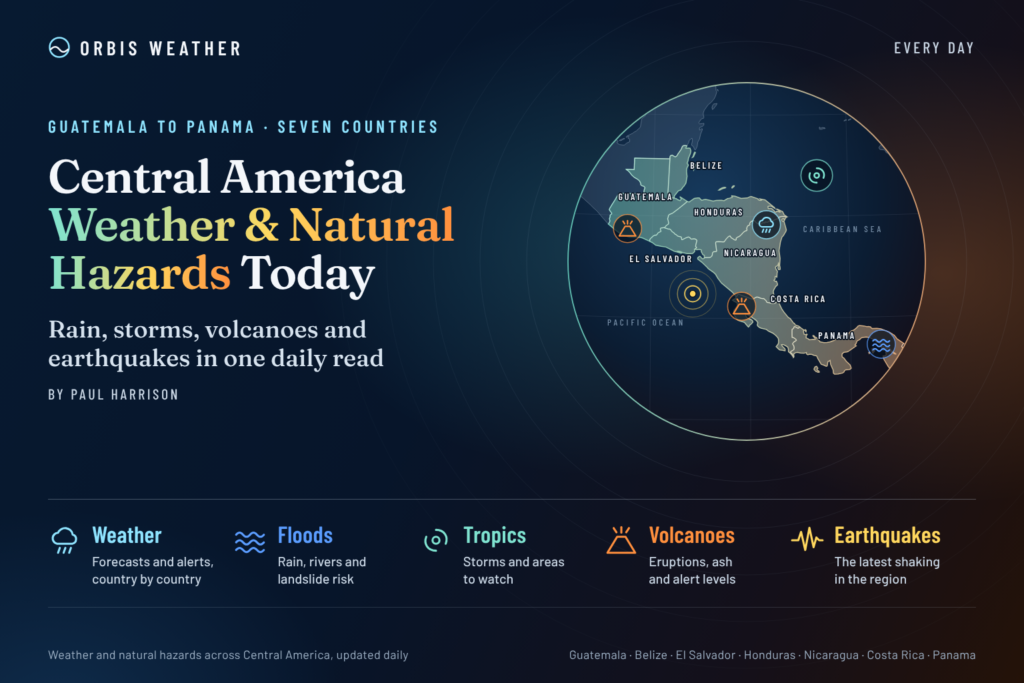
Central America Weather & Natural Hazards Today

- Europe Weather & Natural Hazards Today – Sunday, November 15, 2026 7:41 PM
- Africa Weather & Natural Hazards Today — Sunday, November 15, 2026 7:34 PM
- Middle East Weather & Natural Hazards Today – November 15, 2026 7:26 PM
- Southeast Asia Natural Hazards This Week: Sunday, November 15, 2026 7:18 PM
- Southeast Asia Weather & Natural Hazards Today: Sunday, November 15, 2026 7:07 PM
- Earth’s Hot Spots This Week November 14, 2026 3:26 PM
- Australia, New Zealand & Oceania Weather & Natural Hazards Today — Sunday, November 15, 2026 11:06 AM
- North America Weather & Natural Hazards Today – November 14, 2026 10:45 AM
- Central America Weather & Natural Hazards Today – Saturday, November 14, 2026 10:36 AM
- South America Weather & Natural Hazards Today – November 14, 2026 10:26 AM
- WESTERN PACIFIC Tropical Weather Update – November 14, 2026 10:19 AM
- U.S. Weather Outlook (Next 7 Days): Nov. 14–20, 2026 9:28 AM
- Australian Region Tropical Weather Update: Saturday, November 14, 2026 9:13 AM
- Daily Earthquakes, Storms, Fires & Floods Report — November 14, 2026 8:50 AM
- Southwest Indian Ocean Tropical Weather Update: Saturday, November 14, 2026 8:40 AM





Central America Weather & Natural Hazards Today – Saturday, November 14, 2026
By Paul Harrison | Orbis Weather
Published: Saturday, November 14, 2026
Coverage: Belize, Guatemala, Honduras, El Salvador, Nicaragua, Costa Rica and Panama
Forecast period: November 14–16, 2026
Regional Overview: Heavy Rainfall, Flooding Risks and Unstable Hillsides Remain Key Concerns
Central America enters the weekend with a mixture of tropical showers, localized thunderstorm threats, lingering flooding concerns and longer-term drought conditions.
The greatest attention remains on southern Central America, particularly Costa Rica, Nicaragua and Panama, following periods of substantial rainfall earlier in November.
Costa Rica’s National Meteorological Institute (IMN) issued a weather notice on Friday, November 13, highlighting brief but intense downpours affecting the Central Valley and Caribbean mountain areas. Weak trade winds, daytime heating and local wind patterns were contributing to atmospheric instability.
Meanwhile, NOAA’s Climate Prediction Center previously identified flooding concerns across Costa Rica and portions of Nicaragua and Panama during November 5–11. Although that forecast period has ended, the assessment provides important context for monitoring saturated ground, vulnerable river systems and potential landslides.
There is more encouraging news from the tropics.
As of Saturday morning, November 14, the National Hurricane Center reports no active tropical cyclones in the Atlantic or eastern North Pacific. Tropical cyclone formation is not expected in the Atlantic basin during the next seven days.
However, the absence of a named tropical storm does not eliminate the possibility of flash flooding, lightning, landslides or dangerous marine conditions.
Today’s Main Weather and Natural Hazards
Hazard | Regional assessment |
|---|---|
🌧️ Heavy rainfall | Localized downpours, especially in southern Central America |
🌊 Flooding | Lingering vulnerability in recently affected areas |
⛰️ Landslides | Saturated slopes and mountainous roads |
⚡ Thunderstorms | Lightning, intense rainfall and gusty winds |
🌀 Tropical cyclones | No active Atlantic or eastern Pacific cyclones reported |
🌋 Volcanoes | Routine monitoring across the volcanic arc |
🌎 Earthquakes | Ongoing tectonic activity; no specific event confirmed in this report |
☀️ Heat and drought | Longer-term dryness across parts of northern and western Central America |
These assessments identify monitoring priorities rather than official warning levels for individual countries.
Tropical Weather Update: Caribbean Sea and Eastern Pacific
Atlantic Ocean and Caribbean Sea
At 7:00 a.m. EST on Saturday, November 14, the National Hurricane Center reported that tropical cyclone formation was not expected across the Atlantic basin during the next seven days.
This includes the Caribbean Sea and Gulf of Mexico.
The Atlantic hurricane season continues through November 30, so tropical monitoring remains important even as the season approaches its conclusion.
For Belize, Honduras, Nicaragua, Costa Rica and Panama, changing Caribbean moisture and trade-wind patterns can still produce showers and thunderstorms without an organized tropical system.
Eastern North Pacific
The National Hurricane Center’s Saturday morning update also indicated that no tropical cyclones were active in the eastern North Pacific.
The eastern Pacific hurricane season likewise continues through November 30.
The immediate regional concern is therefore localized rainfall and the consequences of earlier wet weather, rather than a confirmed approaching tropical cyclone.
Country-by-Country Weather and Natural Hazards
🇧🇿 Belize: Caribbean Showers, Heat and Localized Flooding Potential
Belize remains exposed to changing Caribbean weather conditions, with coastal showers and localized thunderstorms among the hazards residents should monitor.
Areas of interest include Belize City, Belmopan, Orange Walk, Corozal, Dangriga, Placencia and Punta Gorda.
Brief heavy rainfall can produce standing water in poorly drained urban areas, while thunderstorms may disrupt coastal activities and small-boat operations.
Longer-term dryness is another concern.
NOAA’s November 5–11 regional assessment identified abnormal dryness and drought affecting parts of Belize, alongside potentially excessive heat in northern districts.
These were conditions identified for the previous forecast period and should not be treated as verified temperature or rainfall forecasts for November 14.
Weekend outlook: Monitor local showers, temperatures and coastal marine conditions. No new nationwide severe-weather emergency has been independently confirmed for today’s report.
Official source: Belize National Meteorological Service.
🇬🇹 Guatemala: Mountain Rainfall, Landslides and Volcano Monitoring
Guatemala faces several contrasting weather and geological hazards this weekend.
The country’s mountainous terrain creates sharp differences between the Pacific lowlands, central highlands, northern Petén region and Caribbean-facing departments.
Particular attention should be given to Alta Verapaz, Izabal, Petén, Quetzaltenango and mountainous transport routes.
Localized heavy rainfall can cause rapid runoff, while fog and low cloud may reduce visibility in elevated areas.
Volcanic monitoring
Guatemala is home to several active volcanic systems, including Fuego, Santiaguito and Pacaya.
Rainfall on volcanic slopes can mobilize loose volcanic material, producing dangerous mudflows known as lahars.
The inclusion of these volcanoes does not mean that a new eruption or lahar emergency has been confirmed today.
Weekend outlook: Monitor mountain rainfall, slope stability, volcanic bulletins and local transportation advisories.
Official sources: INSIVUMEH and CONRED.
🇭🇳 Honduras: Flooding Vulnerability and Changing Caribbean Weather
Honduras remains vulnerable to localized flooding and landslides, particularly in mountainous communities and river valleys.
Areas requiring routine monitoring include Tegucigalpa, San Pedro Sula, La Ceiba, Choluteca, Comayagua, Gracias a Dios and the Bay Islands.
Caribbean moisture can produce rainfall along northern and eastern districts, while intense showers over inland mountains can lead to rapid river rises.
Honduras also faces longer-term rainfall deficits in portions of its agricultural regions.
NOAA’s earlier November assessment highlighted abnormal dryness and drought affecting parts of the country.
This combination illustrates the contrasting challenges facing Central America: flooding in some locations and water shortages in others.
Weekend outlook: Monitor rainfall advisories, river levels, mountain roads and any new emergency information issued by national authorities.
Official source: COPECO Honduras.
🇸🇻 El Salvador: Thunderstorms, Urban Flooding and Unstable Slopes
El Salvador’s compact geography and mountainous terrain make localized heavy rainfall particularly important.
Areas to monitor include San Salvador, Santa Ana, Sonsonate, La Libertad, San Miguel, Usulután and La Unión.
Intense thunderstorms can overwhelm drainage systems, particularly in urban areas.
Steep hillsides may also become unstable following repeated rainfall.
Along the Pacific coast, changing wind and swell conditions can affect fishing and marine activities.
Volcanic hazards
El Salvador’s volcanoes, including Santa Ana and San Miguel, remain subject to routine scientific monitoring.
No new major volcanic emergency dated November 14 has been independently established for this report.
Weekend outlook: Watch for locally intense rainfall, lightning and updated national weather advisories.
Official source: El Salvador Environmental Observatory.
🇳🇮 Nicaragua: Recent Regional Flooding Concerns and Seismic Activity
Nicaragua remains an important country to monitor following unsettled weather across southern Central America earlier this month.
NOAA’s November 5–11 regional hazards outlook identified flooding concerns in parts of Nicaragua.
Although that outlook has expired, river levels and ground conditions in previously affected communities remain relevant considerations.
Areas of interest include Managua, León, Chinandega, Granada, Rivas, Bluefields and Puerto Cabezas.
Heavy showers can cause localized flooding, particularly in low-lying areas and locations with inadequate drainage.
Nicaragua also sits along the Central American volcanic arc, where earthquake and volcanic activity are continuing geological hazards.
Volcanoes requiring routine monitoring include Masaya, San Cristóbal and Telica.
Weekend outlook: Monitor rainfall, river conditions, landslide-prone roads and official seismic and volcanic updates.
Official source: INETER Nicaragua.
🇨🇷 Costa Rica: Intense Rainfall and Lingering Flood Concerns
Costa Rica remains one of the most significant areas of concern in today’s regional assessment.
On Friday, November 13, the National Meteorological Institute issued a weather notice warning of brief, intense downpours in the Central Valley and Caribbean mountain areas.
The agency identified weak trade winds, daytime heating and local wind circulations as contributing factors.
This follows significant rainfall earlier in the week.
On November 9, the IMN reported that a low-pressure system previously affecting Costa Rica had moved away from the country. The system had produced rainfall totals exceeding 300 millimeters (11.8 inches) over two days in parts of the Nicoya Peninsula.
Although the original system moved away, areas that experienced substantial rainfall may remain vulnerable to additional runoff and slope instability.
Areas to monitor
Guanacaste, the Nicoya Peninsula, Puntarenas, the Central Valley, the Northern Zone and Caribbean-facing mountain districts remain important locations for updated weather information.
Potential hazards include localized flooding, rising streams, lightning and landslides.
Weekend outlook: Costa Rica deserves particular attention for renewed heavy showers and conditions in previously saturated areas. The November 13 weather notice should not automatically be interpreted as an active warning for every location on November 14.
Official sources: Instituto Meteorológico Nacional and National Emergency Commission.
🇵🇦 Panama: Thunderstorms, Urban Flooding and Mountain Rainfall
Panama continues to face the possibility of localized heavy rainfall and thunderstorms.
Western provinces and mountainous districts can experience rapid runoff when intense tropical showers develop.
Areas to monitor include Panama City, Colón, Bocas del Toro, Chiriquí, Veraguas, Darién and the Azuero Peninsula.
NOAA’s November 5–11 hazards outlook previously identified flooding concerns in portions of Panama.
However, that assessment does not establish the presence of active flooding across the country today.
In Panama City and other developed areas, short periods of intense rainfall can produce localized street flooding.
Western mountain communities may also face landslide risks when soils become saturated.
Weekend outlook: Monitor updated rainfall forecasts, river conditions and national emergency advisories.
Official source: SINAPROC Panama.
Heat and Drought: A Continuing Concern Across the Dry Corridor
While recent flooding has attracted attention, longer-term drought remains an important environmental and agricultural issue across Central America.
NOAA’s November 5–11 assessment identified abnormal dryness and drought in portions of Guatemala, Belize, Honduras, western Nicaragua, western Costa Rica and Panama.
The same assessment identified potentially excessive heat exceeding 35°C (95°F) in parts of northern Guatemala, northern Belize and eastern Nicaragua during that earlier forecast period.
These conditions can affect crop development, livestock, soil moisture and drinking-water availability.
The Central American Dry Corridor is particularly sensitive to irregular rainfall, prolonged dry spells and changing seasonal weather patterns.
A single heavy rainfall event does not necessarily eliminate a longer-term water deficit.
Earthquake and Volcano Monitoring
Central America lies along an active tectonic boundary where the Cocos Plate is subducted beneath the Caribbean Plate.
This geological setting produces frequent earthquakes and supports a chain of active volcanoes extending from Guatemala through Costa Rica.
Volcanoes to monitor
Country | Volcanoes |
|---|---|
Guatemala | Fuego, Santiaguito, Pacaya |
El Salvador | Santa Ana, San Miguel |
Nicaragua | Masaya, San Cristóbal, Telica |
Costa Rica | Poás, Turrialba, Rincón de la Vieja |
These are established monitoring locations, not a list of confirmed eruptions on November 14.
Earthquake outlook
Earthquakes cannot be reliably predicted by date, magnitude or location.
No independently verified list of significant earthquakes occurring across Central America on November 14 was established during preparation of this report.
Readers can consult the USGS Latest Earthquakes Map for current seismic observations.
Caribbean and Pacific Marine Conditions
Marine conditions remain important for coastal communities, fishing fleets, tourism operators and commercial shipping.
Along the Caribbean coast, changing winds, thunderstorms and locally heavy showers can affect visibility and small-vessel operations.
On the Pacific side, coastal thunderstorms, swells and changing wind conditions may affect fishing and recreational boating.
No specific regional wave-height measurements or new coastal emergency warnings for November 14 have been independently verified in this report.
Marine operators should obtain local forecasts before departure.
Central America Weather Outlook: November 14–16, 2026
SAT
14
NOV
Saturday – Localized rainfall and flooding monitoring
Watch Costa Rica’s updated rainfall advisories and conditions in recently affected areas of Nicaragua and Panama.
SUN
15
NOV
Sunday – Thunderstorms and mountain conditions
Continue monitoring national forecasts for heavy showers, unstable slopes and river-level changes.
MON
16
NOV
Monday – Updated regional forecasts needed
Review new national weather bulletins and tropical outlooks for changes early in the working week.
This is a qualitative regional outlook, not a verified city-by-city rainfall or temperature forecast.
Public Safety: Advice for Residents and Travelers
Flooding: Never drive through floodwater or attempt to cross fast-moving streams.
Landslides: Avoid unstable hillsides and roads affected by falling rocks or debris.
Lightning: Seek shelter inside a substantial building during thunderstorms.
Volcanoes: Follow official exclusion zones and geological monitoring bulletins.
Earthquakes: Drop, cover and hold on during shaking. Follow tsunami instructions if issued after a coastal earthquake.
Marine travel: Check local wind, wave and thunderstorm forecasts before departing.
Heat: Stay hydrated and reduce strenuous outdoor activity during periods of excessive heat
About the Author
Paul Harrison — Founder & Publisher, Orbis Weather
Paul Harrison founded Orbis Weather in 2026 to make global weather and natural-hazard information easier to find, follow and understand. His coverage includes tropical cyclones, severe weather, extreme temperatures, earthquakes, volcanoes, wildfires, flooding and significant natural disasters worldwide.
View all articles by Paul Harrison → | Editorial Standards →
Global Weather Tracker Hub
Explore weather maps, tropical systems, storms and natural hazards around the world.
No matching trackers found.