
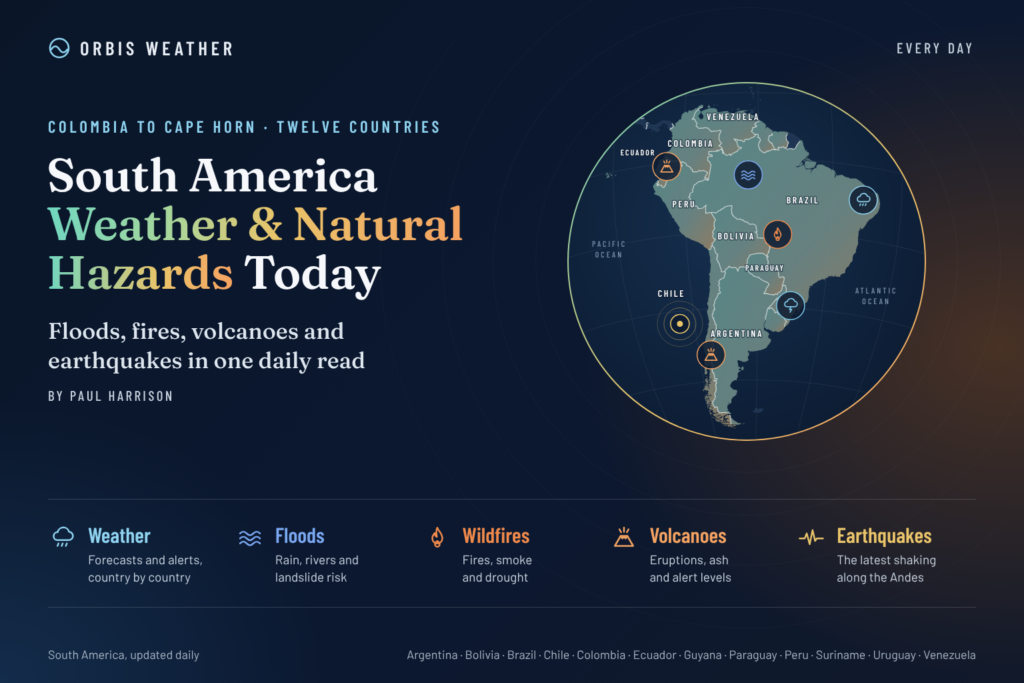
South America Weather & Natural Hazards Today

- Earth’s Cold Spots This Week November 11, 2026 3:06 PM
- Severe Thunderstorms Batter Queensland and NSW as Giant Hail, Damaging Winds and Flash Flooding Threaten 12:05 PM
- Australian Region Tropical Weather Update — Thursday, November 12, 2026 11:46 AM
- Southwest Indian Ocean Tropical Weather Update – Thursday, November 12, 2026 11:36 AM
- Australia, New Zealand & Oceania Weather & Natural Hazards Today — Thursday, November 12, 2026 11:01 AM
- North America Weather & Natural Hazards Today — Wednesday, November 11, 2026 8:36 AM
- Central America Weather & Natural Hazards Today – Wednesday, November 11, 2026 8:28 AM
- South America Weather & Natural Hazards Today – November 11, 2026 8:20 AM
- Daily Earthquakes, Storms, Fires & Floods Report — November 11, 2026 8:08 AM
- Weekly Earth’s Extreme Weather Report — Wednesday, November 11, 2026 8:01 AM
- Tropical Atlantic Daily Report: Wednesday, November 11, 2026 7:54 AM
- Eastern & Central Pacific Tropical Weather Update: Wednesday, November 11, 2026 7:47 AM
- WESTERN PACIFIC Tropical Weather Update – November 11, 2026 7:38 AM




South America Weather & Natural Hazards Today – November 11, 2026
By Paul Harrison | Orbis Weather
Regional weather outlook covering Brazil, Argentina, Chile, Peru, Colombia, Ecuador, Bolivia, Paraguay, Uruguay, Venezuela and the Guianas.
🌎 South America Weather Overview
South America enters Wednesday, November 11, with several important weather hazards to monitor, including tropical thunderstorms, potential flash flooding, severe convective storms, mountain weather and volcanic activity along the Andes.
November is a transitional month across much of the continent. Tropical rainfall becomes increasingly important across the Amazon Basin, while springtime warming and developing thunderstorms influence Argentina, Paraguay, Uruguay and southern Brazil.
Along the Pacific coast, Peru and northern Chile generally experience drier conditions, although localized rainfall in mountainous areas can still create dangerous flooding and landslide conditions.
Farther south, Patagonia remains exposed to rapidly changing weather, strong winds and occasional mountain snowfall.
Verification note: Current official warning bulletins and live observations for November 11 could not be independently confirmed during preparation of this report. The regional outlook below identifies seasonal weather patterns and hazards requiring monitoring, rather than claiming that specific warnings or disasters are currently active.
🚨 South America Natural Hazards Summary
Region | Main hazards to monitor |
|---|---|
🇧🇷 Brazil | Thunderstorms, heavy rainfall, localized flooding |
🇦🇷 Argentina | Severe thunderstorms, hail, strong winds |
🇨🇱 Chile | Mountain weather, volcanic activity, southern winds |
🇵🇪 Peru | Andean rainfall, landslides, earthquakes |
🇨🇴 Colombia | Heavy tropical rainfall, flooding, landslides |
🇪🇨 Ecuador | Thunderstorms, volcanic activity, earthquakes |
🇧🇴 Bolivia | Tropical rainfall, localized flash flooding |
🇵🇾 Paraguay | Thunderstorms, lightning, strong winds |
🇺🇾 Uruguay | Frontal systems, thunderstorms, coastal winds |
🇻🇪 Venezuela | Tropical downpours, river flooding |
🇬🇾 🇸🇷 🇬🇫 Guianas | Tropical showers, thunderstorms, localized flooding |
These are potential regional hazards, not a list of confirmed active alerts.
🇧🇷 Brazil – Thunderstorms and Heavy Rainfall Potential
Brazil’s expansive geography produces very different weather conditions between the tropical north, central interior and southern states.
Southeastern Brazil
São Paulo, Rio de Janeiro, Minas Gerais and Espírito Santo are entering a period when increasing heat and atmospheric moisture can support afternoon and evening thunderstorms.
The most important hazards to monitor include intense short-duration rainfall, lightning, localized urban flooding and gusty winds.
Urban areas are particularly vulnerable when heavy rainfall overwhelms drainage systems. Motorists should avoid flooded underpasses and low-lying roads.
Central and Northern Brazil
Across Amazonas, Pará, Mato Grosso and surrounding regions, tropical moisture can support frequent showers and thunderstorms.
Rainfall may become locally intense, particularly where thunderstorms repeatedly develop over the same area.
River conditions should be monitored using observations from Brazil’s national water agencies.
Southern Brazil
Rio Grande do Sul, Santa Catarina and Paraná can experience stronger thunderstorms associated with frontal boundaries and unstable springtime air.
Potential hazards include damaging wind gusts, hail, frequent lightning and localized flash flooding.
Official monitoring: Brazil National Institute of Meteorology (INMET).
🇦🇷 Argentina – Spring Storms and Severe Weather
Argentina’s spring weather can produce significant contrasts between warm northern provinces, the central agricultural belt and cooler southern Patagonia.
Buenos Aires and Central Argentina
Buenos Aires, Córdoba, Santa Fe and Entre Ríos should monitor the potential for developing thunderstorms.
Where sufficient atmospheric instability and wind shear overlap, storms can become organized and produce hail, damaging winds and heavy rainfall.
These conditions are possibilities associated with the season, not a confirmed severe-weather outbreak for November 11.
Northern Argentina
Chaco, Formosa, Corrientes and Misiones can experience warm, humid conditions favorable for thunderstorms.
Localized flooding is possible during periods of prolonged or repeated heavy rainfall.
Patagonia
Southern Argentina can experience strong winds, cooler temperatures and rapidly changing conditions, especially near the Andes.
Travelers in exposed areas should monitor wind forecasts and mountain conditions.
Official monitoring: Argentina National Meteorological Service (SMN).
🇨🇱 Chile – Pacific Weather, Mountain Hazards and Volcanoes
Chile stretches across multiple climate zones, from the Atacama Desert to the storm-prone far south.
Northern Chile
Antofagasta, Tarapacá and Atacama generally experience dry conditions at this time of year. However, rainfall events in mountainous terrain can create dangerous runoff even where surrounding desert areas remain dry.
Central Chile
Santiago, Valparaíso and nearby regions are moving toward warmer summer conditions.
Heat, dry vegetation and occasional strong winds can increase wildfire concerns, although no specific active fire is confirmed in this report.
Southern Chile
Los Lagos, Aysén and Magallanes remain exposed to Pacific weather systems, gusty winds and changing mountain conditions.
🌋 Volcanic Monitoring
Chile contains numerous active volcanic systems, including Villarrica, Llaima and Nevados de Chillán.
Changes in seismic activity, gas emissions or surface temperatures can indicate volcanic unrest, but do not necessarily mean an eruption is imminent.
Official sources: SENAPRED and SERNAGEOMIN volcanic monitoring.
🇵🇪 Peru – Andean Rainfall, Landslides and Seismic Hazards
Peru faces several distinct natural hazards because of its Pacific coastline, high Andes and Amazonian interior.
Lima and Coastal Peru
Coastal areas typically remain comparatively dry during November, although cloud cover, humidity and localized weather variations are possible.
Andes Mountains
Mountain communities should monitor developing rainfall, especially in steep valleys and locations vulnerable to landslides.
Heavy rainfall can destabilize slopes, damage roads and increase river levels.
Amazonian Peru
Loreto, Ucayali and Madre de Dios can experience tropical showers and thunderstorms.
River flooding becomes an important concern during extended wet periods.
🌎 Earthquake Risk
Peru lies along the boundary where the Nazca Plate moves beneath the South American Plate.
This geological setting creates the potential for powerful earthquakes.
No specific November 11 earthquake is being reported here without confirmation from seismic monitoring agencies.
Official sources: SENAMHI Peru and Geophysical Institute of Peru.
🇨🇴 Colombia – Tropical Rainfall and Landslide Concerns
Colombia experiences significant rainfall across many regions during November.
Bogotá and the Andes
Mountainous areas surrounding Bogotá, Medellín and other Andean communities can experience periods of heavy rain.
Steep terrain, saturated soils and expanding urban development can increase landslide vulnerability.
Pacific Colombia
The Pacific coastal region is among the wettest areas of South America.
Persistent tropical moisture can support heavy rainfall and river flooding.
Caribbean Colombia
Coastal areas, including Cartagena, Barranquilla and Santa Marta, should monitor tropical rainfall and marine conditions.
Although the Atlantic hurricane season continues through November 30, this report does not establish that a tropical cyclone currently threatens Colombia.
Official monitoring: IDEAM Colombia.
🇪🇨 Ecuador – Volcanoes, Rainfall and Earthquakes
Ecuador’s varied terrain creates a combination of meteorological and geological hazards.
Quito and the Highlands
Mountain weather can change quickly, with afternoon showers, thunderstorms and reduced visibility.
Coastal Ecuador
Rainfall patterns are influenced by Pacific Ocean temperatures, atmospheric circulation and the developing seasonal transition.
🌋 Volcanic Activity
Ecuador’s monitored volcanic systems include Cotopaxi, Reventador and Sangay.
These volcanoes require ongoing observation because activity can affect nearby communities, aviation and transportation.
Volcanic ash can reduce visibility, contaminate water supplies and disrupt air travel.
Official monitoring: Instituto Geofísico, Ecuador.
🇧🇴 Bolivia – Tropical Rainfall and Highland Conditions
Bolivia’s weather differs considerably between the tropical lowlands and the high-altitude Andes.
Santa Cruz and the eastern lowlands can experience warm conditions with developing thunderstorms.
La Paz, El Alto and surrounding highland communities face cooler temperatures and rapidly changing mountain weather.
Heavy rainfall in steep terrain can create localized landslide risks.
Residents should monitor official alerts, particularly when traveling through mountain roads or river valleys.
Official monitoring: SENAMHI Bolivia.
🇵🇾 Paraguay and 🇺🇾 Uruguay – Thunderstorm Development
Paraguay and Uruguay can experience increasingly active spring weather as warm, humid air interacts with passing frontal systems.
Paraguay
Asunción and surrounding regions should monitor thunderstorms capable of producing lightning, heavy rainfall and gusty winds.
Uruguay
Montevideo and the surrounding coastal region can experience frontal rainfall, thunderstorms and changing wind conditions.
Marine conditions along the Río de la Plata and Atlantic coast can deteriorate when strong weather systems approach.
Official sources: Paraguay Meteorological Directorate and Uruguay Meteorological Institute.
🇻🇪 Venezuela and the Guianas – Tropical Weather
Venezuela, Guyana, Suriname and French Guiana remain influenced by tropical moisture and regional rainfall patterns.
Thunderstorms may produce localized flooding, lightning and reduced visibility.
In Venezuela, mountainous terrain can increase the risk of flash flooding and landslides following prolonged rainfall.
Across the Guianas, river conditions and local drainage systems are important considerations during heavy rainfall.
Residents should follow national meteorological and civil protection agencies for localized warnings.
🌊 Pacific and Atlantic Ocean Conditions
South America’s extensive coastline is affected by different oceanic weather systems.
Pacific coast: Chile, Peru, Ecuador and Colombia can experience changing swell conditions, coastal currents and locally hazardous surf.
Atlantic coast: Brazil, Uruguay and Argentina can experience elevated waves and stronger winds when frontal systems or offshore low-pressure areas develop.
Caribbean coast: Northern Colombia and Venezuela should monitor tropical showers, thunderstorms and marine advisories.
Fishermen, coastal residents and recreational boaters should consult local marine forecasts before departure.
🌡️ El Niño and South America’s Weather
One of the broader climate factors to monitor is El Niño, which can alter rainfall and temperature patterns across South America.
Reporting in September 2026 described unusually strong El Niño conditions and the potential for substantial regional climate impacts.
Historically, El Niño can contribute to wetter conditions in portions of Ecuador and Peru, changes in rainfall across Brazil, and altered storm patterns in southeastern South America.
However, these relationships vary by location, season and the strength of the event.
An El Niño forecast is not a prediction that a particular city will experience flooding, drought or severe storms on a specific day.
For current assessments, consult NOAA Climate Prediction Center ENSO updates.
🌎 Earthquake Monitoring Across South America
The western edge of South America is one of the world’s most seismically active regions.
Earthquakes occur frequently along the Peru–Chile Trench and surrounding tectonic boundaries.
Area | Principal seismic concern |
|---|---|
Chile | Subduction-zone earthquakes and tsunami potential |
Peru | Strong earthquakes along the Pacific margin |
Ecuador | Offshore and inland earthquakes |
Colombia | Complex tectonic faults and seismic zones |
Argentina | Andean seismic activity |
Bolivia | Deep and intermediate-depth earthquakes |
November 11 seismic status: A verified event-by-event earthquake list was not available for inclusion in this report. This table describes seismic exposure, not earthquakes confirmed today.
For updated earthquake magnitudes, depths and locations, consult the USGS Earthquake Map.
🌋 South America Volcano Watch
The Andes contain numerous active volcanoes requiring continuous monitoring.
Volcano | Country | Main hazards |
|---|---|---|
Villarrica | Chile | Lava, ash, lahars |
Nevados de Chillán | Chile | Ash, explosive activity, lahars |
Sabancaya | Peru | Ash emissions, explosive activity |
Reventador | Ecuador | Ash, lava, volcanic debris |
Sangay | Ecuador | Ash, lava flows, debris flows |
Nevado del Ruiz | Colombia | Ash, lahars, volcanic unrest |
This is a monitoring list, not a statement that each volcano is erupting or under an elevated alert today.
For authoritative updates, consult national geological agencies and the Smithsonian Global Volcanism Program.
🔥 Wildfire and Air Quality Outlook
As temperatures increase during the Southern Hemisphere’s spring, wildfire conditions can become more favorable in areas experiencing dry vegetation, low humidity and strong winds.
Regions to monitor include central Chile, portions of Argentina and seasonally dry parts of Brazil.
Wildfire smoke can affect air quality well beyond the immediate fire zone.
Sensitive individuals, including children, older adults and people with respiratory conditions, should follow local air-quality advisories when smoke is present.
No specific active wildfire perimeter or air-quality reading has been independently verified for November 11 in this report.
📅 South America Weather Outlook – Next 72 Hours
November 11–13, 2026 | Regional planning outlook, not a verified numerical forecast
Region | Conditions to monitor |
|---|---|
Amazon Basin | Tropical showers and thunderstorms |
Southeast Brazil | Afternoon storms and localized heavy rainfall |
Northern Argentina | Spring thunderstorms and possible severe weather |
Central Chile | Warming conditions and dry-weather hazards |
Southern Chile | Pacific systems and gusty winds |
Andes Mountains | Mountain showers, reduced visibility and slope instability |
Colombia and Ecuador | Tropical rainfall and localized flooding |
Paraguay and Uruguay | Frontal changes and thunderstorm potential |
Exact daily rainfall amounts, temperatures, storm timing and warning levels require updated numerical forecasts and national meteorological bulletins.
🛡️ Safety Advice for Residents and Travelers
Flooding: Never drive through flooded roads. Water depth and road damage may be impossible to judge.
Thunderstorms: Move indoors when thunder is heard and avoid exposed areas.
Landslides: Watch for cracks in slopes, falling rocks, unusual ground movement or rapidly changing streams.
Earthquakes: Drop, cover and hold on during shaking. Follow local tsunami instructions after a strong coastal earthquake.
Volcanic ash: Follow evacuation instructions and avoid unnecessary exposure to airborne ash.
Marine hazards: Check official wave, wind and coastal warnings before boating or swimming.
📡 Official Weather and Natural Hazard Sources
Orbis Weather recommends the following authoritative sources for regional observations, warnings and emergency information.
Agency | Coverage |
|---|---|
Global meteorological coordination | |
Brazil | |
Argentina | |
Chile | |
Peru | |
Colombia | |
Global earthquakes | |
Global volcanic activity | |
International disaster alerts |
🔎 How Orbis Weather Prepares This Report
Orbis Weather combines meteorological information, climate research, publicly available hazard data and regional risk analysis to help readers understand natural hazards.
Our editorial approach distinguishes between confirmed observations, official warnings, forecasts and general seasonal risks.
For this edition: Public reporting and climate background were reviewed, but a complete set of live November 11 observations, national warning bulletins, seismic events and volcanic status updates could not be verified. Accordingly, this article does not assign numerical risk levels or report unconfirmed emergencies.
Forecasts are subject to change. Weather and geological hazards can develop rapidly, and local conditions may differ substantially from regional assessments.
Orbis Weather is an independent information service and is not a government warning authority.
Readers should always prioritize official national weather services, geological agencies and emergency management instructions.
🌎 Final Outlook – What South America Should Watch
The most important regional weather concerns for November 11 include tropical rainfall across northern South America, potential spring thunderstorms across Argentina and neighboring countries, and changing mountain conditions along the Andes.
Earthquake and volcanic hazards remain important considerations along the continent’s Pacific margin, while wildfire and air-quality risks require monitoring in areas experiencing dry conditions.
The precise location and severity of any developing hazard will depend on current atmospheric conditions and official observations.
Orbis Weather will continue covering South America’s weather systems, earthquakes, volcanoes, flooding, severe storms and environmental hazards.
South America Weather & Natural Hazards Today is prepared by Paul Harrison for Orbis Weather.
About the Author
Paul Harrison — Founder & Publisher, Orbis Weather
Paul Harrison founded Orbis Weather in 2026 to make global weather and natural-hazard information easier to find, follow and understand. His coverage includes tropical cyclones, severe weather, extreme temperatures, earthquakes, volcanoes, wildfires, flooding and significant natural disasters worldwide.
View all articles by Paul Harrison → | Editorial Standards →
Global Weather Tracker Hub
Explore weather maps, tropical systems, storms and natural hazards around the world.
No matching trackers found.