
Singapore Lightning & Thunderstorm Tracker – Live Storms

- Europe Weather & Natural Hazards Today – Wednesday, November 18, 2026 7:09 PM
- Southeast Asia Weather & Natural Hazards Today: Wednesday, November 18, 2026 7:01 PM
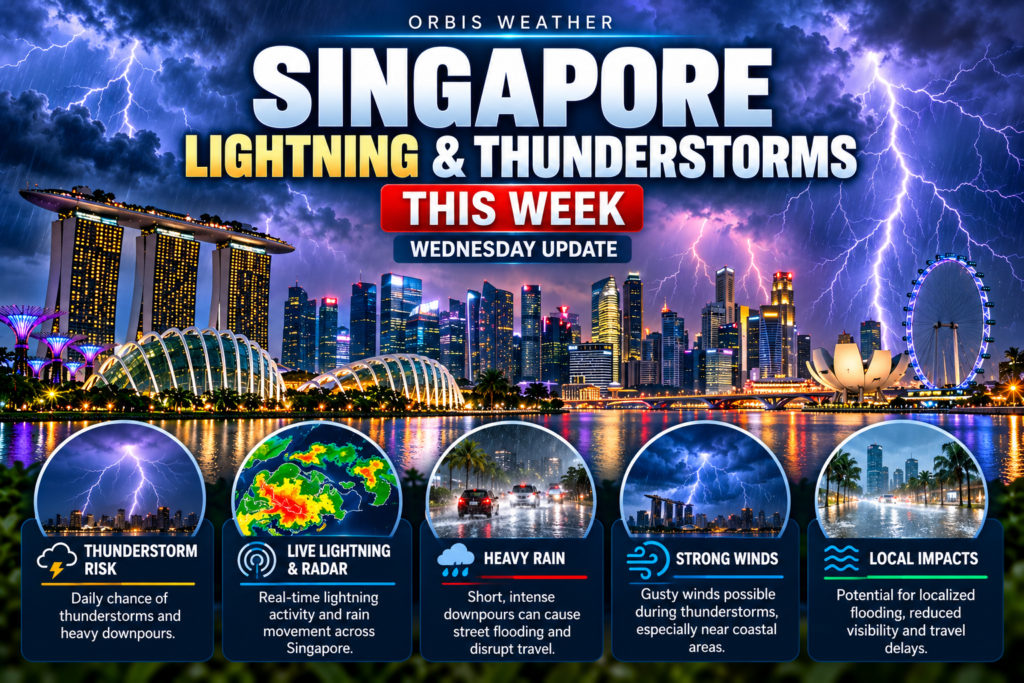
- Singapore Lightning & Thunderstorms This Week — Wednesday, November 18, 2026 6:54 PM
- Africa Weather & Natural Hazards Today — Wednesday, November 18, 2026 5:12 PM
- Middle East Weather & Natural Hazards Today – Wednesday, November 18, 2026 3:58 PM
- Europe’s Cold Spots This Week Nov 17, 2026 2:56 PM
- Australia, New Zealand & Oceania Weather & Natural Hazards Today — Wednesday, November 18, 2026 11:04 AM
- North America Weather & Natural Hazards Today – November 17, 2026 8:16 AM
- Central America Weather & Natural Hazards Today – Tuesday, November 17, 2026 8:03 AM
- South America Weather & Natural Hazards Today – Tuesday, November 17, 2026 7:50 AM
- Weekly Tropical Storm Tracker: Tuesday, November 17, 2026 7:37 AM
- Daily Earthquakes, Storms, Fires & Floods Report — November 17, 2026 7:29 AM
- Australian Region Tropical Weather Update: Tuesday, November 17, 2026 7:09 AM
- Southwest Indian Ocean Tropical Weather Update: Tuesday, November 17, 2026 7:01 AM
- WESTERN PACIFIC Tropical Weather Update – November 17, 2026 6:56 AM




Singapore Lightning & Thunderstorms This Week — Wednesday, November 18, 2026
By Paul Harrison, Orbis Weather · Wednesday, November 18, 2026
At a glance
- Forecast: afternoon thundery showers every day from Wednesday to Sunday, with highs of 33°C (91°F) and lows of 24°C (75°F).
- Lightning: the risk peaks each afternoon, sometimes into the night. The Northeast Monsoon is expected to set in later this fortnight.
- Recent days: MSS Heavy Rain Warnings on 16 and 17 November led PUB to flag flash-flood risk at roads near Upper Serangoon, MacPherson, Woodlands and Senoko. News reports mentioned no injuries.
- Early November: the wettest day was 6 November, with 94.2 mm (3.7 in) near Rivervale Drive. Paya Lebar reached 35.4°C (95.7°F) on 4 November.
- Official sources: the Meteorological Service Singapore (MSS) and the National Environment Agency (NEA) issue Singapore’s official forecasts and warnings.
Day by day
Every day from Wednesday to Sunday carries the same forecast: thundery showers in the afternoon, with highs near 33°C (91°F).
Day | Forecast | High / low | Wind |
|---|---|---|---|
Wed 18 Nov | Thundery showers over many areas in the afternoon | 33°C (91°F) / 24°C (75°F) | Variable, 5–15 km/h (3–9 mph) |
Thu 19 Nov | Afternoon thundery showers | 33°C (91°F) / 24°C (75°F) | Variable, 5–15 km/h (3–9 mph) |
Fri 20 Nov | Afternoon thundery showers | 33°C (91°F) / 24°C (75°F) | Variable, 5–15 km/h (3–9 mph) |
Sat 21 Nov | Afternoon thundery showers | 33°C (91°F) / 24°C (75°F) | East, 5–15 km/h (3–9 mph) |
Sun 22 Nov | Afternoon thundery showers | 33°C (91°F) / 24°C (75°F) | North-northeast, 5–15 km/h (3–9 mph) |
Wednesday is from the MSS 24-hour forecast issued at 5.36 am on 18 November. Thursday to Sunday are from the MSS 4-day outlook issued at 5.40 am on 18 November. All times are Singapore time.
Day of note: Sunday’s wind turns north-northeast. That fits the expected arrival of the Northeast Monsoon later this fortnight.
The MSS outlook for 16 to 30 November expects short afternoon thundery showers on most days, extending into the night on a few. They could be widespread and heavy on some days, and fortnight rainfall is forecast slightly above average over most of the island.
Why storms happen now
Singapore is at the end of the October–November inter-monsoon, when light, variable winds meet land and sea breezes and set off afternoon thunderstorms. MSS expects the Northeast Monsoon to set in during the second half of November, with winds strengthening and turning northeast or northwest. The monsoon typically lasts until March.
MSS describes inter-monsoon thunderstorms as “at times severe”, mostly in the afternoon and early evening. December usually brings more total rain but fewer thunderstorm days.
Long-term average (1991–2020, Changi) | November | December |
|---|---|---|
Rainfall | 252.3 mm (9.9 in) | 331.9 mm (13.1 in) |
Rain days | 19 | 19 |
Thunderstorm days | 19 | 14 |
Lightning days | 22 | 16 |
Mean daily high | 31.2°C (88.2°F) | 30.5°C (86.9°F) |
Mean daily low | 24.6°C (76.3°F) | 24.3°C (75.7°F) |
Lightning in Singapore
Lightning is part of everyday weather here: NEA’s Changi Climate Station records it on about 176 days a year, or one day in two. MSS states that a forecast of thundery showers means an imminent risk of lightning, so the risk this week runs every afternoon from Wednesday to Sunday, and into the night on some days. NEA notes that lightning typically strikes within 6 km (3.7 mi) of a location but can strike more than 10 km (6.2 mi) from the storm cloud. No lightning injuries in Singapore were reported in news coverage of the past week.
Staying safe and checking warnings
The safest plan this week is to finish outdoor activities before the afternoon and to watch for alerts.
- Outdoors: seek shelter as soon as thunder is heard, in a building or a car. NEA advice is to stay inside for at least 30 minutes after the last thunder.
- In the open: avoid open fields, high ground, isolated trees and poles, and metal fences. Do not hold umbrellas or golf clubs, and head for shore if on the water.
- At work: WSHC advises against using power tools in wet conditions or working at heights until the weather improves.
- If someone is struck: call 995. Victims are safe to touch, so check breathing and pulse, start CPR if needed and use an AED until help arrives.
- Flash floods: do not walk into flooded areas or through moving water above ankle height. Drivers should avoid water above kerb height or where road markings are hidden.
Tool | What it gives |
|---|---|
Lightning alerts for chosen locations, forecasts and flash flood alerts | |
24-hour forecast, 2-hour nowcast, rain radar and Heavy Rain Warnings | |
Daily forecast, updated at 5 am and 6 pm | |
Heavy Rain Warning texts, plus water-level alerts from 210 canal and drain sensors at 50%, 75%, 90% and 100% full | |
Links to the PUB Flood Alerts Telegram channel |
Frequently asked questions
What time of day are storms most likely this week? Afternoons. MSS forecasts afternoon thundery showers on every day from Wednesday to Sunday, and some may continue into the night.
How does the myENV lightning alert work? Users pick a location in the app. An alert arrives when cloud-to-ground lightning is detected, or thundery showers are forecast, within 6 km of that spot in the next two hours.
Has the Northeast Monsoon started? Not yet, as of 16 November. MSS expects it to set in during the second half of November, bringing stronger winds from the northeast or northwest.
Will this week be hotter than usual? Forecast highs of 33°C (91°F) are near the upper end of normal. MSS says daily highs may reach slightly above 34°C (93°F) on a few days this fortnight.
Is haze a concern this week? It is not expected to be. NEA’s haze update of 3 November said showers and variable winds would limit smoke reaching Singapore, and the current forecasts are for wet afternoons.
About this report
This report covers Wednesday 18 to Sunday 22 November 2026, Singapore time. It draws on the MSS 24-hour forecast issued at 5.36 am and the 4-day outlook issued at 5.40 am on 18 November, and the fortnightly outlook issued on 16 November. Forecasts change through the day, and showers are often local, so official MSS and NEA updates take priority.
Term | Meaning |
|---|---|
Inter-monsoon | The transition between monsoons, with light, variable winds and frequent afternoon storms |
Northeast Monsoon | December to early March season, with northerly to northeasterly winds and a wet early phase |
Thundery showers | Showers with thunder, which MSS treats as an imminent lightning risk |
Heavy Rain Warning | An MSS alert that heavy rain is expected to affect Singapore |
Lightning day | A day on which lightning is observed at a climate station |
Sources
- MSS 24-hour forecast
- MSS 4-day outlook
- MSS home page
- MSS fortnightly outlook
- MSS monsoon update
- MSS climate of Singapore
- NEA advisory: Wet weather to continue for rest of November 2026 with onset of Northeast Monsoon
- NEA haze situation update, 3 November 2026
- NEA weather page
- MSE written reply to PQ on lightning alert system
- PUB SMS alert subscription
- PUB flood safety tips
- SCDF
- WSHC: Wet weather safety reminder
- NTU CCEH: Lightning safety awareness
- Mothership: How to avoid getting struck by lightning (NEA advice)
- AsiaOne: Thundery showers with gusty winds, 17 November
- AsiaOne: Thundery showers over most of Singapore, 16 November
- Yahoo News / The Straits Times: Motorists advised to avoid several areas, 16 November
- AsiaOne: Wet weather to continue for rest of November
Next 6 Hours
Storm Safety Snapshot
Official & Related Sources
Global Weather Tracker Hub
Explore weather maps, tropical systems, storms and natural hazards around the world.
No matching trackers found.
⚡ Singapore Lightning & Thunderstorm Tracker – Live Storms
Monitor thunderstorms, heavy rain and lightning risk across Singapore with the Orbis Weather Singapore Lightning & Thunderstorm Tracker.
Singapore’s tropical climate creates favorable conditions for thunderstorms throughout the year. Warm temperatures, abundant moisture and strong atmospheric instability can allow storms to develop rapidly, sometimes bringing intense rainfall, frequent lightning and gusty winds within a short period.
The Orbis Weather tracker provides a quick look at current rain, thunderstorm potential, wind and conditions expected during the next several hours.
For official Singapore weather warnings and lightning information, always follow the Meteorological Service Singapore and other appropriate Singapore authorities.
⚡ Why Singapore Gets So Much Lightning
Singapore’s location close to the equator creates an environment highly favorable for thunderstorm development.
Temperatures remain warm throughout the year, while surrounding tropical waters supply large amounts of moisture to the atmosphere.
When warm, humid air rises, it cools and condenses into towering clouds.
If atmospheric conditions are sufficiently unstable, these clouds can develop into powerful cumulonimbus thunderstorms capable of producing torrential rain, strong winds and frequent lightning.
⛈️ How Thunderstorms Form
A thunderstorm generally requires three basic ingredients: moisture, unstable air and a mechanism that causes air to rise.
Singapore regularly has abundant atmospheric moisture.
Strong tropical sunshine heats the surface, encouraging warm air to rise. Sea breezes, regional wind boundaries and other atmospheric features can provide additional lift.
As rising air cools, water vapor condenses and clouds grow vertically.
Strong thunderstorms can eventually extend many kilometres into the atmosphere.
Inside these clouds, powerful updrafts and downdrafts move water droplets and ice particles through the storm.
Electrical charges can separate within the cloud, eventually producing lightning.
🌧️ Why Singapore Thunderstorms Can Produce Intense Rain
Tropical air can contain enormous quantities of water vapor.
When thunderstorms develop, this moisture can condense rapidly and produce very heavy rainfall.
A storm does not necessarily need to last for hours to create problems.
A short but extremely intense tropical downpour can overwhelm drainage systems, produce temporary road flooding and reduce visibility.
This is why rainfall intensity can sometimes be as important as total daily rainfall.
⚡ What Causes Lightning?
Lightning is an enormous electrical discharge.
Inside a thunderstorm, collisions between ice particles, water droplets and other particles help separate electrical charges.
When the difference in electrical charge becomes large enough, electricity rapidly travels between regions of the cloud, between separate clouds or between the cloud and ground.
The resulting electrical discharge heats the surrounding air extremely rapidly.
That sudden heating causes the air to expand explosively, producing the sound we hear as thunder.
🌩️ Cloud-to-Ground vs. In-Cloud Lightning
Not every lightning flash reaches the ground.
A large amount of lightning occurs entirely within clouds or between clouds.
Cloud-to-ground lightning occurs when an electrical discharge connects the storm with Earth’s surface.
Both types can indicate an active thunderstorm.
A storm producing frequent in-cloud lightning can still pose a serious threat because cloud-to-ground strikes may develop at any time.
👂 If You Can Hear Thunder, Lightning Is Close Enough to Matter
Thunder provides a simple warning that lightning is occurring nearby.
Lightning can strike outside the area experiencing the heaviest rain.
That means waiting until rain reaches your exact location before seeking shelter can be dangerous.
If thunder is audible, move to a substantial enclosed building or other appropriate shelter.
Beaches, open fields, exposed coastal areas and isolated trees are poor places to remain during a thunderstorm.
🏝️ Lightning at Singapore Beaches
Singapore’s beaches and coastal areas can become particularly exposed during thunderstorms.
Open beaches provide relatively little protection from lightning.
Swimming should also be avoided when thunderstorms are nearby.
People visiting Sentosa, East Coast Park and other coastal recreation areas should monitor developing weather before and during outdoor activities.
A storm may develop or approach rapidly even when conditions were sunny earlier.
🏗️ Lightning and Outdoor Work
Singapore has extensive construction, port, aviation and outdoor commercial activity.
Workers operating cranes, scaffolding or exposed equipment can face additional risks during thunderstorms.
Outdoor operations should follow appropriate workplace lightning procedures and official safety requirements.
The Orbis Weather tracker can provide general awareness of developing conditions but should not replace professional workplace lightning-warning systems.
🌬️ Thunderstorm Wind Gusts
Lightning and rain are not the only hazards produced by Singapore thunderstorms.
Strong downdrafts can develop when rain-cooled air descends rapidly from a storm and spreads outward near the surface.
These winds can produce sudden powerful gusts.
Loose outdoor objects, temporary structures, tree branches and marine activities can all be affected.
Conditions may deteriorate rapidly as a strong thunderstorm approaches.
💨 What Is a Downburst?
A downburst occurs when a concentrated column of rapidly descending air reaches the surface and spreads outward.
Downbursts can produce damaging straight-line winds.
Smaller, concentrated events are often called microbursts.
Although they are different from tornadoes, powerful downburst winds can still cause damage and create serious aviation hazards.
Heavy tropical thunderstorms are capable of producing these sudden wind events.
🌧️ Thunderstorms and Flash Flooding
Intense thunderstorms can produce large amounts of rainfall in a short period.
When rainfall exceeds the ability of drainage systems to remove water, localized flash flooding can occur.
Roads and low-lying areas may become flooded rapidly.
Never assume floodwater covering a road is shallow enough to drive through safely.
Singapore’s official authorities should always be consulted when heavy-rain or flood warnings are issued.
🌬️ What Is a Sumatra Squall?
One of the most interesting thunderstorm phenomena affecting Singapore is the Sumatra squall.
These organized lines of thunderstorms generally develop over or near Sumatra and move eastward across the Strait of Malacca toward Peninsular Malaysia and Singapore.
They can bring sudden heavy rainfall, frequent lightning and strong gusty winds.
Sumatra squalls can occur during the night or morning, making them different from thunderstorms produced mainly by afternoon heating.
Because they can affect a large area, they are important for aviation, marine operations and outdoor activities.
🌦️ Afternoon Thunderstorms
Many Singapore thunderstorms develop during the afternoon.
Strong daytime heating makes the lower atmosphere increasingly unstable.
Local sea breezes can then interact with winds over the island, helping air converge and rise.
Thunderstorms can develop rapidly once these boundaries interact.
This explains why a hot, relatively sunny morning can sometimes transition into a stormy afternoon.
🌙 Can Singapore Get Thunderstorms at Night?
Yes.
Although daytime heating is an important trigger for many thunderstorms, storms can occur at virtually any hour.
Regional weather systems, Sumatra squalls, monsoon conditions and existing thunderstorm complexes can bring overnight or early-morning storms.
This is another reason not to assume thunderstorms are exclusively an afternoon hazard.
🌧️ Singapore’s Monsoons and Thunderstorms
Singapore experiences two primary monsoon regimes: the Northeast Monsoon and Southwest Monsoon.
The transition periods between them are known as inter-monsoon periods.
Thunderstorm behavior can change with these seasonal wind patterns.
Inter-monsoon periods often feature relatively light winds and strong local heating, creating favorable conditions for afternoon thunderstorms.
The Southwest Monsoon can also produce Sumatra squalls, while the Northeast Monsoon can bring longer periods of widespread rain during monsoon surges.
🌊 Thunderstorms and Marine Conditions
Singapore is surrounded by busy coastal waters.
Thunderstorms can produce lightning, sudden wind shifts, heavy rain and sharply reduced visibility.
These conditions can be dangerous for small boats, kayaks, paddleboards and other recreational watercraft.
Marine conditions can change considerably faster than expected when a strong thunderstorm approaches.
Check current weather and official marine information before heading onto the water.
✈️ Thunderstorms and Changi Airport
Thunderstorms can also affect aviation.
Lightning near an airport can interrupt some ground operations, while heavy rainfall can reduce visibility.
Strong thunderstorm winds can affect aircraft approaches and departures.
Thunderstorms along flight routes may require aircraft to deviate around hazardous weather.
Individual flight status should always be checked directly with the airline or airport.
📡 Weather Radar and Thunderstorms
Weather radar is one of the most useful tools for tracking thunderstorms.
Radar sends energy into the atmosphere and measures signals reflected by precipitation.
This allows meteorologists to identify where rain is occurring and how storms are moving.
Areas of stronger radar returns can indicate heavier precipitation.
Radar does not, however, show every thunderstorm hazard directly.
Lightning observations, wind measurements, satellite imagery and surface observations provide additional information.
⚡ Lightning Tracker vs. Weather Radar
Lightning data and radar complement each other.
Radar primarily shows precipitation and storm structure.
Lightning detection shows electrical activity.
A thunderstorm can produce substantial lightning even when the heaviest rainfall is somewhere else.
Likewise, heavy tropical rain does not always contain large amounts of lightning.
Using both types of information provides a more complete understanding of storm activity.
☔ What Does Rain Chance Mean?
Rain probability estimates the likelihood of measurable precipitation for a particular location and time period.
It does not mean that rain will occur continuously for that percentage of the day.
A 60% rain probability, for example, should not be interpreted as meaning it will rain for 60% of the time.
In tropical climates such as Singapore, thunderstorms can also be highly localized.
One part of the island may experience heavy rain while another remains relatively dry.
📍 Is There a Thunderstorm Near Singapore Right Now?
The Orbis Weather Singapore Lightning & Thunderstorm Tracker provides a quick overview of current precipitation, thunderstorm potential, wind and the next several hours of forecast conditions.
Because tropical storms can develop quickly, conditions should be checked again if you’re planning outdoor activities later in the day.
For official warnings and detailed Singapore observations, use information from the Meteorological Service Singapore.
📊 Understanding the Next 6 Hours
Short-range forecasts can be especially useful for Singapore because of the rapidly changing nature of tropical weather.
The Orbis Weather dashboard displays expected conditions over the next several hours to help visitors identify periods when rain or thunderstorm potential may increase.
Forecasts are not guarantees.
The exact location and timing of individual thunderstorms can be difficult to predict because convective storms can form, strengthen and dissipate rapidly.
🇸🇬 Singapore Lightning Safety
When thunderstorms approach, the safest option is generally to move inside a substantial enclosed building.
Avoid exposed beaches, open fields and isolated trees.
People on the water should return to appropriate shelter before a thunderstorm reaches their location whenever possible.
Do not depend solely on visible rainfall to determine lightning risk.
Lightning can occur beyond the main rain shaft.
🛰️ Where Does Orbis Weather Get Its Storm Data?
The current Orbis Weather Singapore Lightning & Thunderstorm Tracker uses Open-Meteo weather and forecast fields as a live storm indicator.
The Meteorological Service Singapore remains the authoritative source for official Singapore weather observations, forecasts and warnings.
Orbis Weather organizes weather information into a convenient dashboard for general situational awareness but does not issue official Singapore thunderstorm or lightning warnings.
⚡ Monitor Singapore Thunderstorms
Singapore’s tropical environment means thunderstorms can develop quickly throughout the year.
Monitoring rain, lightning potential, wind and short-range forecasts can help residents and visitors better understand changing conditions.
Use the Orbis Weather Singapore Lightning & Thunderstorm Tracker for quick situational awareness and explore the Singapore Weather & Natural Hazards, Singapore Monsoon & Flood Tracker, Singapore Haze & Air Quality Tracker and Southeast Asia Natural Hazards pages for a broader view of conditions across the region.
Important Thunderstorm & Lightning Disclaimer
The Orbis Weather Singapore Lightning & Thunderstorm Tracker is provided for general information, education and situational awareness.
The current browser-based tracker uses Open-Meteo weather information as a storm indicator. It should not be interpreted as an official lightning-detection or warning system. The page itself currently identifies Meteorological Service Singapore as the official reference.
Thunderstorms can develop rapidly, and lightning can occur outside areas of heavy rainfall.
Do not use this tracker alone for life-safety decisions.
Follow Meteorological Service Singapore and Singapore authorities for official warnings and emergency information.