
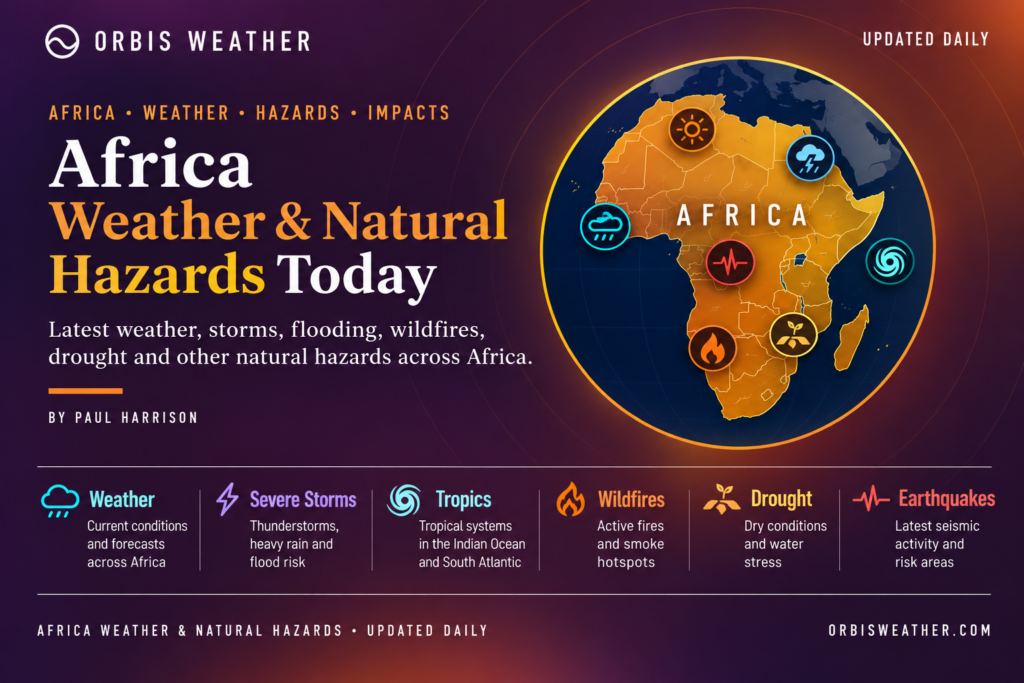
🌍 Africa Weather & Natural Hazards Today

- Europe Weather & Natural Hazards Today – Wednesday, November 18, 2026 7:09 PM
- Southeast Asia Weather & Natural Hazards Today: Wednesday, November 18, 2026 7:01 PM
- Singapore Lightning & Thunderstorms This Week — Wednesday, November 18, 2026 6:54 PM
- Africa Weather & Natural Hazards Today — Wednesday, November 18, 2026 5:12 PM
- Middle East Weather & Natural Hazards Today – Wednesday, November 18, 2026 3:58 PM
- Europe’s Cold Spots This Week Nov 17, 2026 2:56 PM
- Australia, New Zealand & Oceania Weather & Natural Hazards Today — Wednesday, November 18, 2026 11:04 AM
- North America Weather & Natural Hazards Today – November 17, 2026 8:16 AM
- Central America Weather & Natural Hazards Today – Tuesday, November 17, 2026 8:03 AM
- South America Weather & Natural Hazards Today – Tuesday, November 17, 2026 7:50 AM
- Weekly Tropical Storm Tracker: Tuesday, November 17, 2026 7:37 AM
- Daily Earthquakes, Storms, Fires & Floods Report — November 17, 2026 7:29 AM
- Australian Region Tropical Weather Update: Tuesday, November 17, 2026 7:09 AM
- Southwest Indian Ocean Tropical Weather Update: Tuesday, November 17, 2026 7:01 AM
- WESTERN PACIFIC Tropical Weather Update – November 17, 2026 6:56 AM





Africa Weather & Natural Hazards Today — Wednesday, November 18, 2026
By Paul Harrison | Orbis Weather
Published: Wednesday, November 18, 2026 — African local date
Coverage: North Africa | West Africa | Central Africa | East Africa | Southern Africa | Madagascar | Southwest Indian Ocean
Africa Weather Overview: Flood Threats Across Central and Southern Africa as El Niño Intensifies
Africa enters Wednesday, November 18, facing contrasting weather hazards, with flooding concerns across central and southern regions, seasonal thunderstorms in East Africa, increasingly dry conditions across the Sahel and growing attention on the Southwest Indian Ocean cyclone season.
The latest FEWS NET Global Weather Hazards assessment, covering November 12–18, identifies flood threats across central and southern Africa, making these areas particularly important to monitor as the forecast period concludes.
Meanwhile, a strong El Niño continues to influence regional rainfall expectations. Although El Niño may suppress overall tropical cyclone activity in the Southwest Indian Ocean, it can also increase drought risks in some locations while contributing to wetter conditions elsewhere.
The World Meteorological Organization has highlighted the possibility of above-normal rainfall in Tanzania, northern Madagascar, Comoros and parts of Seychelles during the November–January period, alongside below-normal rainfall in parts of Mozambique and Madagascar.
For Wednesday, the principal concerns include localized flash flooding, damaging thunderstorms, landslides, lightning, water shortages and seasonal coastal hazards.
Forecast verification: This report uses the latest available regional hazard assessments and official seasonal outlooks. The FEWS NET outlook covers November 12–18; it does not establish that every identified hazard is occurring throughout November 18. Individual national warnings, cyclone positions and real-time observations require confirmation from the relevant authorities.
1. Africa’s Main Weather Hazards — November 18
Region | Primary concern | Assessment |
|---|---|---|
Southern Africa | Heavy thunderstorms and flooding | Elevated regional concern |
Central Africa | Flooding and tropical downpours | Elevated regional concern |
Kenya and Uganda | Seasonal rain and flash flooding | Monitoring |
Tanzania | Heavy rainfall potential | Monitoring |
Rwanda and Burundi | Landslides and thunderstorms | Seasonal risk |
Mozambique | Flooding and uneven seasonal rainfall | Monitoring |
Madagascar and Comoros | Heavy rainfall and cyclone-season hazards | Monitoring |
Nigeria and the Sahel | Heat, dust and dry conditions | Seasonal risk |
North Africa | Mediterranean storms and desert dust | Monitoring |
Southwest Indian Ocean | Tropical disturbances and rough seas | Seasonal monitoring |
These are regional risk assessments, not a list of verified active emergency warnings.
2. Southern Africa — Flooding, Severe Thunderstorms and Changing Rainfall Patterns
South Africa: Storm impacts remain a concern
South Africa continues to warrant close attention following severe thunderstorms reported earlier this week.
On Monday, November 16, severe weather affected parts of KwaZulu-Natal, with reports of flooding and damage around Estcourt and Mandeni. The South African Weather Service also issued an Orange Level 5 severe-thunderstorm warning for Mpumalanga.
Those earlier warnings should not be assumed to remain active on Wednesday.
The main hazards to monitor include intense thunderstorms, localized flooding, lightning, damaging wind gusts and hail.
Eastern and northeastern provinces are particularly exposed to summer thunderstorm activity, while western areas frequently experience much drier conditions.
Road users should exercise caution near low-water bridges and flood-prone crossings, especially following heavy rainfall.
Zimbabwe, Zambia and Malawi
The summer rainfall season is becoming increasingly important for agriculture and water supplies across Zimbabwe, Zambia and Malawi.
Afternoon heating and increasing atmospheric moisture can produce thunderstorms capable of delivering heavy rainfall over relatively small areas.
The principal risks are:
Flash flooding in low-lying settlements.
Dangerous cloud-to-ground lightning.
Hail and localized crop damage.
Disruption to rural roads and transport.
Uneven rainfall affecting planting and early crop development.
A strong El Niño can influence the region’s seasonal rainfall, but individual storms and short-term rainfall totals remain highly variable.
Mozambique: Flooding and drought risks can coexist
Mozambique faces a particularly complicated seasonal outlook.
Although the country is entering its wetter summer period, the WMO’s November 5 outlook identifies below-normal rainfall expectations for central and southern Mozambique during November 2026–January 2027.
That does not eliminate the possibility of short-lived heavy rain or flooding.
Even a season with below-average rainfall can include damaging thunderstorms, river flooding or tropical cyclone impacts.
Northern coastal districts should also monitor developments over the Mozambique Channel as the tropical cyclone season progresses.
Botswana and Namibia
Hot, dry conditions remain important seasonal concerns in Botswana and Namibia.
Where rainfall has been limited, dry vegetation and gusty winds can contribute to grassfire danger.
Blowing dust may also reduce visibility along exposed roads.
3. East Africa — Seasonal Rainfall, Flooding and Landslide Concerns
East Africa remains within the October–December rainfall season, although rainfall distribution differs significantly between countries and individual districts.
The developing El Niño introduces additional uncertainty into seasonal rainfall expectations.
Kenya
Kenya faces a mixture of rainfall and dry-weather concerns.
Western Kenya, the Lake Victoria Basin and some central highland districts are seasonally vulnerable to thunderstorms, localized flooding and landslides.
Heavy rainfall can overwhelm urban drainage systems, particularly where roads and settlements are already susceptible to flooding.
Eastern and northeastern districts may experience substantially different rainfall conditions.
The most important hazards to monitor are sudden river rises, flooded roads, lightning and unstable hillsides.
Uganda
Uganda’s tropical rainfall patterns continue to support the potential for showers and thunderstorms.
Communities near Lake Victoria should pay particular attention to rapidly changing wind and weather conditions.
Thunderstorms over the lake can generate dangerous waves, lightning and sudden reductions in visibility.
Low-lying urban neighborhoods and agricultural areas may also experience localized flooding during intense rainfall.
Rwanda and Burundi
Rwanda and Burundi remain vulnerable to rainfall-triggered landslides because of their steep terrain and densely populated valleys.
Saturated soils can become unstable following prolonged or intense rainfall.
Residents in hillside communities should monitor local advisories, particularly where previous landslides or erosion have weakened slopes.
Ethiopia
Rainfall patterns across Ethiopia vary considerably with elevation, geography and season.
Southern and southeastern districts require monitoring for localized heavy rainfall where thunderstorms develop, while other areas may face drier conditions and water-supply pressures.
Flash flooding can occur in normally dry channels following heavy rainfall upstream.
Tanzania
Tanzania is among the countries highlighted in the WMO’s latest Southwest Indian Ocean regional outlook for an increased likelihood of above-normal rainfall during November–January.
Northern Tanzania, the Lake Victoria region and some coastal areas are important locations for rainfall monitoring.
Potential consequences include localized flooding, agricultural disruption, lightning and transport delays.
This is a seasonal forecast rather than confirmation of widespread heavy rain on November 18.
Somalia and South Sudan
Rainfall and water-security conditions remain uneven across Somalia.
Communities dependent on seasonal rainfall may experience water shortages when precipitation is insufficient.
Flooding remains a separate concern along river systems where heavy rainfall occurs upstream.
In South Sudan, existing flood vulnerability and difficult road access can complicate humanitarian assistance and transportation.
4. Central Africa — Flood Threats Across the Congo Basin
Central Africa is another major focus of the current FEWS NET hazard assessment.
The November 12–18 outlook identifies flood threats affecting parts of central Africa, emphasizing the need to monitor rainfall accumulation and river conditions.
Democratic Republic of the Congo
The Democratic Republic of the Congo experiences substantial tropical rainfall across much of its territory.
Intense thunderstorms can create dangerous conditions in urban settlements, especially where drainage systems are limited.
Kinshasa and other major cities are vulnerable to rapid surface flooding during heavy downpours.
Eastern mountainous districts face additional landslide risks when soils become saturated.
Cameroon, Gabon and Republic of the Congo
Seasonal rainfall continues to be an important weather factor across equatorial Central Africa.
The principal hazards include tropical downpours, localized flash flooding, lightning and reduced visibility on roads.
Rural transport routes can become difficult to navigate when unpaved roads deteriorate after repeated rainfall.
Central African Republic and Equatorial Guinea
Localized thunderstorms and heavy rainfall remain seasonal hazards.
No new nationwide severe-weather emergency for Wednesday, November 18, has been independently established in the sources reviewed for this report.
5. West Africa — Dry-Season Heat, Harmattan Dust and Air Quality
West Africa is transitioning further toward its dry season.
Across the Sahel, rainfall generally decreases during November, while dry air becomes more established.
Nigeria
Northern Nigeria is moving deeper into the dry season.
Increasingly dry conditions can contribute to dust exposure, reduced visibility and grassfire risks.
The Harmattan, associated with dry northeasterly winds carrying Saharan dust, typically becomes more influential as the season progresses.
Southern Nigeria may still experience showers and thunderstorms, especially in coastal and humid districts.
Ghana, Côte d’Ivoire and Liberia
Coastal West Africa can continue experiencing rainfall even as the wider region moves toward drier conditions.
Localized heavy showers may produce temporary street flooding in urban areas.
Thunderstorm activity generally becomes less widespread as the main rainy season retreats.
Senegal, Mali, Niger and Chad
Dry-season weather is becoming more established across much of the Sahel.
Important concerns include daytime heat, dust, reduced air quality and pressure on water resources.
People with respiratory conditions may be particularly sensitive during significant dust episodes.
However, no specific widespread dust emergency for November 18 has been independently verified for this report.
6. North Africa — Mediterranean Weather and Saharan Dust
North Africa faces a different weather pattern from tropical and equatorial regions.
Autumn and early winter bring increasing opportunities for Mediterranean disturbances, while the Sahara remains predominantly dry.
Morocco
Atlantic weather systems can bring showers, thunderstorms and gusty winds to northern and western Morocco during November.
Mountainous terrain can intensify runoff during heavy rainfall.
Normally dry river channels may become dangerous when rainfall occurs upstream.
Algeria and Tunisia
Mediterranean coastal districts may experience periods of unsettled weather as frontal systems move across the region.
Inland desert districts generally remain much drier.
Potential hazards include localized heavy rain, gusty winds, dust and large day-to-night temperature changes.
Egypt and Libya
Dry conditions generally dominate interior desert areas.
Northern coastal districts can occasionally receive Mediterranean showers during November.
Travelers should monitor local forecasts for wind, visibility and possible coastal weather disturbances.
No widespread severe-weather warning for November 18 has been independently confirmed in the reviewed sources.
7. Southwest Indian Ocean — Cyclone Season Underway
The Southwest Indian Ocean tropical cyclone season is now underway, with Madagascar, Mozambique, Mauritius, Réunion, Comoros and Seychelles among the territories requiring regular monitoring.
The latest WMO seasonal outlook, published November 5, predicts a quieter-than-average cyclone season, influenced by the strong El Niño.
Named storms forecast
6–10
Tropical cyclones forecast
3–5
Chance of below-normal activity
70%
Madagascar
Madagascar faces several seasonal weather hazards, including heavy rainfall, flooding, landslides and tropical cyclone impacts.
Northern Madagascar has an increased probability of above-normal rainfall during November–January, while western and southern districts may experience comparatively dry conditions.
The eastern coastline remains particularly vulnerable to tropical systems approaching from the Indian Ocean.
Mauritius and Réunion
The Mascarene Islands face seasonal risks from tropical disturbances, heavy rainfall, strong winds and hazardous seas.
The WMO expects near-normal rainfall during November–January, with wetter conditions becoming more likely during February–April 2027.
Comoros and Seychelles
Comoros and parts of Seychelles are included in the region’s above-normal seasonal rainfall outlook.
Prolonged heavy rain can increase flash-flood risks, particularly in low-lying coastal settlements and steep terrain.
Cyclone status for November 18: No active named cyclone, current cyclone position or imminent landfall has been independently verified for this report. This does not establish that the basin is disturbance-free.
Official tropical cyclone advisories should be checked through Météo-France La Réunion.
8. El Niño — Africa’s Growing Climate Challenge
One of the most significant developments affecting Africa’s longer-term weather outlook is the strengthening El Niño.
The World Meteorological Organization has identified the event as a major influence on global rainfall and temperature patterns, while FEWS NET has highlighted substantial agricultural and food-security concerns across East and Southern Africa.
Southern Africa: Drought and agricultural concerns
Strong El Niño events are historically associated with an increased likelihood of below-average summer rainfall across parts of Southern Africa.
FEWS NET identifies Zimbabwe, south-central Mozambique, southern Malawi and southern Zambia as areas of particular concern.
Potential consequences include reduced crop yields, water shortages, deteriorating pasture conditions and increased heat stress.
East Africa: Rainfall extremes
El Niño can contribute to enhanced rainfall across parts of equatorial East Africa, but its effects are not uniform.
Some locations may experience damaging rainfall and flooding, while others face prolonged dry spells.
Local rainfall forecasts and observations remain essential.
Food security and economic impacts
Weather extremes can affect food availability long after the initial event.
Flooding can damage roads, markets and crops, while drought can reduce harvests and livestock productivity.
The World Food Programme emphasizes that climate shocks can worsen existing food-security problems, especially where communities are already affected by conflict, displacement or economic hardship.
9. Other Natural Hazards — Earthquakes, Volcanoes and Wildfires
Earthquakes
Africa’s most seismically active regions include the East African Rift System, the Afar region and parts of North Africa.
Countries with significant seismic exposure include Ethiopia, Kenya, Tanzania, Uganda, Rwanda, the Democratic Republic of the Congo, Morocco and Algeria.
Earthquakes cannot currently be predicted reliably by date, time and location.
No specific significant earthquake occurring on November 18 has been independently verified for inclusion in this report.
Readers can consult the USGS Real-Time Earthquake Map for current seismic activity.
Volcanoes
Africa’s active volcanic regions include the Democratic Republic of the Congo, Ethiopia and the wider East African Rift.
Notable volcanoes requiring routine scientific monitoring include Nyamuragira, Nyiragongo and Erta Ale.
Volcanic activity can produce hazardous gases, ash, lava flows and disruption to nearby communities.
No new major eruption on November 18 has been independently confirmed for this report.
Wildfires
Dry-season vegetation fires remain an important environmental hazard across parts of Africa.
Fire danger can increase where hot weather, dry vegetation and strong winds occur together.
Smoke can reduce air quality and visibility, while uncontrolled grassfires can threaten settlements and agricultural land.
No specific major wildfire outbreak has been independently verified for November 18 in the sources reviewed.
10. Africa Weather Outlook — November 18–20, 2026
Date | Main monitoring priorities |
|---|---|
Wednesday, November 18 | Central and southern African flood threats, East African seasonal rainfall and severe-thunderstorm risks |
Thursday, November 19 | Updated flood assessments, Southern African rainfall patterns and El Niño-related agricultural concerns |
Friday, November 20 | Tropical cyclone monitoring, regional rainfall trends, dry-season heat and dust |
These are forward-looking monitoring priorities rather than confirmed daily forecasts for every African country. The FEWS NET hazard assessment cited in this article ends November 18; subsequent conditions require newer guidance.
11. Weather Safety and Preparedness
Flooding: Never drive or walk through fast-moving floodwater. Flooded roads may conceal damaged bridges, deep channels or strong currents.
Thunderstorms: Move indoors when thunder is heard. Avoid isolated trees, exposed hillsides, open water and metal structures.
Landslides: Residents in mountainous regions should watch for ground cracks, leaning trees, unusual water movement and rapidly increasing stream levels.
Extreme heat: Drink water regularly, avoid strenuous outdoor activity during the hottest hours and check on older residents and vulnerable neighbors.
Dust and air pollution: During significant dust events, limit prolonged outdoor exposure, particularly for people with respiratory conditions.
Tropical cyclones: Coastal residents should follow official advisories and prepare for possible power outages, transport disruption and flooding.
12. Official Weather Sources and Monitoring
Orbis Weather uses established meteorological, scientific and humanitarian information sources to support its reporting.
Organization | Information provided |
|---|---|
International weather and climate outlooks | |
Weather hazards, drought and food-security monitoring | |
South African forecasts and warnings | |
East African climate monitoring and forecasts | |
Southwest Indian Ocean cyclone advisories | |
Climate impacts and food-security information | |
Earthquake monitoring | |
Global disaster alerts and coordination |
Editorial methodology and verification
This report combines published regional weather-hazard assessments, seasonal climate outlooks and established scientific information.
Weather hazards are distinguished from confirmed incidents wherever possible. Seasonal forecasts indicate probabilities and tendencies, not guaranteed outcomes for individual countries or communities.
No unverified casualty figures, rainfall totals, cyclone positions or emergency-warning levels have been included.
Because conditions can change rapidly, readers should consult national meteorological services for location-specific forecasts and emergency instructions.
13. Final Outlook — Flooding and El Niño Remain Africa’s Biggest Weather Concerns
Wednesday, November 18, brings a complex weather picture across Africa.
Central and southern Africa remain important areas for flood monitoring, while East Africa continues to face seasonal rainfall variability and localized flooding risks.
Across Southern Africa, attention is increasingly turning toward the agricultural implications of a strong El Niño, particularly in regions vulnerable to below-average rainfall and extreme heat.
West Africa is transitioning further toward dry-season conditions, while North Africa faces the possibility of Mediterranean disturbances and Saharan dust.
In the Southwest Indian Ocean, a quieter-than-average cyclone season is forecast, but the possibility of a damaging tropical cyclone remains.
The central message is that Africa’s weather hazards are becoming increasingly uneven: some regions face excess rainfall and flooding, while others must prepare for drought and water shortages.
Orbis Weather will continue monitoring severe thunderstorms, flooding, drought, tropical cyclones, earthquakes, volcanic activity and other significant natural hazards affecting the African continent.
Africa Weather & Natural Hazards Today is produced for Orbis Weather by Paul Harrison. Published November 18, 2026, using the African local date. This report provides general weather and natural-hazard information and does not replace official forecasts, warnings or emergency instructions
About the Author
Paul Harrison — Founder & Publisher, Orbis Weather
Paul Harrison founded Orbis Weather in 2026 to make global weather and natural-hazard information easier to find, follow and understand. His coverage includes tropical cyclones, severe weather, extreme temperatures, earthquakes, volcanoes, wildfires, flooding and significant natural disasters worldwide.
View all articles by Paul Harrison → | Editorial Standards →
Global Weather Tracker Hub
Explore weather maps, tropical systems, storms and natural hazards around the world.
No matching trackers found.