
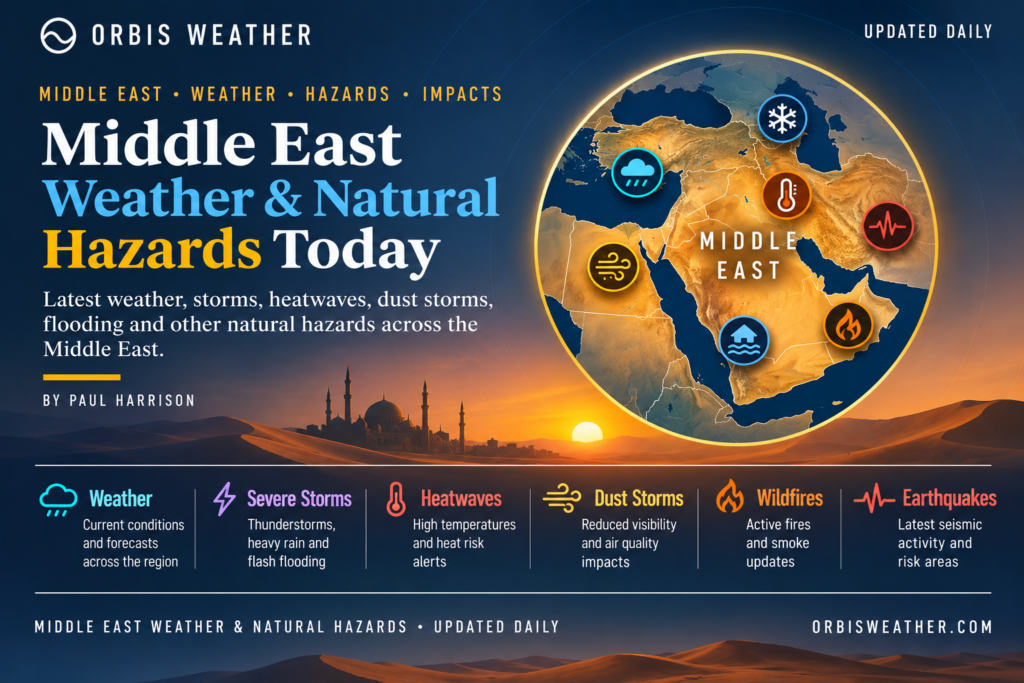
🌍 Middle East Weather & Natural Hazards Today

- Europe Weather & Natural Hazards Today – Wednesday, November 18, 2026 7:09 PM
- Southeast Asia Weather & Natural Hazards Today: Wednesday, November 18, 2026 7:01 PM
- Singapore Lightning & Thunderstorms This Week — Wednesday, November 18, 2026 6:54 PM
- Africa Weather & Natural Hazards Today — Wednesday, November 18, 2026 5:12 PM
- Middle East Weather & Natural Hazards Today – Wednesday, November 18, 2026 3:58 PM
- Europe’s Cold Spots This Week Nov 17, 2026 2:56 PM
- Australia, New Zealand & Oceania Weather & Natural Hazards Today — Wednesday, November 18, 2026 11:04 AM
- North America Weather & Natural Hazards Today – November 17, 2026 8:16 AM
- Central America Weather & Natural Hazards Today – Tuesday, November 17, 2026 8:03 AM
- South America Weather & Natural Hazards Today – Tuesday, November 17, 2026 7:50 AM
- Weekly Tropical Storm Tracker: Tuesday, November 17, 2026 7:37 AM
- Daily Earthquakes, Storms, Fires & Floods Report — November 17, 2026 7:29 AM
- Australian Region Tropical Weather Update: Tuesday, November 17, 2026 7:09 AM
- Southwest Indian Ocean Tropical Weather Update: Tuesday, November 17, 2026 7:01 AM
- WESTERN PACIFIC Tropical Weather Update – November 17, 2026 6:56 AM





Middle East Weather & Natural Hazards Today – Wednesday, November 18, 2026
Saudi Arabia’s Thunderstorm Threat Remains Under Watch as Flash-Flood Risks, Changing Gulf Weather and Winter Conditions Demand Attention Across the Middle East
By Paul Harrison | Orbis Weather | Wednesday, November 18, 2026
Middle East Weather Overview
The Middle East enters Wednesday, November 18, with several weather and natural-hazard concerns requiring attention, including recent thunderstorms across Saudi Arabia, changing conditions around the Arabian Gulf, seasonal rainfall across Iraq and Iran, and growing winter-weather vulnerabilities in the eastern Mediterranean.
The most significant recent severe-weather developments have been concentrated in western and southwestern Saudi Arabia, where thunderstorms, hail, strong winds and potentially dangerous runoff have featured in official forecasts.
Across the United Arab Emirates, recent forecasts have indicated variable cloud cover and the possibility of light rainfall in northern and coastal areas.
Farther north, November’s transition toward winter is bringing renewed attention to flooding, mountain weather and the safety of vulnerable communities in Syria, Lebanon, Palestine and neighboring countries.
Important forecast distinction: The latest available reporting establishes recent weather conditions and hazards, but a complete set of official forecasts specifically for Wednesday, November 18, could not be independently verified. This report separates documented developments from hazards that require continued monitoring rather than presenting seasonal risks as active weather warnings.
1. Saudi Arabia – Thunderstorms, Hail and Flash-Flood Monitoring
Saudi Arabia remains a leading regional weather-monitoring priority following a period of unsettled conditions.
Official forecasts issued on November 16 identified the potential for moderate to heavy thunderstorms across parts of Jazan, Asir, Al-Baha and Makkah, accompanied by hail and potentially dangerous runoff.
These areas are particularly vulnerable because steep mountains, narrow valleys and normally dry watercourses can rapidly channel rainfall toward roads and settlements.
Areas to monitor Wednesday
Jazan: Heavy showers, if renewed, could create dangerous runoff in mountainous and low-lying districts.
Asir: Steep roads, mountain passes and valleys are vulnerable to sudden flooding and poor visibility.
Al-Baha: Thunderstorms may produce localized hail, slippery roads and rapid water accumulation.
Makkah: Flood-prone drainage channels and roads require monitoring following recent unsettled weather.
Riyadh and central Saudi Arabia: Blowing dust and localized thunderstorms remain potential hazards when weather systems develop.
Wednesday outlook
The key question is whether the recent storm-producing weather pattern continues or weakens during November 18.
The November 16 forecast should not be interpreted as confirmation of severe thunderstorms on Wednesday.
Residents should consult the Saudi National Center for Meteorology for the latest district-level forecasts and warnings.
2. United Arab Emirates – Variable Cloud Cover and Coastal Weather
The United Arab Emirates has recently experienced a transition toward more variable November weather.
The National Centre of Meteorology’s forecast for Tuesday, November 17, indicated partly cloudy to cloudy conditions, with possible light rainfall over islands and some northern and coastal districts.
Winds were expected to occasionally strengthen, although relatively slight seas were forecast.
Areas to monitor
Dubai and Sharjah: Changing cloud cover, coastal humidity and any localized showers could influence visibility and road conditions.
Abu Dhabi: Coastal wind changes and marine conditions remain important for offshore operators.
Ras Al Khaimah and Fujairah: Northern and eastern districts warrant attention when cloud bands and showers develop near the mountains.
Wednesday outlook
The preceding day’s forecast suggests that changing cloud cover and localized rainfall are relevant short-term considerations. However, it does not establish that rain will occur on November 18.
There is insufficient verified information to declare a widespread severe-weather emergency across the UAE for Wednesday.
Official updates are available from the UAE National Centre of Meteorology.
3. Iraq – Recent Flooding and Continued Rainfall Vulnerability
Iraq is entering a wetter period of the year, with recent heavy rainfall highlighting the country’s exposure to flash flooding and drainage problems.
Earlier November flooding demonstrated the danger posed by intense rainfall in urban areas and regions with inadequate stormwater infrastructure.
Main areas of concern
Baghdad: Intense showers can overwhelm drainage networks and leave standing water on major roads.
Mosul and Nineveh: Northern districts face localized flooding risks when thunderstorms produce substantial runoff.
Erbil and Sulaymaniyah: Mountain roads and valleys can become hazardous during heavy rainfall, particularly where slopes are unstable.
Basra: Low-lying urban areas remain vulnerable to water accumulation during intense downpours.
Wednesday outlook
Flood recovery, local drainage conditions and the possibility of additional rainfall remain priorities.
However, no new nationwide flood warning specifically for November 18 has been independently established in the sources reviewed.
Residents should follow Iraq’s meteorological and civil-defense announcements for current warnings.
4. Iran – Mountain Weather, Flooding and Seismic Hazards
Iran faces a combination of seasonal weather hazards and continuing geological risks.
The country’s mountainous geography makes western and northern regions particularly sensitive to heavy rainfall, falling temperatures and deteriorating travel conditions.
Western Iran and the Zagros Mountains
Steep terrain increases the risk of flash flooding, landslides and rockfalls during prolonged or intense rainfall.
Travelers using mountain highways should monitor local forecasts and road conditions.
Tehran and northern Iran
Colder nights, mountain fog and increasingly wintry conditions are important considerations as November progresses.
Higher elevations may experience substantially different weather from nearby cities.
Southern Iran
Dust, wind and occasional rainfall remain possible seasonal concerns, particularly around exposed roads and coastal districts.
Earthquake monitoring
Iran lies within one of the world’s most seismically active regions.
Earthquake preparedness remains important, although seismic activity cannot be reliably predicted from weather patterns.
No major earthquake specifically occurring on November 18 has been verified for this report.
Real-time earthquake information is available from the US Geological Survey.
5. Oman – Wadi Flooding and Mountain Weather
Oman’s combination of rugged mountains, coastal settlements and extensive desert valleys creates a distinctive set of natural hazards.
Even relatively localized thunderstorms can produce dangerous flooding when rainfall becomes concentrated over mountain catchments.
Areas to monitor
Muscat: Coastal weather, urban drainage and changing winds remain important considerations.
Sohar and northern Oman: Marine conditions and visibility may change as regional weather systems move through.
Nizwa and the Hajar Mountains: Mountain roads, steep valleys and normally dry riverbeds are particularly vulnerable during intense rainfall.
Salalah and Dhofar: Coastal winds and localized changes in mountain weather require routine monitoring.
Wednesday outlook
No new nationwide flash-flood emergency for November 18 has been independently verified.
Travelers should avoid entering wadis when rainfall is forecast anywhere within their upstream catchments.
Official information: Oman Meteorology.
6. Qatar, Bahrain and Kuwait – Winds, Dust and Marine Conditions
The northern and central Arabian Gulf are moving further into their cooler season.
Although temperatures generally become more comfortable during November, occasional stronger winds can still produce blowing dust, reduced visibility and choppy marine conditions.
Qatar: Doha and surrounding coastal districts should monitor wind changes, humidity and marine forecasts.
Bahrain: Offshore activities may be affected by strengthening northwesterly winds, particularly when regional pressure patterns change.
Kuwait: Exposed desert highways remain vulnerable to blowing dust and sudden reductions in visibility.
No widespread severe-weather warning specifically covering all three countries on Wednesday has been independently confirmed.
7. Lebanon – Winter Rainfall and Mountain Conditions
Lebanon is entering its Mediterranean winter rainfall season, when passing weather systems can bring showers, thunderstorms and falling temperatures.
Rainfall is essential for water resources, but heavy downpours can create localized hazards in densely populated areas and mountainous districts.
Main concerns
Beirut and Tripoli: Urban flooding can develop where drainage systems become overwhelmed.
Mount Lebanon: Mountain fog, slippery roads and colder conditions can affect travel.
Bekaa Valley: Falling nighttime temperatures increase the importance of winter preparedness.
Northern Lebanon: Mountain communities may face deteriorating road conditions during periods of heavy rain.
Wednesday outlook
The principal concern is seasonal preparedness rather than a verified nationwide weather emergency.
Residents should follow local meteorological bulletins before traveling through mountainous districts.
8. Syria – Winter Weather and Humanitarian Risks
Syria faces significant weather-related challenges as temperatures fall and the winter rainfall season develops.
Damaged infrastructure, displacement and inadequate shelter can make ordinary seasonal rainfall particularly disruptive.
Northern Syria
Heavy rain can turn unpaved roads into mud, limiting access to temporary settlements and complicating deliveries of food, water and medical supplies.
Western Syria
Mediterranean weather systems can bring periods of rain, stronger winds and lower temperatures.
Mountainous districts
Cold nights, fog and slippery roads may become increasingly important during the coming weeks.
Humanitarian outlook
Families living in temporary accommodation remain vulnerable to flooding, cold exposure and water contamination.
No new nationwide flooding disaster specifically occurring on November 18 has been independently verified.
The humanitarian consequences of winter weather can nevertheless be serious even without a major regional storm.
9. Israel and Palestine – Rainfall, Flash Flooding and Winter Exposure
The eastern Mediterranean is transitioning into its wetter season, increasing the potential for rainfall and occasional thunderstorms.
Israel and the West Bank
Coastal districts, including Tel Aviv and Haifa, can experience localized flooding during intense downpours.
Inland valleys and desert drainage systems are particularly sensitive to sudden runoff.
The Dead Sea region is especially vulnerable because rainfall occurring far upstream can send floodwater through narrow channels.
Gaza – Winter Weather and Humanitarian Vulnerability
Winter weather remains a serious concern for displaced families and communities living amid damaged infrastructure.
Rainfall can create additional difficulties through flooded shelters, muddy access routes, standing water and exposure to colder nighttime temperatures.
Poor drainage and damaged sanitation systems can increase the risk of contaminated water.
These are established humanitarian vulnerabilities. A new widespread flooding event specifically on November 18 has not been independently confirmed in the information reviewed.
10. Jordan – Desert Flash Flooding and Colder Nights
Jordan’s mountainous terrain and desert valleys create substantial differences in weather conditions over relatively short distances.
Areas to monitor
Amman: Heavy showers can overwhelm urban drainage systems.
Petra: Narrow valleys can channel floodwater rapidly, creating dangerous conditions for visitors.
Wadi Rum: Desert tracks and camping areas may become hazardous during thunderstorms.
Dead Sea region: Steep drainage channels can carry floodwater from distant rainfall.
Northern Jordan: Seasonal rainfall and colder temperatures may affect agricultural and mountainous communities.
Wednesday outlook
No new nationwide flash-flood warning for November 18 has been independently established.
Visitors should check forecasts for the wider drainage basin rather than relying only on weather conditions at their immediate location.
11. Yemen – Flash Flooding, Landslides and Infrastructure Vulnerability
Yemen remains highly exposed to natural hazards because of its mountainous geography and vulnerable infrastructure.
Although the country’s principal rainfall patterns vary significantly by region and season, intense localized storms can still create dangerous conditions.
Areas of concern
Sana’a and the central highlands: Heavy rain can produce rapid runoff and localized flooding.
Taiz: Steep mountain roads and unstable slopes increase the potential for landslides during intense rainfall.
Aden: Coastal drainage problems can disrupt transportation when heavy showers develop.
Western mountain districts: Remote settlements may become isolated if roads or bridges are damaged.
Wednesday outlook
No new nationwide flooding emergency for November 18 has been independently verified.
The main concern remains the potentially severe consequences of any significant rainfall in communities with limited emergency resources.
12. Middle East Natural Hazards Summary – November 18, 2026
Country or region | Main weather or natural hazard | Assessment |
|---|---|---|
Saudi Arabia | Thunderstorms, hail, flash flooding | Recent official warnings; monitor Wednesday updates |
United Arab Emirates | Scattered rain, gusty winds | Rain forecast for Wednesday |
Iraq | Flooding, drainage problems | Recent flooding and seasonal monitoring |
Iran | Mountain weather, earthquakes | Seasonal and geological hazards |
Oman | Wadi flooding, mountain hazards | Conditional risk |
Qatar | Wind and marine conditions | Routine monitoring |
Bahrain | Coastal winds and sea conditions | Routine monitoring |
Kuwait | Dust and visibility | Routine monitoring |
Lebanon | Rainfall and mountain conditions | Winter preparedness |
Syria | Rain, cold exposure, vulnerable shelters | Humanitarian concern |
Israel and Palestine | Flash flooding and winter exposure | Seasonal preparedness |
Jordan | Desert flash flooding | Conditional risk |
Yemen | Flooding and landslides | Continuing vulnerability |
This table combines verified short-term forecast information with established seasonal and geological risks. It is not a list of active official warnings.
13. Regional Weather Outlook – Next 24 to 48 Hours
Arabian Peninsula
Saudi Arabia’s western and southwestern regions remain important monitoring areas following repeated official forecasts for thunderstorms, hail and flash flooding.
The Saudi National Center for Meteorology’s November 17 forecast continued to identify moderate to heavy thunderstorms across Jazan, Asir, Al-Baha and Makkah, with fog also possible in affected areas. Whether these hazards persist on Wednesday requires an updated daily forecast.
The United Arab Emirates has a more clearly established Wednesday forecast.
According to the UAE National Centre of Meteorology’s November 15 five-day bulletin, partly cloudy to cloudy conditions are expected on November 18, with rainfall possible across northern, eastern and coastal areas.
Winds are forecast at 10–25 km/h (6–16 mph), occasionally reaching 40 km/h (25 mph). Seas should be slight to moderate at times in the Arabian Gulf and slight in the Oman Sea.
Selected UAE forecast highs for Wednesday, November 18
Dubai
88°F
31°C
Abu Dhabi
86°F
30°C
Al Ain
90°F
32°C
Northern Middle East
Iraq and Iran should continue monitoring seasonal rainfall, mountain conditions and areas affected by earlier flooding.
No verified region-wide storm forecast covering both countries for Wednesday has been established.
Eastern Mediterranean
Lebanon, Syria, Israel, Palestine and Jordan face increasing seasonal rainfall and winter-weather concerns.
The most significant potential consequences involve flood-prone valleys, exposed mountain roads and communities with inadequate shelter.
Gulf and Red Sea Marine Conditions
Marine operators should pay particular attention to changing winds, thunderstorms and visibility.
Saudi Arabia’s November 17 forecast indicated that waves could exceed two meters in parts of the central and southern Red Sea where thunderclouds developed. This is a previous-day forecast, not a confirmed Wednesday sea-state assessment.
14. Weather Safety and Emergency Preparedness
Residents, travelers and marine operators should follow these precautions during unsettled weather:
Never drive through flowing floodwater or attempt to cross a flooded wadi.
Avoid camping in dry riverbeds when thunderstorms are possible upstream.
Check mountain-road conditions before traveling, particularly in areas vulnerable to landslides or rockfalls.
Reduce speed during heavy rain, fog and blowing dust.
Monitor official marine forecasts before boating, fishing or offshore operations.
Prepare essential supplies in areas where flooding or damaged roads could cause isolation.
Follow evacuation instructions and emergency announcements from local authorities.
Flash flooding can remain dangerous after rainfall ends, especially where runoff continues from distant mountains.
15. Official Weather and Natural Hazard Sources
Orbis Weather recommends consulting the following organizations for updated forecasts, warnings and emergency information.
Organization | Information |
|---|---|
Saudi weather forecasts and warnings | |
UAE weather and marine forecasts | |
Oman forecasts and alerts | |
Qatar weather conditions | |
Earthquake monitoring | |
International meteorological information | |
Humanitarian emergencies |
Recent reporting and forecasts reviewed
Saudi National Center for Meteorology, November 17, 2026: Continued thunderstorm and flash-flood potential across southwestern Saudi Arabia.
National Center For MeteorologySaudi Gazette, November 16, 2026: Red rainfall alert for Makkah and thunderstorms across other western and southwestern regions.
Saudi GazetteUAE National Centre of Meteorology, November 15, 2026: Five-day bulletin covering November 18 rainfall, wind and sea conditions.
15-11-2026Khaleej Times, November 17, 2026: Wednesday’s UAE weather forecast and selected city temperatures.
Khaleej TimesAletihad, November 17, 2026: NCM meteorologist’s assessment of light to moderate rainfall chances in the UAE.
Aletihad News Center
16. Orbis Weather Final Outlook – Wednesday, November 18, 2026
The Middle East enters Wednesday with Saudi Arabia’s recent severe thunderstorms and the United Arab Emirates’ forecast rainfall among the principal weather developments to monitor.
In Saudi Arabia, repeated forecasts for heavy thunderstorms, hail and flash flooding across western and southwestern districts make updated warnings particularly important.
In the UAE, official forecasts identify a chance of rain over northern, eastern and coastal districts, accompanied by occasionally stronger winds.
Across Iraq and Iran, seasonal rainfall and mountain conditions remain important, while Lebanon, Syria, Jordan, Israel and Palestine face growing winter-weather concerns.
The broader regional message is one of preparedness rather than a confirmed widespread weather emergency.
The key message for November 18: Monitor local weather alerts, avoid flood-prone valleys during unsettled conditions and remain cautious on mountain roads and exposed coastal waters.
About Orbis Weather
Orbis Weather provides independent international weather reporting, regional natural-hazard analysis and public-safety information.
This report was prepared by Paul Harrison using available meteorological forecasts, recent reporting and established geographical and natural-hazard information.
Editorial methodology: Weather forecasts and active warnings are distinguished from seasonal risks and general preparedness advice. Where a current warning or event cannot be independently verified, it is not presented as confirmed. Information is subject to revision as new official bulletins become available.
Corrections and updates: Orbis Weather aims to correct factual errors and update significant weather developments when reliable new information becomes available.
Disclaimer: This article is intended for general public information and does not replace official weather warnings, evacuation instructions or emergency guidance. Conditions can change rapidly, and readers should consult their national meteorological agencies and local emergency authorities before making weather-sensitive decisions.
Published for Orbis Weather | Wednesday, November 18, 2026
About the Author
Paul Harrison — Founder & Publisher, Orbis Weather
Paul Harrison founded Orbis Weather in 2026 to make global weather and natural-hazard information easier to find, follow and understand. His coverage includes tropical cyclones, severe weather, extreme temperatures, earthquakes, volcanoes, wildfires, flooding and significant natural disasters worldwide.
View all articles by Paul Harrison → | Editorial Standards →
Global Weather Tracker Hub
Explore weather maps, tropical systems, storms and natural hazards around the world.
No matching trackers found.